Category Archives: Sunshine

More data on entities registered in international tax havens

The International Consortium of Investigative Reporters today announced the release of new Pandora Papers data from two offshore service providers, adding “more than 15,000 companies, foundations and trusts” to their database of entities registered in secrecy jurisdictions.\

The International Consortium of Investigative Journalists is publishing data on the beneficial owners of more than 15,000 offshore companies, foundations, trusts, and other entities from the Pandora Papers investigation. The records were incorporated into the Offshore Leaks database and come from two offshore services providers: Panamanian law firm Alemán, Cordero, Galindo & Lee (Alcogal) and Fidelity Corporate Services, headquartered in the British Virgin Islands.

With this publication, ICIJ’s Offshore Leaks database now contains crucial information about more than 800,000 offshore entities that stem from five different leaks, and links to people and companies in more than 200 countries and territories.

The addition of this data brings more transparency about the real owners of companies, foundations and trusts registered in secrecy jurisdictions. In all, the interactive application reveals more than 740,000 names of people and companies behind secret offshore structures.

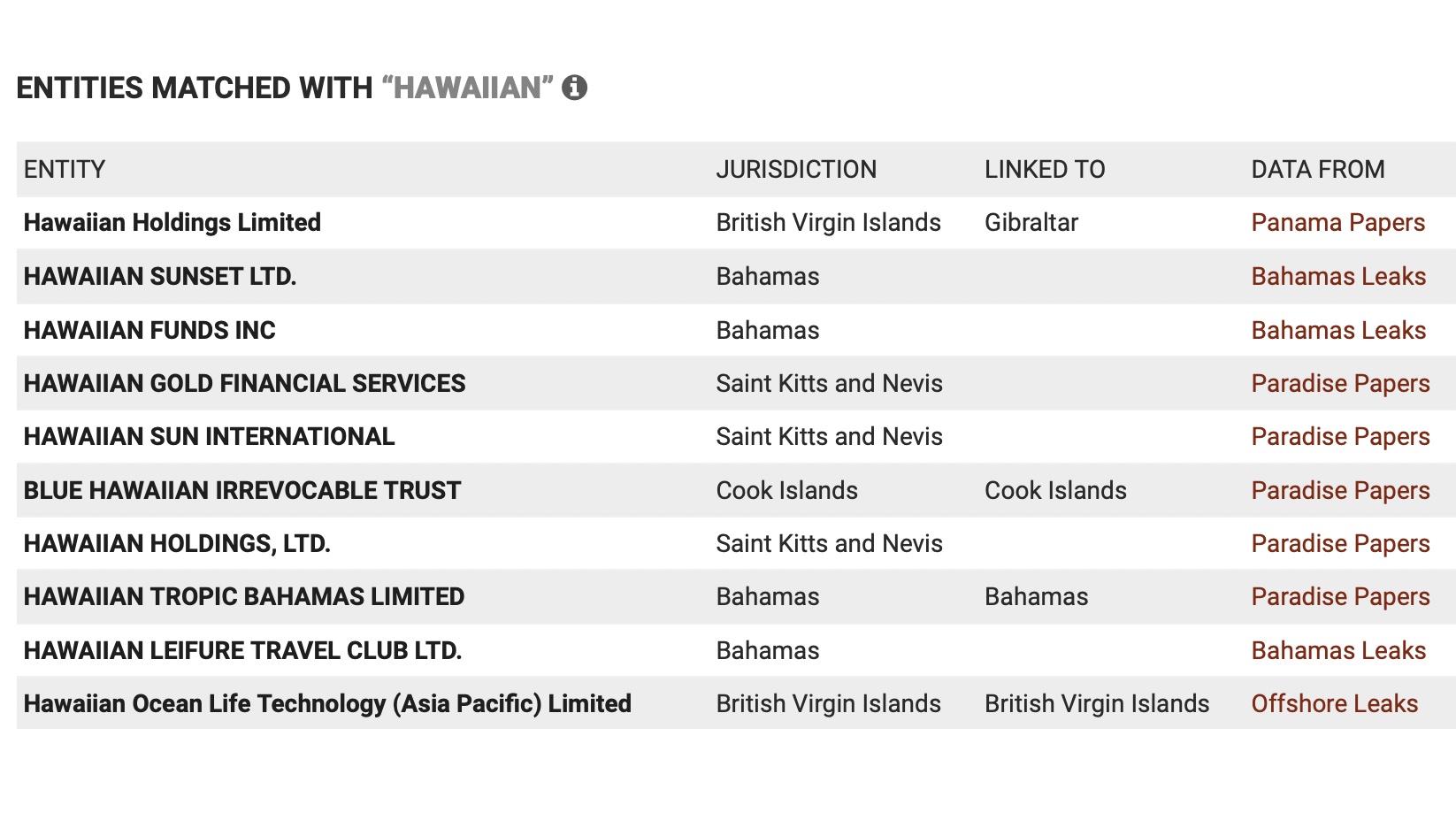
Just for fun, I typed “Hawaii” into their search box. This is the list that was returned. It appears to have found names that included “Hawaii” rather than necessarily based in Hawaii.

Here’s the same search for “Hawaiian”.

Okay, I’m sure there are a few aspiring sleuths out there who will want to dive in and see what you can find about these entities, and whether they are in fact based in or controlled from Hawaii.

Some of the backstory on “Judges for Justice”

A post on longtime journalist Bob Jones’ blog yesterday led with a headline that posed a provocative question: “Re-Open The Dana Ireland Rape-Murder Case?

His post was prompted by an oversized glossy postcard delivered to mailboxes in our neighborhood this week from a group calling itself “Judges for Justice,” (JFJ). The mailing touted the group’s belief that three men were wrongfully convicted of the murder and rape of Dana Ireland on the Big Island in 1991, and that the actual killer is still at large.

But Jones’ question has already been “asked and answered,” as lawyers say.

The investigation in the Ireland case was reopened in May 2019 through the work of the Hawaii Innocence Project (HIP), a nonprofit law clinic affiliated with the University of Hawaii’s William S. Richardson Law School, and the New York-based Innocence Project. Lawyers with the two groups are seeking to exonerate Albert Ian Schweitzer, who is currently serving a life sentence with a minimum term of 130 years in prison after being convicted in the Ireland case.

The reopening of the case appears to have had little or nothing to do with the Judges for Justice organization. In fact, court records show HIP has been at odds with the Seattle-based judges’ group for years, and has repeatedly asked the judges’ group to stop interfering in the matter because their actions threaten Schweitzer’s case. Those pleas have so far been ignored by Judges for Justice. In an attempt to discourage JFJ’s attempts to insert itself into the case, HIP filed complaints with the Washington State Office of Disciplinary Counsel, along with Hawaii’s attorney general, Disciplinary Counsel, the Hawaii State Bar Association, and other agencies.

The central figure in Judges for Justice (JFJ) is Mike Heavey, a former Washington State legislator and judge, now retired. Civil Beat published a profile of Heavey in December 2018 (“A Retired Judge Keeps Asking, Who Really Killed Dana Ireland?“).

The renewed investigation was disclosed in an October 2019 memo filed in court on behalf of Schweitzer by prominent local defense attorney, Brook Hart, on behalf of Hawaii Innocence Project. The memo is in opposition to an attempt by JFJ to unseal two documents in Schweitzer’s case dealing with DNA testing.

According to Hart’s memo, those documents “were filed and sealed by agreement between HIP and Hawaii County Deputy Prosecutor Charlene Iboshi.”

“These sealed agreements were part of HIP’s early efforts to gain evidence of Mr. schweitzer’s innocence,” Hart wrote.

Currently attorneys for the Hawaii Innocence Project and the Innocence Project “have entered into a re-investigation agreement with Hawaii County Prosecutors…in this matter, to find the individual who has yet to be identified, but whose DNA has been found on critical crime scene evidence,” the memo states.

Heavey had learned about the Schweitzer case after visiting the UH law school in 2013, and was initially seen as a potential resource by HIP.

However, “Schweitzer’s HIP legal team soon realized that Mr. Heavey’s knowledge of the case was ill-infored, his theories were not in line with those of our legal team, and his tactics of gaining immediate attention were too premature and likely to be harmful to Mr. Schweitzer,” Hart wrote.

“Mr. Heavey, who is not formally affiliated with Mr. Schweitzer’s case in any way, has continuously sought to publicize Mr. Schweitzer’s case in the eletronic media, newspapers, through mass emails, and his ‘documentary’ videos, even though he has been cautioned by Mr. Schweitzer’s attorneys that doing so could jeopardize our current reinvestigation and could harm our client and potential witnesses.”

Hart said Heavey has ignored concerns “of the very real danger that publicizing Mr. Schweitzer’s controversial case may bring.” HIP points to what happened when Heavey first notified news media that Schweitzer’s case was being reinvestigated. The very next day, Frank Pauline, Schweitzer’s co-defendant and a key witness in the case, was killed in a New Mexico prison.

The memo acknowledges this may have been “just a remarkable coincidence,” but argues it illustrates why publicity at this stage of the reinvestigation is dangerous and counterproductive.

In another example, Heavey publicized the name and other information of another potential witness, even after the witess “asked Mr, Heavey not to publicize her name, face, and information.”

“Mr. Heavey’s and Judges for Justice’s continued interference greatly impairs our ability to effectively represent Mr. Schweitzer, and our ongoing and collective efforts with the Hawaii County Prosecutors to re-investigate his case,” Hart wrote.

Ken Lawson, co-director of the Hawaii Innocence Project, said last week the situation has not changed.

“This guy (Heavey) has ignored everybody,” Lawson said. “He is really, really causing problems.”

Lawson said confidential information in the case contradicts key parts of the Judges for Justice narrative, and that some of the group’s public accusations “could be jeopardizing people.”

Last month, the Intermediate Court of Appeals ruled Judges for Justice is entitled to a hearing on its motion to unseal the two documents related to DNA testing in Schweitzer’s case. The Hawaii Innocence Project indicated it will continue to oppose unsealing of these documents because “there is an ongoing criminal investigation that could be jeopardized if the documents are unsealed and disclosed.” A hearing date in 3rd Circuit Court has not yet been set.

Memo in Opposition to Judges for Justice Motion in case of Albert Ian Schweitzer by Ian Lind on Scribd

Federal appeals court upholds disclosure of New York police misconduct records

After decades of secrecy, the New York City Civilian Complaint Review Board, the agency with oversight over complaints against the city’s police and other law enforcement officers, posted a publicly-accessible online database with information on more than 83,000 past complaints against active and inactive NYPD officers.

The records include the date of each incident, complaint type, penalty impose (if any), and can be indexed by rank, precinct, shield number, name of the officer involved and number of other substantiated complaints.

The state legislature amended the law last year to eliminate a special exemption from the law enforcement officers, but public disclosure of the records had been delayed by a series of lawsuits filed by unions representing New York police officers, fire fighters, and correctional officers impacted by the change.

Last month, the U.S. 2nd Circuit Court of Appeals rejected the unions’ bid for an injunction to delay any required disclosure until all of their pending cases and appeals have run their course.

Documents from the long history of the issue in New York has been collected by the New York State Defenders Association.

Many of the issues considered and rejected in the ruling are relevant to the continued efforts to block disclosure of police misconduct by the State of Hawaii Organization of Police Officers (SHOPO), the union representing police officers statewide.

For example, the court ruled the NY Police Department “cannot bargain away its disclosure obligations” under state law. Indeed, the rights implicated are not rights of police officers, but rather the right of the public to access information to hold the police, and individual officers, accountable. The court also noted that while “numerous other states make similar records available to the public,” the unions did not present any evidence officers have been “irreparably harmed” by public disclosures in those jurisdictions. The New York unions argued officers would face additional dangers on the job if misconduct were disclosed, and would also be harmed in future job searches if unfounded or unsubstantiated complaints were made public. The court found neither argument was backed up by evidence.

See:

Police Unions Lose Bid to Keep Disciplinary Records a Secret,” Benjamin Weiser, NY Times, February 16, 2021

NYPD Watchdog Releases Long-Awaited Database On Police Misconduct,” Jake Offenhartz, Gothamist.com, March 4, 2021.

Documents in SHOPO v. City & County of Honolulu, Civil Beat Law Center.

Documenting the January 6th U.S. Capitol takeover

I’ve said many times how much I value source documents.

Back 30-35 years ago, I had a number of interactions with a new project that called itself the “National Security Archive,” and visited their office in Washington several times during that period. The new organization was challenging government secrecy by using the federal Freedom of Information Act to extract important documents from the government, and making those available to the public and the news media.

Luckily for us, National Security Archive is still around and active.

It is now documenting the January 6, 2021 takeover of the U.S. Capitol with an ongoing effort, “The Capitol Riot: Documents you should read.”

According to the group’s website: “The January 6 Sourcebook publication marks the continuation of a systematic campaign by the Archive, a champion of the Freedom of Information Act, to use the FOIA to open the documentary record of what the government knew and when, and what the government did and didn’t do and when, about the mob attack on the Capitol. Archive staff have already drafted more than 100 specific, targeted FOIA requests to multiple federal agencies.”

The Capitol Riot: Documents You Should Read (Part 1)

Washington, D.C., January 13, 2021 – The Pentagon’s timeline of its response to the January 6, 2021 mob attack on the U.S. Capitol features multiple discrepancies with the public record, while the first federal indictment of mob participants details the specific legal charges that likely will be brought against others, according to the documents in the National Security Archive’s first “January 6 Sourcebook” posted today.

The Sourcebook, subtitled “documents you should read,” includes:

* the Dissent Channel message signed by more than 100 State Department employees denouncing the attack as undermining the U.S. promotion of democracy abroad (published by Josh Rogin of the Washington Post in his Twitter feed);

* the earlier 2006 FBI report warning of white supremacists’ influence in far-right circles, released by the House Oversight Committee;

* the Department of Homeland Security threat assessment from October 2020 warning that violent white supremacy was “the most persistent and lethal threat in the Homeland” (published by Lawfare);

* the FBI poster “seeking information” on “violence at the U.S. Capitol”;

* the text of the speech by President Trump at the Ellipse just prior to the mob marching on the Capitol (published and annotated by the Washington Post);

* the Congressional Research Service report detailing the steps Congress was taking to certify the presidential election vote when the mob interrupted (posted by Steve Aftergood of the Federation of American Scientists); and

* the federal grand jury indictment of one of the mob members, Mark Leffingwell, citing five different sections of the U.S. Code violated by the mob. (First reported by Josh Gerstein of Politico.)

The Capitol Riot: Documents You Should Read (Part 2)

Washington, D.C., March 3, 2021 – Video evidence presented by House impeachment managers during Donald Trump’s second impeachment trial shows just how close the violent mob came to physically confronting Vice President Mike Pence and Senators Mitt Romney and Chuck Schumer, and includes footage of the mob rifling through congressional desks and offices. The never-before-seen cell phone and surveillance footage, which members of Congress watched at the same time as the public, makes the Pentagon’s continued silence about its delay in sending in the D.C. National Guard to protect the U.S. Capitol all the more glaring.

The videos, as well as the flash message that was sent at 5:39 PM ordering all D.C. National Guard not already at the Capitol to report to duty – hours after the assault was underway – are among the documents posted today in the National Security Archive’s second “January 6 Sourcebook”.

The Sourcebook’s second installment includes:

* A collection of seven videos presented by House impeachment managers;

* An FBI press release announcing a $75,000 reward for information on the person(s) who placed pipe bombs at the Democratic and Republican National Committee buildings;

* The flash message sent by Joint Operations Command ordering all D.C. National Guard troops not already supporting Operation First Amendment Support to report to the D.C. National Guard armory at 7 PM for encampment duty;

* The official written testimonies submitted by Steven A. Sund, Former Chief of Police, U.S. Capitol Police, Robert J. Contee III, Acting Chief of Police of the Metropolitan Police Department, Washington, D.C., and others for the first joint Senate hearing on the events of January 6, “Examining the January 6 Attack on the U.S. Capitol”;

* A re-posting of the Defense Department’s three-page timeline that fails, particularly in light of the impeachment video evidence, to answer mounting questions about the catastrophic decision to delay sending in the D.C. National Guard to assist the Capitol Police.