Category Archives: War & Peace

My mother’s letter describing December 7, 1941

December 7, 1941, was a Sunday. It was my father’s birthday. The night before my parents had been partying. Then their world changed.

In May 2013, a few  months after my mom died, I found a letter she had written to her sister on that infamous December 7. I’m sharing it again today. Read on.

It was in a box of papers uncovered yesterday afternoon as I slogged through another section of a small storeroom at my parents’ home in Kahala. The papers are dirty, faded, and covered with a fine layer of dust and rather old looking termite droppings and other bits of unknown origin. The papers included bits of genealogy, a collection of British newspapers reporting the funeral of King George VI and the coronation of Elizabeth, a carefully tied bundle of Bonnie’s school work from first through third grades, etc., etc. Then there was a small sheet of blue paper, folded in thirds. I immediately recognized my mother’s clear handwriting.

It’s a letter from my mother to her sister, Marguerite, written late on the morning of December 7, 1941, my father’s 28th birthday, as machine gun fire could be heard overhead and puffs of smoke seen in the sky.

The paper is brittle, there’s some old termite damage, but this treasure survived.

I’ve transcribed it below. You can see the original letter here.

Dec. 7, 1941
11:30 a.m.

Dear Margot:

Something is brewing but we don’t exactly know what the score is. We were awakened by a telephone call from Ma this morning saying that Japanese planes were bombing Pearl Harbor. I had a big head from a party last night so didn’t talk very much. She told John the house was shaking like a leaf. We’ve been sitting here watching the shooting. I wish I were at Waipahu to see more of it. We have to be content with just watching the puffs from the shots.

Every 10 minutes an announcement is made over the radio for people to report for one thing or another. The latest report is total blackout tonight. We still don’t know whether this is real or not. Jimi was called for sea-scout duty early this morning. All ROTC students are getting their equipment. I guess they’ll patrol the streets. One funny thing happened today. We went out to the street to watch them haul cannons. The soldiers were throwing kisses to all the gals along the street.

Guess we’ll have to stay put today. We can’t use the telephone anymore & we can’t drive our cars, so here we are.

11:50 Well, there goes the radio. Station KGMB has been ordered off the air. Governor Poindexter is declaring a state of emergency on station KGU. There come the planes!! Oh, oh, and machine gun fire right above us. I’m getting jittery! Shucks, this letter won’t get to you anyway; might as well quit.

The letter was apparently never sent, but perhaps because of that it survived over the decades, to be found and shared more widely than she could ever have imagined.

Nuremberg prosecutor featured on “60 Minutes” defended Hawaii peace activists in 1972 case

The CBS news program, 60 Minutes, featured a segment on 99-year old Ben Ferencz, the last living prosecutor at the Nuremberg war crimes trials following WWII (“What the last Nuremberg prosecutor alive wants the world to know“).

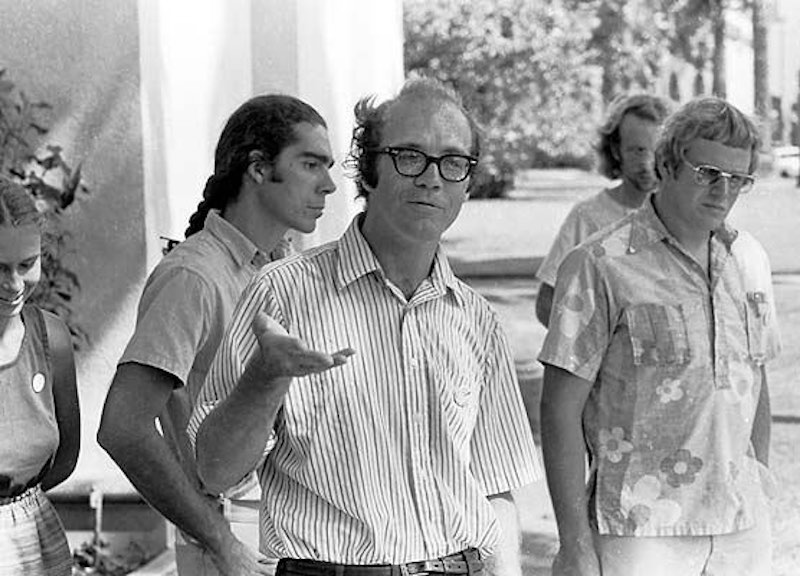
Here’s a historical tidbit. Ferencz, and a second Nuremberg prosecutor, Mary Kaufman, appeared in federal court in Honolulu in the 1972 trial of the so-called “Hickam Three.”

The Hickam 3–UH religion professor and author Jim Douglass, peace activist and teacher Jim Albertini, and Chuck Giuli–were charged with destroying government property by pouring human blood onto secret Vietnam war files in an office at Hickam Air Force Base in a March 2, 1972 protest. The blood pouring incident became a center of anti-Vietnam War protests in Honolulu during 1972.

All charges against Giuli were dropped after government witnesses failed to tie him to the destruction of documents.

Ferencz and Kaufman argued in court that the defendants’ actions were legal because they were trying to prevent war crimes from being committed by the U.S. government.

The former Nuremberg prosecutors court appearance was reported by both Honolulu daily newspapers. Honolulu Advertiser reporter Tim Toner wrote:

Ferencz argued the defendants “believed crimes were about to be committed by an agency of their government and took such steps as were reasonably possible to prevent the commission of the crimes.”

The defense cited the Hague Convention of 1907 prohibiting “the use of weapons (such as antipersonnel bombs0 that cause unnecessary suffering.”

Federal Judge Samuel P. King ruled that the “war crimes” defense could to be used because the relationship between the Hickam files and any potential war crimes was too remote. However, King did allow defendants to testify about their own feelings about the war in order to describe their “state of mind” during the blood-pouring protest.

I found two articles describing the former prosecutors’ appearance in the courtroom in Honolulu old Federal Building.

Both men were convicted of conspiracy and destruction of government property, and sentenced to a year probation and a $500 fine. Both refused to pay the fine. Albertini was later sentenced to 90 days in Halawa prison for his refusal. Douglass moved to Canada, but was arrested in 1975, brought back to Honolulu, and sentenced to 2-1/2 years probation.

Behind today’s headlines: “Iran, WTF?”

With the threat of U.S. military action against Iran very much in the news this week, I recommend spending 51 minutes with this thoughtful podcast from the folks at the Lawfare Blog.

The Lawfare Podcast: Scott Anderson and Suzanne Maloney on Iran, WTF?

Benjamin Wittes sat down with Suzanne Maloney and Scott R. Anderson to talk it all through. They talked about whether the AUMF covers Iran, why Iran is doing this stuff, whether the Trump administration brought this all on itself, and where it’s all going from here.

Ben Wittes is editor-in-chief at Lawfare and a Senior Fellow in Governance Studies at the Brookings Institution. I knew him back when he was a young reporter in Washington and I was relatively new at the Honolulu Star-Bulletin.

Suzanne Maloney is deputy director of the Foreign Policy program at the Brookings Institution and a senior fellow in the Brookings Center for Middle East Policy and Energy Security and Climate Initiative, where her research focuses on Iran and Persian Gulf energy.

Scott R. Anderson is a David M. Rubenstein fellow in Governance Studies at the Brookings Institution. He previously served as an Attorney-Adviser in the Office of the Legal Adviser at the U.S. Department of State and as the legal advisor for the U.S. Embassy in Baghdad, Iraq.

Memorial Day musings

Tomorrow is Memorial Day. So although it’s a day early, I’m using the occasion to repost something I wrote six years ago. It definitely needs repeating.

It’s Memorial Day. It isn’t a day that puts me in a good mood. It is a day to mourn, not to celebrate. We seem to have forgotten that part of it.

Memorial Day was officially proclaimed on 5 May 1868 by General John Logan, national commander of the Grand Army of the Republic, in his General Order No. 11, and was first observed on 30 May 1868, when flowers were placed on the graves of Union and Confederate soldiers at Arlington National Cemetery. The first state to officially recognize the holiday was New York in 1873. By 1890 it was recognized by all of the northern states. The South refused to acknowledge the day, honoring their dead on separate days until after World War I (when the holiday changed from honoring just those who died fighting in the Civil War to honoring Americans who died fighting in any war). It is now celebrated in almost every State on the last Monday in May (passed by Congress with the National Holiday Act of 1971 (P.L. 90 – 363) to ensure a three day weekend for Federal holidays), though several southern states have an additional separate day for honoring the Confederate war dead: January 19 in Texas, April 26 in Alabama, Florida, Georgia, and Mississippi; May 10 in South Carolina; and June 3 (Jefferson Davis’ birthday) in Louisiana and Tennessee.

The day has now become an occasion for mainstream media to pour out an unrelenting stream of stories promoting the mythology of the heroic warrior killed in battle. It’s the kind of myth that does a great disservice by aiding and abetting the glorification of state-ordered killing.

When I think about war, I think about the nearly two million men of my generation who were drafted and given a hard choice–prison or war. It wasn’t pretty, whichever choice was made. Many didn’t come back (about 18,000 draftees died in combat). Many more of those who did found their lives changed for the worse, as veterans of Iraq and Afghanistan are now finding.

I think about those who were ensnared by official government lies and distortions, from the Pentagon Papers to the Saddam’s nonexistent WMDs.

I also think about victims of the economic draft, who are driven to join the military because it seems the only way to avoid chronic unemployment.

I think about the men and women of conscience who have suffered because their conscientious objection to war and killing is disrespected and marginalized, with the complicity of our mainstream media.

I think about the old white men who send young men off to kill and die.

I wonder what would happen if we had boot camps and basic training in peace making and conflict resolution, instead of basic training that breaks down our natural reluctance to take the lives of others.

And I think, as I do each and every year, how many more? How many more must die in wars before we decide there must be better ways to settle differences or manage power.

How many more?

Photo: Memorial Day Protest, Punchbowl National Cemetery, 1971. Click on the photo for more.