Category Archives: War & Peace

We’ve gone from prosecuting war crimes to threatening those who do

We went to see Operation Finale this week. Here’s the summary of the plot from the website, Rotten Tomatoes:

Fifteen years after the end of World War II, Israel’s intelligence agency Mossad and security agency Shin Bet – led by the tireless and heroic agent Peter Malkin (Isaac) – launched a daring top-secret raid to capture the notorious Eichmann (Kingsley), who had been reported dead in the chaos following Nazi Germany’s collapse but was, in fact, living and working in a suburb of Buenos Aires, Argentina under an assumed identity along with his wife and two sons. Monitoring his daily routine, Malkin and his operatives plot and execute the abduction under the cover of darkness just a few feet from Eichmann’s home. Determined to sneak him out of Argentina to stand trial in Israel, Malkin and Eichmann engage in an intense and gripping game of cat-and-mouse.

The summary doesn’t mention the war crimes that made up the Halocaust during WWII, or Eichmann’s status as a war criminal who had escaped the Nuremberg Trials and taken up residence in Argentina.

I didn’t come in cold on this topic. Years ago, I read and was deeply affected by Hannah Arendt’s account of the subsequent Eichmann trial (“Eichmann in Jerusalem, A Report on the Banality of Evil,” and Raul Hilberg’s exhaustive account of the bureaucracy of the Halocaust, “The Destruction of the European Jews.”

This week also was marked by an attack by National Security Advisor John Bolton on the International Criminal Court, described by Newsweek as “mandated by most of the international community to prosecute genocide, war crimes and crimes against humanity.”

Crimes such as those that Adoph Eichmann was tried for and convicted of.

In the movie, Argentinian Nazis and Nazi sympathizers were trying to block the Israeli team from hustling Eichmann out of the country to face a public trial. You can’t help seeing them as the bad guys.

Yet here, while this movie , Bolton put the United State’s rather firmly on the side of those accused of war crimes, going so far as to threaten sanctions against judges on the International Court involved in such prosecutions.

I wasn’t born when the Nuremberg Trials were held after WWII to bring those alleged to have carried out acts of genocide to justice. The U.S. was a leading force in establishing this forum, along with the basic premise that there are consequences for war crimes and crimes against humanity, and the defense of “I was only following orders” is not sufficient.

I’m sad and embarrassed by Bolton’s attack on the international court. As a nation, we should be able to say that we do not participate in, support, nor condone war crimes.

Bolton’s posture seems to be that if we may commit such crimes with impunity because, well, the United States just doesn’t care.

That’s a very sad position for a country that used to take pride in being seen as a promoter of global human rights.

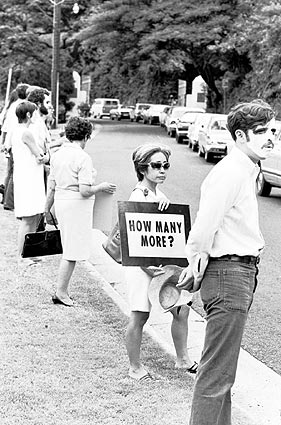
Throwback Thursday: War Tax protest mid-1970s

In honor of tax week…Protesters in a silent vigil against the nuclear arms race outside the old Federal Building in downtown Honolulu.

It was Tax Day, April 15, sometime in the mid-1970s. I credit Quaker activist Elaine “Woody” Schwartz, an Aina Haina housewife, who was a strong advocate for protests against war spending each time tax day rolled around, and drew others into the protests by her strong personal example.

Leaflets asked passersby to consider the proportion of tax dollars going for war and the proliferation of nuclear weapons, and urged withholding of war taxes.

I believe the figure on the far left in the photo, closest to the camera and holding an American flag, is longtime activist Jim Albertini, who now makes the Big Island his home.

Click on the photo to see a larger version.

The following is from a history of war tax resistance during the years of the Vietnam War by the War Resisters League. The tactic continued after that war ended and peace activists turned to grapple with the global arms race.

Indochina War

War tax resistance gained nationwide publicity when Joan Baez announced in 1964 her refusal to pay 60 percent of her 1963 income taxes because of the war in Vietnam. In 1965 the Peacemakers formed the “No Tax for War in Vietnam Committee,” obtaining signers to the pledge “I am not going to pay taxes on 1964 income.” By 1967 about 500 people had signed the pledge.

Then several events in the mid- to late-1960s occurred making this a pivotal period for the war resistance movement, signaling a shift in war tax resistance from a couple hundred to eventually tens of thousands of refusers.

A committee led by A.J. Muste obtained 370 signatures (including Joan Baez, Lawrence Ferlinghetti, David Dellinger, Dorothy Day, Noam Chomsky, Nobel Prize winner Albert Szent-Gyorgyi, publisher Lyle Stuart, and Staughton Lynd) for an ad in The Washington Post, which proclaimed their intention not to pay all or part of their 1965 income taxes.

A suggestion in 1966 to form a mass movement around the refusal to pay the (at that time) 10 percent telephone tax was given an initial boost by Chicago tax resister Karl Meyer. This was followed by War Resisters League developing a national campaign in the late 1960s to encourage refusal to pay the telephone tax.

In 1967, Gerald Walker of The New York Times Magazine began the organizing of Writers and Editors War Tax Protest. The 528 writers and editors (including Gloria Steinem and Kirkpatrick Sale) pledged themselves to refuse the 10 percent war surtax (which had just been added to income taxes) and possibly the 23 percent of their income tax allocated for the war. Most daily newspapers refused to sell space for the ad. Only the New York Post (at that time, a liberal newspaper), Ramparts (a popular left-wing anti-war magazine), and the New York Review of Books carried it. To see an image of the ad, click on link above.

Ken Knudson, in a 1965 letter to the Peacemaker, suggested that inflating the W-4 form would stop withholding. Again, Karl Meyer was instrumental in promoting this idea, which was adopted by Peacemakers, Catholic Worker, and War Resisters League, among other organizations in the late 1960s. Inflating W-4 forms also brought a new wave of indictments and jailings by the government — 16 were indicted for claiming too many dependents; of those, six were actually jailed.

The number of known income tax resisters grew from 275 in 1966 to an estimated 20,000 in the early 1970s. The number of telephone tax resisters was estimated to be in the hundreds of thousands. Many groups were formed around the country including “people’s life funds,” to which people sent their war tax resisted money to fund community programs.

The popularity of war tax resistance grew to such an extent that the WRL could no longer handle the volume of requests. So in 1969 a press conference was held in New York City to announce the founding of the National War Tax Resistance (WTR). Long-time peace activist Bradford Lyttle was the first coordinator. Local WTR chapters blossomed around the country, and by 1972 there were 192 such groups. WTR published a comprehensive handbook on tax resistance, Ain’t Gonna Pay for War No More (edited by Robert Calvert), and put out a monthly newsletter, Tax Talk. Radical members of the historic peace churches began to urge their constituencies to refuse war taxes.

In 1972 Congressman Ronald Dellums (CA) introduced the World Peace Tax Fund Act in Congress, which was designed to create a conscientious objector status for taxpayers. The National Council for a World Peace Tax Fund was formed to promote this legislation (later changed to National Campaign for a Peace Tax Fund). The bill has been introduced into each Congress since.

During the Indochina War, war tax resistance gained its greatest strength ever in the history of the United States, and on a secular basis rather than as a result of the historic peace churches, who played a very minor role this time. The government did its best to stop this increase in tax resistance, but was hamstrung by telephone tax resisters. There were so many resisters and so little tax owed per person that the IRS lost money every time they made a collection. The cost of bank levies, garnished wages, automobile and property seizures, and even the simplest IRS paperwork was simply too expensive to be worth it.

Will we agree to restrict the use of killer robots?

Forget the threat of Facebook’s privacy intrusions. How about killer robots? Hollywood has done a good job of getting the public used to the idea of killer robots of various kinds.

But it’s no longer just a matter of fantastic computer graphics in movies. Technology has developed to the point where the issue is not “if” we will be able to build systems of robot weapons, but when.

And, for those who are trying to maintain a legal framework for international arms control, it’s a problem that needs to be addressed sooner rather than later.

Put simply, the international laws of war have to be rewritten to take maintain their relevance as this new type of warfare arrives on the scene.

The Lawfare Blog just published a review of the current status of international discussions of “Lethal Autonomous Weapons Systems,” or LAWS.

Though states have not agreed on a definition of LAWS, the International Committee of the Red Cross (ICRC) has defined “autonomous weapon systems” as “[a]ny weapon system with autonomy in its critical functions—that is, a weapon system that can select (i.e. search for or detect, identify, track, select) and attack (i.e. use force against, neutralize, damage or destroy) targets without human intervention.”

The article links to a couple of versions of a 2014 report from an “expert meeting” organized by the International Committee of the Red Cross to discuss the issues (“Autonomous weapon systems technical, military, legal and humanitarian aspects“).

There’s also a useful link to another scholarly article, “Debating Autonomous Weapon Systems, Their Ethics, and Their Regulation Under International Law.”

Recalling that 1962 nuclear test

A Civil Beat article and podcast recall the 1962 atmospheric nuclear test that was visible from Hawaii (“Offshore: When Hawaii Welcomed A Nuclear Blast“).

The U.S. high-level open air atmospheric test was conducted at Johnston Island, some 800 miles from Honolulu.

Civil Beat says there were celebrations of the blast.

People in Hawaii were so excited to witness the blast that hotels in Waikiki planned watch parties, families lined up in parks and on beaches to find a good viewing spot, and newspapers printed viewing guides.

End of the world parties, more likely. Coming at the height of the cold war, with nuclear war preparations very much part of the daily news, it was profoundly unsettling to experience the power of nuclear weapons, even from this safe distance. Life changing? I don’t know, but it’s not something anyone who was here will forget.

I remember staying up late as media–radio or television, I don’t recall–counted down to the blast. We stood in our back yard looking up at the sky, and stood in awe as the night gave way to a bright flash, which slowly faded through the color scale over a number of minutes as the colors slowly mutated and faded. It was awe inspiring for sure. Fear and anxiety inducing also.

I’m looking forward to listening to the Civil Beat podcast.