
Tag Archives: Carey D. Miller

Finding connections

Back in April 2013, I scanned and posted a scrapbook put together by the late UH Professor Carey D. Miller from the time of her arrival in Hawaii in 1922 through her travels around the islands during her first year.

I actually posted two entries, the first showing the scrapbook page-by-page, and then a follow-up with larger versions of the 62 tiny photographs that accompanied her tales.

Today I received a reply out of the blue, courtesy of the small world created by the internet and online searching. It’s from a California artist whose great aunt was of one of the women who traveled to Honolulu with Miller and stayed for a year before returning to the mainland.

Dear Ian Lind,

I cried out upon seeing these photos – I was so excited to find my Aunt Hallie Hyde with her friends Carrie and Ada in Hawaii.

Recently, I went back on ancestry to renew my subscription, and noticed that Hallie had taken a trip in 1922 on the ship Wilhemina. After not finding much on the ship, I decided to do a general search on Hawaii in 1922 and found your website and these wonderful photos. I tried to email, but letter came back.

Hallie was one of the few women in 1911 to receive her Master’s Degree in Home Economics in Illinois. Her father was a physician in Brookings, SD. Hallie was an artist as well. My father and I followed in her footsteps in this regard. I am so excited to see photos of my great Aunt Hallie! The last picture I had of her was from her days as a student at South Dakota State College….

Thank you so very much!!!!

I just never know whether any of the historical items I’ve posted will hit home with anyone, and it’s really nice to hear when it happens!

[text]Meantime, it’s Veterans Day, and four years since we scattered my dad’s ashes in the ocean out past the surf break at Ala Moana. Here’s part of what I wrote at the time.

Four canoes from the Waikiki Surf Club, including its legendary Koa racing canoe, Malia, escorted my father’s ashes out of Ala Wai Boat Harbor late yesterday afternoon as we scattered his ashes in the ocean that he loved. It was a very high honor bestowed on the club’s co-founder.

In this photo, Wally Froiseth, co-founder of the Waikiki Surf Club and a friend of my dad’s since 1939, says a simple, “Goodbye, John” as he tossed a final handful of flowers in the water….

It was quite a sendoff. A fine afternoon.

I took photos that day, playing the role of participant-observer, and former Star-Bulletin photographer turned videographer, Dean Sensui, captured it in video. The video is posted on YouTube. You can jump ahead to about the 22 minute mark, where the canoes gather in a rough circle as his ashes and lots of flowers were dropped into the sea.

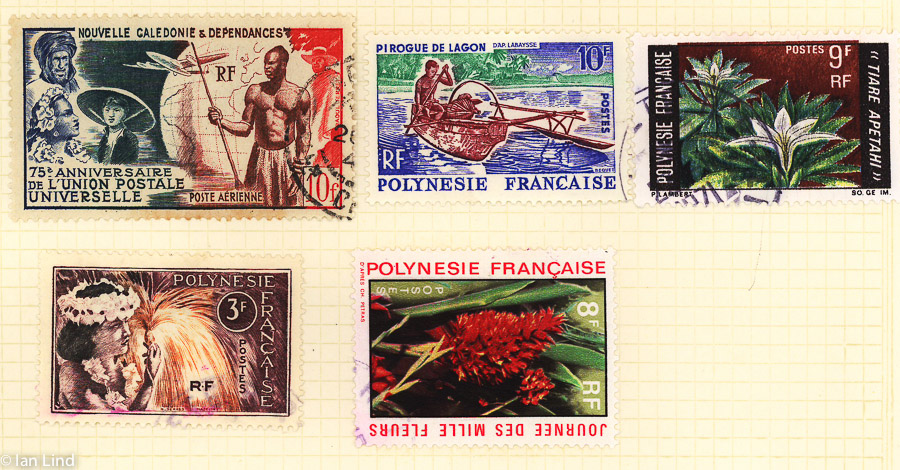
A few stamps of French Polynesia

I had a little time yesterday to scan a few pages of the Pacific stamps collected by the late UH Professor Carey D. Miller.

I’ve been told collections like this have little monetary value, but they are wonderful little collections of art. I’ve just gathered a few below, and will post the 15 pages scanned yesterday when I have a bit more time to compile them.

In the meantime, enjoy these images from French Polynesia, captured in these miniature engravings.

Click on any image for a larger version.

Stamps

Stamps

Stamps

Where was this photo taken?

Here’s another goody–an old photo of a night blooming Cereus somewhere in Honolulu. Where was it taken?

It’s from a small box of color photographic images on small glass plate. They were in an old box containing more materials from Professor Carey D. Miller at the University of Hawaii. My mother had been her student, worked for her over several years after graduation from UH, and was a lifelong friend.

Miller arrived at UH in the early 1920s. The date of the image is unknown. I’m guessing it was perhaps from the 1930s, but that’s just a guess.

I was able to scan the image with at least partial success. But to make this more complicated, the image could be reversed. I didn’t know which side of the glass slide should be “up” when making the scans, so you’ll have to take that into account when matching it with known locations/buildings.

The question: Where is this? There are highly visible plants that bloom on the walls around the Punahou campus. Is that a Punahou building that can be seen in the background?

Leave your educated guesses below.

Where are we?

More info on Hawaiian foods

Here are two more sets of notes about Hawaiian plants and foods. I found these in files containing research notes belonging to the late University of Hawaii Professor Carey D. Miller.

First, there are two pages of typewritten notes based on conversation with Mr. & Mrs. C.C. Conradt. They described the feeding of babies (sometimes nursed for three years), including baked sweet potato and poi.

• restrictions on what women could eat “were very strictly kept. And baby girls were not allowed food tabu to women.”

• Why didn’t they eat more chicken? Not many raised. no place for them.

• Common people and chiefs ate the same food. “Quantity varied, not quality so much.”

Then there are another two pages dated 1957, “Notes taken in conversation with Mary K. Pukui and Mr. Wm. Meinecke.

This consists mainly of a list of foods eaten regularly or occasionally.

Ka’u people were sweet potato eaters. Taro was down only on the edge of the forest and breadfruit only mauka. The land in general was too arid for anything but sweet potatoes.

Hilo people were taro eaters, “Hilo ai luau” is the phrase. They had an abundance of water and didn’t eat many sweet potatoes.

People of Mokapu area were the fishing group [land pieces were part of the large ahupua’a on the windward side (Kailua, Kaneohe, and Heeia)] and other pieces of the land area provided abundance of taro.

The sweet potato eaters of Oahu were the people inhabiting the area from Makapu’u to Kokohead.

Act of cutting hair and knocking out teeth, tattooing tongue–all done in grief to show aloha for the ali’i–was called manewanewa.

All quite interesting.