
An unsigned memo last week from the State Ethics Commission to state legislators advised that “some of the forms that were filed with our office were not completely filled out and that information that is required by law was not provided on some forms.”
The memo, dated July 12, 2012, asked legislators to “review your completed form to ensure that you have provided all of the information that is requested for each item on the form.”
Click on the image below to read the full memo.
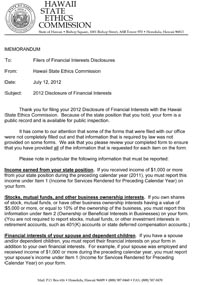
The commission’s memo pointed to several specific items required to be reported, presumably areas where deficiencies were found:
• Income earned from your state position.
• Stocks, mutual funds, and other business ownership interests.
• Financial interests of your spouse and dependent children.
• Amounts and values of your financial interests.
During an informal interview a year ago, Ethics Commission Director Les Kondo said the commission was planning to begin basic reviews of financial disclosures. I reported at the time:
They now plan at least two simple checks. The first section of the financial disclosure form requires reporting of all income received for services rendered. In the case of public officials and employees, this section should at least contain their state salaries. If it is blank, then it may be an indication that less than sufficient care has been taken in completing the form.
The second category of disclosure is ownership interest in any business that is worth over $5,000 or represents 10% of the company.
“The instructions are clear, but many people don’t realize this includes corporate stocks,” Kondo said.
Since then, though, questions about incomplete disclosures have been repeatedly raised here and by Larry Geller’s Disappeared News blog.
Last week’s blanket, unsigned memo avoids embarrassing those legislators who filed disclosures that fell short of legal standards, and its almost apologetic tone fails to signal a new commitment to enforcement. Remember that those required to file statements must certify that their disclosures are “true, correct, and complete” and, in addition, must acknowledge that filing an incomplete or inaccurate statement is a violation of Chapter 84, the State Ethics Code.
Even if the commission intends to cut legislators some slack this time around, a more pointed message could have been delivered like this:
“An informal commission audit has found some legislators have failed to fully comply with state law regarding disclosure. Failure to file a true and complete financial disclosure is a violation of the State Ethics Code. As a one-time courtesy, the commission is giving you an opportunity to review and amend your recently filed financial disclosure. In the future, the commission shall treat incomplete or untrue statements as ethics violations and pursue them appropriately.”
I know the commission is caught in the political crossfire between its statutory responsibilities, public interest in full disclosure, and pushback from reluctant legislators. It appears to be up to concerned members of the public to keep up the pressure. It just doesn’t do a lot of good to get reasonable ethics laws on the books if they can’t be enforced. The public needs to help create the political will to see this through.
Discover more from i L i n d
Subscribe to get the latest posts sent to your email.
This begs the question: why was it unsigned?
I normally toss all letters received without a name into file 13.
I don’t know- although it’s worded very diplomatically those last two sentences do serve as a “final notice- “a one-time courtesy (that i)n the future, the commission shall treat incomplete or untrue statements as ethics violations and pursue them appropriately.” We have no choice but to take them at their word but we can also hold them to it. Any future failure to “pursue” “violations” will be make liars of the commission.
Ian, I suppose that the rationale for the memo being unsigned is that it is the view of the five commissioners who determine everything at the commission. However, I would wonder if the Commission really voted on this, and whether staff is just trying to avoid flak and work.
That said, I think a memo with a name on it does an awful lot of good. Recipients know who sent it and is responsible for it in terms of questions and follow-up–these would be issues for staff. I signed everything I sent when I was the director of the Commission, and I think recipients and the media and public need to know who is responsible. The Commissioners could sign, but they come only for meetings, so there should be a staff person signing the memos for follow-up, and for the reasons mentioned above. It seems to look like hiding, and thus a failure to be accountable. Again, I would emphasize there has to be a strong visible presence at a minimum. People are getting paid to do this work–there is an impression of dodging responsibility and accountability. These are all lawyers. If there are problems signing memos, one can only wonder what other work is avoided that would increase one’s visibility or work-load. And, is there a double standard–avoiding visibility with things that go to legislators and other officials with power, while at other times not hesitating to deal directly with those one feels less threatened by in terms of subjecting them to enforcement, then there is a serious problem, and a double standard.
Anyway, that is the impression I get. If one is not fairly in the face of the powers that be, nothing is going to happen, except maybe going after folks who are not particularly threatening.
I agree in particular with the last three sentences of your blog. The public is going to have to keep up the pressure. Laws not enforced are meaningless. And, the public needs to be involved more, unfortunately.
When I was the associate director in the early eighties, the Commission and I at the time agreed that we had to have hearings where warranted to let everyone know we were serious. Thus, I did two in 1985. These are not easy and require a lot of work, and the other side always lawyers-up with competent counsel. But the hearings produced findings of violations that were then covered in the media.
I spent at least half my time on enforcement cases as associate director and as executive director. Unfortunately, due to confidentiality laws, much of the good work could not get public notice in a way that appealed to the media, thus the public would not know. For example, in the early eighties a fairly high-up state employee agreed to resign and not work in state government again if we did not go a hearing. The main reason for not going to a hearing was that the case might have had evidentiary problems, and a gone corrupt state official was a good outcome, but could not be advertised, so to speak.
The Commission needs to go to hearings when warranted to “send a message”. These hearings should be for cases generally of knowingly violating the law or ignoring it repeatedly, and other fairly serious things. The last hearing that was scheduled was set in 2006 for then-Senator Kanno, who resigned once we publicly announced that we were going to a hearing. Under the circumstances, this was a good result–there was nothing like restitution or money to pursue. There have been publicly announced settlements with fines in other cases. One of these that was handled with a fine and settlement I would have gone to a hearing on, but the Commission decided otherwise. I felt a hearing in that particular case would have really ended a problem we worked on for over 30 years, because the evidence was so potent–visually recorded–this always gives a clear impression of what people are doing.
The Commission does not need to audit every financial disclosure with a field audit (desk audits should be done, of course). It can pick a few at random (and others one suspects of intentional non-compliance) to check, and if there seems to be a flaunting of the law, go to a hearing and show that the Commission is being serious with the apparently powerful people. This will send a quick message, and is only fair as to those who do take the time to comply with the law.
Ian, if I am not mistaken, Andy is confusing your suggested (stronger) re-write of the Commission memo with the actual Commission memo. Am I missing something?
Also, the memo is addressed to “Filers of Financial Interests Disclosures”. There are around 1,700 filers, about 250 or so public, and the rest confidential.
However, a reading of the first paragraph of the memo indicates it was only sent to “public” filers, not all filers. We don’t even know if this memo went to all filers or just the public ones. I assume it went just to the public ones, and thus the memo is misleading, and raises the question of why it was not addressed to the public filers in the first place. This only strengthens the impression of not signing the memo to avoid flak from the powerful (the “highest” officials are the ones filing public disclosures, including elected officials–legislators, governor, cabinet members) and accountability, and making the memo faceless. Again, there has to be a strong personal presence in terms of enforcing the laws the Commission administers. Thanks for bringing this to light. It is a confusing memo, and we have no idea who is responsible for it. I would doubt the Commissioners saw it before it went out. They do not necessarily review memos, but I do not know what the policy is now, but presume this memo was done by staff.
Haha- I did misread the context Dan…. perhpas it was wishful thinking that a sentence like that would be included in the actual memo.
Andy, Yes, I can understand. One’s better instincts allows this kind of stuff to happen!