
Coincidence?
Check these photos and stories published more than a week apart.
The Star-Bulletin was there first with a story back on November 21st about UH football ticket scalpers accompanied by this photo by Jamm Aquino:
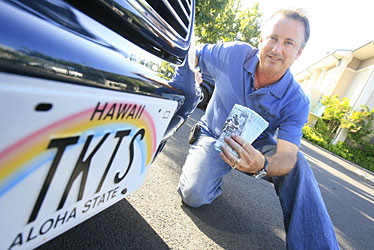
The Advertiser ran a story on the same topic nine days later, on November 30, with this familar-looking photo by Greg Yamamoto:
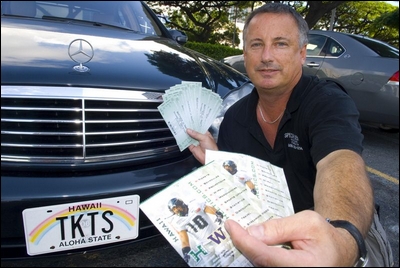
So which story gets attention from other media? Apparently the ‘Tizer’s late entry, according to an angry reader who commented yesterday on this lack of respect:
I heard a story on a local radio station this morning about the professional ticket scalper who’s making a killing reselling UH football tickets online.
Either the station or the AP broadcast wire (unsure which), lifted the story from today’s Honolulu Advertiser … when the Star-Bulletin had the story and a nearly identical photo DAYS ago.
Gosh that torques my jaw!
Why didn’t the radio station/AP local bureau pick up and use the Bulletin’s story?
What, just because it appears in the Advertiser more than a week later, it’s finally news?
The Advertiser should be ashamed of itself, for its redundant reporting and nearly identical photo, but I guess “shame” doesn’t factor in when one is the 800-lb. gorilla — or when it’s the Tizer’s more than week-after-the-fact story that gets picked up by other media. Shame on the other media, too, I guess.
Another reader commented at length about the dispute over disclosure of documents in the extortion case involving former Lingle campaign chair and state administrative director, Bob Awana. This is a long but extremely important comment. I would encourage you to read through it.
Nice job on pushing everyone along on the secrecy order relating to Awana’s alleged procurement of female entertainment on his state trips.
It seems to me, though, that with all the focus on what Awana did or did not do and how the secret evidence relates to the alleged improprieties, that a larger issue is being missed. That is, how is it that the court can grab this foreign man overseas, extract him back to the United States, and then convict him for a felony , all on “evidence” that we as a community never get a chance to review? I think that as a society we need to be able to monitor judicial officers to see exactly how they wield the immense power that we have given them. Thus, I am troubled that Judge Seabright does not seem inclined (per the comments quoted in the Star Bulletin) to lift the protective order, thus keeping the evidence related to Awana from reaching the public.
We all understand how the victim of a crime (in this case extortion) may have evidence that he or she is not anxious to have the community at large see. This happens all the time: victims of fraud may not want the world to know how dumb they were, victims of battery may not want their wives to know where they were when battered, etc. Still, normally the process goes on without special protective orders protecting the accusers. (There are a number of exceptions, including for commercial secrets, minors and rape victims, but in those cases society has determined that there is an important interest countervailing the public’s right to review the administration of justice.)
The “right” of the complaining witness to keep his evidence secret needs to be tempered by our right as citizens to be able to check on the judiciary. Some foreigner just got a felony conviction based on what is effectively secret evidence. Was this fair? How do we know (unless we can freely inquire) if the court system is not railroading someone simply because he got crosswise with powerful people? This kind of question takes on particular force where: (1) the judge is a recent appointee by a Republican administration, (2) Awana is closely tied to the state Republican administration and may have been personally instrumental in getting Seabright his appointment, and (3) the prosecutor who insists on secrecy is part of a scandal-ridden justice department that just had the Attorney General resign under fire.
It is important for us as a society that secrecy in the court system be kept to a minimum. It is not written in the stars that judges can do no wrong. There is ample evidence that some courts at some times have bowed to local political pressure and done the wrong thing.The conviction of the Scottboro boys for rape, the outcome of the Massey case in Hawaii with a one hour punishment for manslaughter, the recent impeachment of Federal Judge Alcee Hastings for bribery all evidence that public oversight of the courts is not simply wasted effort.
Frankly, I am surprised that the court appears to be insensitive to this issue. Perhaps the most powerful weapon the courts have is the general respect of the population and a willingness by citizens to accede to their rulings. This power is undercut when courts make discretionary rulings which benefit insiders and then hide the “evidence” from public scrutiny.
Very well said. Thank you.
Discover more from i L i n d
Subscribe to get the latest posts sent to your email.
There is case law around breaking judicial seals and releasing information into public view. I found quite a bit when, during the heyday of the Felix Consent Decree, we were trying to break through the secrecy of years of talks between either Judge Ezra or the Court Monitor Ivor Groves and the state and plaintiff attorneys. Trouble was, that wasn’t an ongoing trial, it was an ongoing “settlement conference”. The case law related to trials.
Felix went on for a decade. It was a dark process, with the public excluded entirely from the overwhelming bulk of the case.
Excellent comments on the court & secrecy.
For me, the questions of privilege & procedure extend to the whole thing. The court is not sending a very reassuring message to us, the citizens, in any aspect of this case.
A couple of issues:
If an ordinary private citizen went to the US attorney or FBI here and complained of extortion by a foreign national in a foreign country, could s/he expect that the FBI would send a shakedown + arrest team to that country to apprehend the suspect, bringing them back to the US for incarceration & trial?
Also, I’ve asked before about the timing in this case. Why didn’t anything come to light before last fall’s elections? Or was the time gap between the grand jury’s actions (March 2006) and the public court proceedings (July 2007) a normal one for the court?