Monthly Archives: December 2008

Wednesday…Bytemarks Cafe this afternoon on HPR, Food Bank can’t meet demand, newspaper bubble, Waikiki 1972

If you’ve got nothing better to do this afternoon, consider tuning in to Bytemarks Cafe on Hawaii Public Radio’s KIPO (89.3 FM) from 5-6 p.m. where I’ll be talking about blogs and blogging with hosts Burt Lum and Ryan Ozawa. You can call in and take part as well. Sounds like it could be fun.

Oops. 5:30 a.m. and the sound of the city garbage truck backing down our street reminds me that I forgot to put out the trash last night after the community association meeting. That’s starting out the day on the wrong foot.

Heard at last night’s meeting…The Hawaii Food Bank has cut down on what is being delivered to every area on the island, including coast from Kaaawa to Kahuku. There’s just not enough food to meet the needs, and smaller local groups are seeking help in filling the gap. And due to budget cuts at the state and city levels, neighborhood boards have been told they can no longer expect city agencies and staff to make community presentations on key issues before the boards. Instead, information will trickle down to the neighborhood boards through designated agency representatives. Fewer opportunities for the public to hear about issues first hand.

Business Week highlights Hawaii’s tourism slump by picking up an AP story by Jaymes Song.

A New York Times analysis yesterday attributes the major woes of newspaper companies, including the now bankrupt Tribune Co., to an investment “bubble” that saw newspaper buyouts and consolidation fueled by high amounts of debt and leverage.

But the companies in the weakest condition are there largely because they borrowed a lot of money to buy papers, often at inflated prices, and the biggest of those deals were struck in 2006 and early 2007. Tribune’s was the biggest of those deals, $8.2 billion to take private the company whose assets include The Los Angeles Times, The Chicago Tribune and 23 television stations, a transaction that almost tripled the company’s debt.

In the year before that takeover was announced, the McClatchy Company bought Knight Ridder, including papers like The Miami Herald and The Kansas City Star; the MediaNews Group bought several papers, including The San Jose Mercury News and The Pioneer Press in St. Paul; investors in Philadelphia bought The Inquirer and The Daily News; a private equity firm, Avista Capital Partners, bought The Star Tribune in Minneapolis. Smaller companies like GateHouse Media bought up dozens of local papers.

If it were possible to unwind those deals, “the business would still be in pretty difficult shape,” said John Puchalla, a vice president and senior analyst for Moody’s Investors Service.

“It wouldn’t have changed the downturn,” he said. “But it sure would have changed the vulnerability to the downturn. Ten to 15 years ago, most newspapers were carrying a pretty low amount of debt. But companies have levered up over time, and in the last couple of years, some companies pushed it too far.”

Most newspapers still have earnings before interest, taxes, depreciation and amortization that are equal to 10 to 20 percent of their revenue. That is down from 20 to 30 percent in the middle of this decade, but tolerable — if not for the burden of making debt payments.

It’s sounding an awful lot like Hawaii’s hotel industry from the wave of resort sales at high prices to Japanese comanies in the 1980s, which left debt-ridden hotels struggling during subsequent visitor slowdowns. The only solution in the case of our hotels were the eventual fire sales in which resort properties were turned over to new owners for pennies on the dollar. Freed from the excessive debt, the new owners could afford the renovations needed to keep up with the market.

It looks like newspapers (and newspaper owners) may have to go through a similar process if any of them are going to survive this period of economic and technological turmoil.

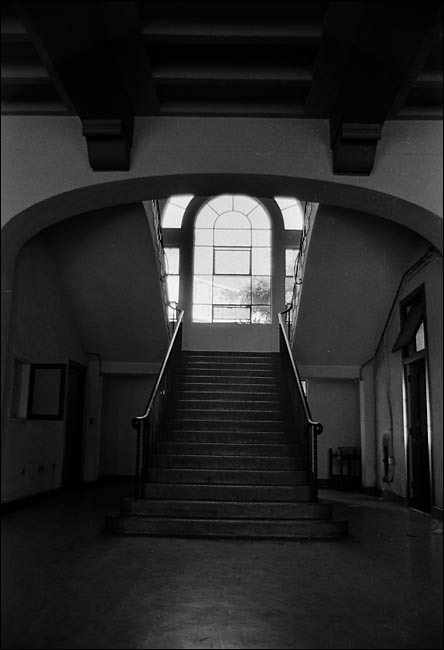
I have to go back and relabel yesterday’s photos of the old Gilmore Hall. I found a note that they were taken in October 1973. I initially guessed that they dated from 1972.

[text]And here’s another oldie from the same period. The Waikiki skyline as it appeared in March 1972. Click for a larger version, as usual.
Tuesday…Old Gilmore Hall on the UH Manoa campus

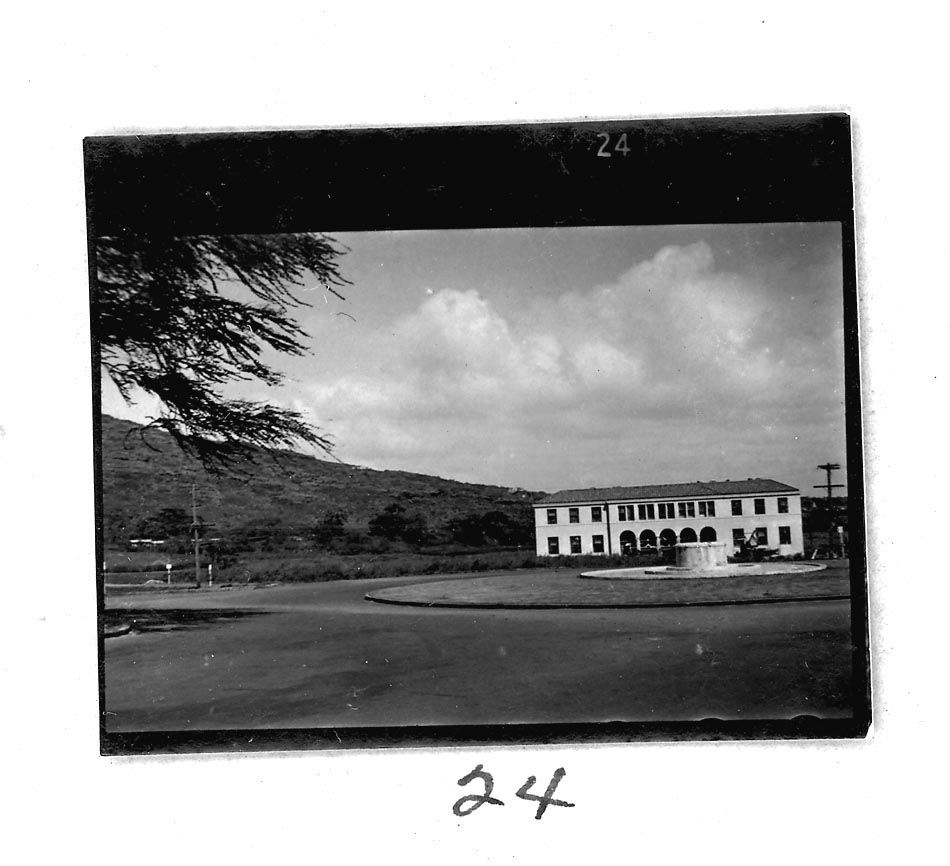
Gilmore HallRemember this photo that appeared here a couple of weeks ago? A reader identified it as the old Gilmore Hall, which sat at the location of the current art building on the UH Manoa campus. According to UH information, the building went up in 1935 and was demolished in 1973 to make way for the new art building.

GilmoreWhile looking through a few old negative files yesterday, I was surprised to find some pictures I had taken in Gilmore while the building sat empty waiting for demolition. I really don’t recall the occasion, but the photos tell the story. Even while gutted and awaiting destruction, it displayed some of those fine architectural features of its day. In retrospect, it’s a shame that it couldn’t have been renovated like Hawaii Hall.

Gilmore came out of an architectural period when stairs were more than just a utilitarian way to get from one floor to another. They also created shapes and forms that made for wonderful internal spaces where light and shadows mixed. By comparison, more modern buildings on campus, well, mostly just suck. Is that a term of art?

In any case, just click on this second photo to see some of the final days of the old Gilmore Hall.

Beyond that, I’m cutting things short today to get into town early. My dad is moving this morning from Queen’s Hospital to a skilled nursing facility. We’re glad he’s getting out of the hospital, but, as you can understand, also nervous about the next stage of this adventure.

Monday…Celebrating the birthday, redesign at the Seattle Times, adding links, and Waialua Asparagus

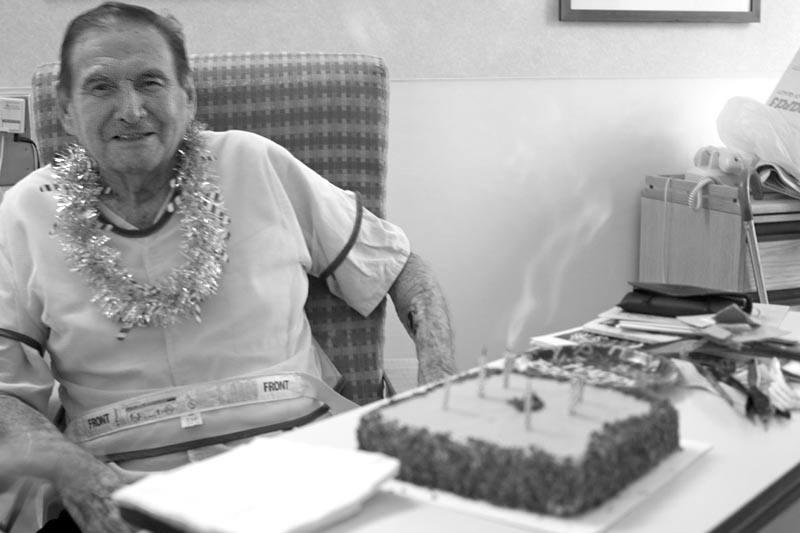
95thWe arrived at my father’s hospital room late yesterday morning with a Leonard’s Bakery cake for his 95th birthday. He was surprised.

When asked how old he was, he gave it a bit of thought and then announced, “seventy three”.

Interesting. When he examined at the emergency room before being admitted to the hospital two weeks ago, the ER doctor asked him what year it is. He answered, “1986”.

In 1986 he would have been 73.

Is this a clue to something or just my mind refusing to accept coincidences? I’m thinking it could be the backbone of a great mystery novel plot.

My sister asked the nurse if it would be okay to light a candle for the cake. After checking, the nurse came back and said it would be okay.

I was surprised when my mother then pulled out six candles and proceeded to light them. In the photo above, he had just succeeded in blowing out the candles. Notice the smoke rising from the candles? Warning sign. It took just a second or two for the room’s smoke alarm to go off. I had visions of the sprinkler system being activated and all of us getting drenched and then billed for the water damage, but luckily a nurse dashed in and quickly disabled the alarm.

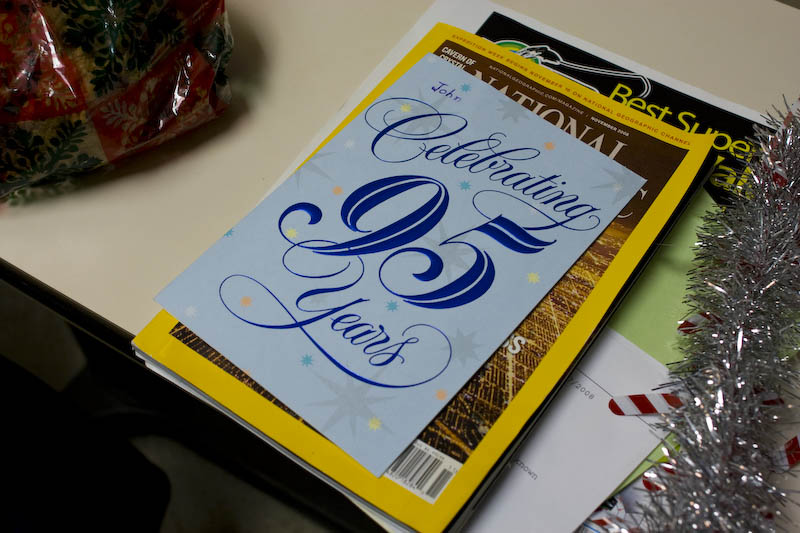
cardA last birthday point. Check the “Celebrating 95 years” card. Is there really enough demand for 95th birthday cards to sustain a commercial market? Maybe some enterprising business reporter will check it out.

The Seattle Times debuts a new look today, described in a column yesterday by executive editor David Boardman. After describing the consolidation into four daily sections from the previous five, Boardman wrote:

What you will no longer find in the daily paper are some features I know many of you will miss: the Bridge column, the Scrabble game, The New York Times crossword puzzle and the daily television listings. We’ll give you TV listings in our Sunday “TV Times” magazine, and those listings and The New York Times crossword will be available on our Web site. We’ll keep our long-running Daily Crossword in the daily and Sunday newspapers, and the NYT crossword on Sunday.

If this were the popular HBO series “The Wire,” this is where the newspaper editor would say, “Less is more,” and that we’re making the paper smaller to save you time in your busy lives.

But I’m in the truth-telling business. We are making these changes because we are reducing our two largest newsroom expenses: staff and newsprint.

Less is less, and we won’t be offering you quite as much content. That said, we’re committed to sustaining the high quality of what we publish. And we’re confident we will give you a newspaper well worth every hard-earned penny you spend on it, each and every day.

Let’s see. Two adult sons of the late Honolulu attorney David Schutter’s are in the news again in Colorado, facing charges of smuggling drugs into a prison where one of the men is currently doing time. Schutter, of course, was one of Hawaii’s legal greats over two decades. He died in 2005.

I was glad to see Advertiser reporter Rick Daysog recognized in editor Mark Platte’s Sunday column, but it points out the difficulty of transitioning from the world of print to the online world. The column would have been more useful had it provided links to each of the stories Platte describes, allowing readers to easily follow Daysog’s prodigious production over the week. In print, it’s not really possible. Online, it’s expected.

Finally, I’ve got to give a plug to Twin Bridge Farms. We bought a bunch of their Waialua Asparagus at the Sierra Club dinner on Friday night, and it became a centerpiece of our dinner last night. Wonderful stuff. Now the question is which stores carry it?

Sunday…My dad’s 95th & a photo album, Bob Jones on deadlines and aggressive journalism, and a new Big Island video blog

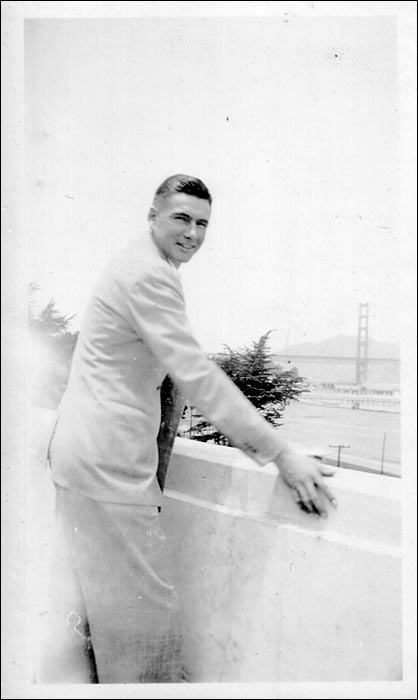
Birthday albumToday marks my father’s 95th birthday. He’s still in Queen’s Hospital, but doing somewhat better. I’m no longer so concerned about whether he’ll survive this bad patch. We’re planning to take a birthday cake to the hospital. I think he’ll enjoy it.

In honor of the occasion, I dredged up some of his old pictures. The most recent in this batch was taken some 55 years ago. That’s pretty amazing!

This first photo was taken about 1937, before he came to Hawaii. Just click on it for the rest of this little album.

This lament comes from longtime reporter and MidWeek columnist Bob Jones:

I’m writing some things for the New York Times about Eric Shinseki’s posting as Veterans Administration chief and digging back into my files and my memory about him when I knew him as a forward observer attached to the 14th Infantry of the 25th Infantry Division in Vietnam near Duc Co, Vietnam, in 1966.

Some things I’m reading in the local press are wrong. He had two Purple Hearts and I was there the day after he got #1. A mortar round blew off all the back of his uniform and hit his shoulder. He refused treatment in order to help a sergeant who was dying.

The local press likes local stories but not within six hours of deadlines. I’d offered one of our papers an exclusive on Shinseki family matters, quotes and deep background at 4:30 p.m. but was told it was too late to print so much or to edit it down. I guess morning dailies are going to “bed” before 6 p.m. these days!

We’re losing journalistic aggressiveness. Remember all those “hold the presses” and “replate” orders of another year?

They don’t have to “replate” any more, just send new computer commands. But sometimes the “evening edition” of my newspaper is in my box by 4 p.m. Same news as the morning edition, just a re-arranged front page.

That’s why people are turning to the internet.

Big Island blogger Damon Tucker wrote to introduce a newcomer:

“…a great new (video) blog out of the Big Island that is doing something unique here….It’s Called “Big Island Video News” and it’s a one man gig run by a nice guy named Dave Corrigan.

I’ve been seeing him at a lot of events lately and he runs a real unique blog that primarily focuses on Video that he has posted.”

And for Sunday reading, you might be interested in these ruminations on Joe the Plumber by my old friend, Gene Stoltzfus.