
Let me try to put the proposed Thirty Meter Telescope (TMT) in perspective, using data from the TMT project EIS and the Supreme Court’s 2018 decision allowing the project to go forward.
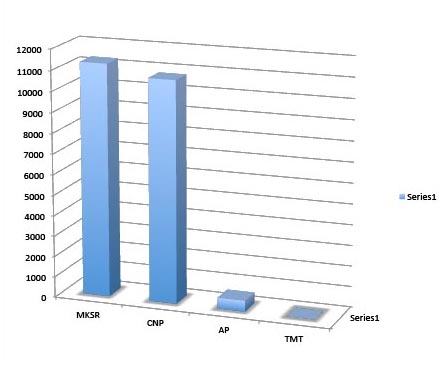
Most of the Mauna Kea summit is within what is designated as the Mauna Kea Science Reserve, which consists of 11,228 acres, surrounded largely by forest reserve.
The bulk (95%) of the total is designated a Cultural and Nature Preservation area consisting of 10,763 acres.
The Astronomy Precinct makes up the remaining 525 acres (about 5% of the total).
And the total area of the proposed TMT, including the observatory dome, support building, and the area disturbed during construction would be about five acres.
Here’s a chart showing the relative sizes. The first column, on the left, represents the entire area set aside as the Mauna Kea Science Reserve. The second column represents what is part of the Cultural and Natural Preserve. The third column shows the relative size of the astronomy precinct. And, finally the last bar represents the size of the TMT site.
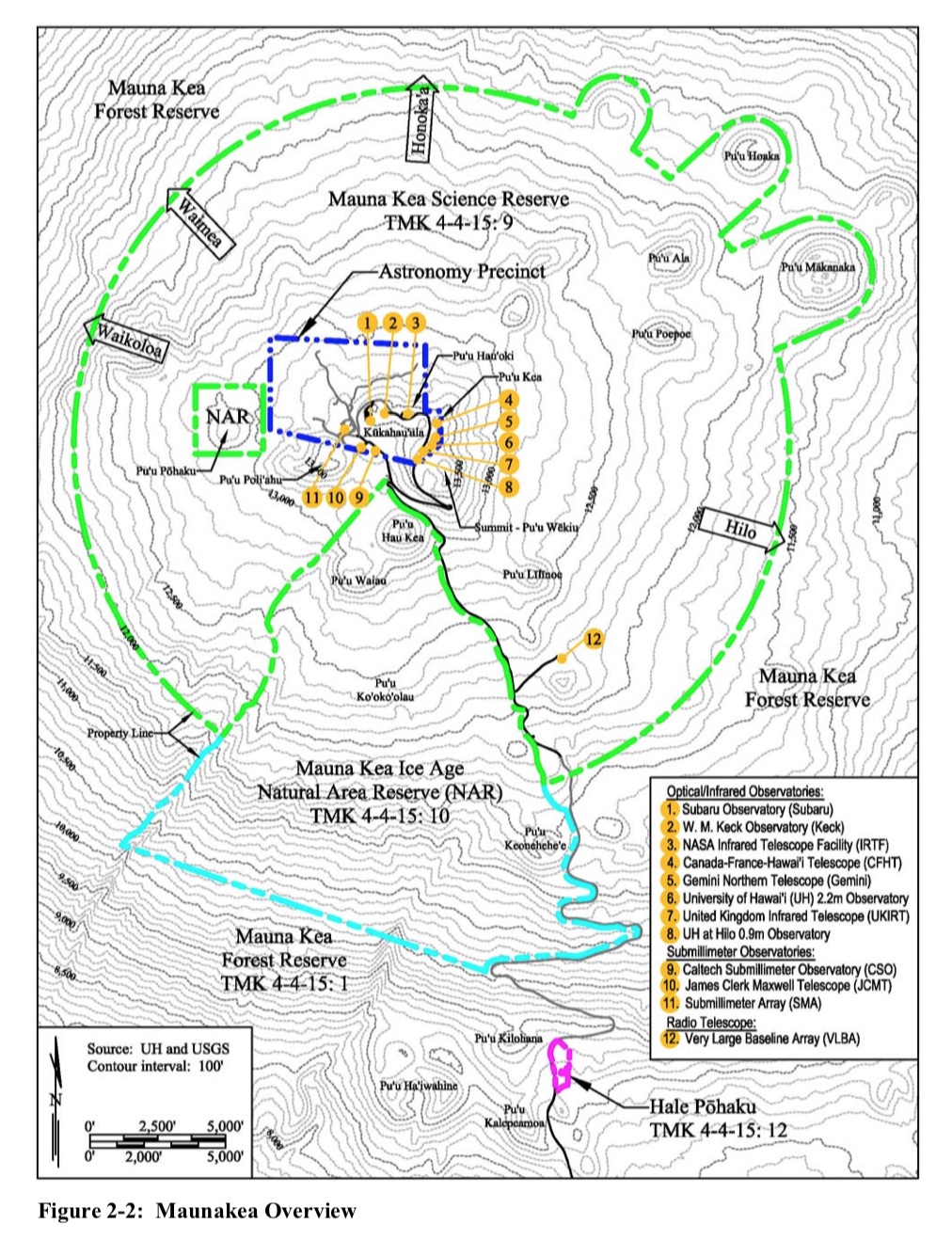
Here’s an overview from the EIS. The Mauna Kea Science Reserve is outlined by the green dotted line. The smaller Astronomy Precinct is outlined by the dotted blue line.
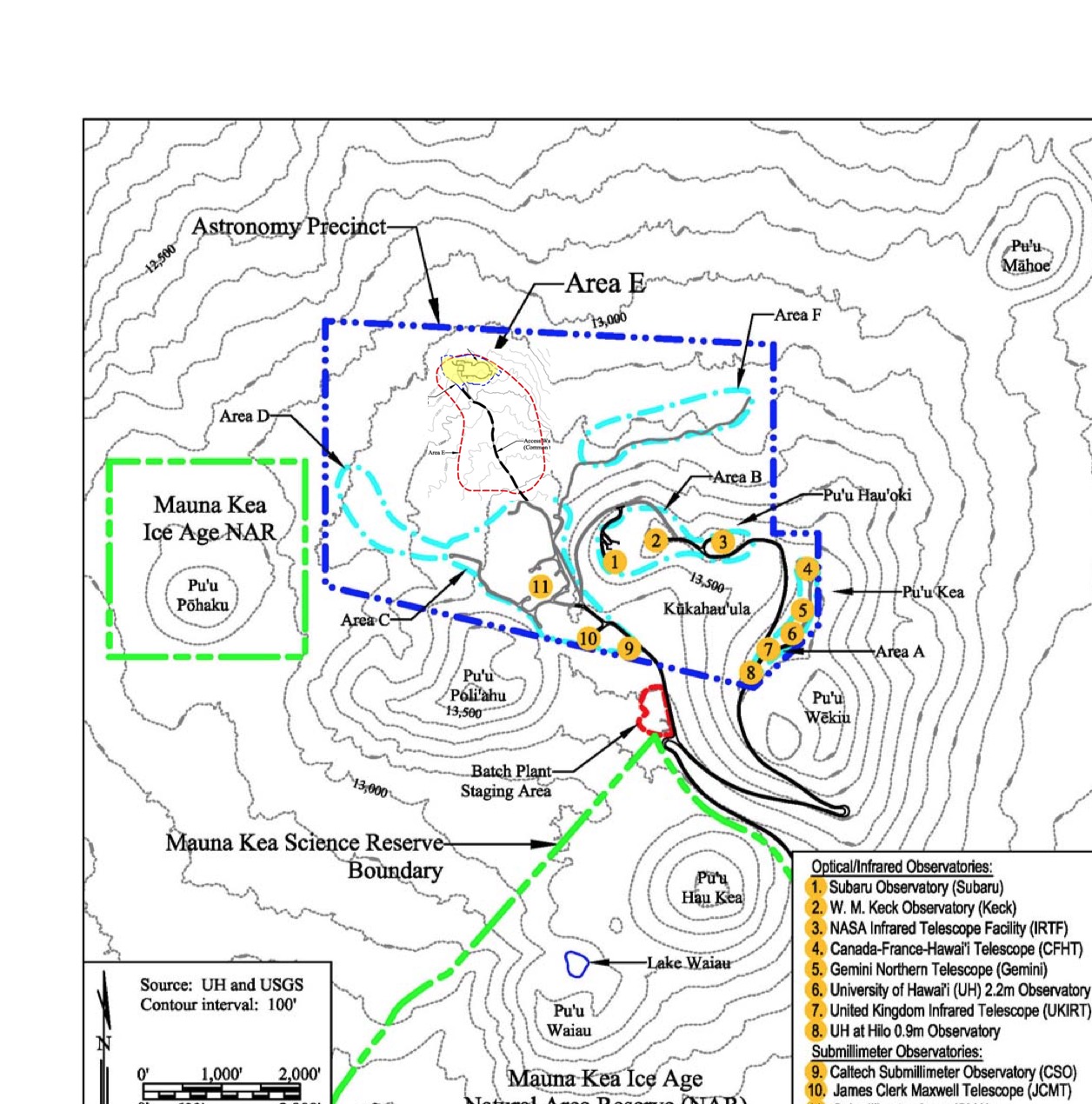
And one more graphic, this time a closer look at the location of the TMT site. The Astronomy Precinct is shown by the dotted blue line. The Astronomy Precinct is divided into five zones, marked as Area A through Area E. The latter, Area E, is in the upper portion of the Astronomy Precinct marked by the red dotted line.
The TMT site is shown in yellow, located in the upper section of Area E. The actual observatory would be in a portion of the area shown in yellow.
The TMT site is located 600 feet below the summit ridge, according to the EIS. The observatory would rise 180 feet above ground, leaving the top of the observatory more than 400 feet below the summit ridge.
Links to the draft environmental impact statement can be found here.
Discover more from i L i n d
Subscribe to get the latest posts sent to your email.
I’ve heard that the EIS filed with the OEQC is NOT the final EIS. I see you are citing to the draft EIS. Have you confirmed whether there is an official FINAL EIS filed with the OEQC? If it is not the final version, do you know why not?
The Final EIS for TMT was filed in May 2010, and is online at the OEQC site. TMT’s own website also has links to the final version (“http://www.maunakeaandtmt.org/get-the-facts/tmt-supporting-environment/environmental-impact-statement/”)
The hidden financial ties between the Long/Crowell family leads one to wonder about financial ties between TMT and their other recent high profile endorser, Navigator Kalepa Baybayan. The 990 return would likely be enlightening.
TMT’s ad campaign wants us to believe that Native Hawaiians strongly support TMT.
https://www.hawaiinewsnow.com/2019/08/08/tmt-takes-tv-airwaves-opponents-attempt-virtually-connect
Of course, independent polling also has shown Native Hawaiian support for TMT.
Polling also puts Joe Biden at Dem top.
Kinda’ depends on how a question is asked and the lead up education on issues at hand.
Have to comment that planners did show some sensitivity in location so as not be an appendage on the skyline.
What is the big pull in building this telescope, considering the ability to peer into the far distant heavens by satellite, a vantage point where the atmosphere is not a deterrent?
Can you educate us on who pays enough money to cover the costs of construction, the workers salaries, maintenance etc, and make what kind of profit from selling what?
You can’t put a 30 meter telescope into space. Hubble, for comparison, is 2.4 meters.
This Native Hawaiian supports TMT.
Kalepa Baybayan works for the imiloa astronomy center, which has received funding from Gordon Moore, one of the Thirty Meter Telescope funders.
I find I’m most curious about the sacred nature of the telescope site. Anyone know anything about that historically?
The Hawaii Supreme Court found no evidence of longterm religious practice at the site and that, in fact, the Mauna Kea access roads actually increased access for cultural practitioners. We see this now, as protesters take their giant trucks and “coal rollers” up the road and take photo ops (which can be seen on the relevant facebook groups).
https://www.staradvertiser.com/2018/10/30/breaking-news/supreme-court-rules-in-favor-of-tmt/
In fact, there was even an adz quarry up on the mountain, so it wasn’t considered untouchable, even well before westerners came.
https://www.nps.gov/places/mauna-kea-adz-quarry.htm
Good perspective, Ian. Weren’t some smaller, defunct telescopes supposed to be removed? What’s happening with that?
I read in the court case that three telescopes will be decommissioned as soon as possible and then two additional telescopes will be decommissioned/removed by 12/33. I heard from someone who works on Maunakea that one telescope is in the decommission process now. I suspect the road blockage likely hampers it’s removal. By the way, the rest are all used currently, as I understand it. So that begs the question, would they actually be removed if TMT doesn’t get built?
The Caltech Submillimeter Observatory is being removed first. Four others to follow; one of them would be the UH teaching telescope and another one might be James Clark Maxwell telescope.
TMT would be the last new site on Maunakea. To build any new telescope, we will have to replace one of the existing ones.
121Danab, Monopod, thank you.
Ian: great article and perspective that shows that the TMT will only occupy what has been legally provided, in the proper area and only a small portion of the total science reserve. Perhaps you might want to investigate another question that has been bothering me. The mainstream media has recently been stating that “some” Hawaiians consider Mauna Kea sacred. Is there really any cultural or historical support for the claim of “sacredness”?
I have lived in Hawaii all my life, studied some Hawaiian history and culture, was involved in anti-developement movements in Kalama Valley, Chinatown, and Ota Camp and have had many discussion with Hawaiian activists over the years. But I have never heard that Mauna Kea was considered a “sacred” mountain in Hawaiian culture or history. Then too, are there any ancient heiau or signs of religious worship there?
Here, I Googled it for you; here are just a few sources:
https://www.theatlantic.com/technology/archive/2015/10/what-makes-a-volcano-sacred/413203/
https://www.smithsonianmag.com/smithsonian-institution/heart-hawaiian-people-arguments-arguments-against-telescope-mauna-kea-180955057/
http://www.honolulumagazine.com/Honolulu-Magazine/August-2019/The-Sacred-History-of-Mauna-Kea/
http://www.ifa.hawaii.edu/info/vis/culture-astronomy-and-natural-history.html (even a UH site acknowledges its sacredness)
https://sites.coloradocollege.edu/indigenoustraditions/sacred-lands/sacred-lands-mauna-kea/ (looks like a student report but plenty of sources cited)
Yes, from what I’ve read, Maunakea was considered sacred, but apparently even the ancient Hawaiians used the mountain when the resources benefited them. Archeological research uncovered a 4,800 acre quarry on the southern slopes. Apparently, from 1100 A.D. through the 1700s, they mined the blue-black basalt used for tools and weapons.
Mahalo for making it easier to understand the size relationship between TMT and the astronomy precinct in the entire Maunakea Science Reserve.
I suppose it could be newly sacred. Religions change over time. On the other hand, Abigail Kinoiki Kekaulike Kawananakoa argued in an article in the Star-Advertiser on July 24, 2019, that the high peaks have all been revered for hundred of years and that the bones of heir chiefly ancestors Kukahauula and his wife Lilinoe were anciently laid to rest at the highest peak of Mauna Kea.
Mauna kea was never a sacred site I lived on the big island for years my ohana is still there and Mauna kea is not sacred
Thank you, Ian, for a clarifying, fact-based article. As I understand it, the TMT project will be funded by universities and other institutions from the US, Canada, China, India and Japan. Additionally, the Gordon and Betty Moore Foundation is giving $200MM. The ‘TMT partners’ signed the Master Agmt in July 2013 according to the foundation website, for ‘designing, financing, constructing, commissioning, operating and decommissioning…’ TMT. So, for the most part, I would think they will hire locally. Also, TMT has already given $2.5MM for STEM scholarships for Hawaiian students plus they’ve pledged $1MM annually to this program. So, that sounds to me like significant financial and educational benefits. Has anyone thought of what we’d lose if TMT goes to the Canary Islands?
In addition to being illegal and unreasonable, the blockading of Mauna Kea is an egregiously misguided exercise in warped identity politics and uncritical group-think that has been deliberately and cynically polluted with fake news and provocations intended to elicit raw emotion, outrage, and imagery providing “proof” of wanton repression.
Even if the blockade ultimately succeeds in killing TMT in Hawaii, that will accomplish absolutely nothing of substance for Hawaiians.
The “leaders” of this divisive charade should be permanently discredited, and their feeble enablers and apologists should be ashamed.
And everyone in Hawaii should think long and hard about what this all portends regarding special rights, entitlements, and sovereignty for certain people based solely on their ability to trace and invoke some element of Hawaiian ancestry.
Enough.
TMT apparently likes this TMT In Perspective blog post and are featuring it on their TMT promotion twitter account.