There’s a column in Wednesday’s edition of West Hawaii Today by Leningrad Elarionoff, who was the arresting officer at the May 1974 protest by Sonny Kaniho and his supporters, who symbolically occupied a Waimea pasture leased to Parker Ranch by the Department of Hawaiian Home Lands (“My Turn: Kapu aloha in 1974 practiced the real meaning“).
Elarionoff, who was later elected to the Hawaii County Council, describes the differences he sees between the aloha displayed by Kaniho in 1974, and the “Kapu Aloha” of those blocking access to Mauna Kea, from the perspective of being an officer on the scene. In his case, the only officer on the scene in 1974, as I recall.
The day arrived and Kaniho, with numerous friends and supporters, gathered at the gate of the property on the Kohala Mountain Road. At the planned hour, they lifted the gate off the hinges and entered the property. The Parker Ranch security called the police and I proceeded to the scene. On my arrival, a group of protesters had already gone beyond the gate. I parked my patrol unit on the roadside among those observers who, not wishing to be arrested, remained on public land. The security personnel gave me a ride to the protest group gathered a ways up on the property in question.
At my arrival, the group surrounded me and we talked respectfully among ourselves. Now the fun part. I took down their names and informed them all that they were under arrest for trespassing. I then informed them to meet me at the police station for booking.
As we left the scene, they worked with the security guard to reinstall the gate. Kapu aloha was demonstrated by the protesters. They showed respect and drove their own vehicles to the police station for processing. Their beef was with the Hawaiian Home Commission, not the arresting officer.
In the Maunakea protest, the arrested kupuna refused to move and had to be carried away for processing. Their idea of kapu aloha was to make it inconvenient for everyone not actively supporting their cause. Had the Kaniho demonstration practiced the same kapu aloha as the Maunakea group, one cop carrying all 18 of them would have been an impossible task. Again, their beef was with the Hawaiian Homes Commission, not with me, the arresting officer.
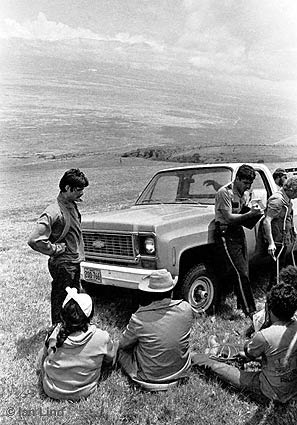 I was among the group arrested that day. To me, a Honolulu kid, it was amazing to be in that pasture looking down to the ocean beyond. It seemed like we were sitting at the top of the world. And when the Hawaii County police officer arrived on the scene, it was Sonny’s cousin, Leningrad.
I later wrote: “You couldn’t make this up–being arrested at the top of the world by a Hawaiian cop named Leningrad.”
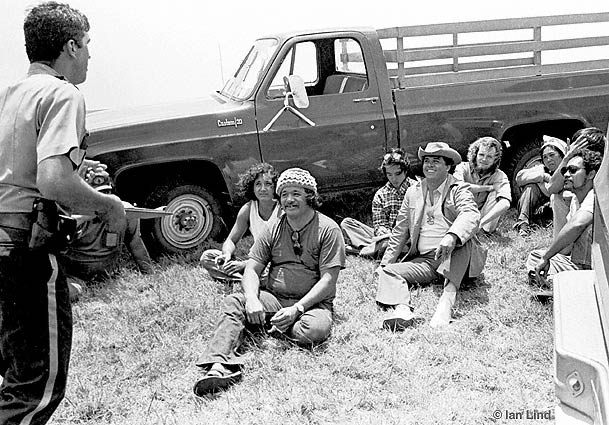
Leningrad then writes that we were all asked to meet him at the Waimea police station for processing.
To tell you the truth, I don’t recall this part of the tale. And the photos that I’ve posted in the past of the protest don’t include a stop at the station. While on the mountain, Leningrad did ask to see identification from each of us, which was then used to issue everyone a penal summons.
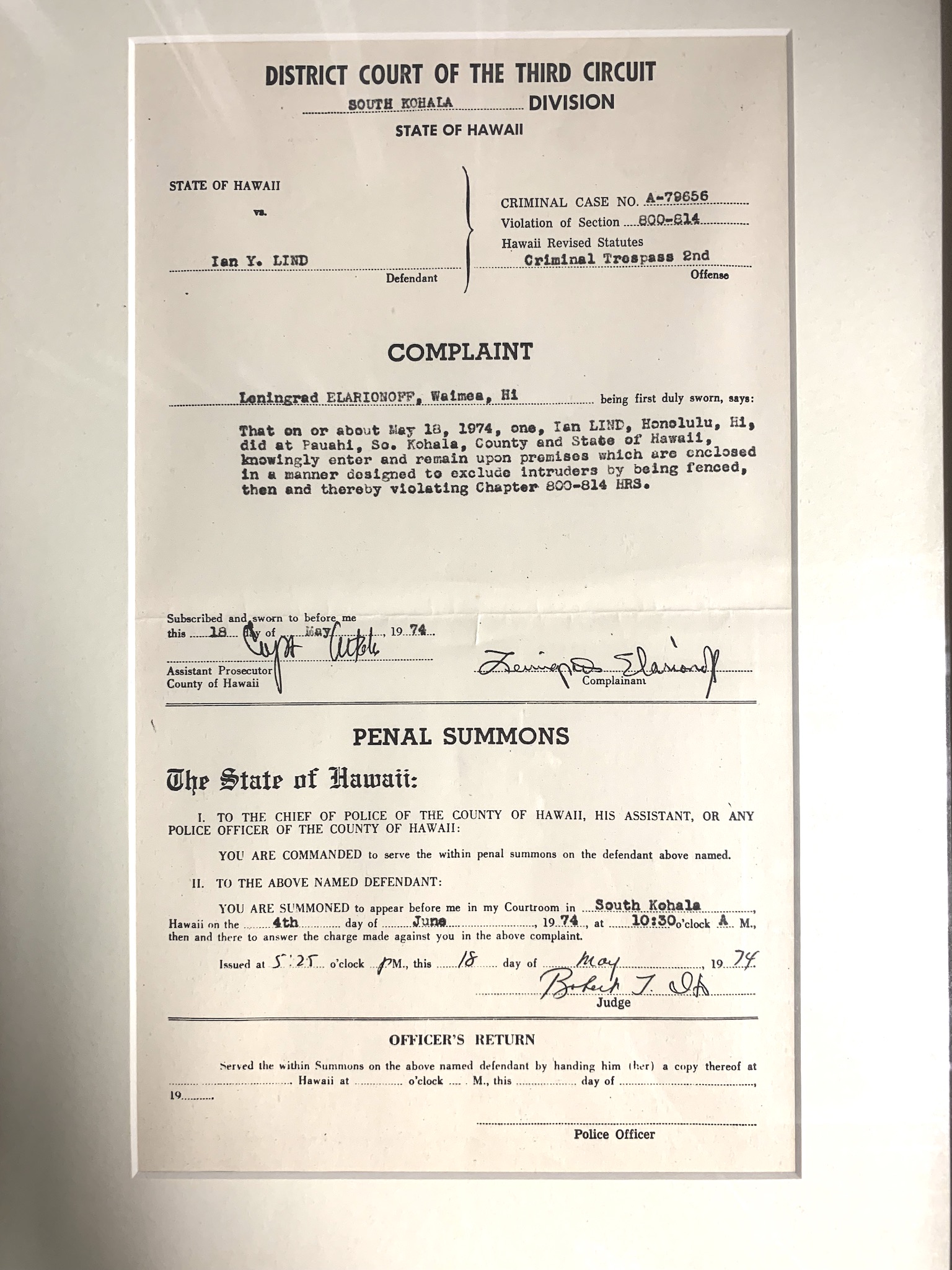
My recollection is that those of us from off-island were free leave, with the understanding that we would receive a summons to appear in court. Perhaps the Big Island residents were processed at the station. I’ll have to tap into someone else’s memory to resolve that discrepency.
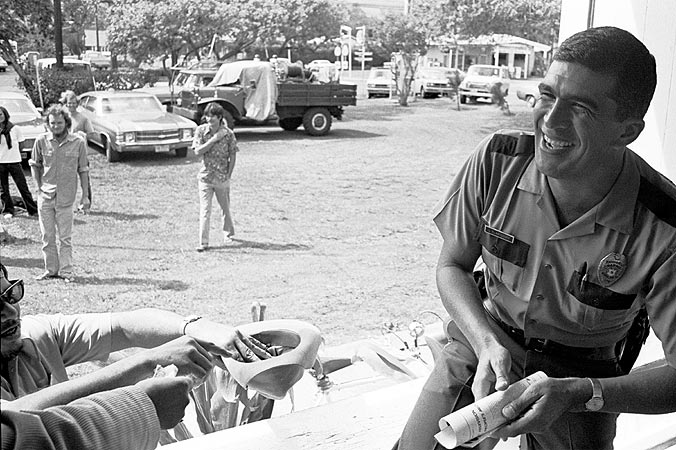
But Elarionoff’s description of good feelings between himself and the Kaniho protesters on the day of our trial was certainly accurate. Several of my photos show him in friendly interactions after our trial ended in acquittal. In the photo below, a hat was being passed around to collect money for refreshments, and it was waved in front of Elarionoff in a good-natured way, and he seems to have had good laugh about it.
Discover more from i L i n d
Subscribe to get the latest posts sent to your email.
I will always remember the pioneering spirit of Uncle Sonny Kaniho and what trails he blazed over 4 decades ago. His style and principles stay with us today, as you and now Leningrad point out. Mahalo for jogging our recollections of that time in 1974. It gives up pause to recognize the timeless contributions of Uncle Sonny to the Hawaiian movement, even long after his passing. May we all remember him and those he inspired. My only question: what motivated you as a reporter to cover this story back in 1974?
I wasn’t a reporter in 1974. I didn’t become a professional reporter, writing for a daily newspaper, until 1993. In 1974, I was among Sonny’s supporters. I traveled to the Big Island for this protest largely through my personal friendship with Gil Johnston.
I aspire that you find the internal Aloha spirit that you exhumed in the 70’s. Your anti-TMT stance presents your current views on Mauna Kea’s sacredness as a conflict.
#BeTrueToYourselfIan
Ah the good old days when a friendly approach by a known local cop to talk out the situation with the feel of goodwill by both sides doing what they believed in or were employed to do but with respect each way.
Today: a posture of strength, non budging, non hearing out either side and in the end skulls get cracked with the possibility of tasering, tear gas or whatever the show of force du jour may be. All followed by arrests and permanent marks on a person’s record to follow for a lifetime.
Ian, thank you. Wonderful true Aloha story.
Unfortunately, today’s proclaimed “Kapu Aloha”, has been heavily impacted by professional mainland activist opposition, who attended training on the Continent in the “Pipeline Dispute”.
The true opponent is still the Hawaiian Homes Commission.
Perhaps, real “Kapu Aloha” protestors are descendants of Ke’ou’a and not Tamehameha!
I believe “mainland activist opposition” to be a mischaracterization of today’s Kapu Aloha. It misrepresents the money, power, and influence behind the information gained painting it as something funded by wealthy white privileged activists. I was with our water protectors at Standing Rock during the “pipeline dispute” and the education regarding civil disobedience and other tactics to gain environmental and social justice were grounded in first nations principles and taught by leaders from many factions that do not possess the ‘mainland’ mentality. Organizations such as the American Indian Movement (AIM) and Native Organizers Alliance (NOA) were integral. This education and tactics have been used by first nations peoples to resist for decades. It laid the groundwork for today’s version of Kapu Aloha which is showcased today. It is EXACTLY the kind of civil disobedience that these types of struggles demand and it also accomplishes many goals at once. It is truly brilliant and beautiful to see.
Today’s Kapu Aloha is the standard of behavior and mindset to situate yourself in to actively participate in non-violent direct action (NVDA) and civil disobedience. It is a crucial part of the modern-day strategy which has been deployed so well by the leaders at Mauna Kea. In order to be effective, it needed to be established well before the coming together of thousands of people, well before police interaction, and subsequently has to continue to have a presence the entire time of the resistance.
Civil Disobedience and NVDA are not meant to be tactics that get along well with the institutions of power’s operations. They are meant to disrupt the status quo and make it difficult for the power to be executed. Hence, the reason why blocking the roadway is so crucial. If the kupuna all just got up from Mauna Kea Access road and took a drive down to the police station together it would have given the institutions of power (police and state) the upper hand and the movement would not have been taken seriously. Instead, forcing the institutions of power to utilize it so you can have a very real and raw visualization of said power, i.e. hauling away elderly leaders who are standing for their rights, was the intended goal. This visualization was the KEY to turning out so many people and activating others. It was the final straw for so many people who were otherwise on the fence. Seeing your elderly loved one and community leader taken away for being peaceful brought thousands of people who didn’t have an opinion on the issue at first to sleep at the base of Mauna Kea. Compare this to Rosa Parks not getting up from her seat, being arrested, and having to go through a court case. If she were to just walk off the bus and say “thank you for letting me make my statement” we certainly would not be referencing her infamous act of civil disobedience today.
The Kapu Aloha of today is seen as the Kanaka’s path to victory. This is apparent even from looking at the 2015 Mauna Kea protests that were very heated with lots of shouting and shoving. Dedicating yourself to non-violence in the face of institutions with extreme power which is founded on principles of racism and immorality is nothing short of heroic.
The true opponent is power in the hands of deeply flawed institutions who run the only game in town and DHHL is an unfortunate pawn in the game.
Mayor Kirk Caldwell also followed the mainland by sending a LRAD sonic cannon against the non violent protest at Sherwood Forest ( a National Register burial grounds). Caldwell’s intimidation threat was so clear. It didn’t even have to be turned up to weaponizing strength.