
From Amazon’s teaser for W.S. Merwin’s book, The Folding Cliffs: “The story of an attempt by the government to seize and constrain possible victims of leprosy and the determination of one small family not to be taken.”
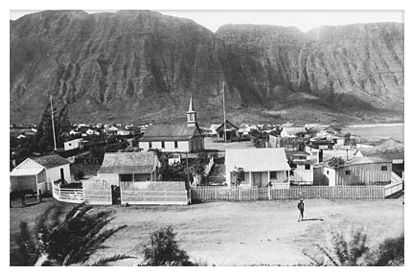
For our family, like so many others, this story strikes close to home. According to mostly unspoken family lore, my grandmother’s grandparents, and two of their sons, were taken to Kalaupapa, the 19th century leprosy colony on a remote peninsula on the island of Molokai, and were believed to have died there.
This was not talked about in the family over several generations. My mother recalled that both her mother, and her mother’s sister, professed to know nothing about their grandfather, Kahooilimoku, and grandmother, Heleualani, who had lived in and around Hana, Maui in the second half of the 1800’s.
“They acted as if they had never known a thing about them,” my mother wrote later in her carefully prepared notes.
But sometime in the 1950s, she was told a family story by George C.K. Kopa, a cousin of her mother, about how Kahooilimoku and Heleualani had been sent to Kalaupapa.
Mr. Kopa had worked at the territorial Bureau of Conveyances for abut 40 years. He had been raised by his grandfather in Hana, and later became a devout Mormon, so he was a significant source of family and genealogical information. In the 1950s he lived just a short distance from my parents’ home in Kahala.
“It seems unbelievable that no one mentioned this before, or that Mr. Kopa was the only living person who knew it,” my mother wrote later. “I now think that my mother and her sister were aware of the facts but chose to remain silent because of the stigma attached to the unhappy circumstances.”
So here’s the tale, recorded by my mother in 1994.
I was in my 40’s when I heard the following story…
At sometime probably in the 1880’s, a person reported to the authorities of the Board of Health that Heleualani had a suspicious spot on her face. Everyone was concerned about leprosy (now called Hansen’s Disease) which had been brought to Hawaii from China and had spread. In an effort to control it, all suspects with skin conditions indicating a possible infection were banished to an isolated center at Kalaupapa, Molokai. Naturally, there was a big commotion in the family and they hid Heleualani away while the kupuna went to Honolulu to a gathering of the relatives at the home of Kaawalauole on Jack Lane to discuss what they should do. The final decision was that she should surrender for examination and in the event she should have to go to Kalaupapa, her husband and two young sons would accompany her as kokua. It is said that all four of them died at Kalaupapa. I once tried to obtain information from the Department of Health, but was given so many excuses that I finally gave up.
And that’s where the story stayed for years. I’ll update the tale here on Sunday.
Discover more from i L i n d
Subscribe to get the latest posts sent to your email.
Ian,
I didn’t know you had family history at Kalaupapa. I passed your article on to Wally Inglis and Valerie Monson, both very active in Kalaupapa preservation. I got to know many of the people at Kalaupapa during the years of the Hale Mohalu struggle. We had several meetings at Kalaupapa and I was there to bury Bernard Punikaia, who was a spokesperson for Kalaupapa in the late 70s and early 80s and a dear friend who named Malu ‘Aina.
jim
An update to the story will get posted here on Sunday.
Ian thanks for sharing. It is a great historical story that is part of Hawaii. I think when searching for your ancestors you come across this walls and either no one knows or you get some convoluted story or stories. Mine was my great grandfather, I finally found it in a newspaper article announcing his death by self inflicted gun shot wound. Nowadays I don’t think they are that blunt in the papers.