
Last year the legislature, in its infinite wisdom, decided to do away with the Board of Health, which had been around for more than a century.
HB898 SD1 (2019) abolished the Board of Health, which had been established to advise the health director on any matters within the department’s jurisdiction.
The bill was introduced by Rep. Della Au Belatti, House Majority Leader, and Health Committee Chair John Mizuno. An identical measure was introduced in the Senate by Stanley Chang (“by request”).
The only testimony on the measure over the course of public hearings before three different committees was a one-page sheet of written testimony submitted on behalf of the Department of Health. The testimony does not indicate whether it was delivered in person, and two of the three committees stamped it “Late,” meaning it was received after the hearing deadline.
No testimony was received from any health providers, health care or community organizations, public health experts, or concerned individuals.
Here’s how the legislators justified the move.
The legislature finds that the board of health was originally intended to serve as an advisory panel to the director of health. However, given the current breadth and complexity of public health issues and prominent guidance from federal programs, the legislature, and the private sector, the board of health has been rendered obsolete and no longer adds value to department of health operations.
The legislature further finds that the board of health has been historically difficult to fill and currently has no members. Abolishing the board of health would more accurately reflect the reality of decision making at the department of health and would reduce the administrative burden on the department.
One thing apparently forgotten along the way. A public board at the top of a department may become the primary access point for concerned members of the community, and a critical avenue for holding a complex agency accountable to the public.
That was the point made by two people who testified on the Senate version of the bill.
“Eliminating the Board of Health will lead to less transparency of the Department of Health and less accountability,” one person noted in opposing the bill.
A second person wrote:
“To have the department of health decisions made by one or two people is leaving grande decision making in a vacume of thought. The department of health needs a sounding board and a committee to keep as a voice of reason and understanding of complex issues.”
In hindsight, their concerns appear spot-on. When the current pandemic brought us face-to-face with a real public health crisis, it’s been the lack of transparency and accountability that have finally become the real story behind the department’s chronic ineptness.
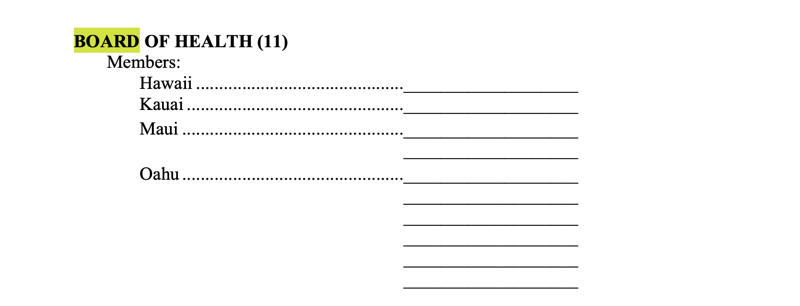
Even before passage of HB898 SD1 eliminated the Board of Health, it had been gradually starved and allowed to wither away. Vacancies on the board were not filled, until eventually it became a ghost board on the top of the Health Department’s organizational chart.
This was the list of members that appeared in recent editions of the standard publication produced by the Legislative Reference Bureau, “Guide to Government in Hawaii.”
Discover more from i L i n d
Subscribe to get the latest posts sent to your email.
Even with a Board of Health, things might not be so different than they are now. As Neal Milner has pointed out, only up until recently, the legislature was very happy with the dysfunctional status quo at the DOH, and so was the population of Hawaii.
I pretty much agree with the language in HB898 SD1 and the points that the Department of Health made in its brief testimony:
—the board of health had no power–it was advisory only. It did not make or enforce policy or have supervisory powers.
—Quoting from DOH’s testimony: “…the scope of the Hawaii Department of Health is too broad and complex—spanning public health, behavioral health, and environmental protection—for meaningful advisement by a generalist board.”
Given those facts, it would have been unrealistic to expect the board of health to provide any leadership in a public health crisis.
I do think advisory boards can make meaningful contributions at lower levels in DOH regarding mental health and development disabilities services and programs, oversight of care homes, etc. etc.
Like Police Commission these advisory boards often become political and ineffective themselves. .