
An anonymous reader called my attention to a special interest bill pending before the Honolulu City Council that would give significant real property tax breaks to businesses that are part of the Sand Island Business Association.
Here’s an excerpt from the comment (received on February 4):
Yesterday the Honolulu City Council’s Budget Committee voted to “postpone” action on a sweetheart property tax bill pushed by former Council Chair Ann Kobayashi on her way out the door. Bill 31, backed by former Kobayashi staffer Milton Holt — who now heads the Sand Island Business Association —and a bunch of Sand Island companies including Mitsunaga Construction (yes, THAT Mitsunaga), would cap property taxes on certain industrial properties even in the event of massive new construction. The Caldwell administration opposed the bill and said it would cost the city more than $8 million per year in lost revenue even without new development, as well as open a big can of worms regarding how other properties are taxed. The Blangiardi admin also opposes but seems to be struggling.
The Sand Island Business Association (SIBA) was formed in 1989, and in 1992 obtained a 55-year master lease on about 70 acres on Sand Island for an industrial park subdivision. SIBA was given direct management control of the 113-lots subdivision on the state-owned land. The lease promised SIBA below market lease rent during the first 25 years in exchange for a requirement the organization pay for providing the necessary on-site infrastructure, from roads to sewers to utilities. At least that was the rationale. SIBA was also given control over the subleases to its members, effectively allowing it to control who benefited from the public subsidy.
The current Bill 31 was proposed and backed by SIBA. No testimony in favor of the project was submitted to the council by anyone other than SIBA and its members who sublease properties in the industrial park.
The bill’s proponents put forward two arguments in support of Bill 31. First, they argued that it was unfair for them to pay property taxes comparable to other industrially zoned land when the Sand Island Industrial Park does not receive the full array of city services.
Dozens of SIBA businesses submitted testimony containing identical language.
The City services that the SIBA tenants do not receive include, but are not limited to, refuse pick up, recycling pick up, bus service, road repaving, city parks, regular police monitoring, and facilities maintenance (e.g., repairs to potholes, streetlights, traffic signs, or sidewalks; tree trimming; sidewalk landscaping or flood control systems).
SIBA’s second argument is that its members deserve special consideration in order for them to recover the cost of the infrastructure improvements required by the original master lease with the state. The improvements, which were completed in the 1990s, were described in testimony submitted in favor of an earlier City Council resolution (Res. 20-14) calling for the Caldwell administration to provide real property tax relief to SIBA and its members.
Due to the negative elevation, the entire industrial park had to be built-up 3 to 4 feet, in order to avoid flooding and remedy the drainage and sewer back-ups. The infrastructure improvements for Sand Island Industrial Park are completed. According to prelliminary plans and specifications as depicted upon the site and utility plan that was prepared by Community Planning, Inc. (dated September 3, 1992) the infrastructure improvements include, but are not limited to: County standard, asphalt paved roadways; concrete curbs, gutters and sidewalks; underground electricity and phone services; public sewer and a waste water pumping station; water; fire hydrants; street lights; front yard planting strips between curb and sidewalk improved with trees and ground cover and an interior drainage system capable of providing adequate drainage for all lots within the subdivision.
Again, several SIBA member businesses submitted similar testimony on Res. 20-14:
Although the infrastructure improvements have been completed and the special assessments charged to each tenant have been paid, we have had difficulty in marketing our respective sub-leasehold interests at prices that would allow us to recover our significant contributions to the improvement assessments, especially with the increasing real property taxes. This has negatively impacted the marketability of our sublease.
Despite opposition from the Caldwell administration, which estimated it would result in at least an $8 reduction in property tax revenue, the resolution passed the council by a unanimous vote at its regular meeting on February 19, 2020. Only one member, Brandon Elefante, supported the measure “with reservations”. Minutes show Elefante argued the appropriate way to address the issues raised would be through the city’s existing real property tax appeal process.
SIBA did file appeals of the real property assessments of its more than 100 subleased properties in state tax court on January 15, 2019. Those appeals were consolidated into case number 1TX19-1-0051, and court records continue to show the appeal as pending.
The city council has so far backed the idea of providing property tax relief, although SIBA’s positions are fundamentally flawed.
As early as 1992, while SIBA and the state were still trying to finalize the master lease, some officials were already saying the deal was overly generous.
I remember because I wrote about it during my first year as an investigative reporter for the old Honolulu Star-Bulletin.
Here’s an excerpt from my September 16, 1993 Star-Bulletin story, which adds necessary details apparently not considered by the council.
Although the state is requiring tenants to pay for improvements, including new roads, sewers and underground utilities, a variety of state subsidies worth tens of millions of dollars makes the project attractive.
For example, the state agreed to heavily discounted lease rents for the first 25 years of the 55-year master lease, providing more than $13 million in savings during the first five years alone.
The Legislature alloted more than $6 million to upgrade Sand Island Access Road and authorized the state to issue $25 million in tax-exempt bonds so that the Sand Island Business Association can repay construction costs at lower interest rates.
Board of Land and Natural Resources Chairman Keith Ahue told legislators earlier this year that the association was being offered too much state aid. Ahue told legislators that the agency had already taken the construction costs into account, resulting in the “very favorable lease rent.”
“We do not believe it would be appropriate for any private entity to benefit from favorable lease rents and the low-interest rates that this bond issue would allow,” he testified.
Earlier, during an April 1992 meeting, Land Board member T.C. Yim also said the state might be giving the Sand Island group too much. “What they’re receiving is very, very generous.”
In retrospect, the 25 years of discounted less rent appeared no less generous, according to a staff submittal to the Board of Land and Natural Resources in 2013.
According to the staff report, a 2012 appraisal found the fair market annual rent for the SIBA lands at that time was $8,250,100, but SIBA was paying an annual lease rent of only $4,908,284, more than $3.3 million annually below the fair market rent.
Further, Department of Land and Natural Resources staff “determined that even with SIBA paying for the infrastructure (via repayment of the infrastructure loan), and adding to that cost the management fee for the park, and the discounted rent, the total paid by SIBA over the first 25 years of the lease is significantly less than the fair-market rental for the same period,” according to a staff submittal to the land board in January 2013.
So it is true that those with SIBA subleases were required to pay assessments for the infrastructure development, but those investments were more than offset by below fair-market lease rents over a 25-year period. Further tax relief based on the need to offset those investments would amount to double dipping at the public’s expense.
And there’s more. According to a footnote in the 2013 DLNR staff submittal:
The lease requires SIBA to build the infrastructure to City and County standards and to dedicate the same to the City and County. SIBA has neglected to satisfy this requirement and has requested the waiver of the requirement. To date, the infrastructure remains undedicated and staff is concerned that SIBA’s failure to dedicate the infrastructure adversely affects the property.
This directly undermines SIBA’s case for tax relief. While SIBA complains about the lack of certain city services, including road repaving and maintenance of roadways and other facilities, the absence of these services appears to be the direct result of SIBA’s failure to dedicate the upgraded infrastructure to the city, as required by its master lease.
And what accounts for SIBA’s success in obtaining such generous terms from the state?
One factor in SIBA’s early success was the political clout gained from substantial campaign contributions by directors and member companies.
This graphic accompanied the 1993 story.
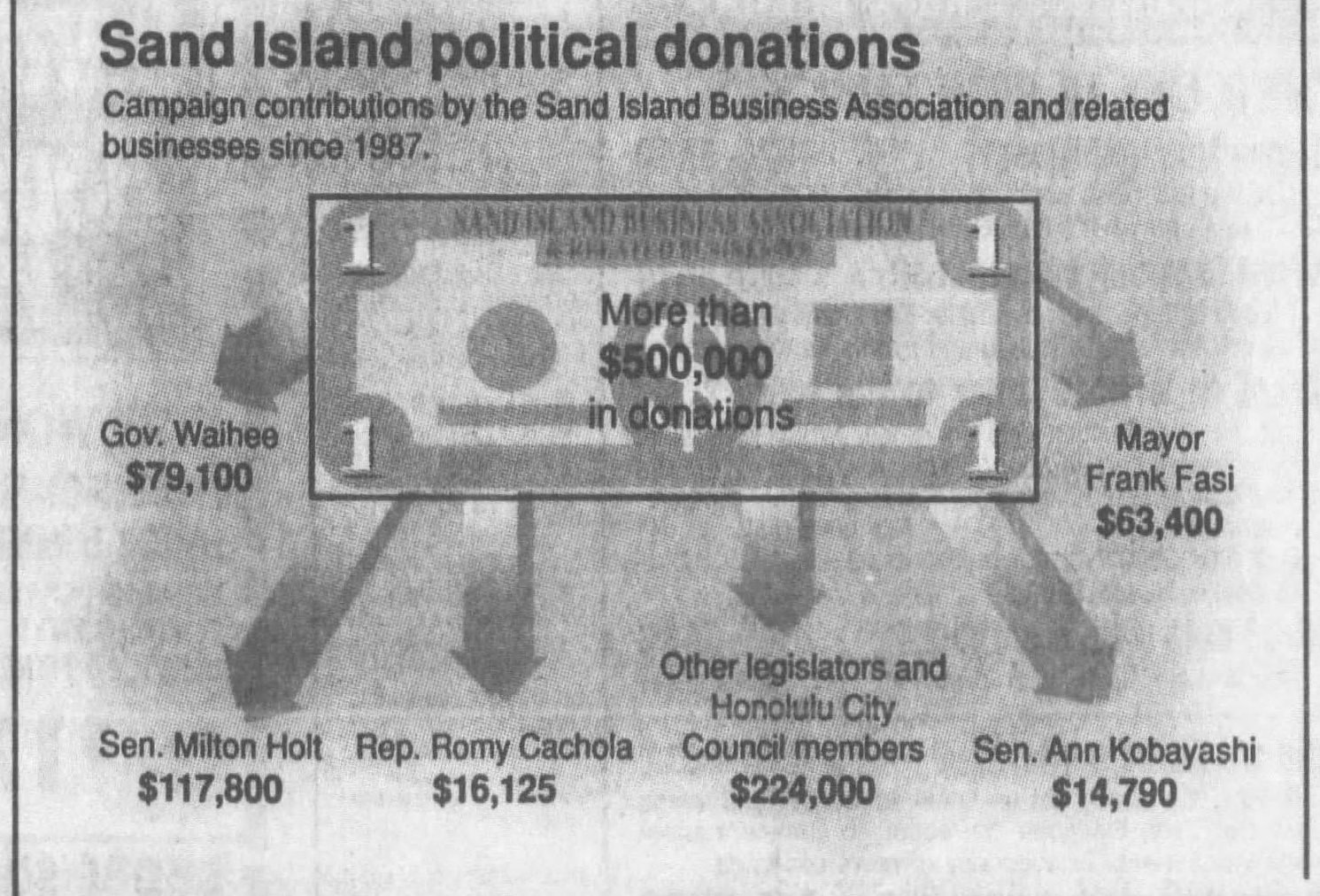
Then-Senator Milton Holt received over $117,000 in campaign contributions from SIBA-related individuals and businesses between 1987 and 1992. At the time, Holt was a rising political star and considered a top contender to take over as Senate President. Holt was credited with sponsoring the bill establishing the Sand Island Industrial Park and managing its passage. The SIBA property was within his Kalihi district, and as the deal was being negotiated with the state, Holt was chair of the Planning, Land and Water Use Management committee, and became Senate vice-president in 1993.
Today, nearly 30 years later, Holt is executive director of SIBA at a reported annual salary of $100,000.
At first glance, SIBA-related campaign contributions don’t appear to be as extensive as they were in the early 1990s. However, a quick review of campaign spending records shows members of the SIBA board of directors contributed a total of $20,000 to Rick Blangiardi’s successful campaign for mayor on the same day, March 26, 2020, and a similar amount to Calvin Say’s successful city council campaign on October 16, 2020.
Neither candidate reported holding a campaign fundraising event on those respective dates.
Although the bill has been “postponed” for now, it can be put in play at any time at the discretion of the council’s budget committee chair, Calvin Say.
Discover more from i L i n d
Subscribe to get the latest posts sent to your email.
Extensive report. Thank you. Wondered what happened to insider Holt? Looks, by salary and organization political donations, he’s still an insider. Calvin has an insider reputation; sorry that voters thought he was worth a vote. We’re all suffering with shutdowns. Buck up SIBA!
Thank you for covering this, Ian. I’m glad to hear that the bill was postponed in committee. If the council decided to pass this, it would set the precedent for many other property owners to similarly argue that the city does not provide certain services and ask for some type of reduction in RPT.
Correct me if I’m wrong, but given that Milton Holt has submitted testimony on this issue as SIBA ED and is paid by them, shouldn’t he be registered with the city as a lobbyist?
Awesome story! It’s high time this stuff received some real scrutiny. The level of cynical duplicity among certain City Council members has been astounding.
“Holt was a rising political star and considered a top contender to take over as Senate President.”
But then there was that whole Bishop Estate thingy and …
Good job Ian. This smells. I’d be surprised if Waters and some others went along.
Wow…the corruption and cronyism gets an early start in this state.
Calvin Say is exactly what is wrong with the system here and a good argument for legislative term limits.
Great reporting. Who is more shameless: the self-regarding Ann Kobayashi, the unrepentant Milton Holt, the oleaginous Dennis Mitsunaga, or the Star-Advertiser for thinking that it’s still a real newspaper?
Kobayashi was quietly regarded by insightful City Hall watchers as the most malignant force to curse that tawdry snake pit for decades, whose awful, repetitive, and thoroughly disingenuous public meeting performances were further enabled by laughably shallow sound-bite journalism for which she was always available to offer a noble-sounding but ultimately meaningless or drastically misleading comment, a near-total lack of real analysis by the pathetically thin bench of local punditry, and by fawning political acolytes whose strings she clearly manipulated. As for the others, “oleaginous” seems to capture the singular zeitgeist with aplomb.
There’s some new blood in Honolulu Hale now. Can they finally do better?
unfortunately, this mud is very deep I do not believe all the rooters have been exposed.
what a wonderful place to put a gambling house!
as for me, I think it is a wonderful location for a world-class casino !\we all know who to pay off.
my friend believes it is a perfect place for a racehorse track
Hawaii business/government are all greased up for more!
Now if we could just have an uncle and nephew on the City Council
hey try wait we got um already
SIBA, for some reason, reminds me of the Mafia front “Legitimate Businessman’s Social Club” that was was shown regularly on The Simpsons.