The redevelopment of the Aloha Stadium relies on a vision of extending tourism from Waikiki to a new visitor playground on the site of the old Aloha Stadium, according to the project’s draft environmental impact statement. The EIS makes clear the “entertainment district” concept is driven by the perceived opportunity to extend Waikiki’s brand of tourism out to Aiea.
At the same time, the lengthy pause in tourism imposed by the pandemic offered the rest of us a vivid lesson in the negatives impacts of mass tourism, and has generated lots of talk about the need to control and limit tourism in the future. None of that discussion and debate appears to have informed the EIS in any way.
Instead, the EIS discloses that the stadium redevelopment plan continues to define the expansion of Waikiki tourism to this new part of the island as wholly positive and justified.
The existing retail in the region predominantly serves local households and employees but does not serve the broader tourist market, which is responsible for a major portion of the State’s economy. The nearest, notable, clusters of retail include the Pearlridge Shopping Center. However, the Leeward Honolulu submarket lags behind the more tourist-serving Central Honolulu submarket (Victus, 2019). A vibrant and exciting retail destination will be crucial to the Proposed Action’s commercial viability and success, contributing towards the creation of an attractive destination that not only serves local and onsite households / employees and visitors to the New Aloha stadium, but that will also draw in tourists as well as residents from across the entire island of O?ahu that may have otherwise not considered visiting the submarket.
Did you get that? Existing retail stores serve locals, but “don’t serve the broader tourist market” and as a result the area “lags behind the more tourist-serving Central Honolulu submarket.” Planners are making clear they see that as something wrong that needs to be fixed. And the fix is to “draw in tourists” from other parts of Oahu.
This is seen as important enough that it was emphasized in the EIS, with at least one hotel proposed “significantly increase the area’s desirability from a hospitality perspective….”
Moreover, the island of O?ahu continues to be one of the most attractive and healthy hotel markets in the country. On the island, Waik?k? is the preferred hotel submarket but, other resort areas with unique amenities or activities are becoming increasingly viable hotel destinations that offer a value alternative to Waik?k?. The Proposed Action could significantly increase the area’s desirability from a hospitality perspective contributing to the vibrancy of the Proposed Action. A hotel at the Project Site could serve potentially over 1.5 million annual visitors to the Aloha Stadium; furthermore, the Proposed Action could potentially serve as a catalyst for growth in visitation, attracting tourists and visitors to the Project Site retail and mixed-use environment that would have otherwise not considered coming to the submarket.
Let me translate–a “hospitality perspective” refers to a perspective from within the tourism industry. So get ready, Aiea!
There are a few other revealing items to be found in the EIS.
The need to replace the aging Aloha Stadium is clearly the basis for the perceived “need” for the project, as well as the sense of urgency that is pushing it forward at breakneck speed in a manner that forecloses thorough public consideration of the issues and options.
Here’s how the EIS puts it:
The existing Aloha Stadium has stood for over 44 years and is deteriorating structurally, with numerous deferred maintenance issues. It has fallen out of compliance with current accessibility and building codes and lacks the amenities of other modern stadiums. While it was once hailed as a first-class, state-of-the-art facility, the existing Aloha Stadium has effectively served its mission as a gathering place well beyond its practical life-span as a multi- purpose venue. Its numerous unaddressed deferred maintenance items are contributing to its obsolescence, and substantial ongoing investment is required to keep it functioning, accessible, and safe for public use.
In other words, at some point the cost of ongoing maintenance just doesn’t make sense any longer, and it isn’t unreasonable to think we’ve reached that point.
So who is affected if the stadium becomes unavailable due to safety concerns?
As I recall, most of the discussion was about the fate of University of Hawaii football, as policy makers recoiled from the spector of our Division 1 football team without a home field to play on.
Of course, UH is not the only user of the stadium, but for more than 40 years it has been the most consistent user, and up until the past couple of months appeared to be the one with the most to lose of Aloha Stadium were to become unavailable. Here’s a list of stadium users that appears in the EIS.
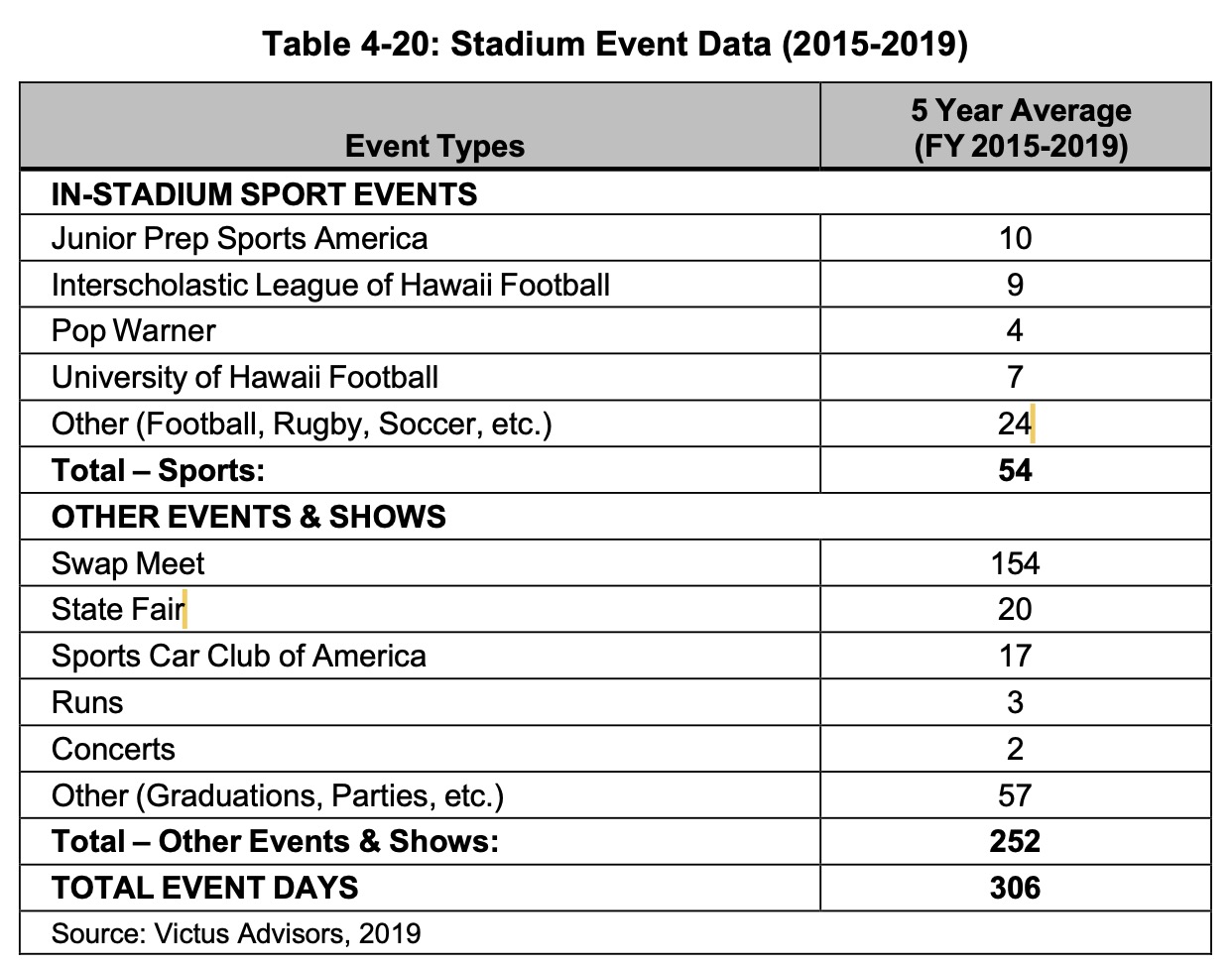
The “time critical and time sensitive nature” necessitating cutting corners procedurally to rush it forward was based on “escalating construction costs and mounting deferred maintenance expenses tied to the continued operation of the existing Aloha Stadium.” Essentially, we would have to keep investing in the old stadium until a new field were ready for UH, and so anything that could be done to speed the process seemed justified.
Then the Stadium Authority threw that plan book out the window, declared Aloha Stadium closed, and forced UH into a last-minute search for an alternative. And by all accounts, they have developed a workable plan, at least for the short term.
At this point, with UH out of the picture, the rationale for unusual haste, and the secrecy it creates, is no longer valid.
Meanwhile, the EIS assures us the selected developer will be required to comply with all current affordable housing requirements. But that approach has done nothing to ease our affordable housing crisis. Kakaako is case in point. Current requirements are simply inadequate. If affordable housing is indeed a crisis, the Aloha Stadium site represents a unique asset, and utilizing it effectively can make a significant contribution to meeting the obvious public need.
See:
“Stadium redevelopment plan’s legacy of deceit,” iLind.net, February 25, 2021.
“A dissenting view of the Aloha Stadium redevelopment,” iLind.net, March 2, 2021.
New Aloha Stadium Entertainment District website
“Draft EIS New Aloha Stadium Entertainment District, Vol. 1”
[Additional volumes, download from the Office of Environmental Quality Control]
Discover more from i L i n d
Subscribe to get the latest posts sent to your email.
This is distressing to read and not in a purely NIMBY-esque way.
Totally unnecessary and a contrived vehicle for developers to build what will not be sustainable all while filling the coffers of involved politicians.
I eagerly await to see how this develops. Very much appreciate your publicizing of this.
I find the whole project ridiculous.
Questions need to be posed to the neighborhood boards from the surrounding area. Are they not paying attention, or worse, are they drinking the Kool Aid?
What has been represented to the Aiea neighborhood? Do they know that the “entertainment district” is projected to bring Waikiki-type development to their residential neighborhood?
I am not saying that I think this is a good idea. However, I would like to point out, having been raised in Aiea, that the residential neighborhood that Nuuanu Pali refers to is predominantly the Halawa Housing and Pearl Harbor military neighborhoods. Aiea is further up on the hillsides and around Pearlridge which is an area that leads into Waimalu and then Pearl City. To the east of the stadium area is Aliamanu and Salt Lake and the airport area. I could never have imagined Aiea as Waikiki #2, but perhaps some development west of the airport might better balance the overdevelopment currently proposed to the east of the airport. That said, the public housing and other residential areas located by the stadium will definitely be changed if this occurs. There should be plans to help either relocate or mitigate problems to residents who would be adversely affected by such development. Those planning such developments should absolutely take this into account and plan on taking care of this important matters.
There’s a side issue here that may seem frivolous to some but is certainly important to others: If the Aloha Stadium swap meet is chased out, where will that commerce go? The closure of the Kam Drive In swap meet a couple years ago to make way for new development was a real loss for lots of local venders and bargain hunters, especially Filipino immigrants. It was a great place for cheap local produce, plants, tools, clothing, and lots more, with no gourmet crap, tourists, or yuppie pretensions like certain “farmer’s markets” to the east. Many venders then moved to Aloha Stadium, which added variety to the mass produced tourist trinket staples marketed mostly to Pearl Harbor visitors and military families. But if that site closes too, will any alternative be available for swap meet commerce?
That’s the plan. Drive out ALL small, local kine stuff and replace it with expensive, redundant, overseas or mainland owned touristy shopping a la Ala Moana Shopping Center. After all, it’s easier to TAX the outsider large corporates over the small local mom and pops.
I’m skeptical that this will work.
What is the real draw for tourists coming to Hawai’i? My guess is that far and above anything else is the beach. And there’s no good public beaches in near the stadium.
I suppose there would be some synergy in being across the street from the Arizona Memorial and Bowfin Museum, and the loading areas for the USS Missouri and the Aviation Museum.
But this is disturbing, and Ian, I appreciate your make us aware of the situation. I hope you can turn this into one of your Civil Beat columns.
They’re creating more boondoggles to justify the biggest boondoggle: RailFail.
But rail won’t reach into Waikiki. It might not even reach Ala Moana.
Remember comedian Pat Paulsen? He said it best: “Picky, picky, picky….”
As a lifetime resident of Oahu(55yrs.) I have always been fascinated by the playbook that developers and their minions use to bamboozle and hoodwink the citizens of our state.
> Imply or create an overwhelming need in a certain community/area that needs to be addressed.
>Present studies and testimonials that re-affirm this position.
>Showcase mock-ups and renderings of their solution to this need.
>Favorable and generous terms of contracts.
>Low bid the process to ensure winning bid. True cost will be absorbed thru unforeseen delays/project changes/change orders/rising cost of labor and supplies(shouldn’t this have already been factored into their bid?).
>Upon approval of selection appoint former political officials, prominent business citizens, and local media personalities to project board of directors.
What we are seeing is just the tip of the iceberg. We are being spoon-feed tidbits of information as if its still in its planning stages. A project of this magnitude has been in the works for years. We are just witnessing the beginning of the fall of dominoes! As always, follow the money.
I have read the Draft EIS as well as the numerous Star Advertiser articles being put out regarding this project. In short, this blog post completely makes erroneous statements that are out of context.
You pick and choose discussions from different points in a 2,000+ page document to craft this story of creating a 2nd Waikiki. The point of the project is to redevelop, what can be considered basically a 100 acre parking lot with a rust bucket to put it bluntly, into a vibrant community with a space that can be utilized 24/7 rather than 7 times a year. It’s won’t only draw tourists (which minds you funds a lot of peoples paychecks and livelihoods and allows us to be locals) but locals alike.
Conversely, the plan, which is completely conceptual at this point in time anyways, only proposes the potential for one hotel. Tell me, how does that make a 2nd Waikiki where there are hundreds of hotels. Moreover, while yes, kakaako erected many luxury condominiums, it also provided affordable housing. This project potentially could to do the same, but essentially adds to a supply constrained housing market. But the State / City county should add more requirements if they want the developer to comply. To add to that point, you do not even know what the RFP looks like since it has not been released publicly. So how can you say what the developer will or will not do or even what they will be required to do in partnership with the State.
Next time I think you should post a more transparent article, rather than taking words out of context and twist the story to get everyone worked up.