
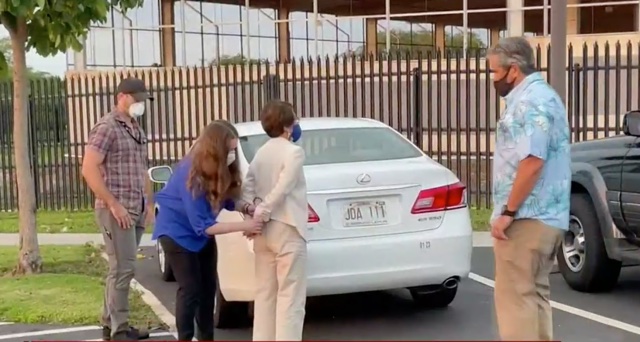
 The image broadcast by Hawaii News Now last night is stunning, showing attorney and former Honolulu Corporation Counsel Donna Leong, at one time the city’s top lawyer, being handcuffed while standing behind her white Lexus.
But the indictment naming Leong, former Honolulu managing director Roy Amemiya, and former Police Commission chairman, which had remained under seal for nearly a month since it was handed down by a federal grand jury on December 16, is a letdown for anyone hoping it might signal the culmination of the years-long federal investigation of local corruption and would finally pierce the veil of secrecy that hides the behind-the-scenes shenanigans within the upper reaches of city and state politics.
This indictment hits central but peripheral players in the political game, it seems to me, on charges akin to taking down the famous mobster, Al Capone, on tax evasion charges.
The government says the three were involved in secretly negotiating and, more importantly, concealing the souce of funding for a $250,000 severance payout to then Chief of Police Louis Kealoha, apparently as an inducement for the chief to “voluntarily” retire at a time when he was already known to be under federal investigation.
According to the indictment, the law requires City Council approval for an expense of this amount, and the government says Leong, Amemiya, and Sword all took part in concealing the payment from the council by twisting arms as well as manipulating internal procedures to initially take the money out of HPD’s budget, over the department’s objections, and then replenish the budget by instructing HPD to request additional funds from an account dedicated to filling vacant positions.
In the normal course of affairs, this might have simply been an instance of insider political hardball. But under the microscope of ongoing federal scrutiny, it checks off all the boxes to be considered an illegal theft of public funds. Potentially a criminal offense, and a felony at that, punishable by up to five years in federal custody.
In the indictment’s recitation of “overt acts” taken in furtherance of the conspiracy, it appears Leong and Sword did the heavy lifting, negotiating the deal with Kealoha’s attorney and then spending months pressing HPD to go along with their narrative regarding the source of funds, even after Kealoha had been paid and the check cleared. Amemiya, even in the government’s telling, enters the tale months later when he was sent to pressure HPD’s representative to avoid mentioning the Kealoha payment when appearing before the council to request additional funds to cover the budget shortfall.
The charge against all three is conspiracy in violation of 18 USC § 371.
If two or more persons conspire either to commit any offense against the United States, or to defraud the United States, or any agency thereof in any manner or for any purpose, and one or more of such persons do any act to effect the object of the conspiracy, each shall be fined under this title or imprisoned not more than five years, or both.
The government alleges the offense that the three conspired commit, bypassing the legally required City Council review of the Kealoha payout and threatening or cajoling others to go along with their scheme, was a violation of 18 USC § 666(a)(1)(A).
(a) Whoever, if the circumstance described in subsection (b) of this section exists—
(1) being an agent of an organization, or of a State, local, or Indian tribal government, or any agency thereof—
(A) embezzles, steals, obtains by fraud, or otherwise without authority knowingly converts to the use of any person other than the rightful owner or intentionally misapplies, property that—
(i) is valued at $5,000 or more, and
(ii) is owned by, or is under the care, custody, or control of such organization, government, or agency;
…shall be fined under this title, imprisoned not more than 10 years, or both.
(b) The circumstance referred to in subsection (a) of this section is that the organization, government, or agency receives, in any one year period, benefits in excess of $10,000 under a Federal program involving a grant, contract, subsidy, loan, guarantee, insurance, or other form of Federal assistance.
(c) This section does not apply to bona fide salary, wages, fees, or other compensation paid, or expenses paid or reimbursed, in the usual course of business.
The government further alleges that their agreed upon plan to bypass City Council review “by materially false and fraudulent pretenses, representations, promises, and omissions of material facts,” resulted in a payment to Kealoha that was routed by the city and its bank was in violation of 18 USC § 1343, a provision relating to wire fraud.
Whoever, having devised or intending to devise any scheme or artifice to defraud, or for obtaining money or property by means of false or fraudulent pretenses, representations, or promises, transmits or causes to be transmitted by means of wire, radio, or television communication in interstate or foreign commerce, any writings, signs, signals, pictures, or sounds for the purpose of executing such scheme or artifice, shall be fined under this title or imprisoned not more than 20 years, or both. If the violation occurs in relation to, or involving any benefit authorized, transported, transmitted, transferred, disbursed, or paid in connection with, a presidentially declared major disaster or emergency (as those terms are defined in section 102 of the Robert T. Stafford Disaster Relief and Emergency Assistance Act (42 U.S.C. 5122)), or affects a financial institution, such person shall be fined not more than $1,000,000 or imprisoned not more than 30 years, or both.
Although the conspiracy charge makes reference to the other two statutes, each of which have far harsher maximum sentences, none of the defendants is directly charged with those offenses.
Understanding how that works, or what it might signal, is something for others to interpret.
And here’s the key unanswered question at this point. If the payment to Kealoha would have been legal had it been reviewed and approved by the City Council, why did these three representatives of the Caldwell administration work so hard to avoid letting the matter be taken before the council?
Sword’s attorney, Bill McCorriston, told Hawaii News Now “said the former police commission chair was simply following the legal advice from Leong’s office and the recommendations of the administration.”
Indictment: USA v. Donna Yu… by Ian Lind
Discover more from i L i n d
Subscribe to get the latest posts sent to your email.
Can we get back the hundreds of thousands given to Leong while she was placed on paid administrative leave on Jan. 15, 2019? How about Kaneshiro as well?
Hopefully her retirement can be garnished. Same with Kaneshiro and Da Chief.
What’s worse than the $250,000 severance is the Police Commission and Honolulu Corporation Counsel Deputy Duane Pang concocting a cash payout or service extension of Kealoha’s sick leave. (The commission’s meeting minutes don’t make it clear.)
Kealoha had accrued 5,080 hours of sick leave. That comes out to 635 days, or about 19 days per year since he started at HPD in 1983.
At his approximate ending pay of $200,000 per year, he would have received about $482,000 if it was a cash out. Another option is the hours converted to months of service and then added to his pension calculation. If that happened, it added about 4.5 years to his pension vesting.
How does the city allow so much sick leave to accrue?
Couple things. Per the CBA sick leave has no cap. Secondly you cannot cash out sick leave, you can only cash out vacation (which does have a cap). Sick leave can be added to your pension. For every 21 days, you are credited a month of service. A full year will increase your pension about 1.5 percent. So the sick leave added about 3 percent to his pension. The increase to his base salary as chief on the other hand probably indeed his pension by 30 percent.