
A recent post on the indictment of Keith Kaneshiro in which prosecutors allege campaign contributions from individuals linked to Mitsunaga & Associates, drew a good comment, which I’m reprinting here:
It would appear that prosecutors need to prove an explicit quid pro quo, which goes beyond a timely nexus of contributions and actions. So is there a witness who could testify that Kaneshiro agreed to the malicious prosecution in exchange for the campaign cash from Mitsunaga and his minions? Could that witness be Katherine Kealoha? Or someone else who was in that office and testified before the grand jury? Or someone in Mitsunaga’s camp? Someone like Unindicted Co-Conspirator 1, “an attorney licensed in Hawaii and California, and [Mitsunaga’s] legal representative in administrative, civil, and criminal matters?”
This raises a simple question. To convict in this case, do prosecutors have to have evidence of a direct statement by either Kaneshiro or the Mitsunaga defendants stating the quid pro quo agreement directly?
A couple of cases stated that the existence of a quid pro quo agreement can be determined by the jury based on all the circumstances and evidence, meaning that a direct statement isn’t necessary.
I spent a bit of time today looking for court cases that were on point, and ended up pulling a long quote US v Davis, Third Circuit Court of Appeals, Jan 5,2021.
It explains the difference between an “explicit” quid pro quo and an “express” agreement.
The case itself does not set a precedent, because it was decided by a three judge panel and not the full court. However, the decision explains key issues and includes citations, which do make for more difficult reading but allow anyone who wants to go further to check specific cases cited.
If any of the lawyers out there can suggest a case providing a clearer explanation, we would welcome your input.
In this case, a businessman was convicted of bribing the Phildelphia sheriff with campaign contributions, among other benefits.
He later appealed, arguing prosecutors hadn’t proved the “explicit” quid pro quo.
From the decision:
Here, the jury found that Davis bribed Green with, among other things, campaign contributions. In a political system based upon private campaign contributions, care must be taken to ensure that a donor is not prosecuted based on only “proof of a campaign donation followed by an act favorable to the donor.” United States v. Siegelman, 640 F.3d 1159, 1170 (11th Cir. 2011). Rather, a campaign contribution becomes an illegal bribe “only if the payments are made in return for an explicit promise or undertaking by the official to perform or not to perform an official act.“6 McCormick v. United States, 500 U.S. 257, 273 (1991).7
Davis asserts that the words “express” and “explicit” mean the same thing, but he is incorrect. See, e.g., Siegelman, 640 F.3d at 1171 (rejecting argument that explicit in McCormick means express); United States v. Blandford, 33 F.3d 685, 696 (6th Cir. 1994) (observing “that by ‘explicit’ McCormick did not mean ‘express'”); United States v. Carpenter, 961 F.2d 824, 827 (9th Cir. 1992) (holding that the “explicitness requirement’ of McCormick does not require an official to “specifically state that he will exchange official action for a contribution”). “Express” refers to something that is “declared in terms; set forth in words . .. and not left to inference.” Blandford, 33 F.3d at 696 n. 13 (emphasis omitted) (quoting Express, Black’s Law Dictionary 580 (6th ed. 1990)). “Explicit,” on the other hand, means “[n]ot obscure or ambiguous, having no disguised meaning or reservation. Clear in understanding.” Id. (alteration in original) (emphasis omitted) (quoting Explicit, Black’s Law Dictionary 579 (6th ed. 1990)). Thus, an explicit arrangement need not be “memorialized in a writing” or spoken aloud. Siegelman, 640 F.3d at 1171. “To hold otherwise . would allow defendants to escape criminal liability through ‘knowing winks and nods.’ Id. (quoting Evans v. United States, 504 U.S. 255, 274 (1992) (Kennedy, J., concurring)). Indeed, “a quid pro quo with the attendant corrupt motive can be inferred from an ongoing course of conduct,” or “implied from [the parties’] words and actions.” Evans, 504 U.S. at 274 (Kennedy, J., concurring) (italics omitted). Thus, “direct and circumstantial evidence,” including the context of the arrangement, may be used to prove that there was a “clear and unambiguous” promise of official action in exchange for payment. Carpenter, 961 F.2d at 827; cf. United States v. Allen, 10 F.3d 405, 411 (7th Cir. 1993) (*Vague expectations of some future benefit should not be sufficient to a make a payment a bribe.”). Therefore, whether based on direct or circumstantial evidence, the “Government need only show that a public official has obtained a payment to which he was not entitled, knowing that the payment was made in return for official acts.” Evans, 504 U.S. at 268.
Here, there is sufficient evidence from which the jury could have concluded that Davis and Green entered into a corrupt bargain. On one side of that bargain, Davis provided Green with a “stream of benefits.” See United States v. Wright, 665 F.3d 560,568 (3d Cir. 2012) (“[Bribery] does not require that each quid, or item of value, be linked to a specific quo, or official act. Rather, a bribe may come in the form of a ‘stream of benefits.'” (emphasis omitted) (quoting United States v. Bryant, 655 F.3d 232, 240-41 (3d Cir. 2011))).
It should also be kept in mind that the defendants are charged with conspiracy to commit honest services wire fraud and federal program bribery, and conspiracy against rights. They are not charged separately with the underlying crimes. The conspiracy, as has been discussed here before, gives prosecutors a leg up in many ways.
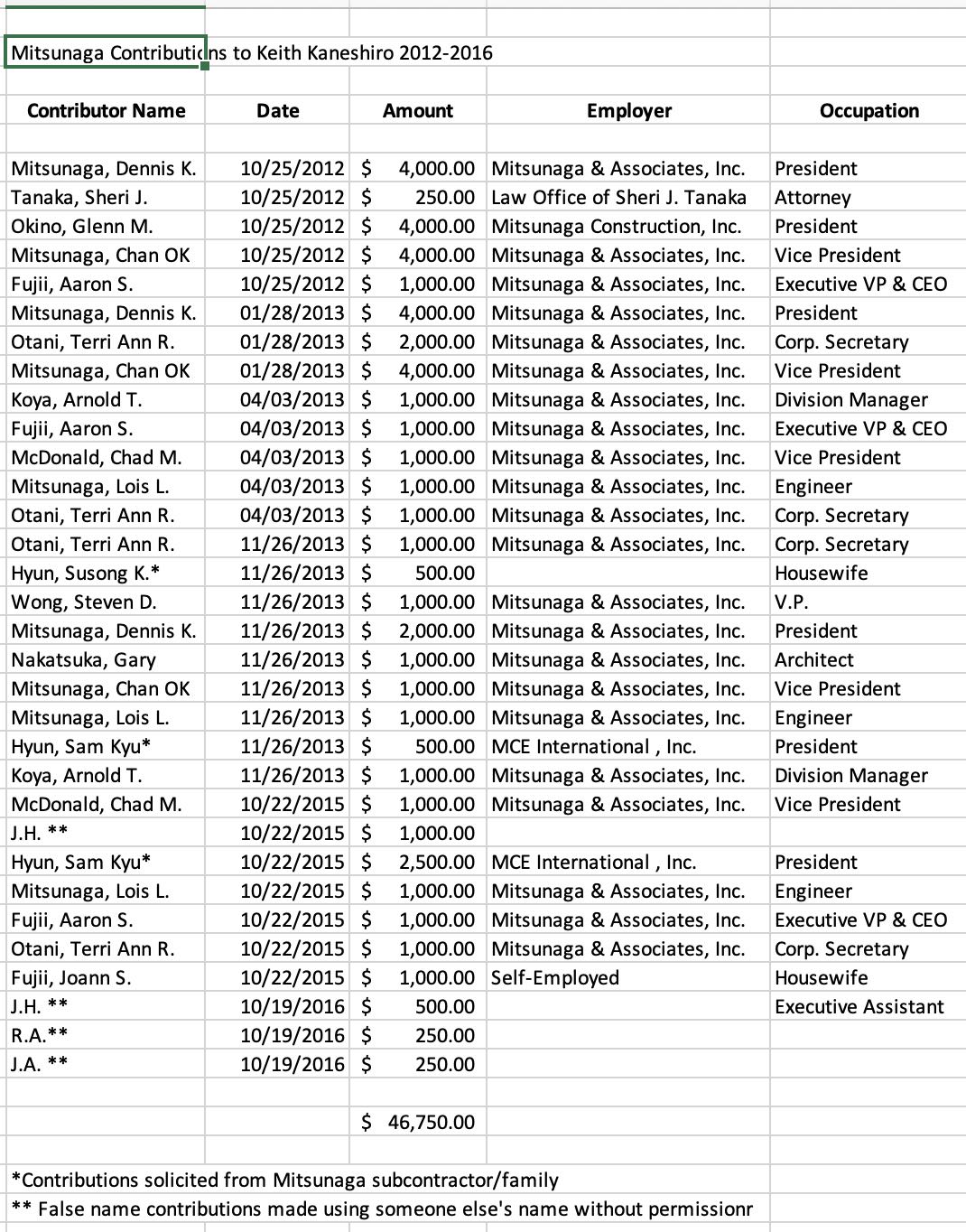
Backing up, though, here is a list that includes campaign contributions to Keith Kaneshiro’s campaign during the 2012-2016 period covered by the indictment, including those from the named Mitsunaga defendants as well as employees, subcontractors, and their family members. These data come from the online database maintained by the Campaign Spending Commission.
My total comes out a bit higher than the one cited in the indictment, and I haven’t had time to find the source of the discrepency.
And, yes, the Mitsunaga firm has been among the top contributors to a variety of candidates over the years. Here’s a list of what appear to be the top recipients of Mitsunaga funds over the years since 2006.
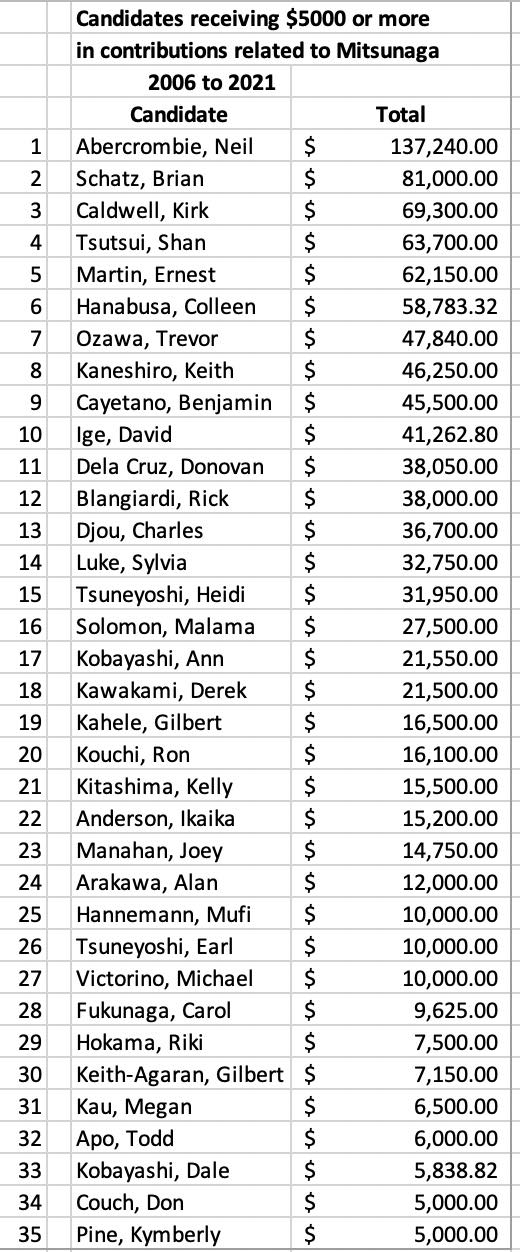
Of course, this does not mean that similar illegal agreements were part of any of these contributions. In one sense, they didn’t have to be. Large contributors gain influence even without any such illegal agreements. That’s the problem that we have with virtually unlimited private interest money being allowed to dominate elections.
Discover more from i L i n d
Subscribe to get the latest posts sent to your email.
No, prosecutors don’t necessarily need a witness to testify that there was an explicit quid pro quo (and the comment didn’t state that such a witness was necessary). But such a witness would make a much stronger case, so it makes lots of sense to wonder whether such a witness has already implicated the defendants or whether prosecutors may produce such a witness. Otherwise, there’s some very suspicious timing that reeks of corruption but doesn’t necessarily prove it. (Just like Civil Beat’s interesting story today regarding a campaign fundraiser for four key lawmakers who voted in support of a controversial wood-burning energy scheme, the fundraiser having been organized by a lobbyist for the company proposing the scheme. It smells very bad, but does it prove corruption? Perhaps in a court of public opinion, but a court of law is a different animal.) Here, there may be additional incriminating circumstantial evidence to which we are not yet privy. But there’s also a convicted felon who is required by plea agreement to cooperate with prosecutors regarding any dirt she may have (Kealoha), others from Kaneshiro’s office have been hauled before a grand jury, and someone very close to a person who’s already been indicted has been explicitly referenced in the indictment as an unindicted co-conspirator (Mitsunaga’s unnamed attorney). So it makes sense to wonder why such a co-conspirator remains unindicted. Perhaps that person is shielded by attorney-client privilege and it makes no real sense to pursue them. But that privilege is not iron-clad, and can certainly be pierced if warranted by solid evidence of conspiracy to commit a future crime — an action that is not protected by the privilege. So again, a snitch witness is not necessary, but it sure would make a stronger case. And there certainly are some potential snitches here. And these feds know what they’re doing, have been working this case for a long time, and have an impressive batting average.
Great read but the Caldwell donations caught my eye. Mitsunaga spent hundreds of thousands of dollars in anti Caldwell super PACS. Was he just hedging his bets? That seems odd. Or were his employees contributing and hoping he wouldn’t notice?
Caldwell’s an interesting creature. You either hate him or truly detest him.
I believe Mitsunaga contributed to Caldwell when he was in the House, not during his runs for mayor.
And to be clear, I fully understand that your questions focus more on the general nature of the evidence necessary and the essential elements of the specific charges. At this juncture, I’m less interested in those weeds than the question of whether a wolf or two lurk among the weeds and could easily trample them, which the indictment suggests. I’m also interested in the (pretty inevitable) superseding indictment.
Wow. I would not want to be an attorney who’s described in a federal conspiracy indictment as an “unindicted co-conspirator”. That’s a pretty big deal.
Mitsunaga’s “unindicted co-conspirator” attorney is described in the indictment as someone who donated a specific amount to Kaneshiro’s campaign on a specific date, so a quick review of those records makes it very clear who she is, and she ain’t the guy who’s defending Mitsunaga now. Also, she’s referenced as CC-1 more than 20 times in the list of overt acts alleged in furtherance of the conspiracy. That doesn’t mean she did anything wrong, but it does make you wonder where the feds are going and whether she could be charged or called as a witness, or just left alone under attorney-client privilege. For whatever it’s worth, Kaneshiro’s executive assistant is also repeatedly referenced among the overt acts too but is not similarly described as an unindicted co-conspirator.
There are times to be grateful for the FBI.