
Here’s another rumor associated with Mike Miske. It doesn’t involve Miske directly, but rather people who were allegedly part of the extensive racketeering organization prosecutors say he controlled and directed. I found this rumor to be the most difficult to deal with because it involves suicide, still a taboo or, at minimum, very sensitive subject to talk to people about. If true, it would certainly be news worth reporting, that would add to the public’s understanding of this criminal operation.
I’m sharing it not because it’s true, but to show the kinds of stories reporters hear that seem plausible but unlikely, yet are worth spending some time with on the off-hand chance evidence emerges to support them.
According to this particular rumor, there was a cluster of suicides of perhaps six young men on the Windward side sometime around 2015-2016. The victims supposedly owed drug debts, perhaps having been “fronted” drugs, and were slow in paying. Collections during this period were allegedly being made by some members of the Nakipi Motorcycle Club, a gang known as the 44 (from Kaneohe’s 96744 zip code) who were involved in the drug trade and, prosecutors say, operated under the umbrella of Miske’s “Enterprise.”
During this period, Nakipi members were known to hang out at the Four4 Bar in Kaneohe. Among them was Norman Akau, one of the founders of Nakipi. He was also one of the original co-defendants in Miske’s pending federal criminal case, and pleaded guilty in June 2021 to being a participant in Miske’s racketeering conspiracy, while also admitting he had been involved in drug trafficking, a murder-for-hire plot Miske sponsored, and other violent acts.
Others included Lindsey Kinney, at one time among the leadership of Nakipi, and Jacob “Jake” Smith, a drug dealer with a reputation for violence and the martial arts skills to back it up. At the time, Smith was dealing drugs with Nakipi members, and was “on call” to assault victims at Miske’s request, for which he was paid in cash. Like Akau, he has also pleaded guilty and is cooperating with prosecutors, and is widely expected to be an important witness against Miske.
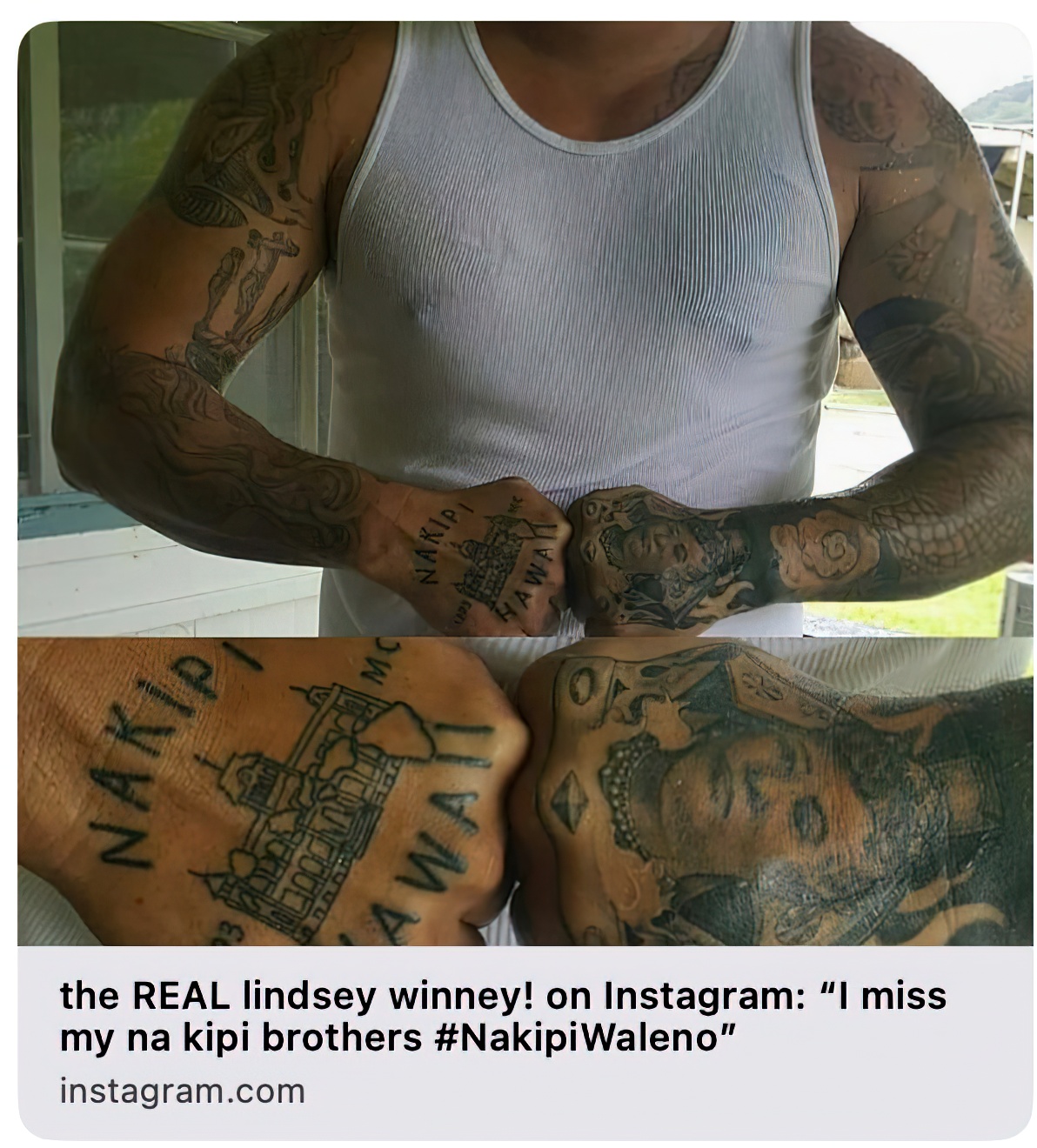 Lindsey Kinney had been the “enforcer” for Nakipi, but split from the group in early 2016 after allegedly turning down a cash offer from Miske to kill Jonathan Fraser, who suddenly disappeared in July 2016. Prosecutors allege Fraser was the victim of a murder plot Miske set in motion and paid for.
In one version of the suicide rumor, threats of violence by members of the 44 if debts weren’t paid drove the victims to suicide. Another version says they killed the kids and staged the deaths to appear as suicides.
I might have first heard a reference to the suicides from one of Lindsey Kinney’s series of Instagram rants taunting and calling out Miske, who Kinney sometimes referred to as “Mike Minsky.”
Here’s an excerpt from one of Kinney’s Instagram posts.
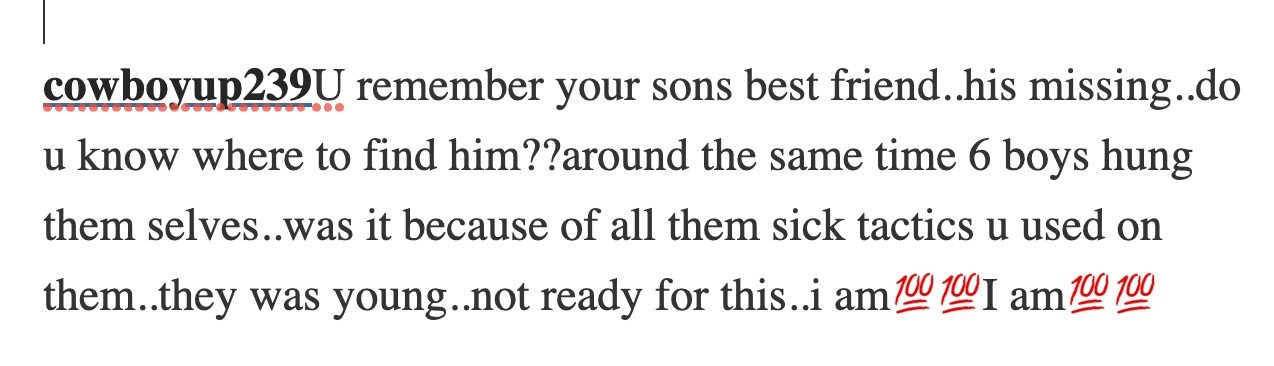
Admittedly, I doubt many would consider Kinney a reliable source, but I also heard the rumor from several other people. One of those has a foot in the law enforcement world. He said he had previously checked into the suicides and found enough support to give credence to the rumor, and at least move it to the “vet and verify” stage of investigation. Another law enforcement source declined to discuss the rumor, citing his position. I couldn’t figure out how to interpret that. Was it a back-handed confirmation? Or simply a “neither confirm nor deny” response?
In any case, I quickly hit a dead end. I contacted people I knew in the neighborhoods, those involved in organizations with roots in the communities. Most said they had not heard anything about a suicide cluster.
I was able to speak with a mother whose son died in an apparent suicide during this period. This was a hard discussion to have, complete with tears and hugs as she recalled finding his body. She didn’t think her son dealt drugs, although he liked to smoke weed, which was certainly not unusual. Coincidentally, he had known Johnny Fraser, who attended his funeral, although his mother didn’t think they had kept in touch in recent years. And the family lived just a short distance from the Kaneohe home of an active drug dealer in Miske’s network who has already pleaded guilty. But there was nothing in what she could tell me about her son’s death to either confirm the rumor or show it to be false.
And, of course, some people I contacted just didn’t respond, probably because they didn’t want to be talking about Miske, who’s violent reputation is very much alive even though he’s behind bars and facing a possible sentence of life in prison.
Candidly, I haven’t found any references to or hints of the suicide rumor in documents from the Miske case that I’ve been able to review over the past 2-1/2 years.
But other incidents in the Miske case, or involving members of Miske’s crew, are consistent with parts of the rumor.
It’s clear that the drug network associated with Miske’s group had tentacles down into neighborhoods and schools in different parts of the island, and that threats of violence were part of their method of collecting on drug debts.
The Christmas 2016 fatal shooting of 20-year old Stevie Feliciano involved a multi-level drug distribution ring that reached down into local high schools. The shooting happened when an apparent attempt to collect a small drug debt went sideways (the amount owed may have been as little as $50). The shooter, Dae Han Moon, was convicted of murder in the Ala Moana case. Lance Bermudez, who flashed an automatic weapon while threatening witnesses right after the shooting and warning them not to talk to police, was convicted of hindering prosecution, using a weapon in a felony, and two other crimes.
Moon and Bermudez were also indicted along with Miske for their alleged roles in the Miske Enterprise. Bermudez, like Akau and Smith, has already pleaded guilty and is awaiting sentencing.
Another case reflecting threats of violence used by Miske’s associates to collect drug debts led to the death of 24-year old Dayson “Dace” Kaae.
My article about this case was published by Civil Beat in October.
According to Smith’s November 2020 plea agreement filed in federal court, an unnamed friend owed Smith “a substantial amount of money” for methamphetamine Smith had “fronted” to him.
Although the plea agreement does not name the friend, Smith’s description matches news accounts of the unsuccessful game room robbery, which identified Kaae after he was arrested at the scene.
“Smith began to pressure the friend to find a way to pay him back and threatened physical harm if he did not do so. In response, Smith’s friend proposed to rob an illegal game room near the Don Quijote supermarket in Honolulu,” according to the plea agreement.
Smith gave Kaae a semi-automatic pistol, and then Kaae and another unidentified associate entered the game room while Smith and another person watched from across the street.
When the incident ended in Kaae’s arrest, the outstanding drug debt remained unpaid and continued to be a problem for Kaae.
Just over a month later, Kaae entered the Aloha Tattoo shop in Kailua, reportedly followed by Smith, who was wearing a black and white skull mask and apparently recording a video of the scene on his phone. Kaae was apparently still trying to work off that drug debt to Smith, and soon attacked the store owner. In the ensuing fight, he was fatally stabbed. Although he was able to leave the story, police later found his body in a getaway car that had been abandoned.
The case shows that those subjected to threats of violence after failing to pay drug debts were afraid enough to agree to take part in dangerous criminal activity. Could that same fear drive young men to suicide?
Miske and his co-defendants are charged with numerous serious crimes, but none are related to the rumored suicides.
As often happens when trying to chase down pieces of a story, it seems like we’ll never find out enough to confirm or deny the suicide rumor. Par for the course in an ongoing story like this one.
Discover more from i L i n d
Subscribe to get the latest posts sent to your email.
It occurs to me that these stories share some characteristics with “legends” in history. Or more precisely undocumented stories about the past. So someone took the Illiad as a guide and searched for Troy. And found it. Then references about Troy were found in correspondence between ancient empires. In this case there is a single fact 6 people died by suicide. This wouild be recorded and part of the public record. Furthermore the ruling “suicide” by a coroner can refer to a self administered drug overdose. While homicide can refer to a drug overdose where someone helped administer the drug overdosse. Such as handing them a loaded syringe. You can’t rule out that this occurred, but you can see if theses deaths did occur. Parenthetically one should understand how these rumors function, they basically spread fear and a sense of powerlessness. While giving those spreading them a sense of power, and knowledge. Making pursuit of criminals, and accountability on the part of the justice system harder.
Club 4-0
’44’ MC club
Cantonese Numerology
4 = death
Just as an aside, something tells me that Liliuokalani and other Hawaiian royalty would be aghast and horrified to see a batshit crazy ignorant drug thug tattoo her likeness and Iolani Palace on his grubby criminal hands.
Jeez! No kidding. Totally agree. Makes me angry.