
A Honolulu jury early this month found former high-flying foreclosure defense attorney Gary Victor Dubin committed legal malpractice and fraud over several years by failing to properly represent a client facing foreclosure.
The jury verdict, announced on June 3 after less than a full day of deliberations, found Dubin committed legal malpractice and fraud, and breached contractual obligations and his fiduciary duty to the client. The jury also found Dubin’s legal malpractice had inflicted emotional distress on his client, but ruled it was not done intentionally.
The jury awarded the client, Joseph K. Chandler, $18,260.10 in special damages and $179,927 in punitive damages, as well as attorney fees and court costs, which have yet to be determined.
Honolulu attorney William Fenton “Willy” Sink, who represented Chandler, said he was happy with the outcome.
However, Sink said prospects of eventually collecting on the judgment are uncertain.
Sink expects Dubin to appeal the jury verdict.
“He knows what he’s doing on appeals,” Sink said. “He has no problem filing paperwork.”
Dubin was initially represented in the case by attorney Keith Kiuchi, who had represented during the disbarment proceedings and taken over Dubin’s active client cases following the Supreme Court’s disbarment order. However, in November 2022, Kiuchi filed a motion in court asking for permission to withdraw as Dubin’s attorney. Kiuchi said he had not been paid, and had been informed that Dubin did not have the funds to pay him in the future.
“If I continue to represent Mr. Dubin I believe that I will not get paid, which would represent an unreasonable financial burden upon me under Rule 1.16(b)(6),” Kiuchi said in a declaration accompanying his motion.
Kiuchi’s motion was granted, and Dubin represented himself in the Chandler trial, apparently after failing to find another attorney to step in and take his case.
Chandler’s lawsuit stemmed from the 2006 purchase of a 4.3 acre beachfront property in Hamakua on Hawaii Island for approximately $550,000 by Chandler and his brother-in-law, Jerry Domingo. Soon after the purchase, unmarked graves were discovered that had not been properly disclosed by the sellers. The discovery of the grave sites blocked any work on the property until corrective actions were taken, although Chandler had to continue making monthly mortgage payments.
In late 2007, Chandler applied for a refinance and construction loan but was turned down. Chandler and his partner then stopped making the monthly mortgage payments, allegedly following Dubin’s recommendation. About two years later, the lender began foreclosure proceedings.
“In late 2009, Plaintiff retained Defendant Dubin to stop the foreclosure proceedings until Plaintiff and Mr. Domingo could resolve the graves issues,” according to Chandler’s pretrial statement. “Over the course of next six years, from 2009 to 2015, Plaintiff paid Defendants approximately $28,000 in attorney’s fees.”
In April 2014, a complaint for foreclosure was filed by the lender. Although Dubin’s law office filed an answer to the complaint, and also filed notice that they were going to file a third-party complaint against the seller for the failure to disclose, no such complaint was ever filed. Further, Dubin’s office failed to file their opposition to the lender’s foreclosure on time and failed to request a delay in considering the lender’s motion for summary judgment.
Dubin also failed to attempt to negotiate a short sale, loan modification, or other resolution with the lender. When Dubin then failed to appear at a hearing to confirm the foreclosure sale or to file any objection on Chandler’s behalf, the foreclosure received final approval from the court.
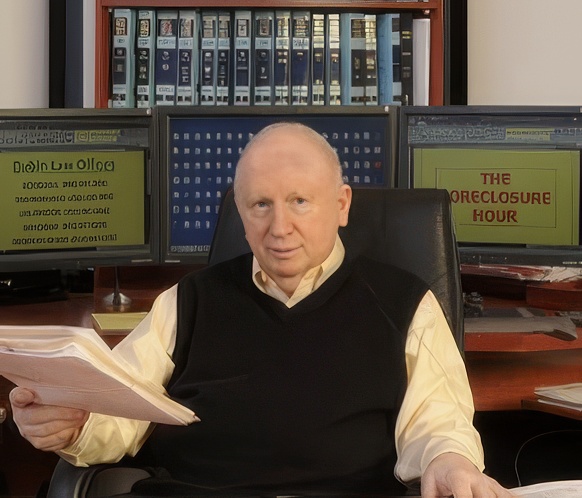
From ForeclosureHour.com
In 2016, Dubin and an associate, Fred Arensmeyer, won a major legal victory when the Intermediate Court of Appeals ruled that virtually all nonjudicial foreclosures conducted by condominium associations were contrary to state law, potentially opening the door to a slew of wrongful foreclosure lawsuits by former owners who lost their property through such out-of-court proceedings. The ICA decision was later upheld by the Hawaii Supreme Court.
But reports of dissatisfied clients and other issues had dogged Dubin throughout his career, earning him the nickname “dubious Dubin” in some legal circles.
Dubin was disbarred by order of the Hawaii Supreme Court in 2020 after a lengthy disciplinary process that stretched over nearly four years, during which he aggressively fought charges brought by the state’s Disciplinary Counsel.
The court’s order spelled out the reasons for its actions, as described in a post here at the time.
In its disbarment order, the Supreme Court found Dubin had violated rules of professional conduct by “by knowingly misrepresenting the truth on a government form on which he certified the information thereon was true,” and then “signing the names of his clients, without their permission, in the endorsement section of a $132,000.00 settlement check made out to them alone and depositing it in his client trust account, thereby gaining control over those funds,” and then “overcharged the clients a minimum of $19,885.00.”
The court found, in another client’s case, Dubin “withdrew $3,500.00 of the client’s funds at a time when, based upon Respondent Dubin’s own accounting, Respondent Dubin had not yet earned those funds.”
The court ruled that in these cases, Dubin “inflicted actual, serious, injury upon the clients and upon the profession and…inflicted injury on the public at large and the integrity of the profession.”
The Supreme Court’s action led to a similar ruling by a three-judge panel of Hawaii’s Federal District Court, which barred him from practicing law in this district.
Dubin unsuccessfully appealed his disbarment to the Hawaii Supreme Court, and then all the way to the U.S. Supreme Court, which declined to hear his case.
He has, however, been able to stall final orders in reciprocal disbarment proceedings in California and the 9th Circuit Court of Appeals, relying on a well-honed strategy of continually seeking delays or “continuances,” seeking reconsideration of every interim decision no matter how routine, and then repeatedly filing appeals typically accompanied by hundreds of pages of documents rehashing previously-rejected grievances and allegations about the actions of the Hawaii Supreme Court.
In a two-week period in April, Dubin filed 16 motions for summary judgement seeking to throw out the reciprocal discipline charges being pursued by the California State Bar, which administer attorney discipline in that state. The trial counsel opposed Dubin’s motions on the basis that they are simply “attempts to relitigate the factual findings of the underlying Hawaii proceedings,” which by law are presumed to be “conclusive evidence” of professional misconduct. All the motions have been denied, as was another subsequent request for reconsideration.
Decisions in the California and 9th Circuit reciprocal discipline proceedings are pending.
Last month, Dubin sued the Harbor Court condominium, alleging that he fell on concrete stairs outside the building’s front door on May 14, 2022, breaking his hip and hitting his head on the concrete. The lawsuit alleges he suffered “debilitating injuries” and continuing medical problems.
The lawsuit blames the condominium’s “negligence and/or recklessness” caused by the lack of handrails on these stairs.
Real estate records show Dubin owns a 1,600 foot apartment in the building where he has lived and worked for 20 years.
Discover more from i L i n d
Subscribe to get the latest posts sent to your email.
I wonder if the issue of the graves was ever resolved? I know this property is adjacent to a fee simple parcel known as “Pepe’ekeo Chinese Cemetery” . Historically the cemetery was several acres. When that area underwent consolidation and resubdivision the several acres became 1 acre. These are marked graves in Chinese language which were interpreted in the early 2,000’s and a report written. All facinating history.
I am sorry to hear all of this. I was a huge fan of the Foreclosure Hour podcast. I pt was fascinating, educational and timely. I really believed Mr Dubin was genuine in his quest to educate the public on these fraudulent foreclosure issues. Since I was in foreclosure myself from 2009 to 2011, I got a lot of good inspiration out of these shows. I hope none of this is true and I wish Mr Dubin well.
I too, am sorry to hear about Gary’s failing health. I am a former client of his. He was the only attorney that actually listenened to my side of a very arduous and tumultuous case against a family member that basically thought whe knew better and wanted to edge me out of benefits awarded to me in a trust dispute. This dispute caused me homelessness and many, many other repercussions but Gary was resolute that we could win. In the end, I did. It took six years in probate, but Gary represented me basically pro bono and only collected a retainer and fees when I won. I am grateful for Gary and I hope he enjoys his retirement years. –Jeris Yukio Amazaki