
Initial notes on my first chemotherapy/immunotherapy infusion session. Monday, June 29, 2026.
A friend picked me up at home and braved rush hour traffic to drop me outside the Kuakini Medical Plaza, a medical office building along North Kuakini Street, adjacent to Kuakini Hospital.
I arrived at the Queen’s Cancer Center on the 4th floor a few minutes early, checked-in at room 402, and after a couple of minutes was shown the way down the hall to the infusion area in room 412. Here I was greeted just outside a room where six large reclining chairs are lined up. Curtains can be pulled into place between the chairs to provide at least a bit of privacy. I was directed to the left, down to the end of the room, last chair, end of the line.
I stopped at the last chair I saw, but was then told to step around the far side of the curtain. Once I did that, I finally saw my destination.
“I put you on the end because you’re the tallest,” Nurse Patricia said. “And you’ll be here the longest,” she said, referring to today’s five-hour+ infusion session.
I took my seat. A median size television screen is mounted on the wall a little to the left, sound turned down low, just enough to hear diners and critics extolling the virtues of meals served in diners across the country, giving way now and then to programs determined to make cooking a contact sport.
Straight ahead, about six feet away, an institutional beige door to a common restroom. There’s lots of traffic, but I won’t have far to go when I have to go!
I asked the nurse if she was a “Patty” with a “y” or “Patti” with an “i”.
“Pattie with an ‘ie’ just to shake things up,” she replied. “My mother used to say that it doesn’t matter how you spell Pattie because it’s not on my birth certificate.”
Then Pattie began assemblng supplies needed to hook me up, and asked which side of my chest now hosts the IV port.
 Right side, I said, as I unbuttoned my shirt. The port was just installed in my chest on Thursday. It looks like the incision may leave a scar, but its barely visible on my chest just below the collarbone.
“They timed it pretty well,” I said, with the port going in on Thursday and my first infusion session the following Monday. The area around the newly installed port was quite sore for a couple of days, but by Sunday I could touch it without experiencing any pain or discomfort.d
“They used to wait two weeks after the port was put in before moving to treatment,” she said. “Probably good for you, but not for us. We’re ready to go!”
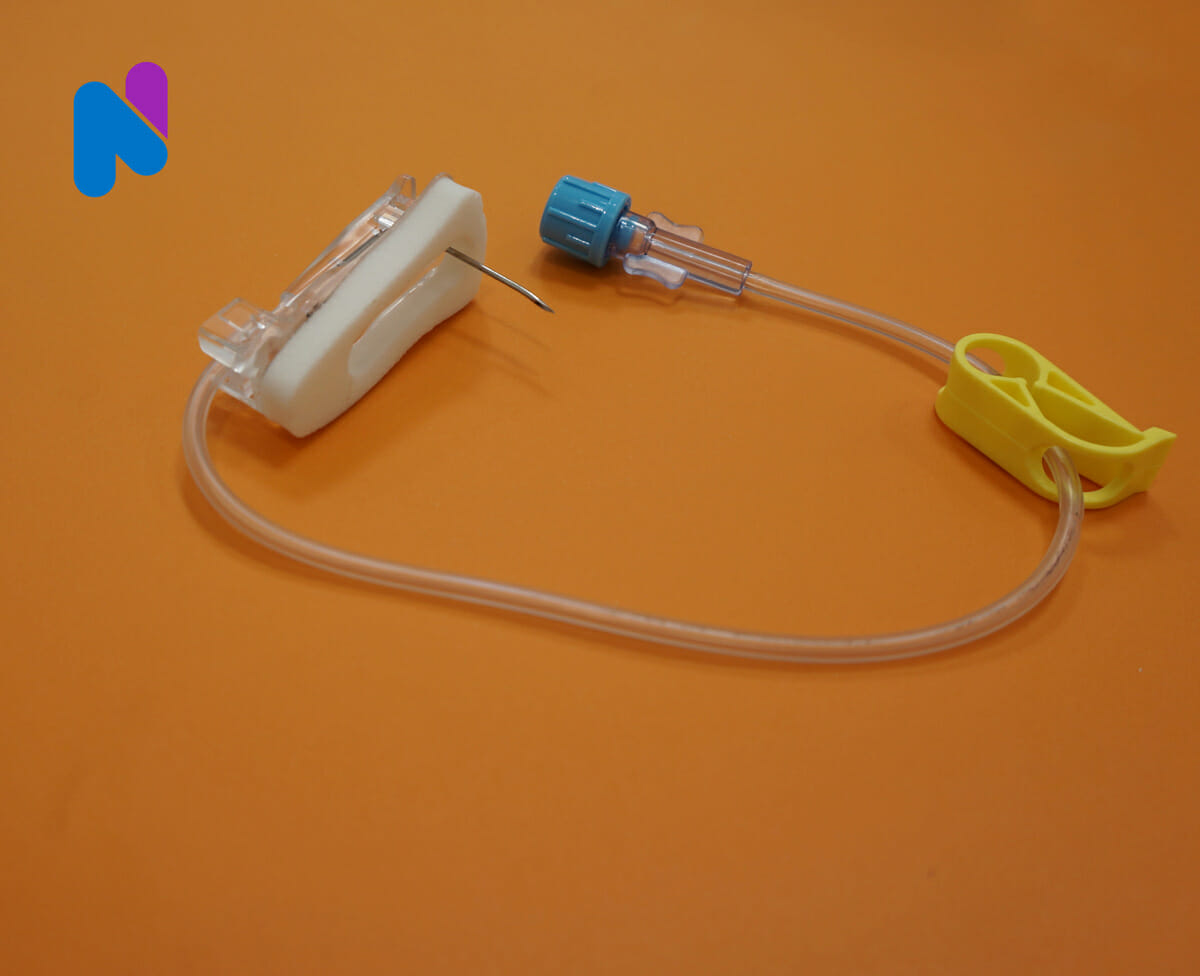
 Now, she said, they could use the port immediately after it was put in place. As she spoke, she was taking a length of thin plastic tubing and a special needle attachment out of a sterile bag and getting them ready to attach to my port.
“This is the part you’re probably worried about,” she said.
Exactly. I explained that people advised me to use Lidocaine or something else to avoid a sting as the port is accessed through the skin of my chest. But Pattie’s answer surprised me. “Lidocaine stings more than this,” she said, pulling my shirt back. “Just take a deep breath,” she said. As I did, she authoritatively pressed the needle into place.
I exhaled. No pain. No sting. And it was in.
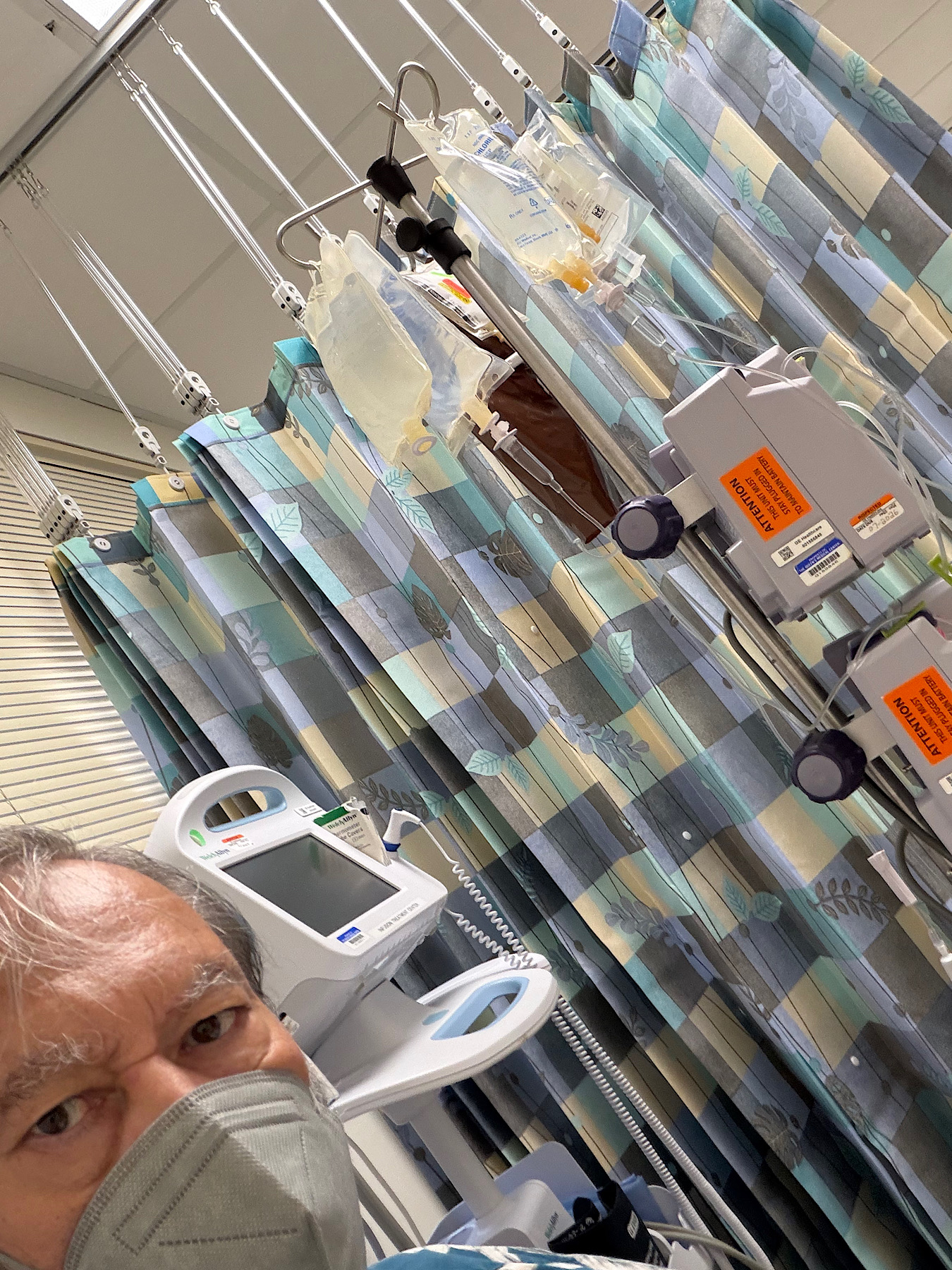
With that, she entered commands into two digital controllers directing the drips from six clear plastic IV bags hanging on the top of a mobile rack, and we’re off!
Less than 15 minutes later and she was back. “You just finished the fast acting anti-nausea drug, and now you’ll get long-lasting one, probably last a couple of days. Then we start the good stuff.”
I learned that the three drugs I’ll be getting are given one after the other, not as a mixed cocktail. All the drugs are accompanied by a constant drip of saline solutions. And more fluid will be dripped through my system to flush excess chemicals after they big three drugs have been administered.
It’s now 9:20 a.m. Today’s session is just 10% complete, and the real treatment will hit my veins soon.
First, Durvalumab. It’s the immunotherapy drug, starting about 9:35. The end of the first hour is still ten minutes away.
“Immunotherapy is always the first, in all the regimens,” Pattie explains.
One of the drip controllers beeps and Pattie returns quickly. One bag of fluid is empty, and she tosses the empty bag, and attaches another.
“This one is potassium,” she explains, otherwise the drugs deplete the body’s supply of this important element. “It also takes about an hour,” she said.
The supporting fluid, including the potassium, accompany the main drugs, dripping alongside them.
The next time I look, it’s 9:55 a.m.
One hour down, four to go.
And, for the first time, I feel the cold. I may have to break out my travel blanket alongside the one I received here. And perhaps I should bring a warm hoody next week.
Discover more from i L i n d
Subscribe to get the latest posts sent to your email.
Aloha Ian — We all mahalo you for sharing the details of this important first step toward recovery. You are such a brave soul and your decades of superb investigative reporting, have successfully brought us along with you; caring spectators at your side on this complex step of the journey. I am so appreciative of your detailed description of the process.
The treatment is amazingly concise and your nurse Pattie is as I have always experienced with the staff associated with the Queen’s Hospital and Medical Center. Kind and competent, but simple and direct while expertly administering an otherwise intimidating treatment.
And as I write this, you are nearly pau your first infusion session and headed home to your faithful Lind Cats who will cuddle and love you through whatever initial adverse reaction you might experience. Fingers crossed for little or none.
Game on indeed! Good Job – you got this!
Been there, done that! Brought back memories. Such a GREAT attitude you have which is half the battle. Know everyone here is cheering for you!
Thanks so much, Paul. I am just trying to view this as I’ve viewed and reported on other less than pleasant events. It helps me keep perspective!
Full moon energy today. Visualizing you on your morning walks, healing gently. Love & Hugs, Tanya
Ian….Thank you for your descriptive account of albiet a so personal process…Helps with us better understanding.
Aloha, Mr.Lind, thank you for sharing your story during the procedures I like how expressive and detailed of everything must be very comforting as the process that you are going through the procedures, my thoughts are with you always while you go through this transition, prayers to your all mighty being.aloha
Cheering from Kahalu?u!!
Go team!!
thanks for taking us with you.
Thank you for pulling back the curtain on this process and demystifying it, for those like me who are unfamiliar. Sending good wishes for your well being.
If anyone can beat it, you can. Hang in there. I am praying for you.
You are a strong, courageous human, Ian. This post is really inspirational. I hope you feel the strength of your readers. We support you 100%. Geev ‘um!
I like the Queens Cancer Group at Kuakini. Sometimes the waiting area (room 412 is crowded), but they try to push everyone through efficiently. I know 402 well, as that is where I see my oncologist, Dr. Kawahara. I know Pattie too, as she give me my monthly Xgeva shot and my 6-monthly Lupron shot. The Xgeva shot is to arrest bone loss, which Lupron and my oral medication, Xtandi, are know to promote.
Having cancer isn’t fun, but it sure is easier to take these days than, say, a decade ago.
Keep your spirits up!