
I appreciated a comment by “Rebecca in Hilo” on an earlier post in which she provided encouraging words about my early photographs as a participant-observer in the nascent modern Hawaiian rights movement of the 1970s.
Her comment made me realize how rare it is to get positive feedback on images that, to my eye, remain powerful and meaningful.
It sent me back yesterday to take another look at some of those photos, and I ended up browsing through images from a “Stop the Bombing” rally on the beach fronting Makua Valley on February 28, 1976. The rally was held less than two months after the original protest landing on the island of Kahoolawe by a group later dubbed the “Kahoolawe Nine.”
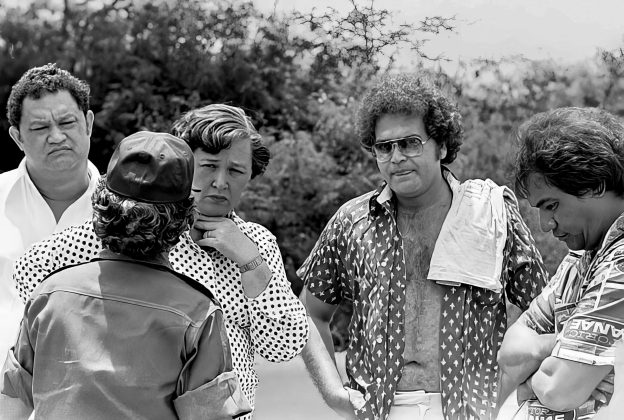
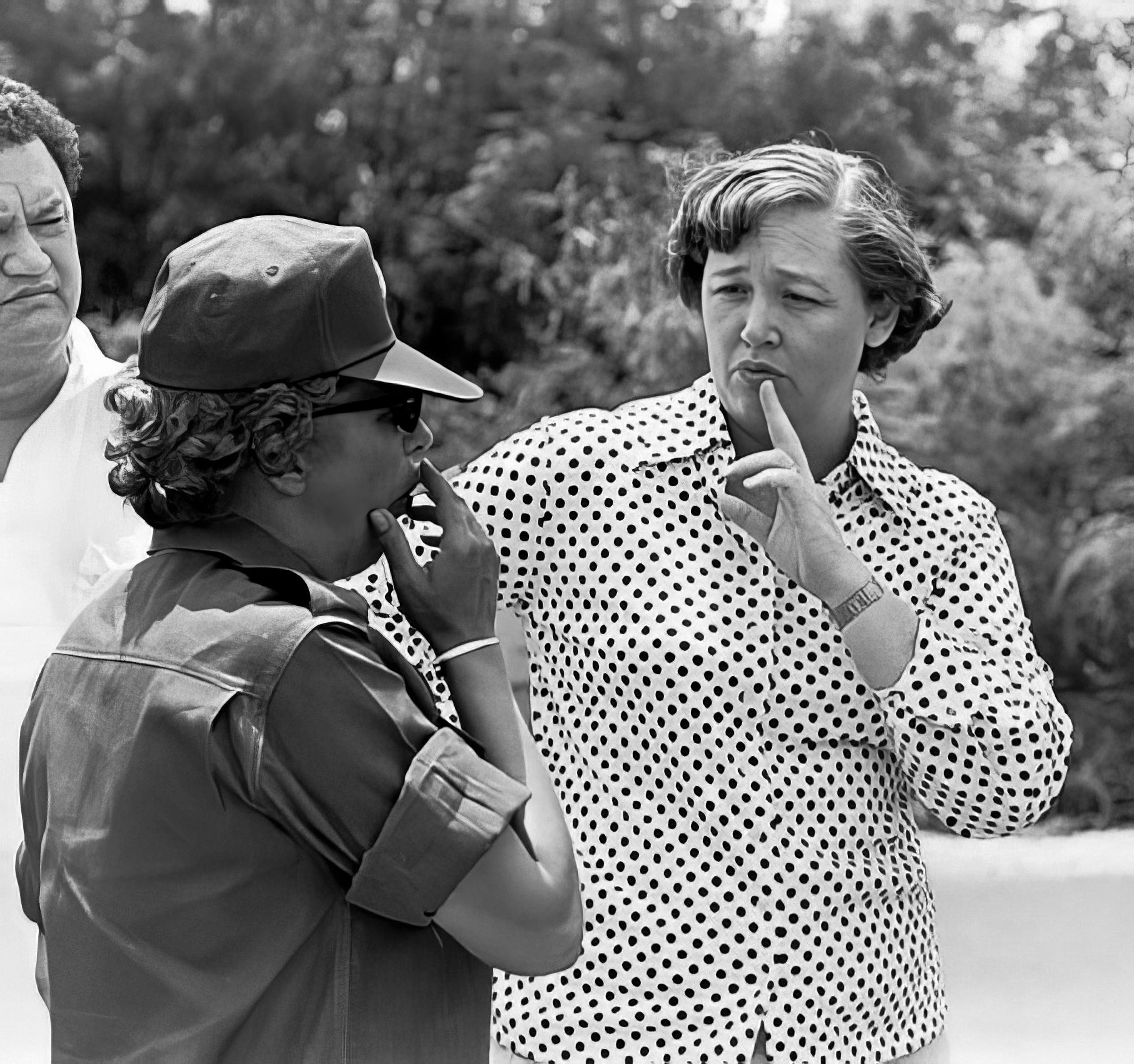
Here’s one that was flying under my radar, a portrait of four giants in the Hawaiian movement. From left to right, Gard Kealoha, Winona Rubin, Gayle Kawaipuna Prejean, and Peter Apo. Only Apo is still living, well into his 80s and until recently still publicly active. In retrospect, quite an inspiring cast of characters!
The photo was taken after the Army sent a female officer to speak to the Hawaiian leaders present at the day-long Makua protest.
I’m sure none except Apo will be familiar to the general public or even activists today, so I asked Google’s Gemini AI to help me with profiles of those who have died. These are dry, factual profiles that don’t convey their colorful natures and powerful personalities. But they do serve to place them in the politics of the period.
Gard Kealoha (1936–1998)
Gardner “Gard” Kealoha was a master of the transition from grassroots organizing to institutional policy. As an At-Large Trustee for the Office of Hawaiian Affairs and the chair of its Culture and Education Committee, he focused on translating community demands into formal policy, federal legislation, and structural advocacy.
One of his defining battles centered on the construction of the Interstate H-3 freeway and the fate of the Luluku agricultural complex in K?ne?ohe. As the State Department of Transportation drew lines on maps that would slice through ancient taro terraces, Kealoha dug in. He understood that to the state, Luluku was simply real estate in the way of asphalt. To Hawaiians, it was a contiguous ahupua?a, a cultural landscape.
Instead of just fighting the state on local ground, Kealoha took the issue to the federal level. When U.S. Senator Robert T. Stafford, chairman of the Senate Committee on Environment and Public Works, sent a letter inquiring about the site’s significance, Kealoha was ready. He coordinated an evaluation by professional archaeologists and delivered it directly to Washington. He argued that cultural sites could not be looked at as isolated pockets; instead, the integrity of the entire system had to be protected. He used bureaucratic language to shield the land.
That ability to navigate federal halls became a hallmark of his career. In 1984, Kealoha traveled to Washington D.C. to testify before a U.S. Senate subcommittee on education. His insights and systemic data helped secure the Matsunaga Amendment, which integrated federal recognition and funding for Native Hawaiian educational initiatives.
Kealoha also knew how to shape a public narrative. As a natural communicator, he utilized early program newsletters and publications—the precursors to what would become Ka Wai Ola—to give the movement its public voice. He was active in recruiting local talent and pushing people into spaces they didn’t think they were ready for, ensuring the movement had the media tools necessary to tell its own story.
Winona Rubin (1929–2024)
If Winnie Rubin was the architect of administrative systems, she viewed the internal friction of the era as a necessary part of building something new. When looking back at the early days of ALU LIKE, Inc. in the mid-1970s—with Rubin steering the organization as executive director—the Hawaiian community was far from a monolith.
The money coming in from the federal Native American Programs Act was a lifeline, but it also triggered internal debates about direction, strategy, and administrative control. Rubin frequently recalled that navigating those early years meant dealing with an immense amount of hukihuki—a literal tug-of-war between competing factions.
But where others saw dangerous fracturing, Rubin recognized an evolutionary step. She understood that these debates were the precise mechanism that allowed a unified, modern Hawaiian political identity to take shape. You couldn’t get to clarity without the clash, and she focused her energy on channeling that heat into operational infrastructure.
Her partnership with others in the movement worked because their talents mirrored one another. While Rubin was buried in data, statewide needs-assessment surveys, and formal organizational structures, she relied on colleagues who knew how to weaponize that data into a public narrative. She focused on building the operational engine of self-determination, utilizing data to back up political demands.
When the political landscape shifted after the 1978 Constitutional Convention and the Office of Hawaiian Affairs (OHA) was born, Rubin and her staff actively packaged up ALU LIKE’s databases, mailing lists, and community surveys, handing them over to OHA’s newly elected board to help them establish their operations. For Rubin, the trajectory of the era proved a long-standing belief: passion could ignite a renaissance, but it took a resilient kind of administrative grit to anchor it in law and make it stick.
While Winona Rubin re-engineered the state’s social service and native advocacy infrastructure, her late husband, Judge Barry Rubin, operated at the highest levels of the local judiciary. Together, they formed a formidable legal and administrative duo in mid-to-late 20th-century Honolulu, navigating the intersection of public policy and the law. Following Winona’s passing in 2024, her ashes were interred alongside Judge Rubin at the National Memorial Cemetery of the Pacific at Punchbowl.
Kawaipuna Prejean (1943–1992)
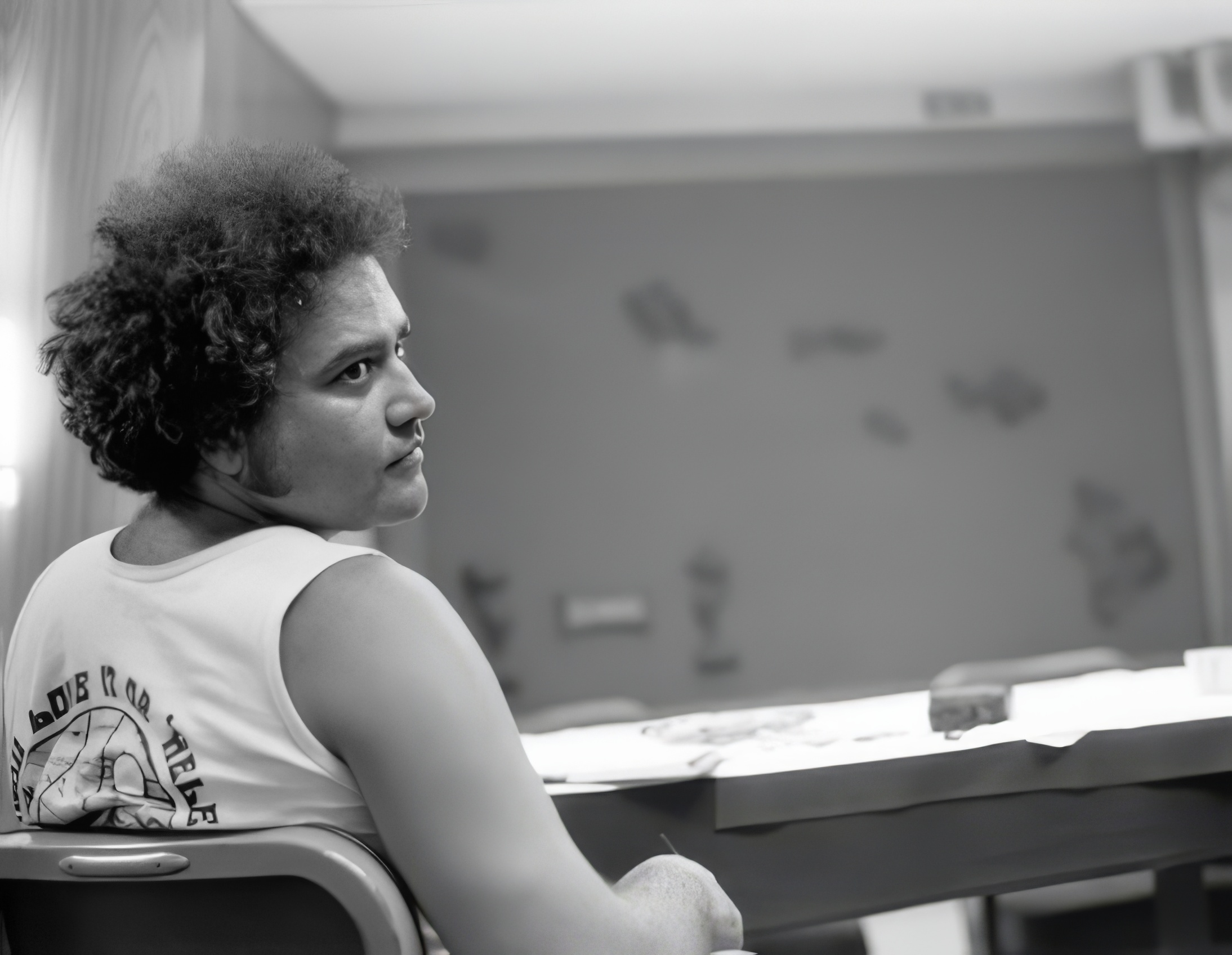
Gayle Kawaipuna Prejean provided the uncompromising vanguard to the movement. If Rubin and Kealoha worked within the gears of committees and state departments to reshape the law, Prejean was the man who questioned the legitimacy of those laws. When he died suddenly on his 49th birthday in April 1992—collapsing shortly after testifying before the state Legislature—the movement lost its chief provocateur, but the legal and international frameworks he set in motion remain central to the political landscape.Kawaipuna Prejean (1976)
Prejean’s vision was paired with a practical understanding of systemic leverage. In 1974, looking at the wave of evictions facing Native Hawaiians as urban development expanded, he recognized a significant gap in legal defense. Alongside a small group of allies, he co-founded the Hawaiian Coalition of Native Claims and stepped up as its first director, quickly becoming its primary public face. Today, that small coalition is known as the Native Hawaiian Legal Corporation (NHLC), an entity that has spent decades litigating land rights, water rights, and traditional access.
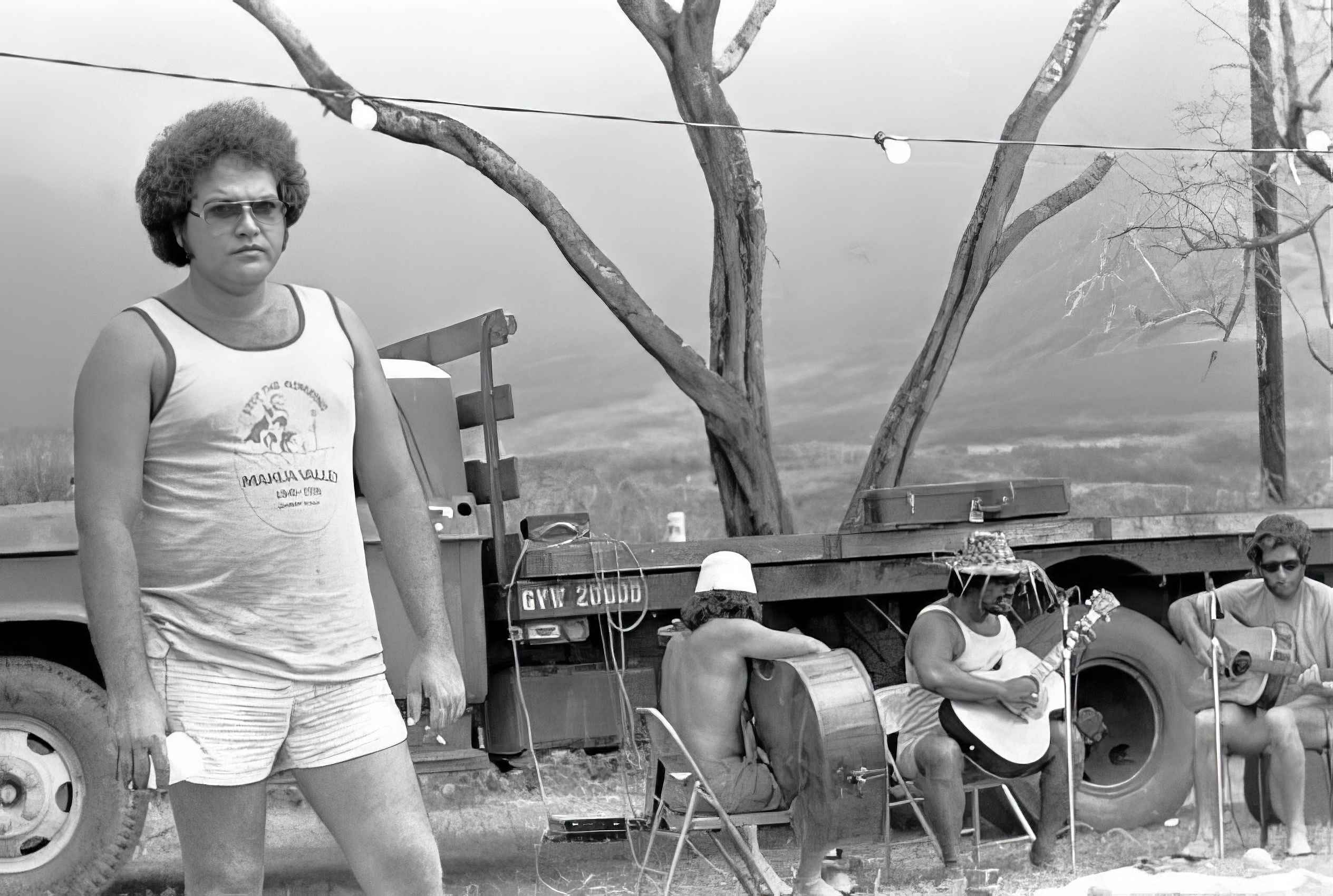
Yet, Prejean’s work extended far beyond a director’s desk. He was a practitioner of direct aloha aina. On January 4, 1976, when a boat slipped past a U.S. Coast Guard helicopter and landed on the forbidden, bomb-torn shores of Kaho’olawe, Prejean was there. As one of the “Kaho’olawe Nine,” his presence on the island helped catalyze the multi-decade resistance that eventually forced the U.S. Navy to stop using the land as a weapons range.Kawaipuna Prejean (1976)
Where others brought strictly legal briefs, Prejean brought a guitar, a booming voice, and biting satire that targeted the military presence and what he termed the “hypocrisy of democracy” in the islands. He understood that music and cultural expression were weapons of survival just as potent as an injunction.
His vision also stretched beyond the reef. Long before international indigenous advocacy was common practice, Prejean traveled to Geneva, Switzerland, attending the earliest sessions of the United Nations Working Group on Indigenous Populations. Forging alliances with the American Indian Movement (AIM) and utilizing observer status with the International Indian Treaty Council, he was among the first Kanaka Maoli to stand before the global community and frame the 1893 overthrow not as local history, but as an ongoing international issue. It was Prejean who originally conceived the idea for the 1993 Kanaka Maoli Peoples’ International Tribunal.
Disclaimer: AI assistants, including Google’s Gemini, make mistakes. However, I have reviewed and edited Gemini’s text, and so I’m now responsible for any errors. Please call any errors to my attention so that they can be corrected.
Discover more from i L i n d
Subscribe to get the latest posts sent to your email.
not a fan of AI, but will take as “yours” since you’ve reviewed and you knew them all. important memories! as i recall, PKO pre-cursor folks decided to focus on Kahoolawe. it took long to get that island back. now, finally, energy is on makua (and pohakuloa). we gotta end these leases! thank you for all you did on this front and for keeping the history alive for us!
Peter Apo is still active with the Royal Order of Kamehameha I. I will send a recent photo by email.