
It’s an excruciatingly long time. Looking back, I can recall the key events as well as the twists and turns of life within each of the past five decades. So much life lived, so many things observed. But I can close my eyes and place myself back in certain events from 50 years ago, sense memory takes over, and I can almost relive those events again in my mind.
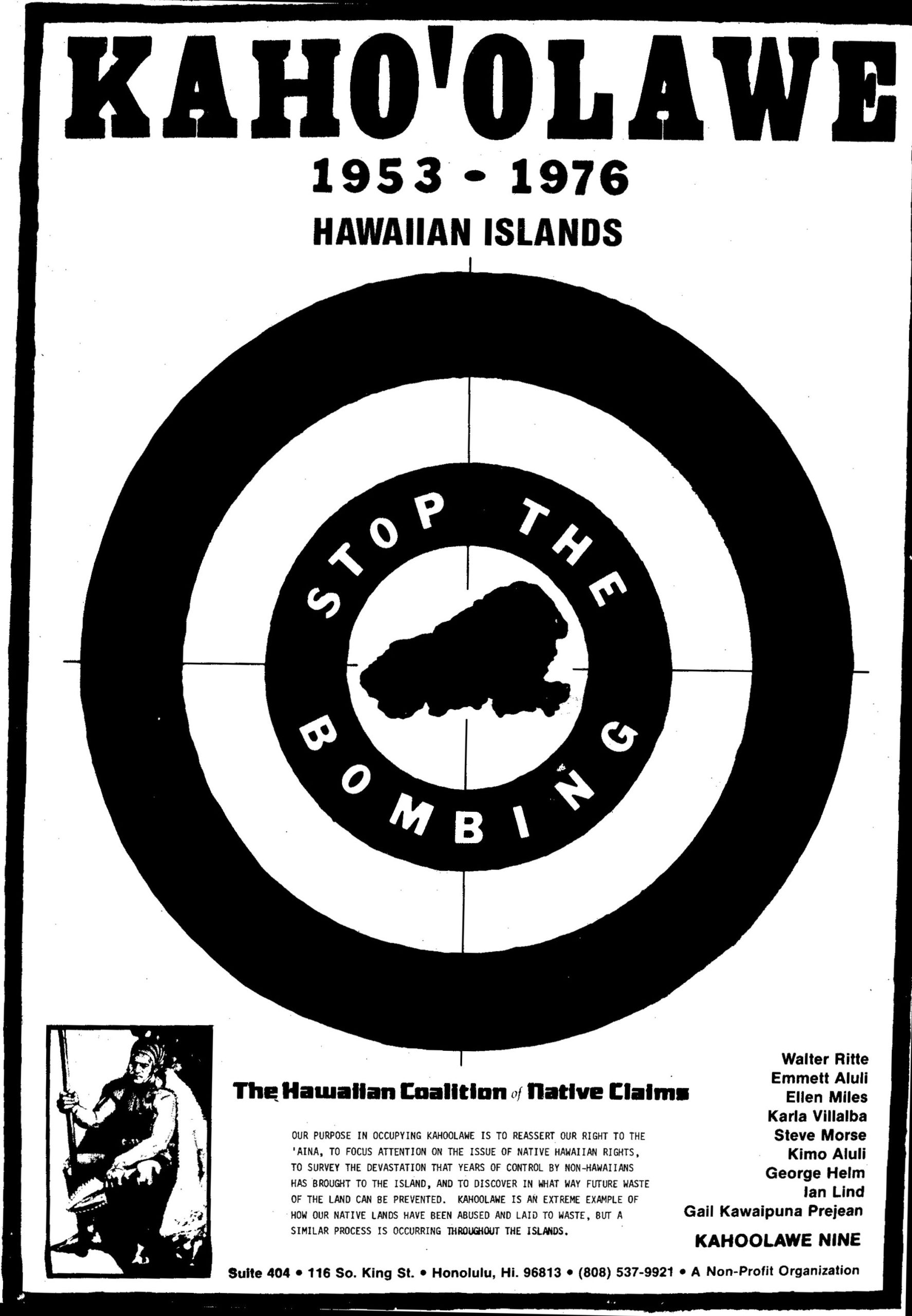 And today marks one of those long-ago events. It is the 50th anniversary of the Sunday, January 4, 1976 when I was part of a small group landing on Kahoolawe, later dubbed the Kahoolawe Nine, as a protest envisioned as a way to put the issues and concerns of Native Hawaiians on the national agenda at the start of the American Bicentennial. It started as the brainchild of Charlie Maxwell to highlight a bill in Congress to authorize reparations to Native Hawaiians for their loss of native lands as a result of the overthrow of the Hawaiian Kingdom in 1893 and its subsequent transition to a U.S. territory.
It’s sobering for me to realize that at least five of the original Kahoolawe Nine did not live to see this 50th anniversary–George Helm (d.1977), Kawaipuna Prejean (d.1992), Emmett Aluli (d.2022), and Stephen Morse (d.2025). The Maui News story about the Kahoolawe Nine in 2006 (see link below) reported Ellen Miles had died previously, although I couldn’t find a published obituary or other available record. Walter Ritte is the only other one of the original nine quoted in current news stories.
 Maui Now published a story about the anniversary today, as did the Honolulu Star-Advertiser. For more of the story, I suggest Maui News reporter Kekoa Catherine Enomoto’s excellent story to mark the 30th anniversary in 2006, and my own Civil Beat column in advance of the 40th anniversary a decade ago. And SFGate.com did their own story for the 50th anniversary, providing a bit of national coverage.
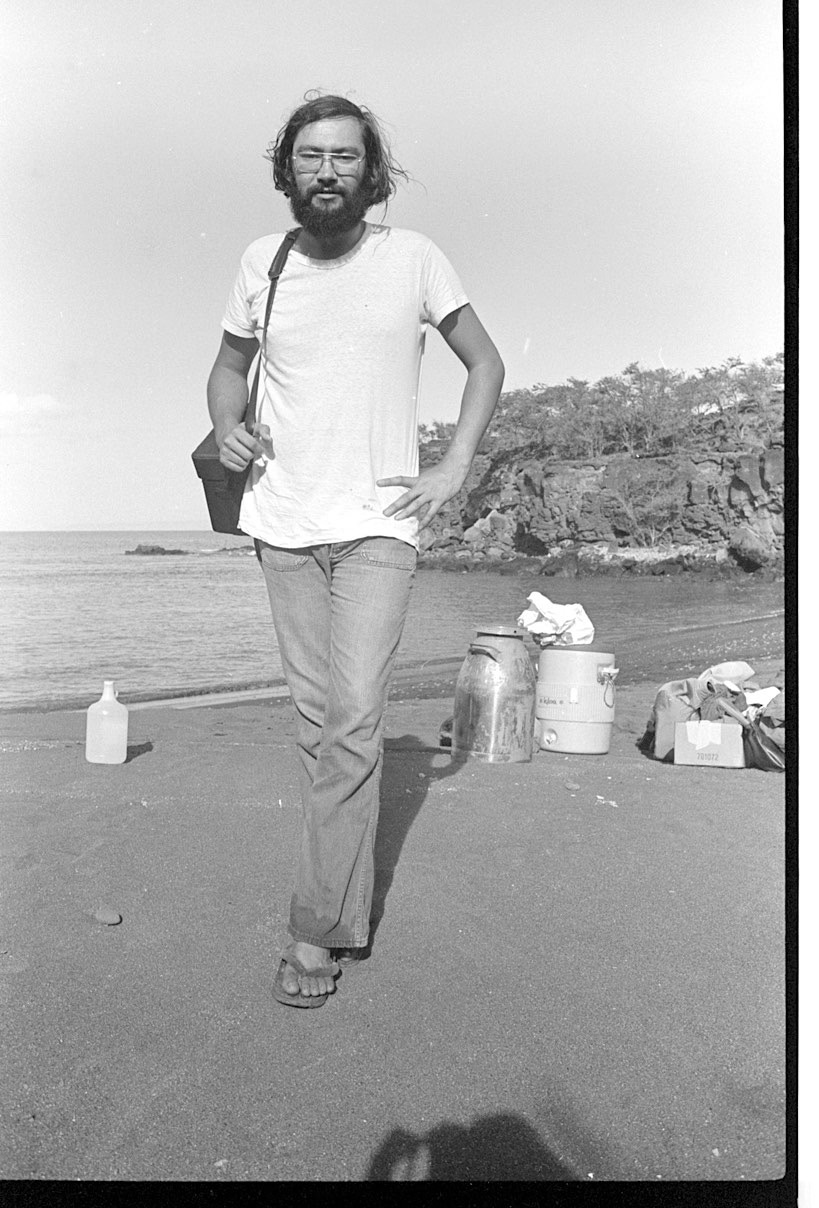
That’s a photo of me on the beach during our relatively brief time on Kahoolawe in 1976. Lots of my other photos of that first landing have also been posted online for several decades. Someday I`’ll get around to reposting better versions of those photos, but for now they’ll have to do.
Afterthoughts
Here are a couple of suggestions that I wanted to pass on.
First, “The Music of George Helm: A True Hawaiian,” recorded before his death in 1977, is available on Apple Music and, I expect, other streaming services as well. George was more than just one of the Kahoolawe Nine. He was a driving force in bringing Kahoolawe’s message to the public as he criss-crossed the state collecting music and stories as he constantly sought to expand his musical knowledge. It was, as I recall, recorded live at the Gold Coin lounge in downtown Honolulu and, as a result, is a bit rough around the edges in a few places. He was lost far too young.
I would would be remiss if I failed to recommend Steve Morse’s self-published memoir, “First Landing: Story of the Kaho`olawe Nine,” available in paperback on Amazon for just $8.99. I checked Powell’s Books, and Alibris.com, a used book site, in search of alternative sources but didn’t find any. It’s an easy read, based primarily on Morse’s personal recollections, but also placing events in a personal and political context. My copy of the book suffers from the choice of a very light typeface which makes reading a bit more difficult, but that shouldn’t deter you from reading Morse’s account.
And the University of Hawaii Press has republished “Na Mana‘O Aloha O Kaho‘Olawe: Hawai‘I Warriors—Love For Land And Culture,” the diaries of Walter Ritte Jr. and Richard Sawyer, written in 1977, “a day-to-day record of their thoughts and reflections when the two men occupied the island of Kaho?olawe for thirty-five days, using their bodies as shields to stop the bombing and desecration of the island by the US military.”
Also see:
Early days of the Protect Kahoolawe Ohana, February 1976
Sovereignty Sunday, January 1977
PKO at the Federal Courthouse in Honolulu, 1977
Aloha Aina Newsletter 1978-79
Discover more from i L i n d
Subscribe to get the latest posts sent to your email.
So where do you think Hawaiians rights are now?
Ian: I didn’t know you were part of the original group protesting physically on Kahoolawe. This was a very courageous action and ultimately sucessful in the Navy’s cessation of the bombing. Are there any lessons we can use to stop the renewal of the leases at Pohakuloa and other military leased lands that have desecrated and ruined native lands ? Thank you for this story, and may we have further victories, including on the national scene.
As the commanding officer of the destroyer DD517 the USS Walker in the late 60s my father bombed Kahoolawe. Marines situated on or near the island would call out coordinates and the destroyer would lob shells to that location. It was rehearsal for Vietnam. He rarely talked about his tour there, but once, years later, he said it bothered him when soldiers called in strikes, because he did not know exactly who or what he was hitting, and it could include villagers. He always remained patriotic to the core, but I guess he carried that guilt with him after the war.
David and Goliath. Brilliant to tie it in with the national Bicentennial. You got many great pictures which helps the younger generations, like me, to understand this history. We don’t realize how awful it must have been for those living on Molokai, Lanai, and Maui to endure the daily bombings for 9 years.
50 years ago. can you believe it. Thank you for the email.
No, I also have a difficult time believing that it’s been that long!
You have lived an amazing and remarkable life.
Congratulations!
What was the connection between all of the nine? School? Neighbors?
There were several connections, but none between all nine. All but one were part Hawaiian, I believe, and I think it’s fair to say that all had been involved in some kind of activity or organizating involving at least one Hawaiian issue. We ended up getting to the island more or less by chance because boats we were on were close enough to the one willing to take us to shore that we could scamble aboard. That was our common denominator.
I’ve been blessed to know two local leaders who have inspired so many: Ian Lind and Shorty Bertelmann, who recently passed away at the age of 76. Though Shorty was known as one of the crew of the first Hokule’a voyage in 1976, he went on to be captain of later voyages and learned navigation from Mau Piailug like Nainoa Thompson. https://archives.starbulletin.com/2007/03/18/news/story04.html
I knew Shorty as a heavy equipment operator in his brother Glenn’s company, a sincere, quiet, lanky, highly respected guy I was friendly with around town and on jobsites.
Ian, you undoubtedly have some overlap with this circle of local luminaries. It’s so important that you are archiving / saving your photos and files, they are irreplaceable.
Charles / Chuck
.