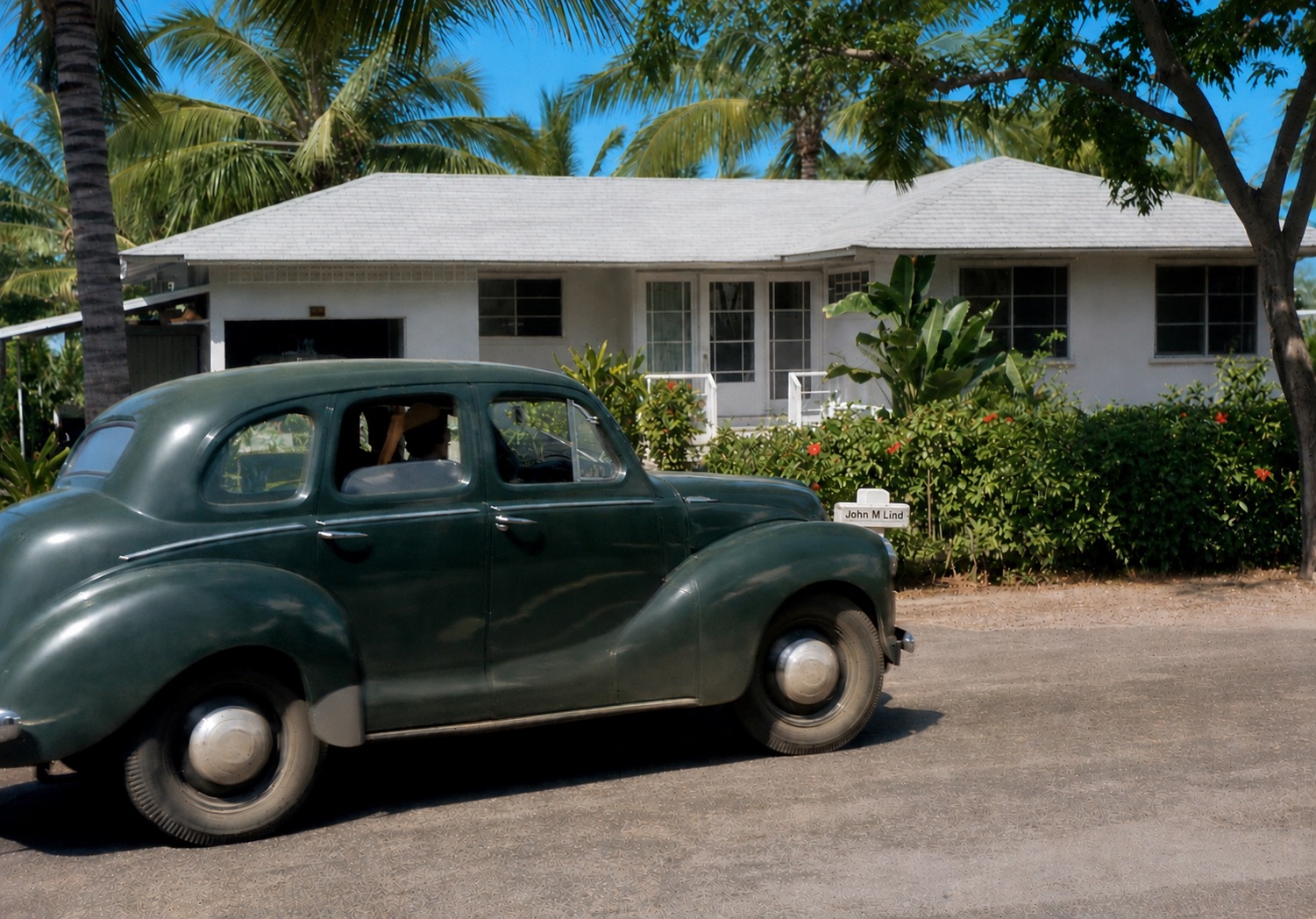
My mother’s car in front of our house in Kahala c. 1958 (restored by ChatGPT)
This is a two-part post. It’s about my mother’s car, but it’s also about the photo, and my success in using ChatGPT to restore the original color slide, which was seriously degraded after 60 years of poor storage conditions.
First, the car
Sometime in about the mid-1950s, my mother bought a car of her own. It was used, purchased from someone in the neighborhood. It provided her new mobility, and initially allowed her to drive my sister to school at Punahou in the mornings. A few years later, she would drop both of us at University lab school when Bonnie and I transferred there beginning in the fall of 1959.
My dad built a little lean-to addition to the side of the small carport without benefit of a permit. You can see that in the background on the left of this photo. You can see some other things as well. My parents had a number of coconut trees in their yard at this time. The shower trees along the street are already quite large. The are still there, older but trimmed so they don’t appear too much bigger. And the giant bird of paradise plant to the right of the front door was already full grown. It’s still there today producing blooms about 70 years later.
My mom named her car “Goliath.” It was an Austin, dated somewhere around 1950. It was a very dark green. I recall it was a 5-gear shifter on the floor. It’s turn signals were little orange “arms” that flipped out from the appropriate side of the car when to let other drivers know which way you were going to turn. I remember that it had a knob marked “Choke” on the dashboard which had to be pulled out in order to start the car, then slowly eased back to normal as the engine warmed up.
And it another issue. Its starter would “stick,” or at least that’s how my mother described it to us. So if the starter didn’t respond, the three of us-my mother, sister, Bonnie, and I-would dutifully open the doors, get out, each stand at one of the doors, and then jump up and down, rocking the car wildly until you would hear an audible click. That was the started unsticking. At that point, we would compose ourselves, get back in the car, and my mom would start the engine.
I’m pretty sure she had that car until around 1960 or 1962, when she bought a used Chevy Corvair from the mother of a classmate and friend of mine who lived down at the end of Kealaolu. I learned to drive on that Corvair. I remember both of these cars fondly.
The photo
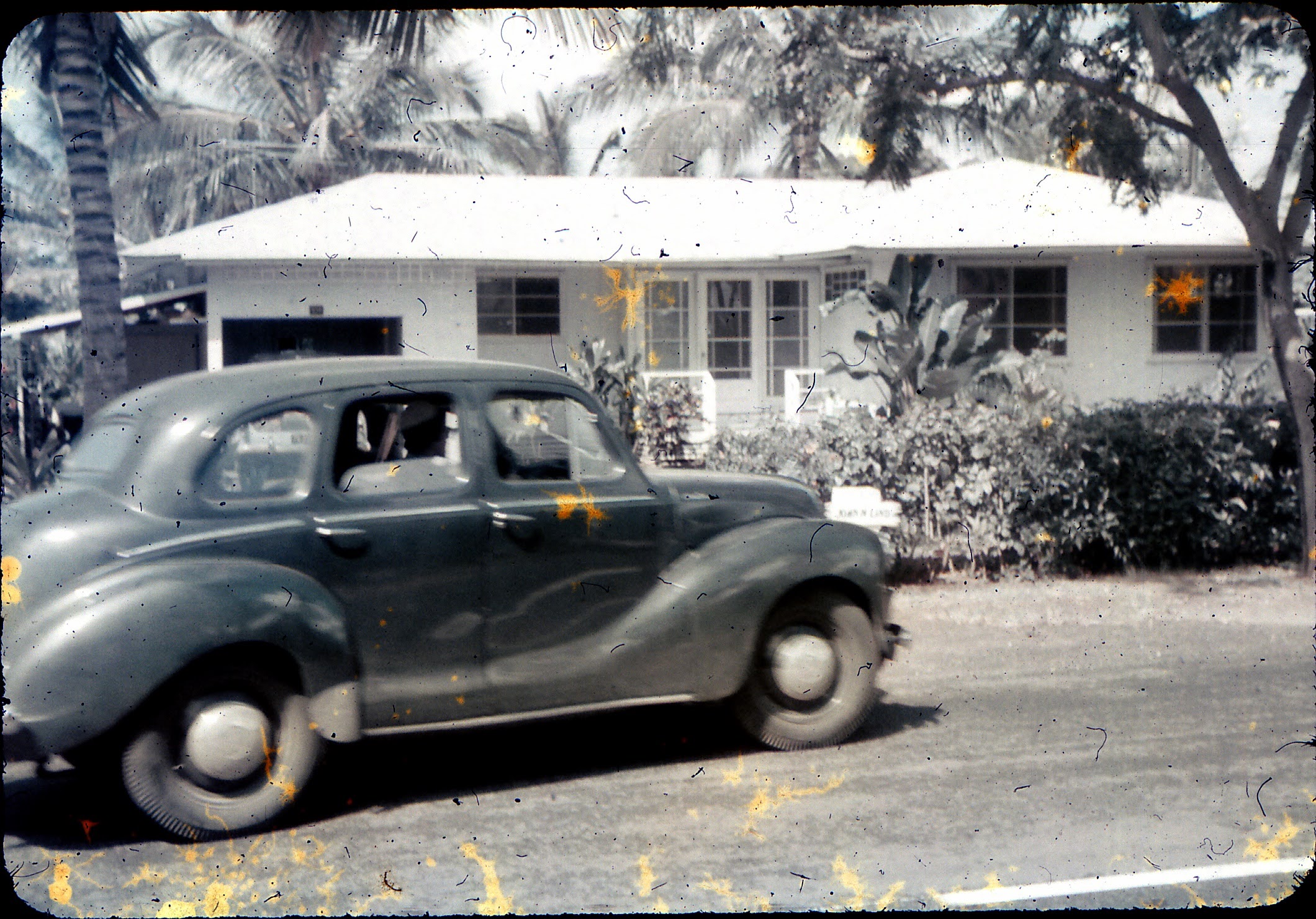 I found the original image of Goliath in a box of my mother’s slides. The color was faded, and some kind of fungus had eaten away at the emulsion, leaving the basic image intact although very washed out, with orange splotches across the frame.
I uploaded a copy of the photo to ChatGPT and typed in a basic instruction: “Clean up this vintage photo, repairing damage and artifacts. Render in color.”
The result was dramatic, now with bold colors, although this first effort had obliterated the bold black letters on the mailbox that spelled out my dad’s name rather than the street address, an interesting sign of the times.
So I gave an additional instruction: “Please repeat the same process, but restore the lettering on the white mailbox visible just in front of the car. It spells out, in black letters, my father’s name: John M Lind”
And that did the trick. It doesn’t look totally correct, but I didn’t know how to phrase an instruction to tone down the lettering so that it looked weathered. Perhaps I’ll try again another time.