Category Archives: Aging & dementia

Another year’s gone by since my dad died

My father, John Montgomery Lind, died just before 2 a.m. on this day nine years go, October 23, 2010. He spent most of the previous two years in the nursing home along Beretania Street in McCully, just a short distance from the where his small restaurant supply business was located for probably 30 years. I was at the nursing home with him until late the night before, but was not there when he passed away in the early morning hours.

In the past nine years, I’ve thought a lot about the things I never got around to asking him, about his life, his relationship with my mother, his relationships with other women, his role in the post-WWII period in Hawaii surfing and canoe racing, and even about the growth of the visitor industry, which he watched as an insider who met and worked with most of the players in the hospitality business while sellilng kitchen equipment and supplies to hotels and restaurants for more than 60 years.

And I have the occasional sense memory of him. We are now living in what had been my parents’ house during most of their 70 years of marriage, and although we remodeled it enough so that it’s not the same, there are still times that I can close my eyes and almost feel him sitting in “his” chair reading the newspaper, or walking from the master bedroom into the hall towards the bathroom, although the door to the bathroom isn’t in the same place after our renovation. Other times, when I’m walking from the living room towards our bedroom, which is still in the same place, I can easily close my eyes and see how it looked when I was just a kid and he returned home after a long weekend day in the sun at some Waikiki Surf Club event, tired, sunburned, and he would retreat into the bedroom and collapse on the bed for a while, and I would hesitantly follow, hoping to lie beside him for a few minutes to maybe hear something about the day as I attempted to feel some fatherly connection, if only briefly.

And now that we walk down the block to Waialae Beach Park every morning before dawn, I can easily imagine being transported back in time to when I was maybe between five and eight years old, and we would finish dinner and, shortly afterwards, he would walk my sister and me down the same street as the evening twilight deepened, and as we passed the park and got to the entrance of the Waialae Country Club, we would be enveloped by the raucous sounds of the hundreds, or possibly thousands, of mynah birds in a banyan tree beside the road where, many mynah generations later, they still carry on in their brash manner, morning and evening. Close your eyes and it could be then, or now.

The world turns.

Here’s a selfie taken with him at the nursing home where I would visit almost daily.

Remembering my mother on her birthday

Today would have been my mother’s 105th birthday. I don’t know if she would have enjoyed living this long.

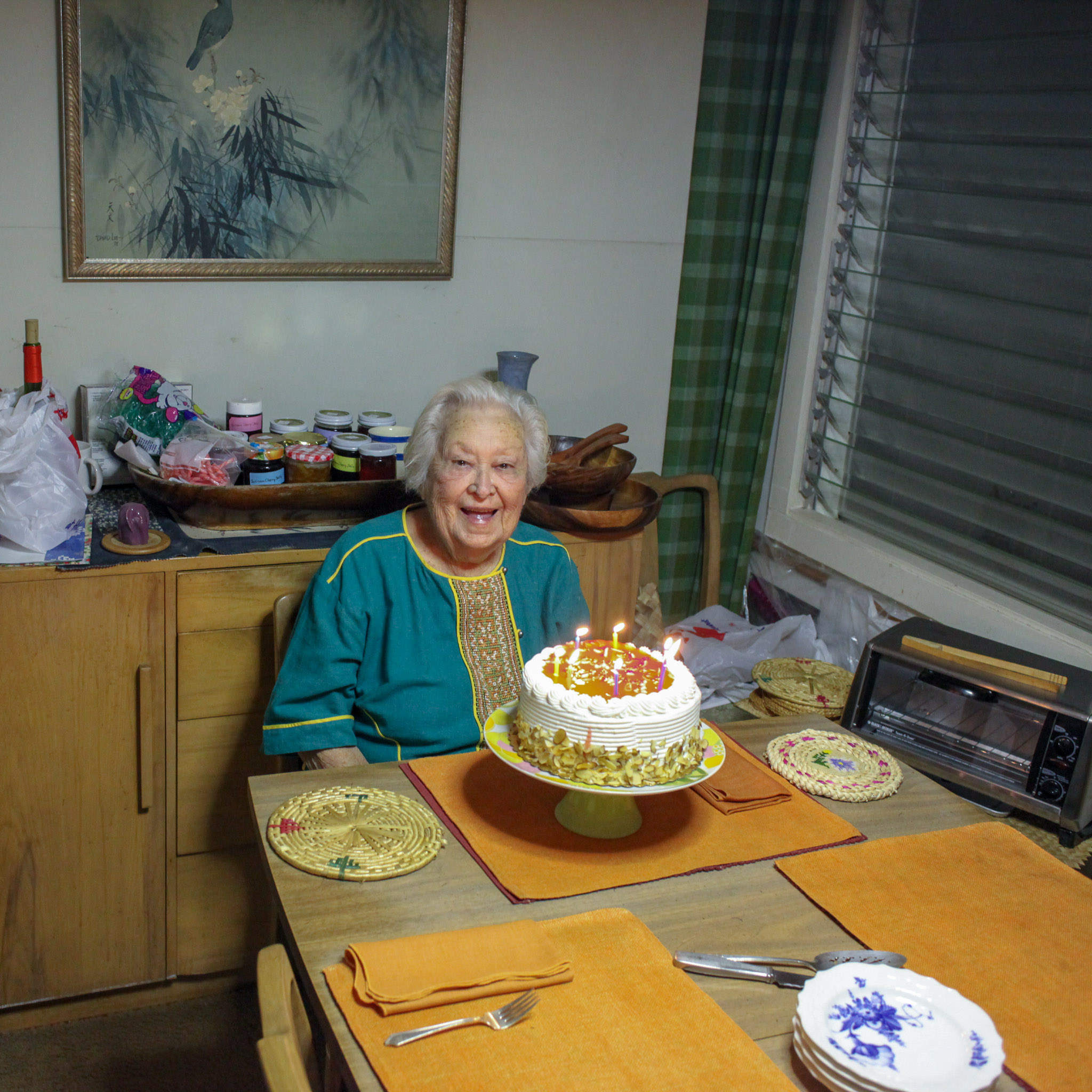
The photo below was taken a decade ago as we celebrated her 95th. She was still very sharp mentally, although slowing down a little physically as a hip replacement down about 20 years before was starting to wear out. On occasion, she would complain all of her friends were gone, and she could, if pressed, list them from memory, how she had known them, who they were related to, who they married, where they had lived, when she had last seen them, and when they passed away.

But this wasn’t a day for complaining. She was enjoying the meal. We all were. Meda and I were there, along with my sister, Bonnie. My mom was laughing as she got ready to blow out the candles on her birthday cake.

This simple photo tells you a lot. Behind her is a large wooden pig bowl that I believe had belonged to her parents. Displayed in it are jars from her latest batch of surinam cherry jelly, orange marmalade, and other goodies cooked in the tiny kitchen she had ruled since they bought the house in 1942. Over her right shoulder is a little purple ceramic elephant, one of her fun and artistic animal creations. Behind her, partially visible, is the neck of a blue ceramic wine decanter, another of her products. On the wall, a David Lee painting on silk she had scrounged at a garage sale. Bits of a good long life, and she was fortunate to enjoy a couple of more good years.

In any case, Happy Birthday to her.

Chicago Tribune investigation tracks nursing home infections, citations

A long investigative story by the Chicago Tribune shines the light on the dangers of sepsis infections in nursing homes across the country.

See: “In Illinois’ understaffed nursing homes, deadly infections persist from bedsores and common injuries that go untreated.”

The “Extra Extra” blog by Investigative Reporters and Editors summarized the report:

A joint investigation by Kaiser Health News and the Chicago Tribune revealed that thousands of older Americans in nursing homes are dying from preventable sepsis infections and offered readers a first-of-its-kind “lookup” that lets readers check infection violations and staffing levels at all 15,616 nursing homes in the United States.

The database tracks “infection related deficiencies and staffing levels for nursing homes that take Medicare/Medicaid. These factors are linked to an increased risk of sepsis infections and are reported to the federal government.

According to the database, two facilities were found to have been cited for the highest level of risk, “immediate jeopardy,” and several others cited for “actual harm.” Most citations involved bedsores or the failure to have or to follow an infection control program.

To check out facilities in Hawaii or elsewhere, go to the Look-Up database and enter the state and/or city or facility that you’re interested in.

It’s an excellent piece of reporting along with a useful presentation of data that should prove useful to many readers.

The death with dignity debate needs to continue

In a March 1 post, I reprinted an earlier column expressing support for legal recognition of our right to choose how and when to die. The post was prompted by an upcoming vote on a limited “right to die” bill that subsequently passed the house. The bill has now been approved by the Senate health committee, and has one more committee hurdle to clear in order to get a vote of the full Senate.

The post drew a quick question, one which exposes the significant limitations of the bill now being considered in Hawaii. I’m posting here for those who don’t follow the comments.

Jim Wright | March 1, 2018 at 8:49 am
How would the change in the law have changed the care your parents received?

Ian Lind | March 1, 2018 at 9:12 am
It wouldn’t have. Neither of my parents had time to consider this kind of option while they were still all there mentally. So the restrictive nature of the bill limits its application. But once in place, I’m guessing it will be easier to amend as experience is gained. We already virtually require people to have a living will or medical directive in which they can select a “do not revive” option. A medical aid in dying bill should ideally allow someone to look ahead and give directions to others to relieve their suffering at a later time if they were then no longer able to make a clear, conscious decision.

A recent Washington Post article looked at the efforts to expand the scope of Oregon’s law (“In Oregon, pushing to give patients with degenerative diseases the right to die“).

Here’s an excerpt, which notes the unusual political twist to the issue.

Rep. Mitch Greenlick (D), chair of Oregon’s House Committee on Health Care, began looking into expanding the state’s Death With Dignity Act a few years ago, when a well-known 78-year-old lobbyist in the capital, Salem, fatally shot himself in the head after learning that he had Alzheimer’s.

“That really shook me up,” said Greenlick, a retired director of the Kaiser Permanente Center for Health Research. “I started thinking, people with Alzheimer’s should be able to have some control over how they die, rather than having to shoot themselves.”

His 2015 attempt to expand the terminally ill window from six months to a year failed. Next year he plans to float another bill that would open up the state’s Death With Dignity law to dementia patients by doing away with all stipulations about terminal time limits.

Some of the efforts have faced opposition from an unlikely adversary: the national right-to-die movement. In particular, groups such as Compassion & Choices, the nation’s largest right-to-die organization, and the Death With Dignity National Center, a main author of the original law, have little appetite for widening access to lethal drugs in the states where medically assisted suicide already is legal.

This can already be done, to some extent, with a combination (not unusual in hospice care) of a strong advance medical directive opting out food or fluids if not able to eat on your own, coupled with liberal doses of morphine after stopping food and water, while the process of dying is rolling on.

As the baby boom generation ages, there are obviously far more of us than ever before contemplating what’s ahead, and how we would each like to manage our final choices. It seems almost inevitable that laws will eventually bend to accommodate our demands.