Category Archives: Business

Following the PPP money

I was on one of those down-the-rabbit-hole online browsing journeys and found myself looking at data identifying the recipients of Payroll Protection Program loans. And, of course, I’m a always interested in taking a closer look when there’s lots of money sloshing around.

So I spent a little time this morning pulling out interesting bits and pieces.

These data are only for PPP loans originated in 2020. Most of these recipients also received a second round of funding in the first few months of 2021, but I didn’t find quick access to those data.

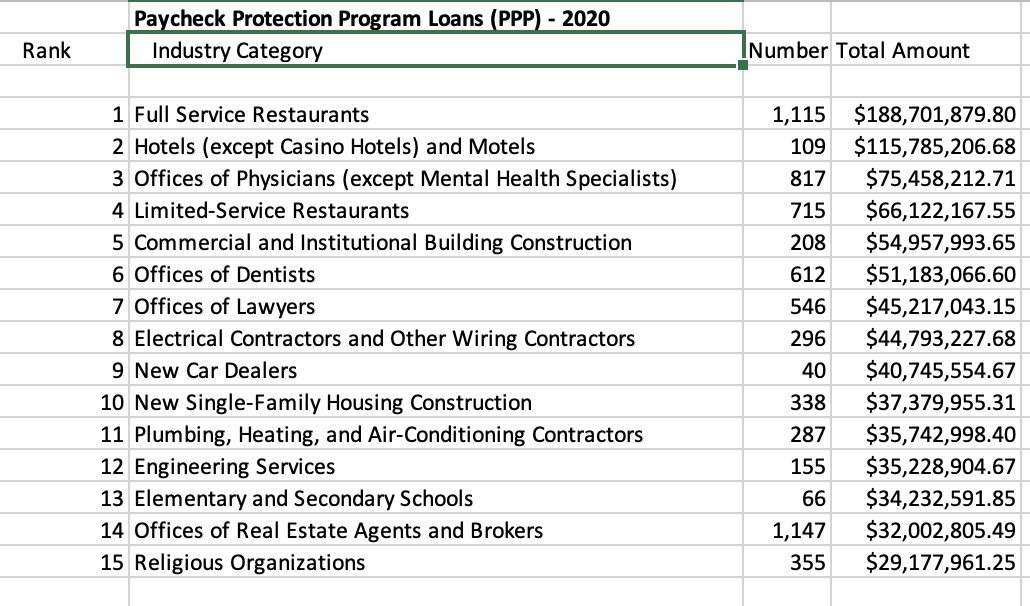
The first table ranks industry groups by the total amount of PPP money received. This is based on the North American Industry Classification System (NAICS) category reported in their original applications, and includes the top 15 industry categories, the number of loan recipients in each category, and the total dollar value of ppp loans made.

It’s no surprise to see restaurants and hotels up at the top of the rankings, and medical professions also right up there.

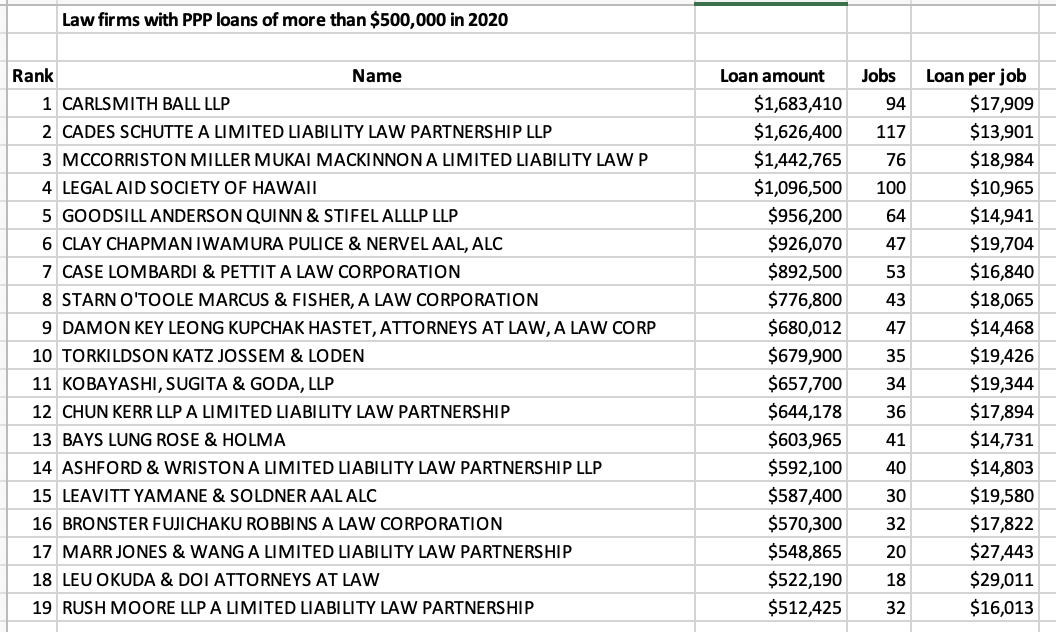
Just for fun, I then looked at the law firms that received the largest PPP loans, again during 2020. This time I added a column dividing the values by the number of jobs reported to be saved due to the loan. It certainly appears that the bigger law firms did well for themselves.

Then I wondered about those religious organizations. Again, here are the top recipients of PPP loans in that category.

Later I’ll try to pull out the numbers for nonprofit organizations to see how they fared.

Measuring tourism’s impact

Over the past year, as local residents realized the absence of tourists, while financially painful, had other benefits. Areas usually overrun by visitors were suddenly available for us to enjoy without the overcrowding, causing a reassessment of the central role that has been ceded to the visitor industrial complex in recent years.

There are now attempts to sell minor tweaks to better regulate use of heavily impacted resources, from Diamond Head to Hanauma Bay and beyond, as if that will be enough to satisfy the hunger for a reshuffling of priorities when it comes to tourism.

I woke up yesterday morning and saw this article in the travel industry news site, Skift.com. There’s a pay wall, but Skift allows nonsubscribers to read three stories for free.

Here’s an excerpt from the Skift article, “Why Tourism Desperately Needs a New Performance Metric Post-Pandemic,” by Lebawit Lily Girma
– Mar 23, 2021 2:30 am

Since Covid, platitudes on greening and reinventing tourism have echoed globally across the industry. A general consensus exists among destinations and tourism businesses that the industry must “build back better.”

It’s not a novel debate. It rings that way now because of the pandemic’s brutal impact on travel. But let’s take at face value — once more — this industry-wide clamor to make travel more sustainable. How will tourism determine “building back better” on the other side of recovery? Surely it cannot continue pretending that its success lies in arrival numbers and contributions to gross domestic product?

Yet as vaccine distribution accelerates and consumer confidence rises, governments are already back to projecting visitor numbers and counting tourism jobs recovered, while comparing performance levels to 2019.

Pay attention to that last sentence, because it describes exactly what is already happening here in Hawaii: “Yet as vaccine distribution accelerates and consumer confidence rises, governments are already back to projecting visitor numbers and counting tourism jobs recovered, while comparing performance levels to 2019.”

That’s exactly what we’ve been getting here, repeated news accounts of visitor arrival numbers, airline passenger loads, hotel occupancy rates, visitor tax revenues. All of the traditional ways of measuring tourisms impacts. And all that avoid the lingering question, how are the lives of Hawaii residents impacted by this industry, are we better off as the industry “recovers”?

The Skift story goes on:

What’s also baffling is that an industry relying on people-to-people exchanges has mostly omitted measuring success according to locals’ sentiments about tourism. Instead, most governments have remained focused on the incoming tourist’s satisfaction.

“How do we measure acceptability of tourism in a destination? We identify places and we don’t even know if these people welcome tourism because we go there with a bag of goodies,” Kopher-Gona said, referring to promises of resort jobs as an example. “We’ve not asked them if they have welcomed tourism.”

Perhaps, as the article suggests, in addition to measures like visitor arrivals and spending, we also need to also use measures of income inequality, poverty, housing affordability, number of residents per household, and so on, when evaluating the impact of tourism.

Definitely food for thought.

Those CPB ads are right on target

It’s quite a trick. Take a series of negative ads aimed at your corporate competitors, and give them a little spin that turns them into charming moments.

Am I the only one really impressed by the series of television ads being run by Central Pacific Bank? These use simple cartoon representations of a couple of guys sitting around talking, using simple language and a pidgin accent to express frustration with one of the “big” banks. Moving over to CPB is offered as the solution.

The ads use examples of small but common insults, the kind that are not rare in the world of banks. And then they get right to the point, as one character recounts reacting to the insult by telling the guy at the bank that he now wants to close his account.

The characters chuckle over little things, giving a warm overlay to the underlying negative barbs about the competition. I find the series charming.

In this particular example, the narrator opens an account and then says he wants a roll of quarters. The banker says no can do–“You have to have a business account.” So the narrator says, “Okay, I want to close my account…I’m serious!” In another, the narrator says he wants to take out all his money, “all five dollars.” And then he went over to CPB.

I’ve been there and I know that feeling, despite our long history with a particular big bank. I expect that walking through the thought process of actually closing a bank account and moving to another, more friendly bank, might actually encourage people to consider it. Just what CPB wants.

In my view, these ads really hit the mark. It makes me curious to find out what agency came up with the idea and produced them. I went looking online, and couldn’t find the answer, which surprised me. Maybe others will have more success.

You can view more of the series on YouTube. Just search for “Central Pacific Bank.”

On a side note, CPB recently named former mayoral candidate Keith Amemiya executive director of the CPB Foundation.

Stadium redevelopment aims to bring Waikiki tourism to Aiea

The redevelopment of the Aloha Stadium relies on a vision of extending tourism from Waikiki to a new visitor playground on the site of the old Aloha Stadium, according to the project’s draft environmental impact statement. The EIS makes clear the “entertainment district” concept is driven by the perceived opportunity to extend Waikiki’s brand of tourism out to Aiea.

At the same time, the lengthy pause in tourism imposed by the pandemic offered the rest of us a vivid lesson in the negatives impacts of mass tourism, and has generated lots of talk about the need to control and limit tourism in the future. None of that discussion and debate appears to have informed the EIS in any way.

Instead, the EIS discloses that the stadium redevelopment plan continues to define the expansion of Waikiki tourism to this new part of the island as wholly positive and justified.

The existing retail in the region predominantly serves local households and employees but does not serve the broader tourist market, which is responsible for a major portion of the State’s economy. The nearest, notable, clusters of retail include the Pearlridge Shopping Center. However, the Leeward Honolulu submarket lags behind the more tourist-serving Central Honolulu submarket (Victus, 2019). A vibrant and exciting retail destination will be crucial to the Proposed Action’s commercial viability and success, contributing towards the creation of an attractive destination that not only serves local and onsite households / employees and visitors to the New Aloha stadium, but that will also draw in tourists as well as residents from across the entire island of O?ahu that may have otherwise not considered visiting the submarket.

Did you get that? Existing retail stores serve locals, but “don’t serve the broader tourist market” and as a result the area “lags behind the more tourist-serving Central Honolulu submarket.” Planners are making clear they see that as something wrong that needs to be fixed. And the fix is to “draw in tourists” from other parts of Oahu.

This is seen as important enough that it was emphasized in the EIS, with at least one hotel proposed “significantly increase the area’s desirability from a hospitality perspective….”

Moreover, the island of O?ahu continues to be one of the most attractive and healthy hotel markets in the country. On the island, Waik?k? is the preferred hotel submarket but, other resort areas with unique amenities or activities are becoming increasingly viable hotel destinations that offer a value alternative to Waik?k?. The Proposed Action could significantly increase the area’s desirability from a hospitality perspective contributing to the vibrancy of the Proposed Action. A hotel at the Project Site could serve potentially over 1.5 million annual visitors to the Aloha Stadium; furthermore, the Proposed Action could potentially serve as a catalyst for growth in visitation, attracting tourists and visitors to the Project Site retail and mixed-use environment that would have otherwise not considered coming to the submarket.

Let me translate–a “hospitality perspective” refers to a perspective from within the tourism industry. So get ready, Aiea!

There are a few other revealing items to be found in the EIS.

The need to replace the aging Aloha Stadium is clearly the basis for the perceived “need” for the project, as well as the sense of urgency that is pushing it forward at breakneck speed in a manner that forecloses thorough public consideration of the issues and options.

Here’s how the EIS puts it:

The existing Aloha Stadium has stood for over 44 years and is deteriorating structurally, with numerous deferred maintenance issues. It has fallen out of compliance with current accessibility and building codes and lacks the amenities of other modern stadiums. While it was once hailed as a first-class, state-of-the-art facility, the existing Aloha Stadium has effectively served its mission as a gathering place well beyond its practical life-span as a multi- purpose venue. Its numerous unaddressed deferred maintenance items are contributing to its obsolescence, and substantial ongoing investment is required to keep it functioning, accessible, and safe for public use.

In other words, at some point the cost of ongoing maintenance just doesn’t make sense any longer, and it isn’t unreasonable to think we’ve reached that point.

So who is affected if the stadium becomes unavailable due to safety concerns?

As I recall, most of the discussion was about the fate of University of Hawaii football, as policy makers recoiled from the spector of our Division 1 football team without a home field to play on.

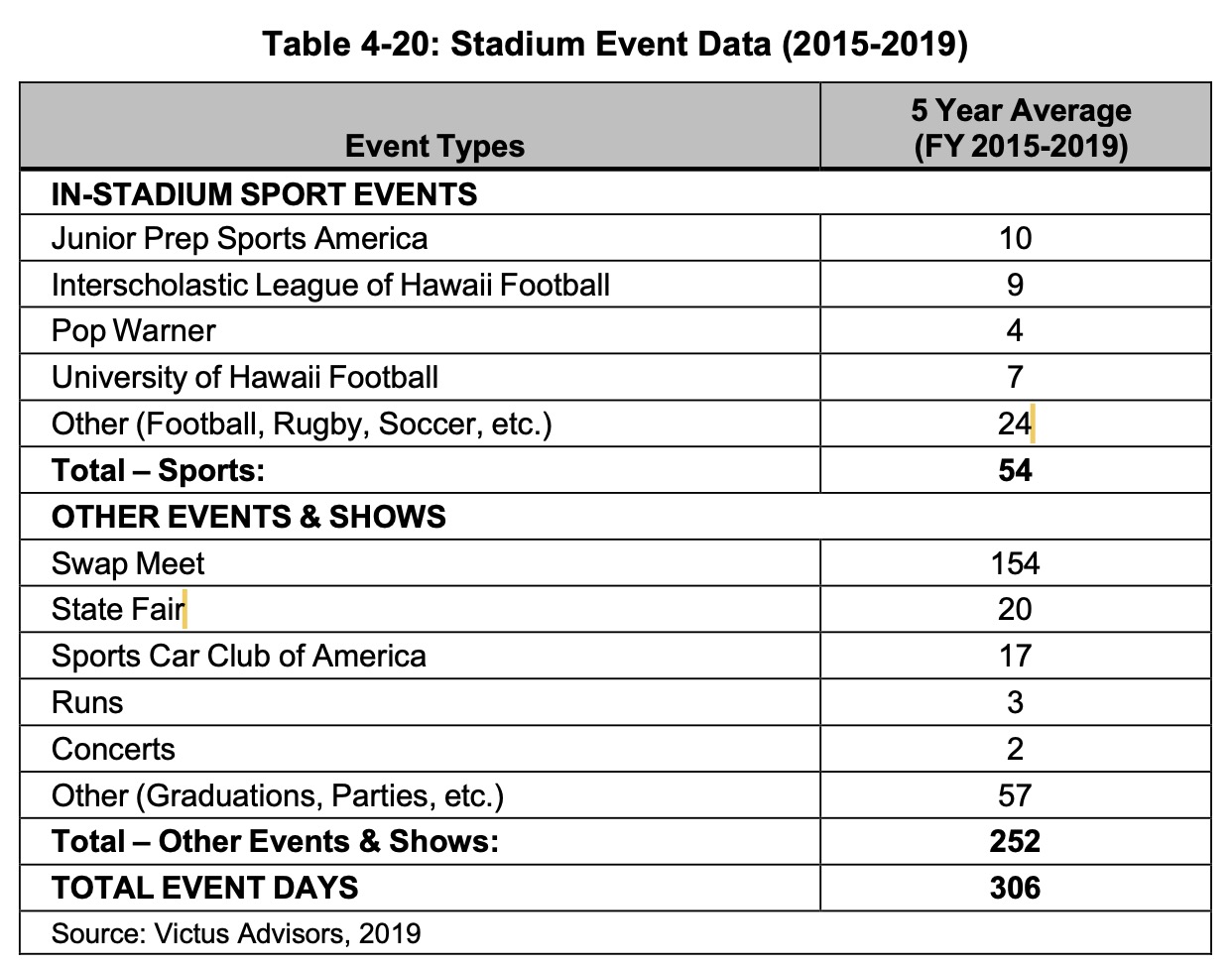
Of course, UH is not the only user of the stadium, but for more than 40 years it has been the most consistent user, and up until the past couple of months appeared to be the one with the most to lose of Aloha Stadium were to become unavailable. Here’s a list of stadium users that appears in the EIS.
The “time critical and time sensitive nature” necessitating cutting corners procedurally to rush it forward was based on “escalating construction costs and mounting deferred maintenance expenses tied to the continued operation of the existing Aloha Stadium.” Essentially, we would have to keep investing in the old stadium until a new field were ready for UH, and so anything that could be done to speed the process seemed justified.

Then the Stadium Authority threw that plan book out the window, declared Aloha Stadium closed, and forced UH into a last-minute search for an alternative. And by all accounts, they have developed a workable plan, at least for the short term.

At this point, with UH out of the picture, the rationale for unusual haste, and the secrecy it creates, is no longer valid.

Meanwhile, the EIS assures us the selected developer will be required to comply with all current affordable housing requirements. But that approach has done nothing to ease our affordable housing crisis. Kakaako is case in point. Current requirements are simply inadequate. If affordable housing is indeed a crisis, the Aloha Stadium site represents a unique asset, and utilizing it effectively can make a significant contribution to meeting the obvious public need.

See:

Stadium redevelopment plan’s legacy of deceit,” iLind.net, February 25, 2021.

A dissenting view of the Aloha Stadium redevelopment,” iLind.net, March 2, 2021.

New Aloha Stadium Entertainment District website

Draft EIS New Aloha Stadium Entertainment District, Vol. 1

[Additional volumes, download from the Office of Environmental Quality Control]