Category Archives: Business

Can a convicted felon operate a nightclub?

A two-part comment on yesterday’s post questions how a Miske-related company was able to obtain a liquor license despite his status as a convicted felon.

You published a Civil Beat article in August 2020 detailing all of Miske’s convictions. By 2011/2012 if I understood that article correctly he already had multiple convictions including a felony. If that’s the case, how could the following have occurred:

1) Liquor license awarded to Hawaii Partners LLC / Leverage LLC with Miske as a minority owner. This is a State/City question.

2) Waterfront Partners LLC / Shidler Group (M Nightclub’s landlord) allowed a business with a convicted felon minority owner to sign a lease to run a nightclub with a liquor license. This is private matter, concerning a landlord who looked the other way to make money, and in the process endangered the lives of hundreds of innocent people including neighboring business owners who sometimes got caught in the crosshairs of Miske’s ambitions.

The quick answer to the first part is that state liquor law allows a license to be issued to a corporation or partnership which has a member, partner, or stockholder who is a convicted felon, as long as their interest is less than 25 percent, and the others are “fit and proper” persons found to be qualified to hold a license.
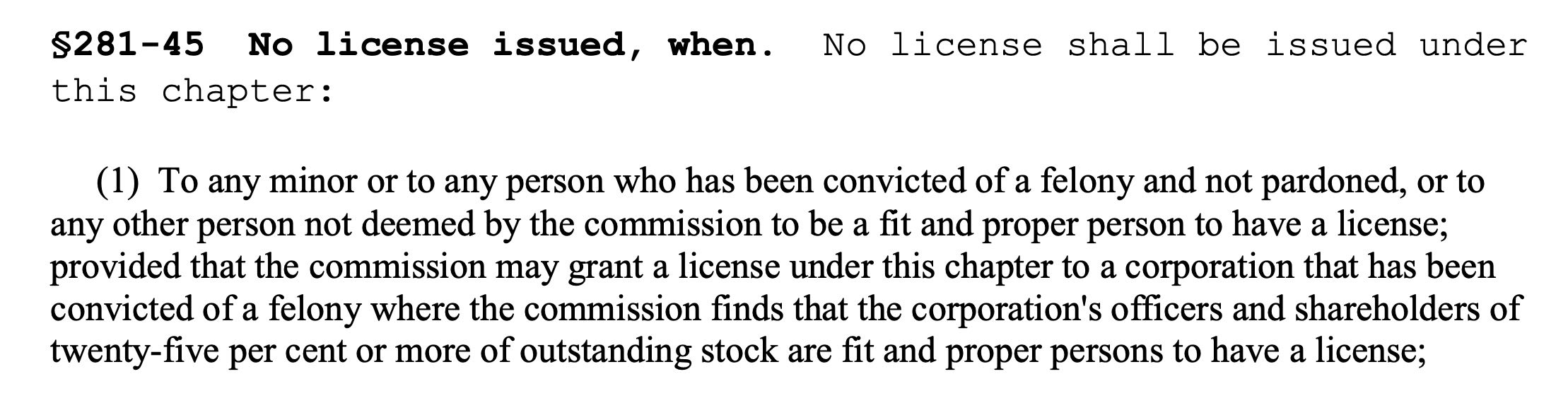
This means that as long as Miske only held a 20 percent interest in the nightclub, as reported to the Honolulu Liquor Commission, granting a license was in line with the commission’s rules and state law.

In this case, of course, prosecutors allege long after the fact that Miske actually controlled the company holding the license for his M Nightclub, although the application claimed he held only a 20% interest, raising questions about how such matters are investigated by the commission.

There’s nothing on the public record to indicate where Jason Yokoyama, who on paper controlled 70% of the company, would have come up with his share of the original investment if it didn’t come from Miske. In 2011, the year before M Nightclub opened, Yokoyama worked for Miske’s Kamaaina Termite. He testified in a later court case that he had no experience with a nightclub before before becoming the majority owner of M Nightclub. There were no loans recorded at the Bureau of Conveyances to Yokoyama, or his companies, including Leverage Inc. and Leverage Entertainment LLC.

As to the question of liability on the part of the landlords of Miske’s M Nightclub, there is no indication that “a landlord looked the other way to make money.” The club was legal, at least on its face. However, several victims of a 2016 attack by bouncers at the nightclub brought a civil suit against the nightclub, its corporate owner, and the landlord and landowner, including Trustees of The Estate of Bernice Pauahi Bishop dba Kamehameha Schools, and Shidler Investment Company, LLC, dba The Shidler Group. These defendants settled last year, and were dismissed from the case.

Leverage Inc., the corporate owner of M Nightclub which prosecutors allege was actually controlled by Mike Miske, later pointed the finger for the assault that night at Michael Buntenbah, and asserted Buntenbah was not an employee of the nightclub, and in fact was rarely at the nightclub. In a sworn deposition, Yokoyama described the two as having “a working relationship,” and did not explain why Buntenbah had not had to pay to enter the club, and was in a rear area of the club off limits to all except staff and guests.

At one point, Yokoyama started explained, “We were both friends of…,” but stopped before finishing the sentence. He was not asked whether they were both friends of Miske.

Buntenbah’s attorney in the federal criminal case said he had been employed as a bouncer at the club, despite Yokoyama’s claim to the contrary.

The Michigan-based attorney, Gary Springstead, said one of the charges against Buntenbah, conspiracy to commit assault in aid of racketeering, “is related to Mr. Buntenbah’s employment as a bouncer at a night club – a role that carries an inherent risk of physical altercation.”
I don’t recall seeing this reported here

The case of a visitor from the Czech Republic who caught Covid-19 while visiting Hawaii is making news elsewhere, but has apparently remained under the radar here.

I saw the case referenced in a New York Times column on Monday (“ Don’t Want a Vaccine? Be Prepared to Pay More for Insurance”).

Getting hospitalized with Covid-19 in the United States typically generates huge bills. Those submitted by Covid patients to the NPR-Kaiser Health News “Bill of the Month” project include a $17,000 bill for a brief hospital stay in Marietta, GA (reduced to about $4,000 for an uninsured patient under a “charity care” policy); a $104,000 bill for a fourteen-day hospitalization in Miami for an uninsured man; possibly hundreds of thousands for a two-week hospital stay — some of it on a ventilator — for a foreign tourist in Hawaii whose travel health insurance contained a “pandemic exclusion.

When I looked further, I quickly found the original report by Kaiser Health News, which reported on the case in May (“Tourists, Beware: Foreign Visitors’ Travel Health Insurance Might Exclude Pandemics
”).

Vlastimil Gajdoš, a visitor from the Czech Republic, appealed to his own government after his travel insurance company gave notice they might not cover his bill for two weeks in Queens Hospital due to a “pandemic exclusion” in the policy’s fine print.

Gajdoš…reached out to the embassy and his employer for help after his travel insurer denied him coverage. The employer pledged to help him if his plan did not cover his hospital stay, he said, but the government intervention worked. The insurer ultimately agreed to cover Gajdoš’ expenses.

The couple would not disclose the final tally for Gajdoš’ hospital stay, but a typical 10-day course of treatment in an intensive care unit can run into several hundreds of thousands of dollars.

He was discharged from the Queen’s Medical Center on April 8, grateful for the care. Gajdoš said his insurer’s actions caught him off guard. He intentionally purchased a more expensive policy with the expectation that they would receive help, not pushback, from the plan.

I suppose that’s news which might not be well received by the visitor industry as it has been promoting Hawaii as a relatively safe tourist destination.

PPP loans in Hawaii: Restaurants

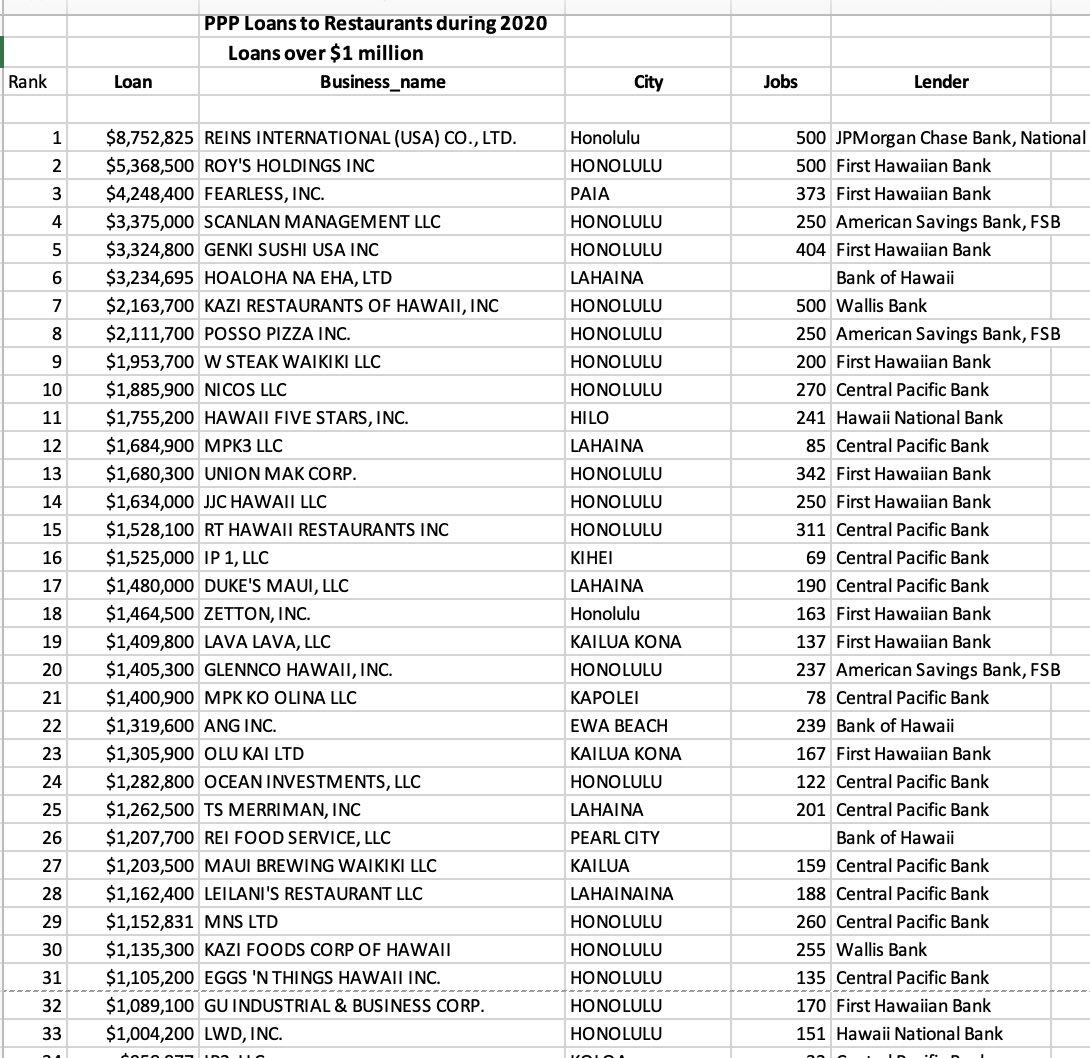
Continuing this exploration of last year’s PPP windfall, the first round of PPP loans. There was a second round this year, which most of these businesses likely took advantage of as well. But that’s another story.

The “Full-service restaurant” category ranked #1 among all industries in the total amount of PPP loans made in Hawaii.

I decided to combine that with a couple of other restaurant categories to include “limited service restaurants” and also cafeterias, grills, and buffets. That pretty much covers the restaurant category, I think.

This list is very top heavy. A total of $254,960,620 in loans was made to 1,834 businesses in these categories.

There were 33 that received loans of more than $1 million. This group made up just 1.8 percent of all the restaurants that obtained PPP loans.

But that 1.8% of the recipients raked in 26.5% of the total loan value.

The full list of all 1,834 businesses in the various restaurant categories can be found here.

PPP loans to organizations listed as “non-profit”

There were 912 organizations in Hawaii that listed themselves as “non-profit” and received Paycheck Protection Program (PPP) loans during 2020 totalling over $213 million. Most likely received similar amounts in the second draw of the PPP loan program in 2021.

The list is heavy on health care, education, and community services of all kinds, again joined by churches.

Ranking #1 and #2 on the list according to loan amount were Hale Makua Health Services on Maui, and Mid-Pacific Institute in Honolulu, which both received more than $5 million in 2020.

The top 30 loan recipients are shown in the table below. These comprise just 3.2% of all the oragnizations funded, but accounted for 39.9% of all PPP loans made during 2020.

Click on the table to see a larger version. This includes the lender of each loan made.

To view the full list of 912 non-profit organizations and the amount of PPP funding each received, click here.