Category Archives: Computers

Still working on those campaign data

It’s proving harder than I expected to clean up the campaign contribution data enough to create a relatively reliable list of those individuals who are reported to have contributed the most to candidates during the first six months of the year, and then to go further and aggregate them by employer.

I was ready to post a list this morning, but spotted that the numbers didn’t aggregate properly.

So back to the drawing board.

In the meantime, here are some nice photos from earlier this morning. I know, it’s not what you’re looking for, but it will have to do for now.

Bits and pieces of dawn

By the way, I never did find a good substitute for Filemaker as a database for analyzing large data sets on a Mac, and ended up having to bite the bullet and invest in the latest version of the high-priced software. I’ll consider it a birthday present to myself.

Browsing the State Ethic Commission’s online disclosure system

The deadline for filing annual gift disclosures by legislators and state employees was on Monday, July 1, so I took a few minutes to check out the State Ethics Commission’s Online Public Documents System.

The commission and its consultants struggled for a number years to implement a robust disclosure system that includes effective online public access. The current system went “live” at the beginning of 2018 and has been phased in over time.

The system now provides public access to financial disclosures, candidate financial disclosures, gift disclosures, and different kinds of lobbyist disclosures.

So I went to the disclosure homepage and selected “Gift Disclosures,” then “2019 Gift/Travel”. While the page is loading, the system displays a logo, “Powered by Salesforce”. Following that is a copyright notice, “Copyright 2019, State of Hawaii, All Rights Reserved.”

What in the world does that mean in a system displaying public records? I haven’t the faintest idea, since it’s not referring to the underlying computer software. Anyway, I guess that qualifies as issue #1.

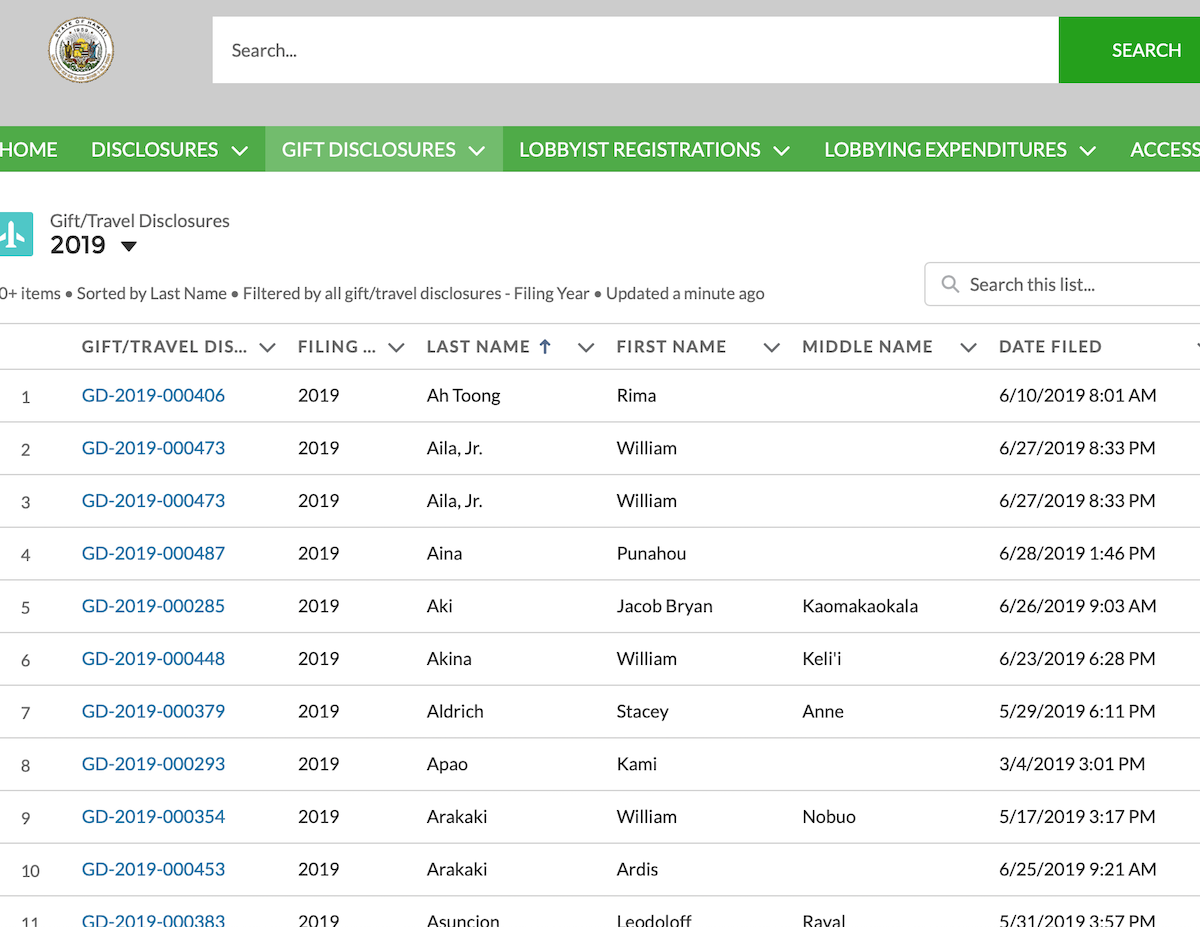
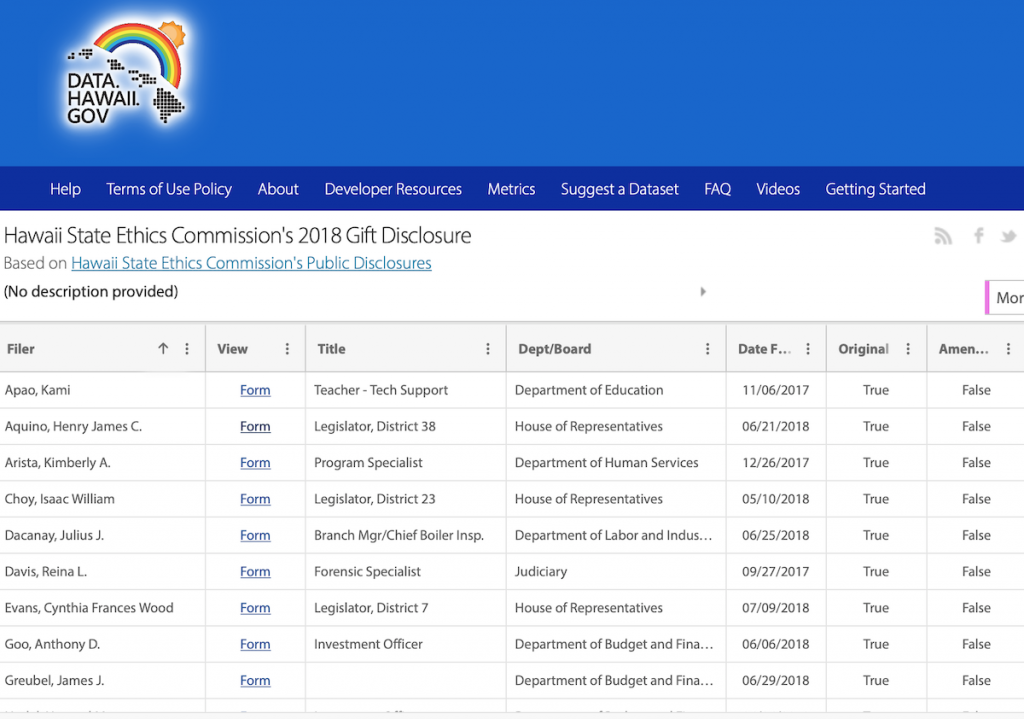
The first page of data is a list of those filing disclosures. It looks like this.

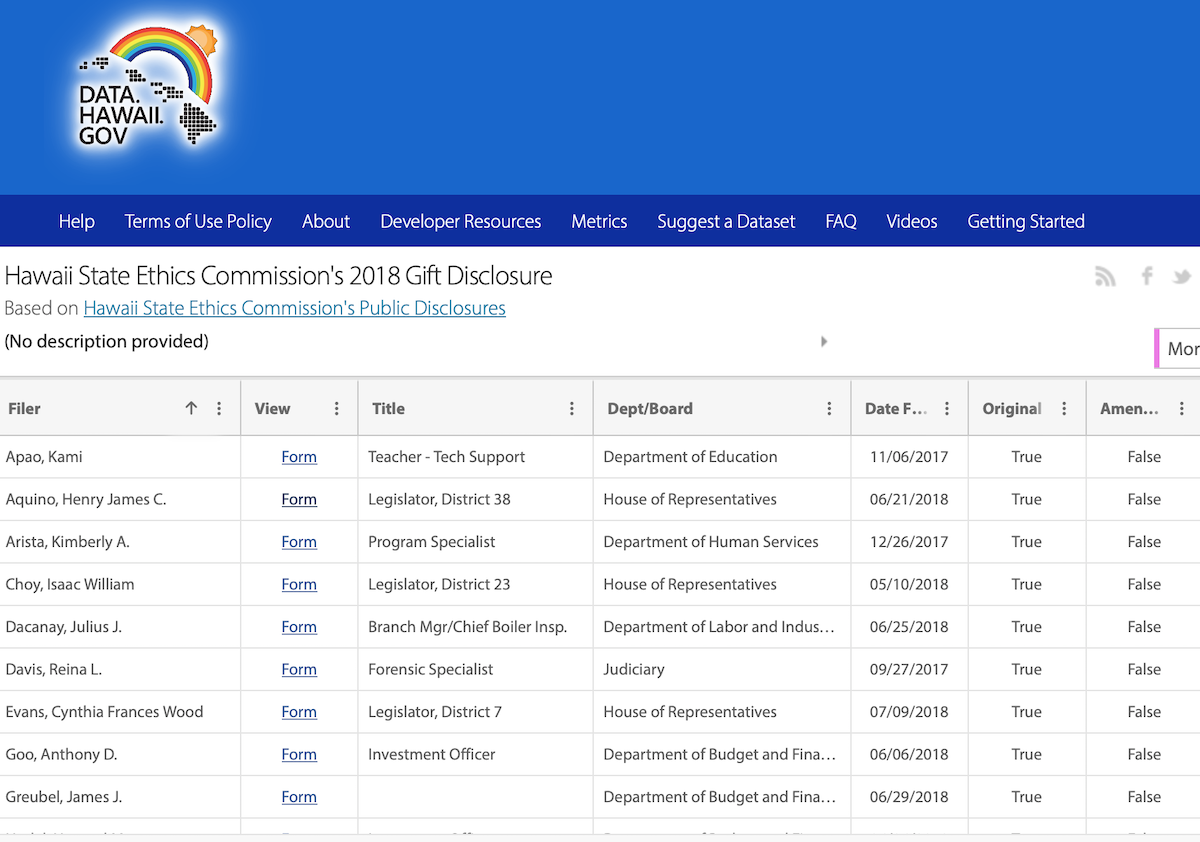
The first problem is that you probably don’t know who a lot of these people are, and they aren’t identified by job title or department, at least not when the list first comes up. We’ll call that issue #2.

The previous system was, in this regard, much more user friendly, and presented both bits of information–job title and department–in the top level listing.
But let’s push ahead in the new system. There are two filings by William Aila, submitted just two minutes apart. The second is identified as an amendment.

Clicking the amended form, you see that Aila reported no gifts received during the year. But keep in mind that since state law only requires disclosure of gifts valued at more than $200 from the same source, there might be additional gifts that fall below the disclosure threshold.

Also notice that Aila’s position is not listed in the top level of information, but below in a separate section, “State Position.” On my laptop, I have to scroll down just a bit to see that.

Since Aina reports no gifts, I’ll go back to the list and select someone who likely did receive disclosable gifts.

Issue #3. I click to go back to the list. It takes perhaps seven seconds to reload the list. If you really want to check more than one or two names, this is going to get very tedious.

Scrolling down, there’s the Attorney General, Clare Connors. Click on the link to the left of her name, and a form comes up showing she received a gift valued at $1,240.09 that was reported in 2019. The time needed to search for and load the form seems to vary.

Scroll down again, and there’s a summary line showing each gift/travel item.

Click on the link, and after a few ore seconds you’ll see a screen with details, including the full description and the date received.

So let’s say you want to browse through the gift disclosures filed by members of the state senate. How do you do that?

Let’s find out. There’s a search box at the top of the list. I enter the search term, “senate”. Press return.

The screen dims for a few seconds, and then comes back.

Blank. “0 items” found. So that search doesn’t work. Then I noticed over on the right, a symbol for “filter”. I clicked that. No help. “Locked Filters” is the message displayed.

So I’m pretty much at a loss about how to narrow the list of filers to members of the Senate, House, particular departments, etc. And without that ability, the system doesn’t seem useable.

Fiddling around, I found that the search function will find a particular name. So I search for “Ige” to see the governor’s gift disclosure.

Again, “0 items.” It seems the governor’s gift disclosure hasn’t been made public yet, or hasn’t been filed.

Well, so far this has been an exercise in frustration. I’m hoping that I’m missing something important here, and that if I were just a bit sharper, I would have immediately been able to focus down on legislators, or officials of the university, or other subgroups, and then quickly do a preliminary scan through their reported gifts.

At present, though, the system doesn’t seem to lend itself to that kind of review.

Please, someone tell me I’m wrong.

Legal records creating potential safety hazard for state courts

Law suits, criminal prosecutions, and the legal proceedings of all kinds produce mountains of paperwork. And after years of relative neglect, all that paper could appears to now pose a hazard to both court workers and the public.

The potentially dangerous conditions are apparent in the public records room at Honolulu’s 1st Circuit Court on Punchbowl Street. This is where the public has to come to inspect the original, certified legal files produced in civil and criminal court cases. Obviously, in our litigious society, keeping up with the ever-growing amount of paper is difficult but vitally important.

But document storage and retrieval is one of those areas in which the Judiciary appears to be falling further and further behind, most likely because of budget constraints. Despite the fact that certain types of files can now be submitted electronically, with documents filed and available online, the paper records keep stacking up.

Eventually, boxes of older files are supposed to be moved to storage, and then scanned. In the meantime, they fill more and more of the space in the public records room and elsewhere in the court building, as well as in rented spaces off site.

It’s now appears to have gotten to the danger point. If a fire were ever to break out, both employees and the public would be at risk.

Remember back in the 1990s when the Honolulu Fire Department released scathing inspection reports showing that “every Oahu high school was found in violation of minimum state fire-code standards,” according to a February 1992 headline in the Honolulu Advertiser?

HFD inspections at that time found that most Oahu public high schools at the time had “unsatisfactory” fire alarm systems, and had a number of other common dangers, including blocked fire exists, missing or broken fire extinguishers, improper storage of flammable materials, and poorly maintained electrical appliances.

If fire inspectors would pay a serious visit to the public records room at Honolulu’s First Circuit Court on Punchbowl Street, I’m sure they would find much the same thing.

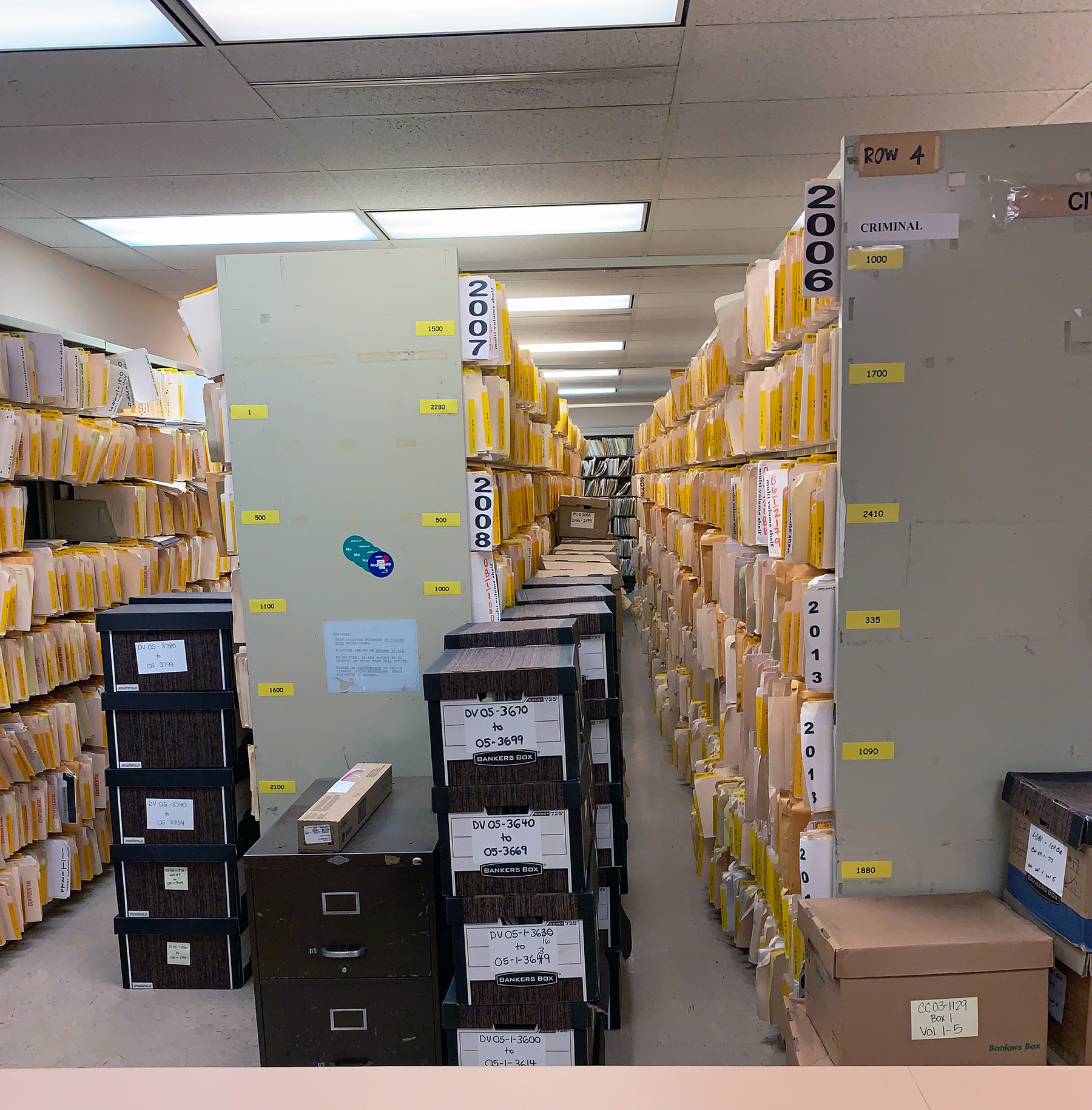
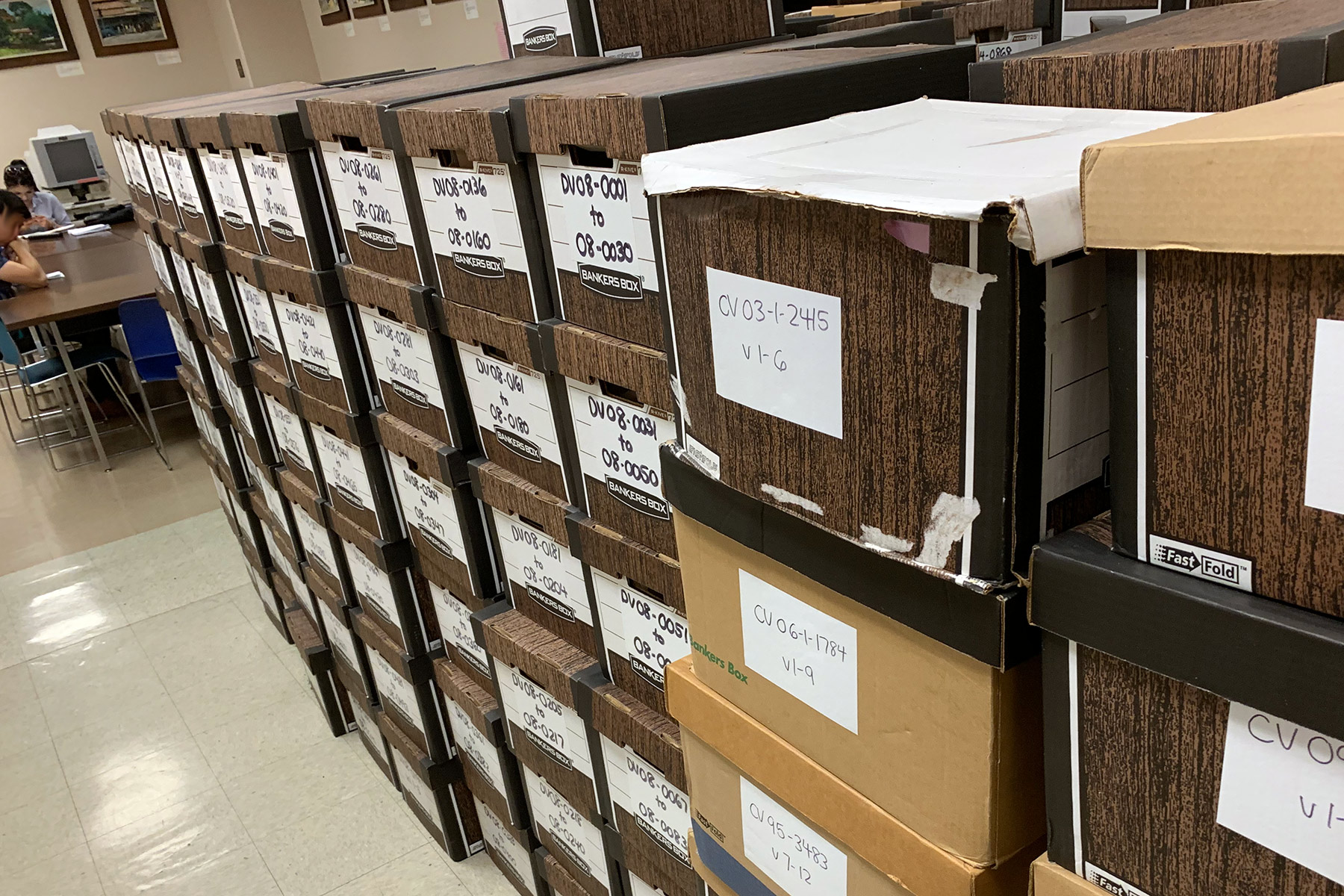
Here are a couple of photos taken in the public records room when I stopped by last month to check out a couple of recent civil lawsuits.

The top photo shows the staff-only area separated from the public area by a counter that runs the length of the room (a bit of it is visible in the foreground. Case files are stored on the tall shelves that fill the room. Older files are stacked in boxes within the rows between shelves.

It has gotten to the point that staff searching for a particular case can’t easily walk up and down the rows. They now have to squeeze past the boxes of older records to get to more recent ones.

The bottom photo shows the area just inside the public entrance to the file room. As you enter or leave the room, you walk past more stacked storage boxes filled with paper files. I didn’t count, but judging from the photo, there are probably close to 300 boxes that fill the corner just inside the entrance. If a fire were to break out there, the only visible public exit would be blocked.

I’ve been told court workers have complained about the situation, but that hasn’t been enough to prod judiciary administrators to make cleaning up this mess a priority.

And I would also guess that the court building, like other older state facilities, relies on extension cords and other makeshift arrangements to make up for the lack of a modern electrical system. Typically, you will find those extension cords running behind, under, and around furniture, equipment, and carpets in order to power coffee cups, computers, desk lamps, and other electrical items. To a fire inspector, I would guess it’s not a pretty sight.

And I seriously doubt the neighbor island courts have it any better.

The Judiciary has made several attempts in the past to address the situation. Back in 2003, the courts launched what they hoped would be a modern data system that would include digital imaging of paper records that would be available to the public.

Today, appellate and criminal cases use an electronic filing system, but the sprawling civil court system still generates those mountains of paper.

Rollout of new state payroll system almost complete

The State of Hawaii is in the final stages of its rollout of a new payroll system, which provides modern tools for managing time and payrolls, and also allows employees direct online access to their payroll information, from bank and direct deposit info to tax forms and pay statements.

The Department of Education and University of Hawaii are the last departments to switch over to the new system, which will happen in time for the January 4, 2019 pay day.

This apparently represents a two-month delay, according to the Hawaii State Teachers Association.

The system was originally scheduled to be implemented in October with Nov. 5 paycheck being issued under the new system.

However, just as HSTA was set to help provide our own reminders, the state announced that HawaiiPay implementation for the DOE and charter schools with DOE payroll services will have a delayed implementation.
The State of Hawaii has determined a schedule extension was necessary to allow for additional testing before going live on the new Hawaii Information Portal (HIP). The Hawaii State Department of Education (HIDOE) and the University of Hawaii concurred.

Currently, the delay is pushed back to implementation in December with the first paycheck under the new system to be issued January 4, 2019.

There is one additional little detail that could cause confusion. Employees that have their paychecks deposited directly into bank accounts will have to reenter their financial institution and banking information directly into the system in order for direct deposits to continue uninterrupted. UH employees have been given a short window from December 3-14, 2018 to log into the system and provide the required information. Since this includes the last week of classes as well as finals, always a busy time of year, I would guess that a lot of people might miss the deadline.

A letter sent to state employees earlier this year explained the problem.

Unfortunately, your current bank and credit union direct deposit details are not formatted in our old payroll system in such a way that they can be moved to the new Hawaii Information Portal. We need you to set up your direct deposit(s) by using Employee Self-Service. This will ensure that your first paycheck from the Hawaii Information Portal is electronically deposited into your bank or credit union.

Hmmmm. It would be interesting to hear more about why that transfer of data from the old system to the new system couldn’t be done as part of getting the new system up and running. Was this really a technical impossibility, or simply something that wasn’t included in the specifications for the project?

And the University of Hawaii Professional Assembly, the faculty union, reports that its members recently faced a series of payroll problems that were likely exacerbated by the shortcomings of the outgoing computer system. According to an August 2018 post on the UHPA website:

The last four faculty paychecks illustrated the problems within DAGS and the ongoing issues when a state agency doesn’t know UHPA and takes some authority away from UH payroll. A brief recap of the mistakes that UHPA identified and ensured there were corrections.

Pursuant to the U.S. Supreme Court Janus v AFSCME decision effective June 27, 2018, dues deduction from nonmembers were to end. On July 5, the Department of Accounting & General Services (DAGS) deducted dues from UHPA nonmembers and no dues deduction were made from members. The dues from nonmembers, which were inappropriately deducted, were deposited to an escrow account established by UHPA. UHPA notified DAGS of their error. DAGS was unable to refund dues from nonmembers deducted from July 27 – June 30. UHPA prepared checks for the refund and checks were mailed to all nonmembers on August 3.

On July 20, DAGS again deducted union dues from UHPA nonmembers. The nonmembers’ dues portion was deposited into the UHPA escrow account. Refunds were made by DAGS with the Aug 5 pay check. UHPA members’ dues deduction was deducted as SD725 and SD726 to correct the mistakes made earlier.

UHPA identified further issues with the August 5 payroll, for those UHPA members whose monthly salary ended in an odd amount, $1.00 was added to the dues deduction instead of $.01. The $.99 correction was made by DAGS on Aug 20.

On August 20, UHPA noticed that 9 month faculty received their negotiated pay increase but DAGS did not recalculate the dues. You will see the DAGS correction on your Sept 5 pay check.

The series of incidents have been frustrating for both UHPA staff and members affected by DAGS’ mistakes. UHPA filed a Prohibited Practice with the Hawaii Labor Relations Boards seeking to remedy these problems and ensure the State is compliant with their obligations under the Hawaii collective bargaining law. UHPA is seeking a resolution that will establish a clear procedure that ensures accuracy for dues collection by DAGS.

Meanwhile, here’s some background from an article in Hawaii Business magazine back at the beginning of 2013, which gives a good sense of the problems the state has faced because of its antiquated computer systems, and the challenges of updating.