Category Archives: Court

Attorney facing criminal charges is sued by a former associate

Robert Chapman, the former managing partner of a major Honolulu law firm who was indicted in June on charges stemming from a fraudulent probate case, has now been sued by a former associate attorney who says he defrauded and defamed her while carrying out the probate fraud.

The complaint filed on behalf of Allison Yee, an associate attorney of the law firm then known as Clay Chapman Iwamura Pulice & Nervell, where where Chapman was her boss and supervising attorney until he resigned from the practice of law in lieu of discipline at the end of 2022.

Yee’s lawsuit alleges Chapman came to her in October 2018 and requested that she sign an application for informal probate of the will of Robert James Boulette, a 77-year-old Honolulu man who had died two years earlier. Chapman, her boss, made the request although Yee did not usually work on probate cases.

Yee asked to see the case file, which included the draft application Chapman had prepared, as well as what appeared to be Boulette’s will and a single supplement, or codicil. After checking the information in the application against the will itself, Yee signed the application, which was filed in court on October 24, 2018, initiating the probate of Boulette’s estate. The application designated Chapman to be appointed as Boulette’s personal representative.

The application was rejected by the court in December 2018 due to “irregularities” found in the will. However, Yee says she was not informed of the denial.

Although the application had been denied by the court, Chapman then took Yee’s name and Hawaii State Bar Association credentials, without her knowledge, and used them to create fraudulent Letters of Administration that allowed him to take control of property belonging to Boulette’s estate, including a Nuuanu condominium, and convert the property and cash to his own use.

The complaint claims Yee did not know about Chapman’s “fraudulent conduct,” including the forged changes to the will, or Chapman’s creation and use of fraudulent letters of administration, until she was interviewed by an investigator from the Attorney General’s office in November 2023.

The lawsuit alleges Yee was damaged in several ways, and seeks “general, special, and punitive damages against Defendants in an amount to be proven at trial.”

Chapman committed civil fraud when he made “false representations” to obtain Yee’s signature on the probate application when he “knew that some of the material information contained therein was false.”

Further, the complaint charges “Chapman defamed or put Plaintiff in a false light
when he caused her to sign The Application, which was prepared by him; and The Application was based upon The Alleged Will, which Defendant Chapman knew to be fraudulent and manipulated.”

Finally, as a result of Chapman’s “intentional, reckless and outrageous” behavior, Yee has suffered extreme emotional distress.

In a declaration filed in court this week, attorneys Jim Bickerton and Tyler Mincavage said they expect the probable jury award “would likely be in excess of $150,000.00.”

Meanwhile, Chapman’s criminal trial, originally set to begin later this month, has been postponed until later this year to allow ongoing plea negotiations to continue.

Court minutes show prosecutors affirmed that a plea offer had been sent and that plea negotiations “are still ongoing.”

Chapman surrendered his law license at the end of 2022 after an investigation of a different case by the Attorney General found he “wrongfully attempted to lay claim to approximately $2,000,000.00 in abandoned property” by falsely claiming to represent the owner, who had been a former client years previously.

Chapman’s name was quickly dropped by his former law firm, which is now known as Clay Iwamura Pulice & Nervell.

Also see:

Fraud allegations lead to resignation of prominent business attorney, iLind.net, December 29, 2022

Two cases of legal fraud linked to prominent firm, iLind.net, April 28, 2023

Former Honolulu attorney indicted in alleged $750K probate fraud, iLind.net, June 21, 2025
More of the “Fat Boy” story

In a post late last month, I promised to be back with more of the story of Tom “Fat Boy” Okuda and the Judiciary’s lobbying organization that was active in the early to mid-1980s (Another bit of Hawaii’s “colorful history”).

So here’s a bit more of the context of that “colorful history,” literally in this case.

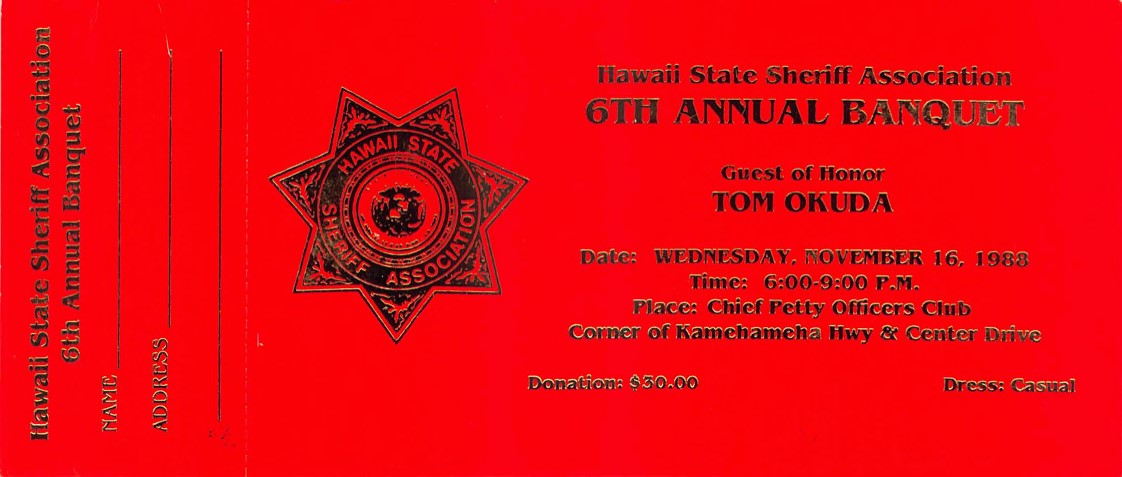
Digging around in my digital archive of scanned documents, I happened to find a ticket to the 6th Annual Hawaii Sheriff Association banquet honoring Tom “Fat Boy” Okuda. It was held on November 16, 1988.

The event was effectively a very public “middle finger” to Okuda’s critics that were attempting to apply routine standards of government ethics to Okuda and his organization.

The timeline is interesting.

In July 1985, Common Cause issued a report alleging that lobbying by a group lodged within the State Judiciary violated state ethics laws in a number of ways, drawing attention to a widely known but rarely mentioned political group. At the time, I was executive director of Common Cause in Hawaii, and had authored the report after being tipped off to the situation by several employees working at the legislature and in court offices.

On August 14, 1985, after nearly continuous news reports of further revelations and allegations rocked the Judiciary, Chief Justice Herman Lum appointed a “Blue Ribbon” panel to investigation and report back.

Then in March 1986, the panel released its report, which found Okuda, the deputy administrative director of the courts, had simply invented a new and unauthorized position of “High Sheriff” or “Chief Sheriff), and assigned day-to-day control of the sheriff’s office to a bailiff who Okuda promoted into another invented and unauthorized position of “Undersheriff.”

Together, according to the panel, they pressured court employees and sheriffs to take part in political activities, including sign waving and catering campaign events for favored candidates, often the committee chairs or vice-chairs of the committees that controlled the Judiciary budget. The report, while understated, was devastating.

Through the direct efforts of the “Chief Sheriff” and the “Undersheriff”, Deputy Sheriffs have been directed to participate in politically-related activities which cannot be tolerated within the Judiciary.

Deputy Sheriffs have been assigned to drive legislators to various functions, to provide massages to legislators, and to provide after-hours, “volunteer” services such as parking cars at functions connected with raising money for EGGS, the unofficial Judiciary lobbying group. (See EGGS discussion, infra). They have been directly or indirectly requested to donate money or supplies used in EGGS’ lobbying efforts. Involvement of the Sheriff’s Office in politically-related activities is unacceptable for reasons set forth elsewhere in this report.

Further, the panel report directly challenged Okuda’s lobbying organization, known originally as “Hui o Kokua” and, later, as Employees for Good Government Service, or EGGS.

EGGS asserts that all of its actions are for the sole benefit of the Judiciary. It is claimed that many Judiciary employees gladly and willingly give up their free time on weekends, in the evenings and during their lunch hours to perform these “volunteer” services. While some employees may be glad to serve, many of the Judiciary “volunteers” recruited by EGGS are subjected to various types of pressure to ensure their “willingness” to be “ready volunteers” for this political activity. There have been reports of peer pressure, implied threats of lack of advancement in employment, and subtle suggestions of being reassigned to unpleasant tasks at work for lack of participation. Conversely, there have been reports of promotions of some EGGS’ activists to positions of power within the Judiciary in return for involvement in political activities. There are also reports of direct pressure from EGGS’ activists to subordinates to sell raffle tickets and food tickets to raise money for EGGS’ political activity. Each of these is a threat to ensure participation by Judiciary employees in EGGS’ political functions. This is coercion. The Panel sees nothing “voluntary” about such cooperation with and support of EGGS.

In December 1987, nearly a year before the Sheriff Association banquet at which Okuda was the guest of honor, he had been indicted on 44 misdemeanor charges of fixing traffic tickets and related charges. His trial was scheduled to start in early 1989.

But despite the political optics, or perhaps because of them, the Sheriff Association showed to whom it owed allegiance.

A fundraiser was held a year later to raise funds to pay Okuda’s legal fees, which included two pending appeals of his prosecution and conviction.

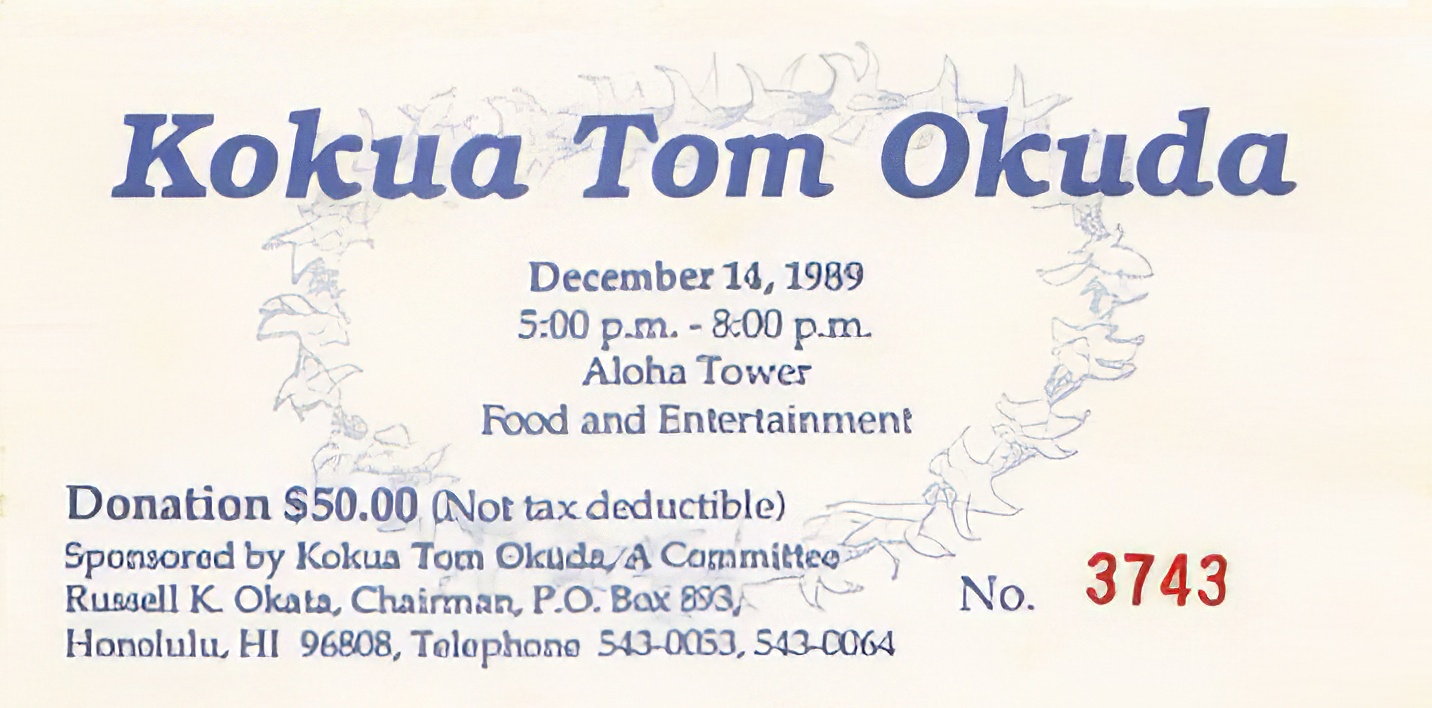
The ticket listed Russell Okata, executive director of the politically influential Hawaii Government Employees Association, the state’s largest union, as chair of the event’s sponsor, “Kokua Tom Okuda, a committee.” Okata was widely considered one of two most powerful union leaders in Hawaii, and signalled Okuda’s support within the political establishment.

According to a Honolulu Star-Bulletin story about the fundraiser, between 500 and 1,000 people attended the $50 per person event held on December 14, 1989, six months after Okuda had been convicted on multiple counts of fixing traffic tickets.

According to reporter Richard Borreca’a account:

Last night Okuda’s friends turned out to be some of the leaders in the political and business establishment. Rep. Henry Peters and former Supreme Court Chief Justice William Richardson, who now are both on the board of the Bishop Estate; attorney Wallace Fujiyama; Senate President Richard Wong; Jack Richardson, chairman of the Democratic Party: U.S. Rep. Daniel Akaka; and David Trask, former HGEA executive, all showed up.

On July 5, 1990, five years after the Common Cause report that put the spotlight on the Judiary’s political activities and a year after Okuda’s conviction on 13 counts, the Hawaii Supreme Court tossed out seven of the charges but upheld six charges of fixing traffic tickets. It also upheld Okuda’s sentence, which included discharge from his job as deputy administrative director of the state courts.

When “immediately” apparently isn’t

On June 4, three men were convicted in federal court on multiple felony charges for their roles in a complex and long running bribery scheme to defraud Hawaii County’s affordable housing program.

Two of the defendants–Paul Sulla and Gary Charles Zamber–are Hilo-based lawyers, the third a businessman.

A month after the jury verdict, a friend asked a simple question.

How is it that the two are still listed as having active law licenses even after being found guilty of multiple felonies?

Hmmmm. Good question. Here’s what I found.

The three were convicted on all charges, including one count of conspiracy to commit honest services wire fraud and nine counts of honest services wire fraud, all felonies. Sulla was also convicted of money laundering, another felony. They are all scheduled to be sentenced in early December.

To appreciate what was involved, here’s a summary of the case from Environment Hawaii, a monthly newsletter that has reported on parts of the underlying transactions for years and is credited with sparking the federal investigation that eventually led to the indictments.

In its case…the Department of Justice has argued that between late-2014 and late-2021, the three men were involved in a conspiracy to provide bribes or kickbacks to former Hawai’i County Office of Housing and Community Development employee Alan Rudo in exchange for his help in securing affordable housing agreements, valuable excess affordable housing credits (made even more valuable by building restriction waivers he facilitated), and land in Waikoloa meant for the development of affordable housing.

The DOJ estimated that their schemes netted them nearly $11 million and eventually charged the men with honest-services wire fraud. It also charged Sulla, who created the various “shell” companies involved, with money laundering.

Looking back at court records, it appears both men continued to practice law and appear in court on behalf of clients over the three years between their indictment in 2022 and conviction in 2025.

The whole process of attorney discipline is shrouded in layers of secrecy, ostensibly to protect the public, but which mostly protect the reputations of those attorneys being investigated, as well as ODC itself. See my 2022 post, “Hawaii’s Office of Disciplinary Counsel has long considered itself a secret enclave.”

Court records show that on July 9, five weeks after Sulla and Zamber were convicted, ODC filed petitions asking the Supreme Court to issue an order “immediately restraining” both men from the practice of law, and to consider this a suspension from law practice for purposes of court rules.

That seems like it should have been a simple matter, but more two weeks have passed and the court has taken no action.

ODC also asked the court to refer the matter back to the Disciplinary Board to “institute formal disciplinary proceedings that will determine the appropriate discipline to be imposed, with formal hearing stayed until such time as the conviction is final.”

And just when is a conviction final? As we learned after the death of Mike Miske, a conviction isn’t final until the defendants have been sentenced and any appeals have been exhausted, or the deadline for filing appeals has passed. Even if the Supreme Court had actually taken “immediate” action, it could still be many months before the ODC’s confidential formal proceedings would begin. Or longer, if the defendants appeal.

This despite the fact ODC has the benefit of a running start. The office opened disciplinary cases against both attorneys when the federal charges were filed in 2022. These cases, which track the federal allegations, were and remain confidential. Their existence was made public only after ODC received subpoenas from federal prosecutors to produce any records of the disciplinary cases involving Sulla and Zamber, along with any statements made responsive to ODC’s actions, requiring ODC to ask the Supreme Court for a partial waiver of case confidentiality so that it could respond to the federal subpoenas.

More information about the status of the disciplinary cases opened in 2022 is unlikely to become public unless and until the pair are sentenced, run out any appeals, and the ODC formalities lead to a recommendation that will go back to the Hawaii Supreme Court for its decision.

Disbarring both men as convicted felons seems like it should be a slam dunk. But procedurally, even that isn’t simple or transparent.

Two Miske associates to appeal their sentences

The Miske co-defendants who drew the longest sentences are both appealing those sentences to the 9th Circuit Court of Appeals.

Lance Bermudez, who was sentenced earlier this week to a 30-year term in federal prison, filed a notice on Friday that he intends to appeal the sentence.

Bermudez, 34, is the last of Mike Miske?s co-defendants and associates to be sentenced, bringing the criminal case to an end. His 30-year sentence was the longest meted out by Judge Derrick Watson, who presided over the long and complex case.

The Notice of Appeal was filed after Magistrate Judge Kenneth Mansfield denied attorney Myles Breiner’s motion to withdraw from the case immediately. Mansfield’s reasons for turning down Breiner’s request may simply be a matter of timing.

In a brief letter attached to the “Notice of Appeal,” Bermudez says Breiner will no longer represent him once the notice is filed. The appeal itself will be filed later, presumably by a different attorney.

Letter attached to notice of appeal

Bermudez becomes the second defendant to challenge his lengthy sentence.

John Stancil, 37, Mike Miske?s younger half-brother, received a 20-year sentence, the maximum provided on the charge of racketeering conspiracy. Stancil filed a notice of appeal last year, which did not state the basis for the appeal. Following several delays, the opening brief in his appeal is due in the 9th Circuit Court of Appeals in September.

The appeals of both men are constrained by the terms of their plea agreements, in which each waived their rights to appeal their convictions and sentences “in exchange for the concessions made by the prosecution….”

Their plea agreements both provide that there are only two grounds of appeal that are available.

The first exception to the waiver provides the convictions or sentences can be appealed “based on a claim of ineffective
assistance of counsel.”

Further, if the defendant?s sentence is longer than the range spelled out in federal sentencing guidelines, the defendant may appeal “the portion of his sentence greater than specified in the guideline range….”

Bermudez’s 360-month sentence exceeds the high end of the guideline range, which was 327 months, the same sentence recommended by prosecutors. Although his plea agreement permits an appeal of the time period in excess of 327 months, even if successful it would reduce his 10-year sentence to “just” 27 years and three months.

At the time of Bermudez agreed to plead guilty in a deal with prosecutors, he was represented by Honolulu attorney Berney Berver. At the time, he did not express any reservations about the quality of Berver?s legal representation. Myles Breiner only took over the case in January, long after Bermudez was convicted, and represented him until this week.