Category Archives: Court

An over-the-top crazy tale of a reporter and the U.S. Attorney prosecuting Comey

This is a story that has gotten a lot of play over the past couple of days.

Lindsey Halligan, the inexperienced interim US Attorney in Virginia who is personally prosecuting the criminal case against former FBI Director James Comey, initiated a text conversation with Anna Bower, a lawyer and senior editor at Lawfare, concerning the case. Not only initiated, but texted multiple times over a couple of days, much to the amazement of the reporter. Halligan is an insurance lawyer with zero experience as a prosecutor, but who was named interim US Attorney for Eastern Virginia by President Trump after her predecessor determined there was not enough evidence to support an indictment of Comey.

Then along came Lindsey, and an indictment was quickly filed.

Here are a few of the published stories about this bizarre string of text messages.

Lindsey Halligan sends multiple texts to legal reporter, The Hill

Reporter publishes ‘unsolicited’ texts from Trump’s handpicked prosecutor, CNN

Interim U.S. Attorney’s Angry Texts To Reporter Revealed, HuffPost

But most amazing is the reporter’s own recounting of the experience (“Anna, Lindsey Halligan Here.” My Signal exchange with the interim U.S. attorney about the Letitia James grand jury).

Her version begins:

It was 1:20 p.m. on the afternoon of Saturday, Oct. 11. I was lounging in my pajamas, idly scrolling through Netflix, having spent the morning reading news stories, occasionally tweeting, and watching TV. It was a rare day off.

Then my phone lit up with a notification. I glanced down at the message.

“Anna, Lindsey Halligan here,” it began.

Lindsey Halligan—the top prosecutor in the Eastern District of Virginia—was texting me. As it turned out, she was texting me about a criminal case she is pursuing against one of the president’s perceived political enemies: New York Attorney General Letitia James.

So began my two-day text correspondence with the woman President Donald Trump had installed, in no small part, to bring the very prosecution she was now discussing with me by text message.

Over the next 33 hours, Halligan texted me again.

And again.

And again.

And again.

I’m still shaking my head after reading her version of events.

And Bower then discussed her story in a video podcast with Lawfare editor in chief, Ben Wittes. It’s a hoot.
The future of Miske’s fortune remains unsettled

The saga of Mike Miske’s fortune continues to unfold at a snail’s pace.

Nine months after the federal government filed a civil forfeiture lawsuit, the question of who will get the property of late-business owner and convicted racketeering boss remains in legal limbo with little progress publicly reported to date.

Following Miske’s conviction after a 6-month trial last year, a jury found that 27 itemized peroperties, including real estate, cash and cashier’s checks, vintage cars, and art work should be forfeited to the government because they constitutedz or were obtained with proceeds of Miske’s racketeering activities. Miske’s properties have previously been estimated to be worth at least $11 million, and perhaps as much at $25 million. The largest single asset is the
8,206 square foot luxury home on most of an acre overlooking the ocean in Portlack.

However, the entire case, including the indictment, convictions, and forfeiture, were vacated following Miske’s death in Honolulu’s Federal Detention Center last December while awaiting sentencing under the legal doctrine of abatement ab initio. As a result, the civil forfeiture lawsuit was filed in order to reclaim the property that had been awarded to the government by the jury.

After the case was filed, the trustees of Miske’s personal trust filed their own claim on the assets, and three lenders entered the case seeking amounts to cover unpaid mortgage loans. Of the three, Bank of Hawaii appears to have the most exposure.

Then in late June, the parties disclosed an agreement to pursue a negotiated settlement that would avoid the expense of another protracted trial in which the government would again have to prove these properties were products of Miske’s criminal enterprise. Instead, they agreed to enter into settlement negotiations with Miske’s trust in order to seek a division of assets that would pay off the the outstanding mortgage debts, and then split the remaining assets and cash between the government and Miske’s trust.

All parties said they needed more time, and agreed to a five-month delay in the case to allow negotiations to move forward. If the stipulated delay ends in late November as scheduled, a scheduling conferece will be held before Magistrate Judge Kenneth Mansfield on December 1 to set deadlines for each of the remaining parts of the process, up to and including a trial in the unlikely event no agreement can be reached between the parties.

The parties have filed monthly status reports, the first in July. In each, the operating phrase for the status of discussions with the lenders, and discussions between the government and the Miske trust, has been simple: “Those discussions are ongoing.”

In the most recent update, filed in court on October 9, attorneys report they have “have begun discussions to schedule an initial settlement conference.”

But, again–“Those discussions are ongoing.”

Retired miltary officials point out dangers of sending troops into urban areas

A group of retired defense officials filed an amicus curiae or “friend of the court” brief this week in the case of State of Illinois v. Trump, 25-cv-12174, Federal District Court for the Northern District of Illinois.

Although the group does not take a position on the lawsuit itself, their brief spells out their common concerns about the deployment of National Guard members to American cities.

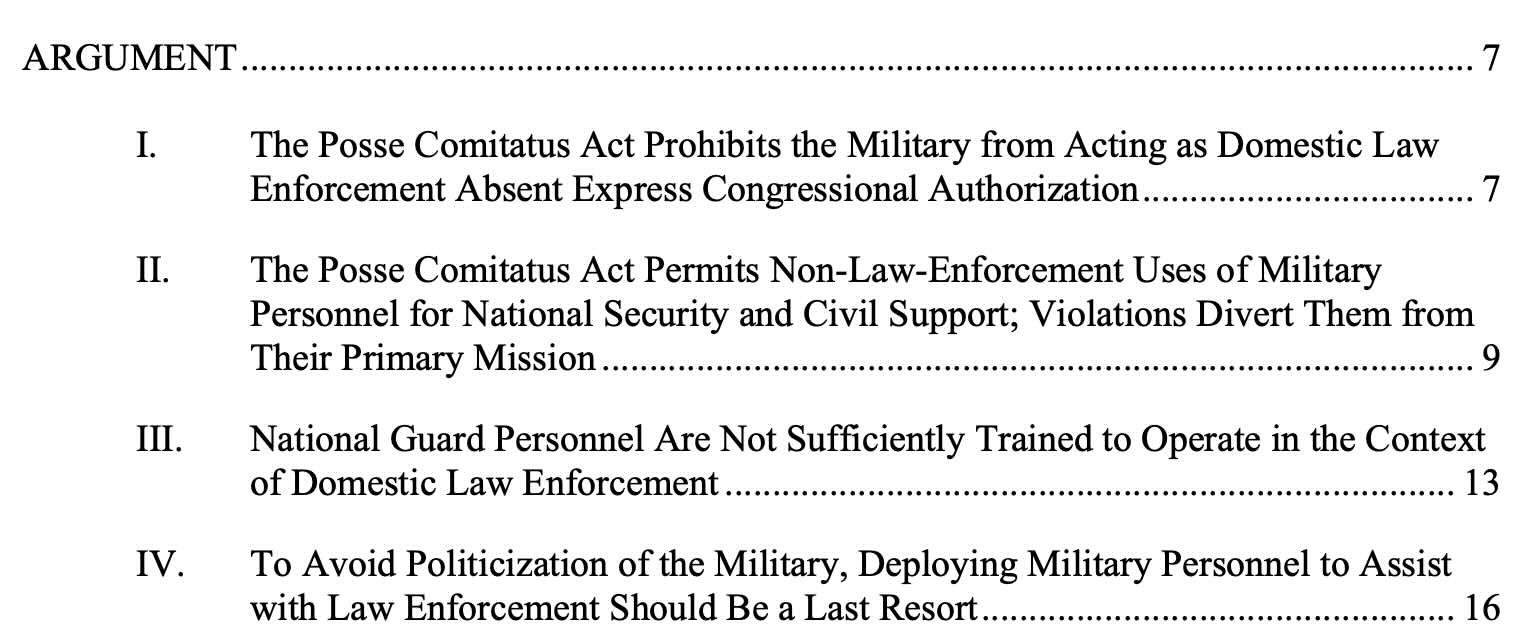
Here’s the introductory section spelling out their interest in the case, along with the major point they make (from the document’s table of contents), followed by the full document.

INTEREST OF AMICI CURIAE

Amici are former secretaries of the Army and Navy and retired four-star admirals and generals. Collectively, they served under each president from John F. Kennedy to Barack Obama. Amici are acutely interested in this case because presidential deployment of the National Guard to perform local law enforcement should be a rare and carefully considered occurrence that strictly complies with the Posse Comitatus Act. Domestic deployments that fail to adhere to these long-established guardrails threaten the Guard’s core national security and disaster relief missions; place deployed personnel in fraught situations for which they lack specific training, thus posing safety concerns for servicemembers and the public alike; and risk inappropriately politicizing the military, creating additional risks to recruitment, retention, morale, and cohesion of the force.

This submission is based on amici’s collective experience serving in and leading our military, their direct experience commanding active-duty service personnel, and their interest in preserving our military’s apolitical role in safeguarding national security.

Screenshot

The legal history of terms like “insurrection,” “rebellion,” and “uprising”

In law, history, precedent, and facts matter. For those who want more than headlines, this court filing provides easy access to a wealth of insight into the current controversy over President Trump’s attempt to send troops into American cities.

This amicus brief was filed by attorneys for Citizens For Responsibility And Ethics In Washington on behalf of Mark Graber in support of the motion for a TRO blocking deployment of federalized National Guard troops in Portland, Oregon. It was downloaded from the Federal Court’s PACER document system.

Graber is the Regents Professor in the University System of Maryland, a Distinguished University Professor, University of Maryland, Baltimore, and a Professor of Law at the University of Maryland Francis King Carey School of Law.

Here’s the summary provided in the first section of the brief.

SUMMARY OF ARGUMENT

The Militia Act of 1903–the statutory predecessor of 10 U.S.C. § 12406–was historically understood to authorize the president to federalize state militias only in response to a war or warlike conditions. The law permits the president to call state militias into federal service only when a large armed force is engaged in an invasion, a rebellion, or a substantial uprising that cannot be contained by ordinary forces under the president’s command and that prevents federal courts from operating. The Militia Act of 1903, was designed to respond to that level of crisis. Nothing in the Act’s text or history allows the president to federalize a state national guard in response to sporadic violence during otherwise peaceful protests that do not incapacitate the courts or the execution of federal laws as a whole.

Historical and judicial precedents make clear that courts are empowered-and indeed obligated to review whether the predicate conditions for the president to federalize state militias exist. Supreme Court decisions from the 19th century emphatically rejected the notion of unreviewable presidential discretion to deploy the military on American soil, dismissing the argument as repugnant to our founding principles. As the Court explained, accepting that the military could be used for regular law enforcement would mean “republican government is a failure” and would mark the “end of liberty regulated by law.” Those words ring just as true today as they did in 1866.

The document can be downloaded or displayed in full-screen mode using the links at the bottom right of the document window.