Category Archives: environment

Did the Hawaii Kai Marina Association “get away” with coastline damage?

A reader using the name “Linda” commented on the post about a Punaluu landowner being fined for unpermitted attempts to stop erosion. Linda wondered how the Hawaii Kai Marina Association was able to “get away” with building a rock groin into the ocean.

How does Hawaii Kai Marina Association get away with building a large rock groin into the ocean and public beach that is permanently altering the shoreline. That is far more impact than Matthew Tang’s illegal work.

Well, the answer wasn’t hard to find. The Marina Association jumped through all the hoops, including required environmental reviews, and was approved to build a more permanent solution to keeping the channel open than had existed previously. They don’t appear to have “gotten away” with anything.

From a December 30, 2016 article by reporter Andrew Gomes in the Honolulul Star-Advertiser:

A community association that owns the private marina in Hawaii Kai wants to more permanently inhibit sand from migrating off Portlock Beach into the boat entry channel by constructing a $2 million rock groin.

The Hawaii Kai Marina Community Association believes the groin, which would replace a row of giant sandbags first installed in 2004 on the east side of the entryway, will keep the channel clear for longer and be less costly in the long term compared with maintaining the sandbags.

However, some nearby residents and other community members are concerned about potential negative impacts on beach erosion and ocean currents.

The project was approved by the Land Board in June 2020. You can read the staff submittal describing the project and its background, which is available on the DLNR website. By the time the item reached the Land Board, it appears to have already received environmental clearance.

A public notice was published by the Army Corps of Engineers in August 2018, which includes photos and other information. It includes a fact sheet, the federal public notice, along with drawings and photos.

So the answer to Linda’s question is that the Marina Association didn’t “get away” with anything. They appear to have complied fully with the law, with lots of opportunity during the permitting process for comments, etc. There are probably additional reports during the review process that I didn’t see in my quick search.
Staff report on Punaluu property owner fined for illegal hardening of the coast fronting his property

Here’s a lot more information about the situation in Punaluu, a small community on the windward coast of Oahu. The entire coastline has been subject to erosion over the years, and the owner of the home at the center of this case has apparently failed to comply with a series of prior orders issued by the state and, instead, continued to attempt to harden the area fronting his home against erosion with sandbags, bolders, large plastic sheets, etc.

A 123-page staff submittal prepared for the March 10 meeting of the Board of Land and Natural Resources details the history of the case, and includes documents from prior enforcement efforts, photos of the shoreline taken over several years, and other information. You can read or download the document below.

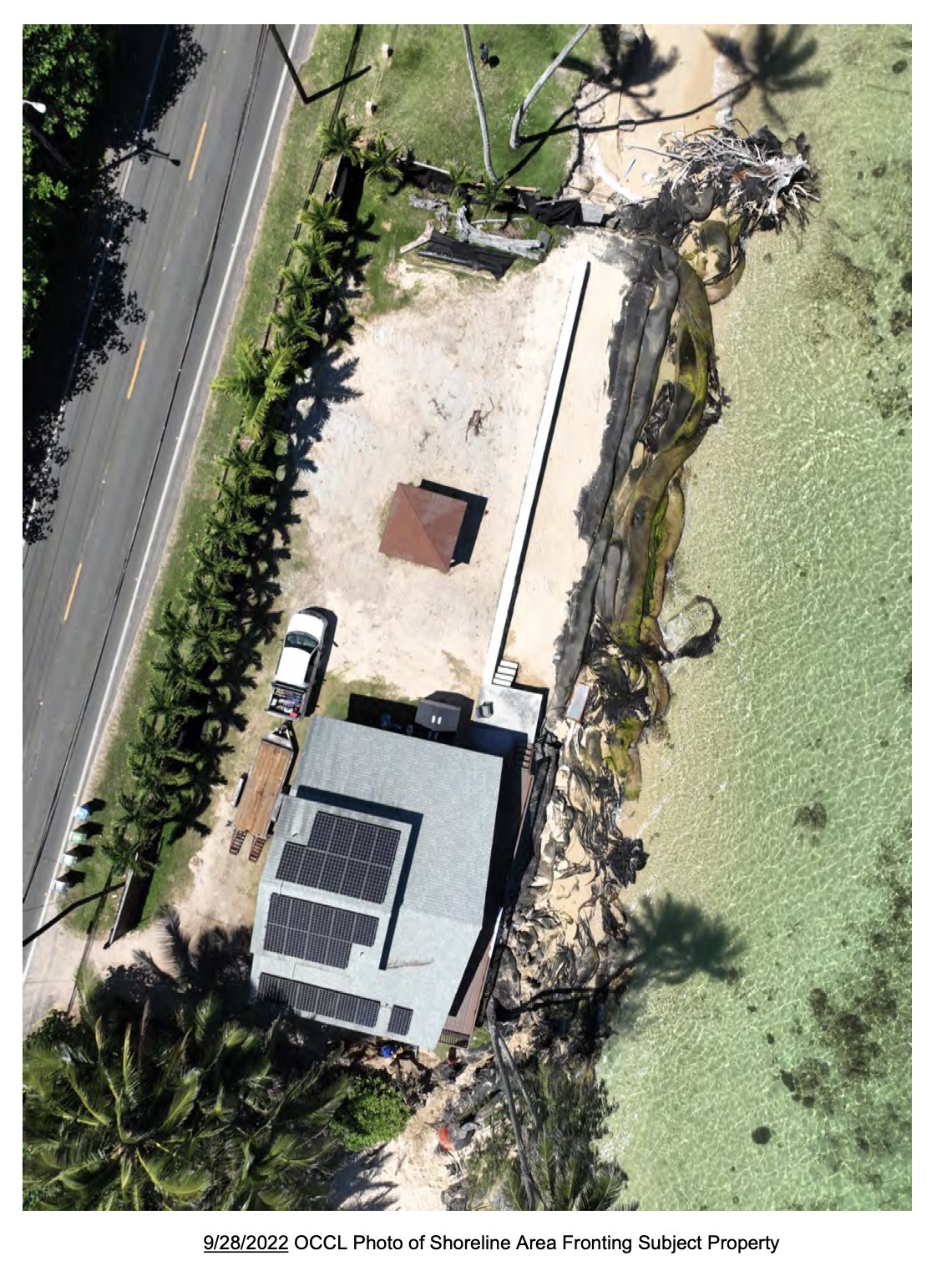
This report concerns an Office of Conservation and Coastal Lands (“OCCL”) Conservation District Enforcement Case OA 23-14 that has two distinct components, as described in this staff submittal. The first component is noncompliance with an Emergency Conservation District Use Permit (“CDUP”) for failing to remove a temporary erosion control structure upon its expiration date in July 2020. The second component is the installation of additional erosion control structures and the installation of additional erosion control materials in the shoreline area fronting the subject parcel.

The photo above shows the home, located on a very narrow strip of land between the ocean and Kamehameha Highway in Punaluu.

According to the report, the home has been used primarily as a vacation rental during most of the period since it was purchased by the current owner.

Staff submittal regarding enforcement action against Punaluu homeowner for shoreline hardening by Ian Lind on Scribd

A great example of marketing

Sophie Cocke’s story about a Punaluu landowner’s attempt to hold back the ocean captured a wonderful example of marketing (“Punaluu homeowner faces $188K fine for shoreline violations“).

The story is that this homeowner bought this oceanfront property in 2012. At the time of this purchase, it had already been subject to extreme erosion, along with surrounding homes, for years. Since then, the homeowner has attempted to “harden” the shoreline and ignored numerous citations issued by the Department of Land and Natural Resources.

All this time, the home has been at risk of collapse as the ocean threatens its foundation.

In October the Star- Advertiser reported Opens in a new tab that the three-bedroom property, with ceiling-high windows that frame the ocean, was for sale for $899,000. Even though ocean waves were undermining the front of the house and the property was racking up violations, an ad for the property boasted of the ocean’s allure:

[Brace yourself, here it comes!] “Imagine waking up every morning to an iconic Hawaiian Sunrise orchestrated by the sound of waves lapping the shore. What sounds like an unreal aspiration to many could be your dream beachfront home available at an unbelievable price!”

Masterfull!

Truth in marketing might have required a rewrite: “Imagine waking up every morning to an iconic Hawaiian Sunrise orchestrated by the sound of waves lapping your home slowly collapsing onto the the shore below.”

Or, as a used car salesman we used to see on television would say, slapping the hood of another vehicle he was trying to unload, “Here’s one that won’t last long!”

Another item for the worry list

There are lots of things to worry about these days from the elections to international conflicts to the rise of domestic fascism, to…well, lots of things.

But this morning an unexpected new item was added to the worry list.

“Solar geoengineering.”

This is from a piece last week on the Lawfare Blog (“ The Case for Researching Solar Geoengineering”).

In a nutshell, solar geoengineering is the intentional modification of Earth’s atmosphere to reflect more sunlight back into space, with the goal of cooling temperatures on a regional or planetary scale. The most discussed and best understood of these techniques is stratospheric aerosol injection—the idea, basically, of using aircraft to release a thin “veil” of aerosols high up in the atmosphere to reflect away a small amount of sunlight.

Everyone agrees that dramatically reducing GHG emissions is essential to addressing climate change, but some see solar geoengineering as a sort of “bridge” to a zero-emissions world or, to use a different metaphor, an insurance policy in case the world cannot decarbonize quickly enough to avoid catastrophic climate impacts. For those who see climate change as a likely planetary emergency, geoengineering may provide a regrettable but necessary way to buy time to improve and commercialize decarbonization technologies, invest in new infrastructure, and, perhaps, prevent runaway warming.

This article reviews the legitimate concerns that are raised in response to the prospect of solar geoengineering.

But then it points out: “But a hotter world could become a more desperate world, and countries may reach for solar geoengineering no matter how little it has been studied or how few governing institutions are in place.”

Yikes! What could possible go wrong here?!