Category Archives: environment

The ocean claimed a once-thriving resort area on the Oregon coast

Last night, we stumbled across a short program broadcast by Oregon Public Broadcasting which should be required viewing by oceanfront residents around Hawaii (“Bayocean: The lost resort town that Oregon forgot”).

It tells the story of Bayocean, a once-thriving resort town on the Oregon coast, which the original developer, investors, landowners, and visitors eventually learned a very painful lesson. The ocean is a nearly irresistable force.

If you drive to the very edge of Oregon and then get out and walk, you can stand where developers built Bayocean, what they called the “Atlantic City of the West.”

It rose up in the early 1900s on a narrow sand spit that forms the western edge of Tillamook Bay.

Built at a time when the West Coast was clamoring for the refined lifestyle of the Eastern Seaboard, Bayocean had a hotel, a bowling alley, a neighborhood of homes and even a small railroad. But then, in what amounts to a slow-motion disaster, it was swept away.

As property owners along Oahu’s north shore engage in futile attempts to stop further erosion, the story of Bayocean, Oregon, is particularly relevant.

Also see:

Bayocean: History

Bayocean: the American city that disappeared because man ignored nature,” The Guardian
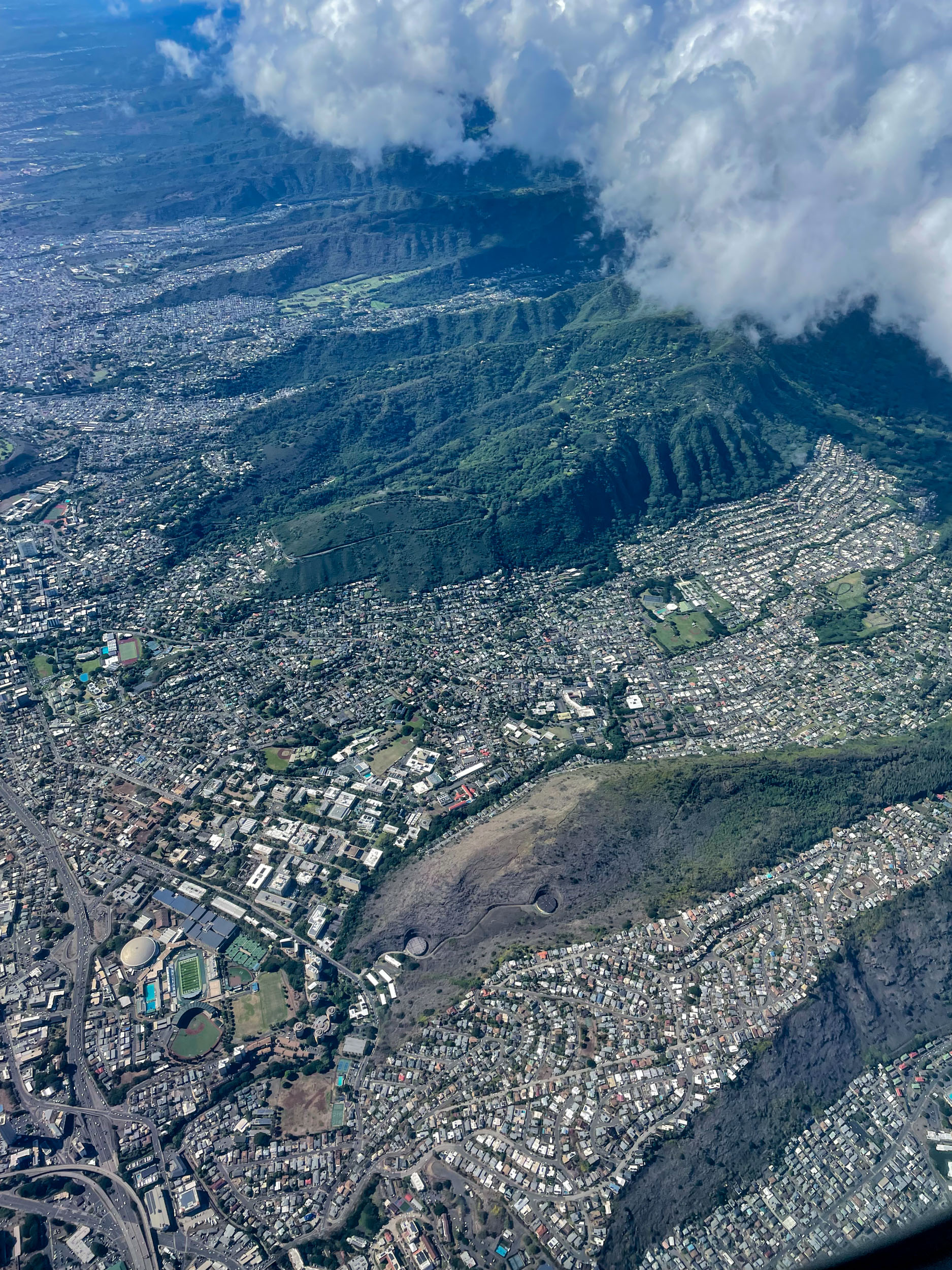
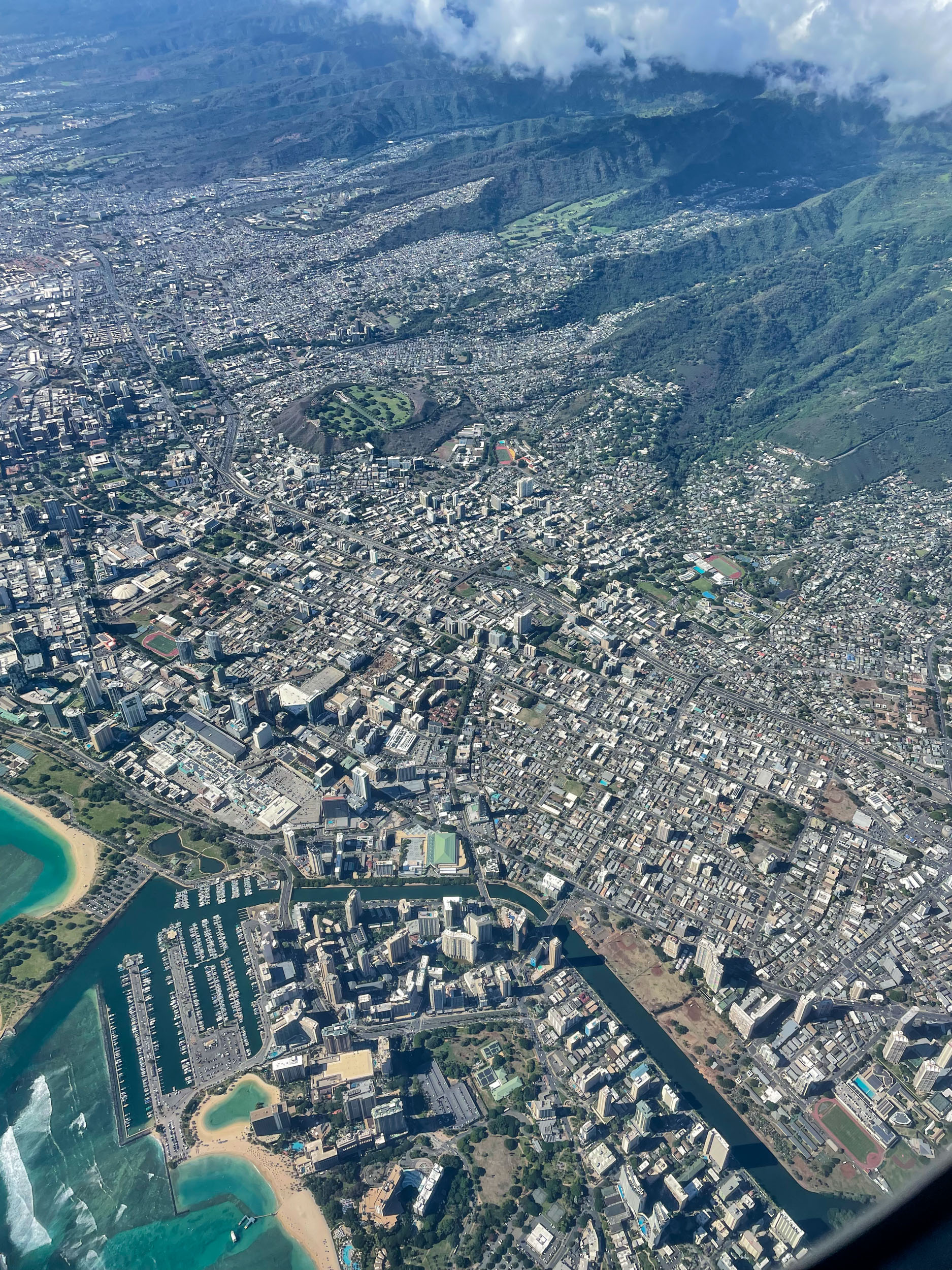
Two views of Honolulu from the air

Our United Airlines flight from San Francisco yesterday afternoon approached Oahu just a bit south of Kaneohe, so the marine base was just below and to the right of our flight path. When we emerged from the clouds on the other side of the Koolau Mountains, we had sweeping views of Honolulu. Here are two that I caught with my iPhone rudely reaching over Meda, who was seated by the window.

Click to see a larger and more detailed version of either photo.

Top photo: Lower right, one piece of the residential area in Palolo Valley. Just above that, St. Louis Heights. Left side, you see the University of Hawaii campus, with the baseball and football stadiums, along with the arena and pool, and then the campus stretching out above them. Manoa Valley, then on across town.

Bottom photo: At the lower left, the Hilton Hawaiian Village Resort, with the lagoon, and Fort DeRussy, with part of Waikiki bounded by the Ala Wai Canal. A bit higher, on the left, part of Magic Island and Ala Moana Beach Park, Ala Moana Shopping Center with its associated condominiums. The Punahou School campus, all the condos of Makiki, and Punchbowl are other landmarks to be seen.

Add your own landmarks as you examine the photos.

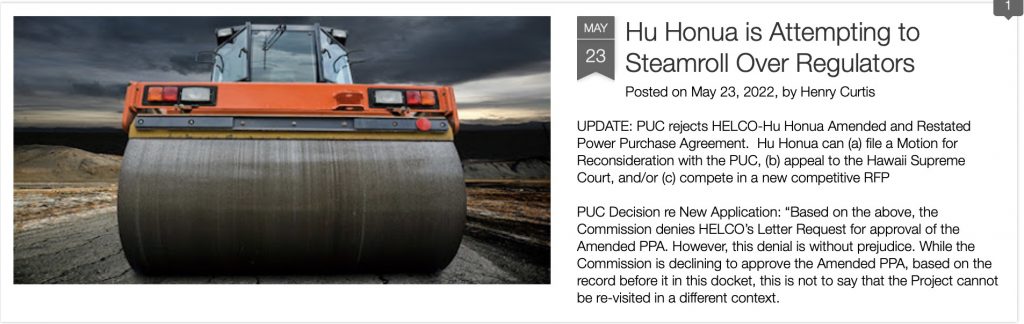
Hu Honua is back to their old tricks

In a decision announced Monday, the Public Utilities Commission turned down a proposed power purchase agreement with Hawaii Electric Light Company that would have let the Hu Honua wood-burning-to-energy project move forward to completion.

PUC Denies Power Purchase Agreement for Hu Honua Project
May 23, 2022 – The Hawaii Public Utilities Commission issued Decision and Order No. 38395, denying HELCO’s request for approval of the Amended and Restated Power Purchase Agreement between HELCO and Hu Honua. Commissioner Leodoloff R. Asuncion, Jr. issued a dissenting opinion. For more information, see Decision and Order No. 38395 and the dissenting opinion.

Skim the opinion, and it’s clear the PUC found it could not rely on Hu Honua’s projections of climate impact or cost of the project, and repeatedly noted that promised benefits to the public were back loaded, meaning they would only come late in the 30-year term of the proposed project, making the somewhat rosy promises less reliable.

I highly recommend jumping over over to Henry Curtis’ Ililani Media for today’s post.

This post ticks off the multiple ways Hu Honua is exerting lobbying, advertising, and political pressure in an attempt to breath life back into their costly proposal. Highly recommended reading.

These pressure tactics are not new.

See:

Powerful state senators pressure agencies to back Hu Honua,” iLind.net, September 17, 2020.

Who’s Hu?” iLind.net, Sept 17, 2020

Lawsuit reveals lead investor now skeptical of Hu Honua,” iLind.net, Sept 20, 2020

We’re learning lots of new details about the Hu Honua proposal,” Sept 21, 2020

Check out this recent ThinkTech Hawaii program on Hu Honua,” iLind.net, October 8, 2020

Two recent Hawaii Supreme Court rulings,” iLind.net, Feb 3, 2021

75th Anniversary of “Meda’s tornado”

Seventy-five years ago, on the evening of April 9, 1947, an F-5 tornado reported to be two miles wide at some points, swept up from Texas and across Oklahoma, finally dissipating in Kansas. Directly in its path was the small town of Woodward, Oklahoma. When the storm moved through, it demolished a reported 100 city blocks in the small town. Over 100 people were killed. 1It is still considered the worst tornado in Oklahoma history, and it remains one of the deadliest in US history.

Meda and her family family were living in Woodward at the time, while her father, a geologist by training, was working in the oil fields nearby. Meda was less than three months old. She was home with her mother the night of the storm, while many of the men were away at work when the storm hit without warning. This was prior to the development of warning systems, and the storm interrupted phone service as well, so news of the devastation took time to spread.

The Weather Channel ranks the storm as the 2nd deadliest tornado in history.

The Monster Tornado of April 9, 1947

The second-deadliest F/EF5 tornado on record was a monster that plowed for 170 miles through Texas, Oklahoma and Kansas on April 9, 1947, killing 181. The town most impacted was Woodward, Oklahoma, where 107 people perished. At some locations along the tornado’s path it was as much as two miles wide, making it one of the largest tornadoes in U.S. annals. This tornado struck just a few years before the modern warning system was established.

Continue reading