Category Archives: environment

Coastal erosion is nothing new

Coastal erosion is back in the headlines after a home on Oahu’s North Shore collapsed onto the beach Monday morning after high surf continued to eat away at the coastline, leaving a string of neighbors also at risk (“Home collapses on Hawaii’s North Shore, more likely to follow“).

Back in 2018, after a series of news stories about what was already an alarming situation with erosion threatening homes along that same coast, I wrote about our own experience while looking at houses back in early 1988.

It’s a bad situation. But it’s not new.

Thirty years ago, we were looking to buy a house or apartment in a more rural part of Oahu where housing was far more affordable than in Honolulu. That led us to a realtor specializing in North Shore properties, and in early 1988 he drove us, along with an airline pilot looking for an investment property, to see several places from Mokuleia to the condominiums at Turtle Bay.

At one point he stopped to show us a small house somewhere in the Sunset Beach area that, he said, was owned or had been owned by a son of the actor, Robert Mitchum. It was a relatively small house sort of in the middle of a large lawn. He walked us over to the ocean side of the lot, overlooking the beach.

He pointed out into the ocean some distance, perhaps 30-40 feet.

“So you see that tree branch sticking out of the water? That’s your property line,” he said dramatically. “If you wanted, you could probably bring in fill and extend the yard.”

We were stunned by this attempt to turn a big negative, coastal erosion, into a positive, the idea that the area could be reclaimed from the Pacific Ocean with a bit of fill. I doubt such a thing would be either legal or feasible. Really, it was absurd then, and more so in hindsight.

But I can really feel for those folks living in oceanfront homes along the North Shore. It’s only going to get worse.

So this crisis has been a long time in the making, with lots of warnings along the way that the future was less than rosy for oceanfront properties generally, and the risk was especially high in a few areas, including this spot along the North Shore.

It’s time to retreat from the ocean in these high risk. And it’s “buyer beware” for those looking to enjoy oceanfront living. You’ve had plenty of warning. But I have to wonder whether other realtors might also be glossing over the risks in order to generate sales. Might their misstatements about coastal erosion create legal liability to buyers?

If February’s weather seemed dry to you, that’s because it was!

Browsing the news yesterday afternoon, I spotted a story in the Mercury News reporting that Sierra-Nevada area recorded least rain during the January-February period since records began in 1921 (“Sierra Nevada snowpack disappearing after driest January-February in recorded history, third year of California drought all but inevitable“). The newspaper reported the area normally provides nearly 1/3 of the state’s water supply.

It got me wondering about February rainfall in Honolulu. I has seemed unusually dry.

That sent me digging online for the answer, which I found on a National Weather Service website.

It turns out there’s quite a bit of variation year to year.

I first compared February’s measured rainfall with other years in the past 20 years. Ouch. This was the driest year recorded in that period.

Then I pushed back in time, first back to 1980, then 1940, and then a full century, back to 1922.

February 2022 goes down as the driest February in the past 100 years.

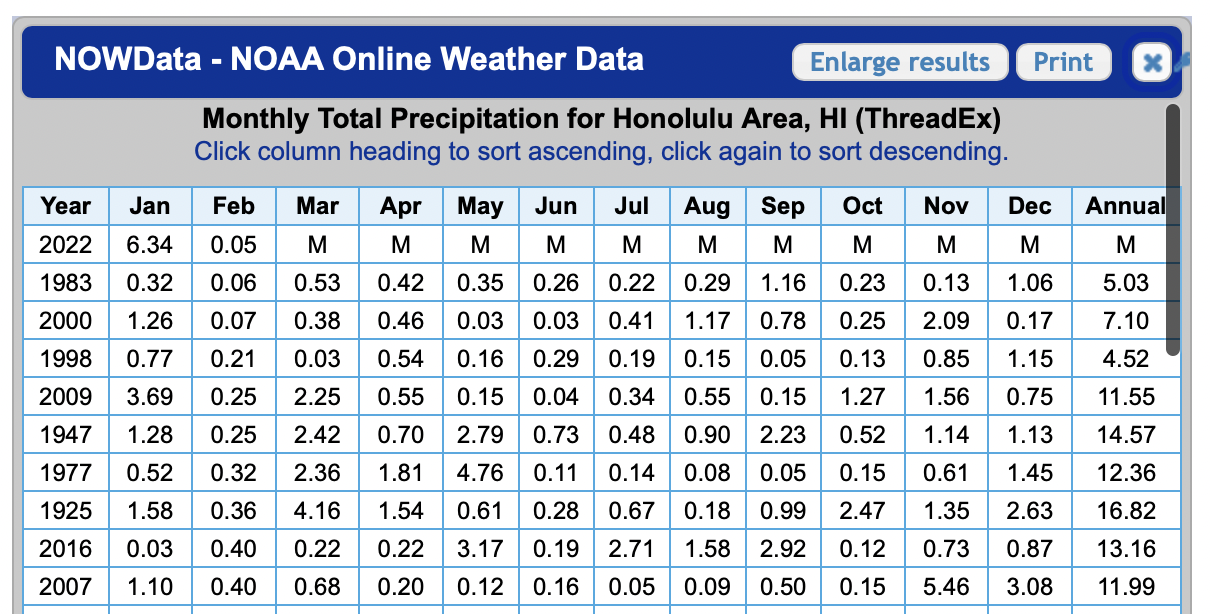
According to the data provided, the Honolulu area had only .05 inches of rain in February. The average February over the entire period 1922-2022 was 1.95 inches.

So last month Honolulu had about 2.6% of its average February rainfall.

Here are two tables that I found interesting.

First, here are ten years since 1922 with the lowest recorded rainfall in the Honolulu area.

And then here’s a summary of the century, with average rainfall, maximum rainfall, and minimum rainfall recorded over the past 100 years, month by month.

I’m no expert at this stuff, just a curious blogger. You might want to visit that National Weather Service site and check out what other factoids you can dredge up.

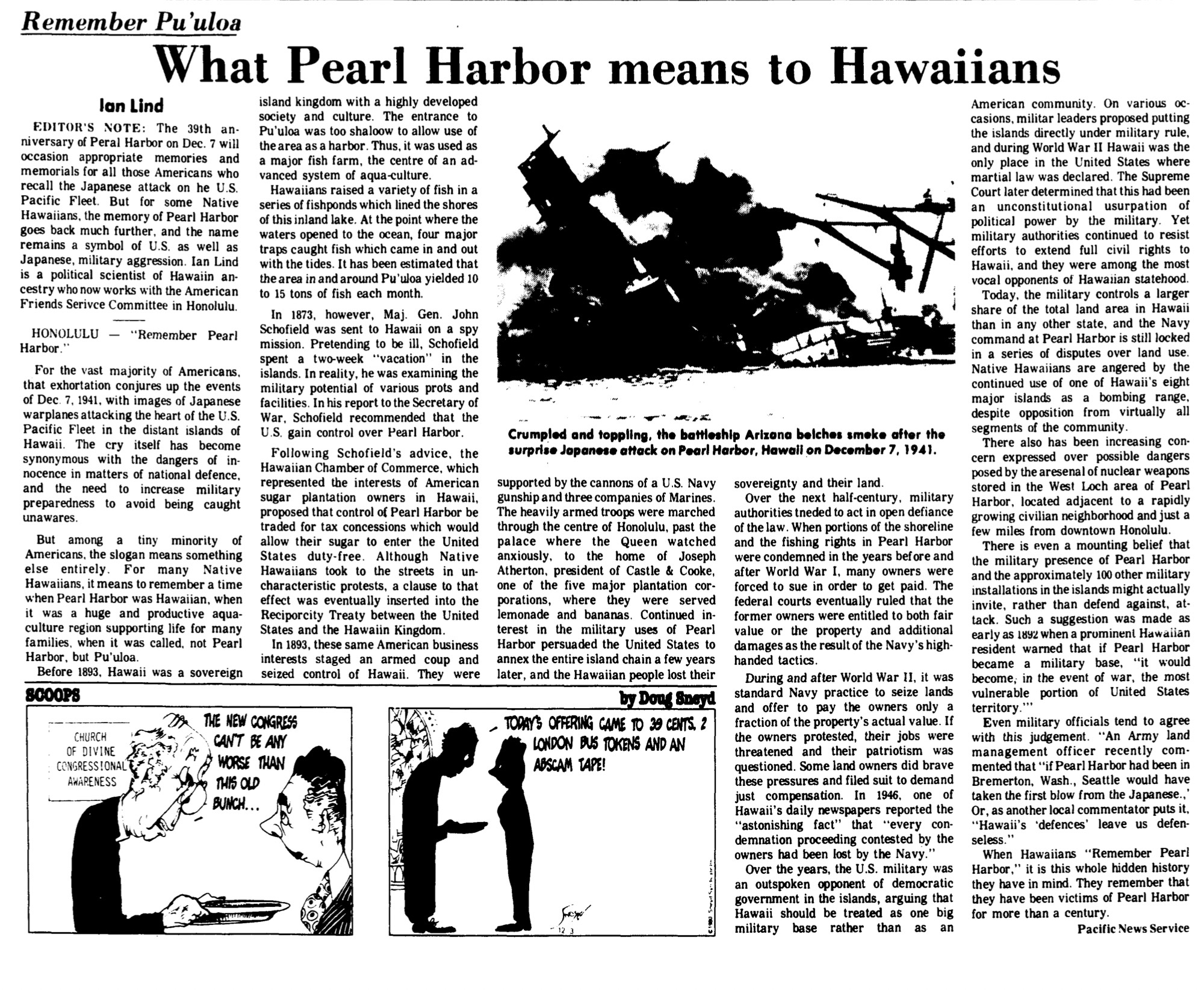
A different way to remember Pearl Harbor

Back before I became a reporter, I wrote a few columns for Pacific News Service.

And this past weekend, I found this one published in December 1980 when, if I recall correctly, I was in one of my periods “between paying jobs.”

I’ll let the piece speak for itself, rather than trying to reinterpret through a 21st century gaze.

If writing this today, I would likely try to be more nuanced in my summary of Hawaii’s history. And such rewrite would obviously benefit from our new knowledge of the Navy’s administrative and political failures leading to the leaking fuel tanks under Red Hill that now threaten a large part of Oahu’s water supply, and a new public appreciation of the threats posed by some routine Department of Defense activities.

In any case, read on. Just click on the article to read a larger version.

Cane fire and crimes

This came in this morning as a comment by a reader, but I thought it worth elevating to a post.

Totally unrelated but something you may wish to mention or pursue.
That big brush fire in Poamoho that exposed a huge illegal auto graveyard was quite a story. But maybe, just maybe, there’s a much bigger story. How did those cars get there? Will authorities even investigate?

Perhaps some of the cars were stolen or abandoned there by the owners, but the remote location and sheer number of vehicles suggests something else.

Did a towing contractor that was paid by the City or another government entity to remove abandoned vehicles and dispose of them properly simply dump the vehicles in Poamoho and pocket the money? If so, that would seem to amount to fraud, theft, conspiracy, racketeering, and some very serious environmental crimes and civil causes of action.

Did a private property owner remove the vehicles from some other area and dump them there? That many? Would individual owners of junk cars really go to all that effort to dump them in the same remote location? Would car thieves?

Some people in the community, including the many illegal squatters, surely know the answers. And will anyone even try to examine any Vehicle Identification Numbers that are still legible and try to track down the last registered owners, or see who has a contract to tow and dispose of abandoned vehicles in the area and whether they can produce records of proper disposal? Does anyone even verify that abandoned cars that get towed at taxpayer expense are disposed of properly?

Obviously, such an investigation would have been much easier if authorities had listened to concerned residents who had complained long before the fire, and had taken a hard look at the situation. But no. The state Agribusiness Development Corporation owns the property and said it hauled 150 cars out of the same area last year. 150! Did anyone even try to determine how those 150 cars got there? And a year later, there are hundreds more! Yet even that didn’t “light a fire” under authorities to get to the bottom of all this blatant illegal dumping on government property. That absolutely smacks of dereliction of duty on somebody’s part, or worse, complicity.

So now, will all the evidence simply get hauled away and forgotten about with the usual shrug? Will anyone even attempt to follow up on any of this? The dumping alone amounts to serious environmental crimes that pollute viable agricultural land and threaten the health and safety of the surrounding community, as evidenced by the fire. And maybe there’s much more to this.

The City Council, the Legislature, the Mayor, the Governor, the Police Commission, the Attorney General or SOMEBODY in a position of authority needs to demand answers!