Yes, i’t ancient history. But it’s still interesting. I had forgotten about this little report done back in 1989, which used city records to document obvious favoritism in the assignment of starting times at Honolulu’s municipal golf courses. I just ran across it while browsing through document I scanned and archived a number of years ago. It’s an example of how public records can reveal patterns of favoritism and corruption that aren’t easily swept away by stock official denials.
I didn’t become a newspaper reporter for several more years, but this was part of my education that made it possible to transition to investigative reporting.
At the time, I was on the staff of then-Honolulu City Council Member Neil Abercrombie. We had heard complaints about rigging of the reservation system used for assigning start times at Honolulu’s municipal golf courses. I don’t remember how we started on this analysis, but we were able to obtain copies of the reservation forms for a two-month period, June-July 1989.
What we found was pretty startling. There was a mad rush every morning for tee times, which had to be made by a telephone system that supposedly chose a single call at random from every 50 calls received, which was then forwarded to a cleark who would assign an available tee time.
The Ala Wai golf course, the most popular city course at the time, received a total of 177,876 calls during one week we looked at in detail. Of those, only 492 were completed and presumably assigned tee times. Less that one-third of one percent of calls were successful in obtaining reservations.
Here’s how the report described the process.
In order to play on a municipal golf course, it is necessary to either reserve a starting time in advance through the City’s “Dial-a-Time” telephone
reservation system or appear in person and sign up on a waiting list for openings.Current golf course rules provide that “reservations for starting times at a golf course must be made through the Dial-a-Time System.”) Reservations
are taken one week in advance, beginning at 6:30 AM. Due to the heavy volume of calls, all incoming calls are routed through a central switching
system at Hawaiian Telephone in batches of 50. A single call is selected at random by the telephone computer from within each batch and is forwarded to a reservation clerk at the golf course, while the other 49 calls are terminated. This process continues until the available time slots are filled.Thousands of calls are made to the telephone reservation system each morning, but only a relative few people are actually able to get through and
make a reservation. An actual count of calls to the Ala Wai Golf Course on April 10, 1986 found that 29,627 calls were attempted during the one hour
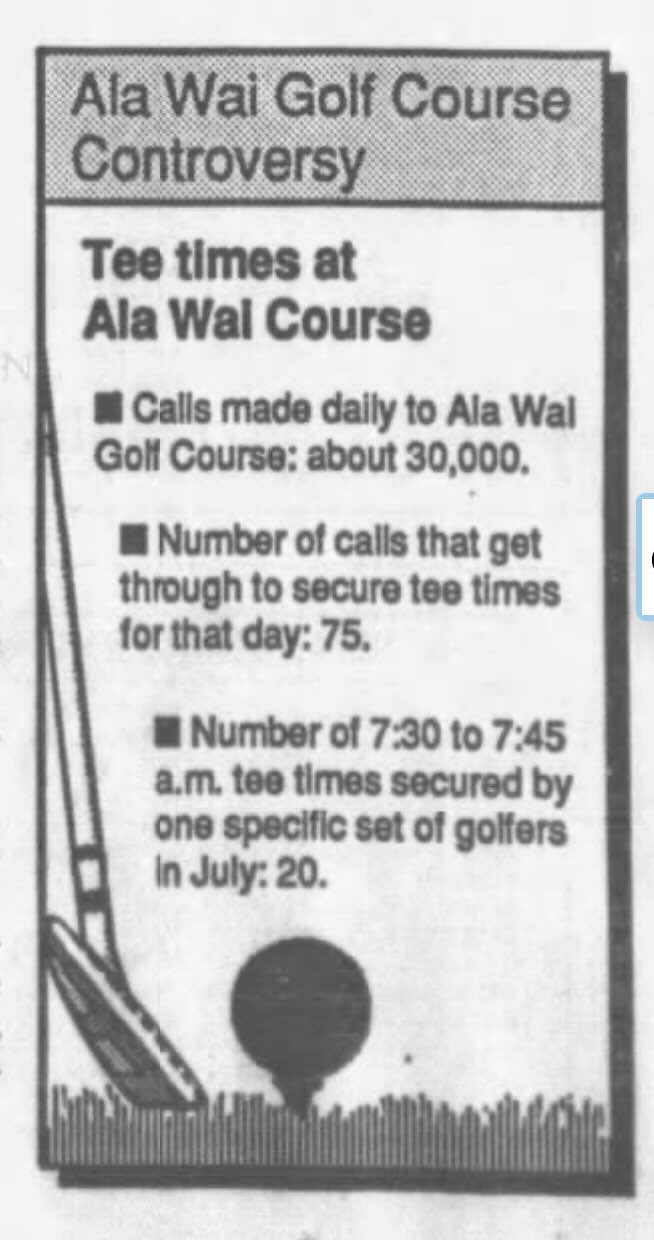
period between 6-7 AM. Since the reservation lines do not open until 6:30 AM, most calls presumably came in the 30-minutes between 6:30-7:00 AM.Of the total number of calls for reservations at the Ala Wai golf course, only 75-just two-tenths of one percent-were completed. For the full week of
April 8-14, 1986, a total of 177,876 calls were made to Ala Wai and only 492 were completed.The odds against getting through for a reservation are clearly substantial. More important, at least for this analysis, is that the chance of getting through early enough to obtain a prime morning starting time are even greater. Figure 1 illustrates the formidable odds that are arrayed against a golfer seeking reservations through the Dial-a-Time system. Only a very few of the thousands o f daily calls actually get through for reservations, and only a fraction of these are able to get early morning times. Yet each of the groups of golfers described below managed to claim morning reservations on a regular basis, a feat that clearly-as illustrated in Figure 1-defies the odds.
Screenshot
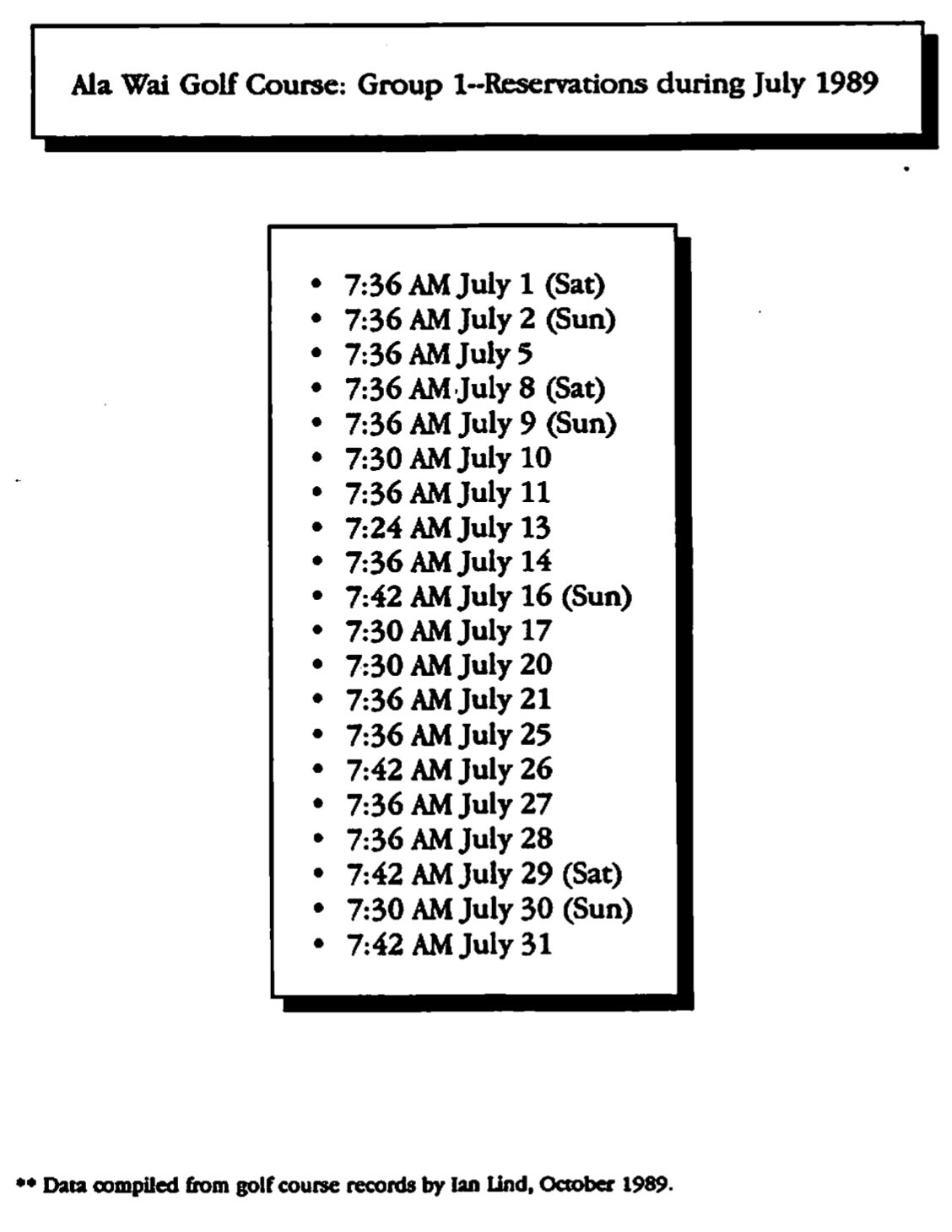
We also stumbled over a policy that allowed city officials to bypass the cumbersome reservation system and request starting times directly from the golf courses. It had ostensibly been approved for use by members of the mayor’s cabinet, but we found it had been used by other city officials, as well as by the mayor’s wife.
According to the report: “Administrators in various departments accounted for the majority of the special reservations. In addition, a dozen reservations were made in Mrs. Fasi’s name during June and July, all but one at the Pali Golf Course.”
What I didn’t recall was that Councilmember Abercrombie requested a legal opinion on the legality of this practice, which found such preferential treatment violated a section of the City Charter prohibiting elected or appointed city officials, or employees, from getting or granting “special consideration, treatment, advantage, privilege or exemption to themselves or any person beyond that which is available to every other person.”
The report made front page news in the Honolulu Advertiser, which displayed this graphic along with a story about the report.
Screenshot
You can read the full report below.