Category Archives: Ethics

Whistleblower Complaint Targets Top Officials at the Public Utilities Commission

The State Senate Committee On Commerce And Consumer Protection, chaired by Sen. Jarrett Keohokalole, has an interim hearing scheduled this morning at 9:30, open in person and by live stream on the Senate YouTube channel.

It looks like a lot of energy policy wonk stuff.

In 2018, the Legislature passed the Hawaii Ratepayer Protection Act, directing the PUC to implement performance-based regulation (PBR), which took effect in 2021 for a five-year term. The PBR framework uses alternative regulatory mechanisms to align utility incentives with performance and policy goals. This briefing will provide an update on the framework and its implications on electrical utilities and rate payers in the future.

But a tip last night suggested I take a good look at the agenda.

And there’s the “easter egg” waiting to be found.

Item #4: Briefing on PUC Whistleblower Complaint Process

And, there attached to the other briefing materials regarding the PUC’s performance-based regulation of Hawaiian Electric, is a 6-page complaint by an anonymous whistleblower which describes disarray and disfunction in an important part of the agency, and pointing fingers at the current PUC chair, Leo Asuncion, and the recently appointed Chief of Policy and Research, Randy Baldemor.

The inclusion of a discussion of the whistleblower complaint process on the hearing agenda, coupled with disclosure of the complaint among the public briefing materials, shows the committee is taking this complaint seriously and not trying to sweep it under the proverbial rug.

Here are some excerpts from the whistleblower complaint. The full letter appears below.

• As you are aware, the Public Utilities Commission plays a critical role in safeguarding the reliability and safety of Hawaii’s electric, gas, water, and sewer utilities, as well as Young Brothers; ensuring the affordability and fairness of utility rates; overseeing HECO’s securitization and liability cap; and advancing Hawaii’s renewable energy goals.

However, the Commission’s ability to carry out this mission is currently being undermined by a toxic and ineffective work environment caused by the new Chief of Policy and Research, Randy Baldemor. We ask that the internal operations of the PUC be promptly and thoroughly investigated, and corrective action taken to address serious ethical and human resources concerns.

• At the PUC’s annual holiday party in December 2024, Chair Leo Asuncion announced that his friend, Randy Baldemor, would be the new Chief of Policy and Research—the top technical and policy advisor for the three Commissioners. Leo told everyone that Randy also lives in Hawaii Kai and they barbeque together with HECO executives.

• It was a running joke at the PUC-new minimum qualification requirements for Chief – “likes to barbecue with Leo and HECO execs” and “lives by Chair Asuncion in Hawaii Kai.”

• The PUC Chair, Leo Asuncion, has created an environment where staff feel unable to share feedback, as he has been unreceptive to previous concerns and remains closed off to input. This has led to a tense atmosphere, where employees have no safe internal channels for raising concerns without retaliation.

• Randy had zero experience in public utility regulation.’ He has zero experience working in electric, gas, water, wastewater, and/or telecommunications industries. He has zero experience with Young Brothers. He has also clearly demonstrated he has zero knowledge of utility regulation and no understanding of utility systems and technologies. Accordingly, he is incapable of leading his team and appropriately
advising the Commission on all regulated industry policy matters [which is a primary job requirement].

• He is not capable of performing the duties of the Chief of Policy and Research due to his complete lack of regulatory and industry experience and apparent disinterest in learning about utilities.

• As COO of HTA, Randy was investigated by the Hawaii State Ethics Commission for accepting multiple courtesy upgrades to business class flights and hotel accommodations while traveling on official state business. He directed staff to solicit these upgrades. (See: Resolution of Charge 2017-4 at https://files.hawaii.gov/ethics/advice/ROC2017-4.pdf)

Of the four people fined, Randy received the biggest fine [$6,000], because he directed staff to seek upgrades for him. The Ethics Commission apparently specifically chose not to fine HTA staff directed by Randy to seek upgrades.

An HTA staff person stated: “Anyone who questioned Randy or George got fired or was asked to resign.

• No one wants to question Randy because of his temper.

• To verify the concerns raised in this letter, the legislature could conduct anonymous interviews with those who work most closely with Randy. This includes his 10 staff in the Policy Branch and many of the 10 staff attorneys, who can all confirm his unprofessional conduct and lack of qualifications.

The person who tipped me to the complaint commented: “Wasn’t me but I agree! Only scratches the surface.”

Hawaii Public Utilities Commission whistleblower complaint by Ian Lind on Scribd

Update: Stories from the ‘Encyclopedia of Ethical Failure’

I originally wrote this column for Civil Beat back in August 2013 (“Hawaii Monitor – Stories from the ‘Encyclopedia of Ethical Failure’“).

If you occasionally find yourself wondering about kind of unethical mischief public officials can get tangled up in, or if you’re an official hoping to steer clear of potential ethical misdeeds, you should definitely take a look at a little known report prepared by the Department of Defense General Counsel’s Standards of Conduct office.

“The Encyclopedia of Ethical Failure” is a compendium of stories drawn from actual cases of employees and officials in various federal agencies who have run aground on ethics laws. Its vignettes are sometimes entertaining and funny, but most often mind-boggling in their stupidity. It’s updated annually and, most importantly, it’s available as a free download.

The cases run the gamut from complex criminal frauds to more mundane ethical lapses.

Now, nearly 12 years later, nothing has changed except that the collection of examples of unethical actions has continued to grow from the original 163 pages to the 260-page update published in January 2025.

Dive in anywhere to see the range of ethical lapses, the circumstances in which they occur, and the penalties when they are discovered.

Encyclopedia of Ethical Failure (Updated January 2025) by Ian Lind on Scribd

A quick look at the top lobbyists during Hawaii’s current legislative session

On Monday morning I decided to take a look at lobbyists’ activity during the current legislative session, digging into the online data posted by the State Ethics Commission.

The data come from lobbyist registrations, and expenditure reports.

I thought it could be an easy and quick post. But I’m sitting here 24 hours later trying to get at least a preliminary post done with the basic information.

State law requires each lobbyist to register within five days of becoming a lobbyist. Registration includes reporting contact information, the name and contact info of any person or organization the lobbyist is employed by, or on whose behalf they will lobby.

Three reports of expenditures and (less often) contributions must then be filed over the course of the year. The first two reports cover the bulk of the annual legislative session. The report due on March 31 cover the January-February period. The next report, due May 31, covers the period from March 1 through April 30. The final report, due January 31 of the following year, covers the period from May 1 through the end of December. The lists below are based on the reports that were due on March 31, 2025.

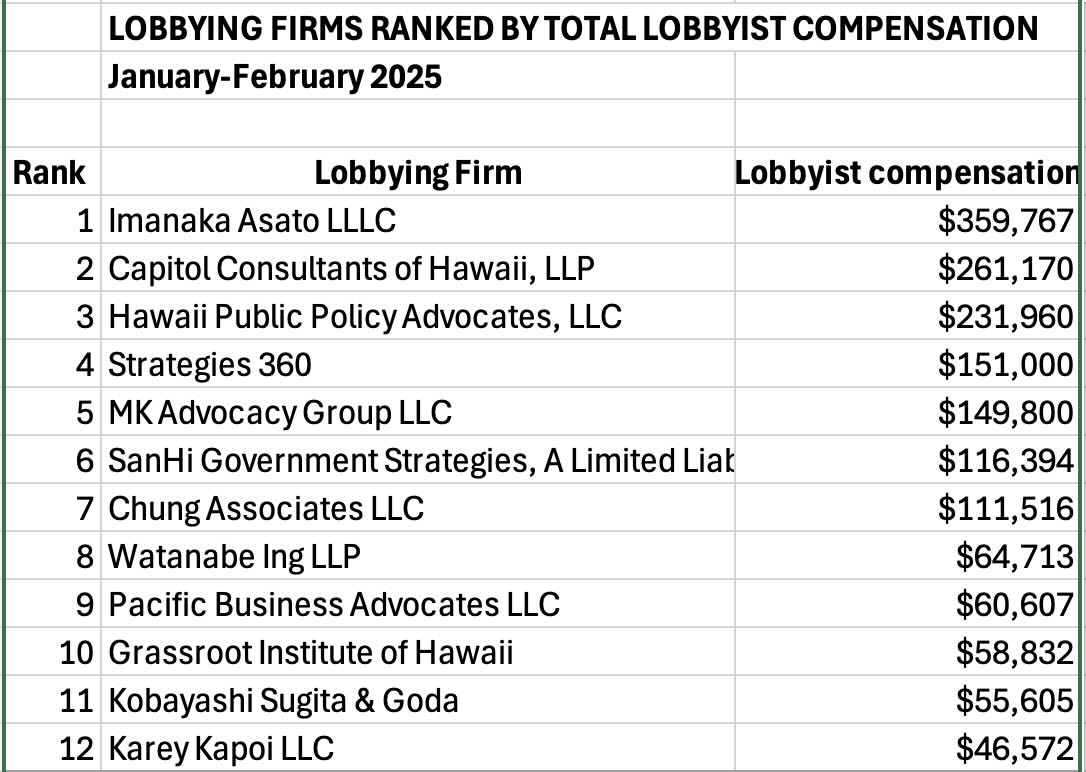
After some browsing, I ended up with three “big picture” snapshots–the top individual lobbyists ranked by their reported compensation from all employers or clients, the top lobbying firms ranked by the total compensation paid to the lobbyists they employ, and the top organizations represented by lobbyists (again ranked by compensation paid to lobbyists).

A total of 512 individual lobbyists registered for the 2025-2026 biennium. The list ranked by compensation is very top-heavy, with only 14 (2.8%) receiving more than $50,000 in compensation from their employers or clients during the reporting period (January 1 through February 28). In total, the top 14 highest earning lobbyists represent about one in five of all organizations hiring lobbyists, and accounted for 39% of total lobbying fees paid.

At the top of the list, and far ahead of the next highest earning lobbyist, is Michael Iosua, an attorney with the firm of Imanaka Asato LLLC. He represents clients through his firm, and also through an independent lobbying firm, MK Advocacy Group LLC, co-owned with Kimberley Yoshimoto, also an attorney with Imanaka Asato. The two are listed as partners in the Imanaka firm’s Government Relations Law group. Iosua, a former UH football player, was a member of the Stadium Authority and was required to file a financial disclosure report, which reported ownership of 50% of MK Advocacy Group.

In the second spot, with just over half the lobbyist fees earned by Iosua, is Ann Chung, and her company, Chung Associates LLC. Although using the “associates” label, Chung is the sole lobbyist registered with the company. She reported seven clients, including the client that paid the highest amount of lobbyist compensation during the two month period. That client, Waikai Consulting LLC, reported spending $65,000, but is kind of a mystery. State business registration records have no company by that name licensed to do business in the state, either as a Hawaii company or a foreign firm doing business here.

According to Chung’s ethics commission filings, Waikai Consulting LLC used the same Laukahi Street address that serves as Chung’s residence and the business address of Chung Associates.

After getting this far, I was running out of time. So what follows is quite sparse, although there are lots of interesting questions to be pursued about what’s shown in these data.

The next table lists the top lobbying firms, several of which employ more than one of the top ranked lobbyists. There are 275 organizations registered as employing lobbyists, but the top 12 firms control 51% of the total compensation paid.

The #1 firm, Imanaka Asato LLLC, employs three of the top paid lobbyists, including Iosua, Kimberly Yoshimoto, and Evan Oue.

Top Lobbyists

The third list ranks the organizations represented by lobbyists according to the amount of lobbyist compensation they pay. While somewhat concentrated at the top, the spending is more evenly spread among the 425 organizations. About 5 percent of the organizations account for 20% of the total compensation paid.

Top Lobbying Firms

Whew. Now I’m going to get this basic information posted for your review.

This trip is part of her job, not a European vacation

I haven’t written about ethics questions for a while, but here goes!

Civil Beat raised an ethics alarm about a company’s gift of a free trip to Poland for the director of the city’s Department of Customer Services in order to finalize design of the next updates to Hawaii’s REAL ID compliant driver’s licenses and identification cards. The donor, Thales DIS USA, Inc., produces the 100% polycarbonate material used for the cards at a factory in Gdansk.

In a pair of articles this past week, Civil Beat pounded on the ethics question, repeatedly arguing the trip violates city guidelines for the acceptance of gifts.

The impulse to question the ethics of any gift is appropriate.

But in this case, I think Civil Beat reached the wrong conclusion.

It appears CB made a mistake by applying the wrong ethics guidelines to this particular gift, which led to the mistaken conclusion that it violates city ethics laws. CB then rejected the city’s explanation, instead doubling down on the notion that it should have been rejected for violating ethics provisions.

Here’s how the issue was framed in an April 16 story (“Honolulu Director’s Free Trip To Poland Raises Ethics Questions“):

A company that just signed a no-bid contract with Honolulu’s motor vehicle office is hoping to send the agency’s director on an all-expenses-paid trip to Gdansk, Poland next month.

The contractor, Thales Group, has offered to cover the flight, hotel, meals and other related costs — a $5,000 value — for Department of Customer Services Director Kim Hashiro to visit their facility. Gdansk is an ancient port city and tourist destination on the Baltic Sea known for building ships and as the amber capital of the world.

Hashiro said the journey is necessary because she needs to sign off on the design of the state’s new licenses and ID cards, including aesthetic elements as well as counterfeit and fraud prevention features such as holographic images.

“It’s a color approval trip,” she said.

The city’s request to accept the gift of the trip will go before the Honolulu City Council on Wednesday, but the measure is already raising some eyebrows.

Honolulu Ethics Commission guidelines prohibit officials with authority over contracts from accepting gifts from contractors, and a City Council resolution forbids them from accepting any gift that could, in fact or appearance, impair their judgment.

Thales has been a city contractor for years but signed a no-bid extension in February that will earn the company $1.4 million in the next fiscal year, Honolulu customer services department spokesperson Harold Nedd said. Hashiro, who has administrative responsibility over the company’s contract, said Thales offered the trip after that extension was granted.

After the City Council voted to approve the gift and Hashiro’s travel, CB followed with a second story that doubled-down on the idea that the ethics guideline applicable to gifts is being violated.

“The Honolulu Ethics Commission’s guidelines on gifts say city officials with authority to award, oversee or evaluate a contract may not accept gifts from contractors that recently had a contract with the city, have a current contract or are likely to seek one in the future,” this second story repeated.

Indeed, a set of guidelines for gifts to city officers and employees provides exactly that: “Generally, an officer or employee who has discretionary authority in the process of awarding, supervising or evaluating the performance of a contract may not solicit or accept a gift from a contractor who recently had a contract with the city, has a current contract or is likely to seek one in the future.”

But here’s the problem. And it’s a biggie.

The city has two different guidelines for two different types of gifts.

One set of guidelines governs gifts to city employees or officials. These generally prohibit officials from accepting gifts from contractors, and appear to be the guidelines referenced in both Civil Beat stories.

But there is a second set of guidelines applicable to gifts given to city agencies rather than to an individual employee or official. It is similar in its intent to avoid ethical conflicts, but different in substance.

And, to be clear, the gift of travel to the factory in Poland was not a gift to Customer Services Director Kim Hashiro herself, but rather a gift to the city. It had to comply with the second set of guidelines, not the first one.

Gifts to city agencies

A memo spelling out Guidelines on Gifts to City Agencies was distributed by the Honolulu Ethics Commission in March 2006.

“Generally, gifts to an agency made to further the proper goals, functions or business of the agency may be accepted as long as a reasonable person would not conclude that the gift was intended to reward or influence an officer or employee in carrying out his or her duty.”

The guidelines then provide in part:

3. The gift must be for a legitimate government function. The donation must be made to help the agency carry out a legitimate government function, such as educating its staff about new services or products. A gift to an agency that supports an activity unrelated to the responsibilities of the agency may be a disguised gift for someone’s personal benefit and violate the gift or other ethics laws.

4. The gift must only be for reasonable and necessary expenses and not for the sole benefit of the affected officer or employee. The gift may only be for the reasonable and necessary expenses associated with the expressed purpose of the donation. If an officer or employee benefits from a gift to the city that exceeds the reasonable and necessary expenses required to discharge his or her city duties (for example, using first class instead of coach air travel), the gift may violate the gift laws and/or may require reimbursement to the donor for the value of an excessive gift.

The guidelines limit the solicitation of gifts, including gifts to a city agency, and provide that “an agency representative not request a donation under circumstances where the request may appear coercive to the person being solicited or create an expectation of special treatment in the mind of a donor.”

A city officer or employee shall not solicit, receive or accept any gift to the city under circumstances that in fact or in appearance:

(1) Rewards, influences or tends to impair the judgment of any city officer or employee in the performance of the officer’s or employee’s official duties; or

(2) Provides special consideration, treatment, advantage, privilege, or exemption for or coerces a potential donor.

Applying the guidelines

Is this trip legitimate city business? The answer is undoubtedly yes.

The donor, Thales DIS USA, Inc., is based in Austin, Texas. It holds contracts for producing driver’s licenses and state identification cards that comply with the federal government’ REAL ID requirements, and has done so for a number of years. Thales provides similar services to 10 other states, according to its website. It is a subsidiary of Thales Group, a global high-technology company with headquarters in France.

A March 20, 2025 letter to the City Council explained the importance of the trip, which will save substantial time and money.

As the Director with signing authority, her attendance is necessary to approve new driver licenses (DL) and State ID (SID) card design updates to implement a state-wide DL/SID card processing and production upgrade in 2025. A new DLISID card design will include updated security features to increase difficulty for counterfeiting, and enable REAL ID and American Association of Motor Vehicle Administrators (AAMVA) compliance.

Is it reasonable? Another strong “Yes” on this factor.

Civil Beat reported, but apparently discounted, why the trip makes good sense both for the city and the donor, saving significant time, which usually translates in cost savings.

The trip was planned at the urging of the contractor, who told the city that its sign-off by mail would take eight to 12 weeks, according to Hashiro.

“They’re saying that this is the most cost-effective and efficient way for them to get this color approval,” she said, “and it is part of their standard practice.”

In a statement, Thales media relations representative Jennifer Tumminio said it’s important to have the customer on-site during a production run to make sure the product meets expectations.

“A factory visit for approvals during initial production cuts down on the time needed for redesigns and approvals,” she said, “and gets identification documents into the hands of the people who need them quicker.”

Since the idea of sending a city representative to the Thales factory came from the company, the offer avoided the guidelines’ cautions about soliciting gifts from contractors.

A 2011 advisory opinion by the Honolulu Ethics Commission discussed the parameters of legitimate business, quoting the 2006 gift guidelines.

The Commission’s Guidelines on Gifts to City Agencies notes: “The gift [to the city] must only be for reasonable and necessary expenses and not for the sole benefit of the affected officer or employee. The gift may only be for the reasonable and necessary expenses associated with the expressed purpose of the donation. If an officer or employee benefits from a gift to the city that exceeds the reasonable and necessary expenses required to discharge his or her city duties (for example, using first class instead of coach air travel), the gift may violate the gift laws and/or may require reimbursement to the donor for the value of an excessive gift.” (Underscoring added.)

But what about the concern that the trip could be considered a reward for Hashiro, who had just exercised her discretion to approve a no-bid contract extension when the trip to Gdansk was suggested?

The facts of the situation, however, show that Hashiro really had no discretion in awarding the extension to Thales. She could not have gone to another vendor, because this is a small part of a larger system, and the state as a whole is locked in with Thales’ version of the enhanced security credentials.

Based on this review, the Department of Customer Services followed existing ethics guidelines by reporting the prospective gift and seeking approval for its acceptance from the City Council. It passed all of the tests laid out in city guidelines. There was no hidden deal, no back-door benefits, no conversion of public property into private benefits.