Category Archives: Genealogy/family

New light on an old tale

Here’s a little voyage into family history you might find of interest, prompted by a recent column by Peter Apo in Civil Beat about the Battle of Kuamo‘o (“Peter Apo: How A Violent Battle In 1819 Still Impacts Hawaii Today”).

Apo had previously observed that he only learned of the Battle of Kuamo‘o a few years ago, and believes most Hawaiians don’t know about it.

I think that’s true, and I know it was true in our family.

Follow me back in time. In the early 1950s, my mother started gathering information about her Hawaiian genealogy. One of best sources was George Kopa, a “cousin” who lived in Kahala just a couple of blocks from our house.

Consistent with his Mormon faith, Kopa had gathered many records. And, consistent with his Hawaiian culture, there were unwritten stories that he also shared. My mom wrote out her annotated summary of Kopa’s information in 1994, when she was 80.

Like many modern Hawaiians, my mother apparently did not know of the Battle of Kuamo‘o, and believed a battle that is part of our family narrative must have been prior to 1800, and that led her to discount Kopa’s account of a battle that brought his ancestors (and ours) to Maui.

This part of my genealogy is based on information given me in the early 1950s by George Clement K. Kopa, who lived for many years on the makai side of Kahala Ave near the corner of Pueo. He was then about 80 and as a devout Mormon, had gathered this information years before and recorded it on a large chart from which I copied what I felt I needed. [My mother’s guess of his age was several years off, as Kopa died in 1963 at age 83.]

His earliest known male ancestor was Kapu, whose son Kahimanapookalani was the grandfather of Mr. Kopa. Apparently Kahimanapookalani was also know as Kopa which became the surname of his sons. We know our ancestor Kina was the daughter of Kahooilimoku who, according to Mr. Kopa, was the brother of Kahimanapookalani. [Note: That would have made Mr. Kopa and my grandmother second cousins, as their grandparents–Kahooilimoku and Kahimanapookalani–were brothers.]

Mr. Kopa also related a number of family traditions which he had not put into writing. It seems to me that some of the traditions don’t fit into recorded history, probably because there seems to be some confusion as to the generation in which particular incidents occurred. For instance, the name Kahooilimoku is said to commemorate a shipwreck. There were four (?) brothers who were warriors serving a high chief on the island of Hawaii, probably Kau. Their army was defeated in battle and their chief was killed. The brothers rescued the chief’s body and escaped from the scene in a canoe. A storm arose and the canoe was blown off course, and wrecked on the coast of Kaupo, Maui. The brothers lay exhausted and injured on the beach where they were found by several young women who took them home and cared for them. The men married their rescuers and remained in Kaupo. The name Kahooilimoku is supposed to commemorate this flight and shipwreck. Mr Kopa implied that this tradition concerns the four sons of Kapu. But the sons on his chart were born probably circa 1820-1840, long after the islands were united and wars between chiefs of the districts of Hawaii had ended. It is my guess that the traditional battle took place no later than 1800. It seems more logical that Kapu was the son of the of the warrior brothers who ended up in Kaupo.

I was very new at genealogy in the 1950s and did not question what I was being told for it seemed impolite. As I review my old notes, I see that I must have been confused and considered the four sons of Kapu as the shipwrecked warriors. Perhaps only one or two brothers were shipwrecked and Kapu was the son of one of them. I leave this for someone else to explore.

My mom’s attempt to reconcile this bit of family lore with the more established dates from her genealogical research might have come to a different conclusion had she known about the bloody battle in North Kona that took place in 1819. It appears to be time to take another close look at this family tale, but I don’t know if I’m up to it.

An aside: Here’s a story that appeared in the Honolulu Advertiser on August 31, 1939, on George Kopa’s retirement. Just click on the story to read a larger version.

Throwback Thursday: Uncle George & Me (reposted from Dec. 2014)

This was originally posted back in December 2014, after Meda and I got back after spending several days on the Big Island. I don’t think that I can do a better job rewriting it today, so I’m just sharing the original.

•———————————————————————————-•

Volcano House PortraitA selfie, “Uncle George and me,” taken on Saturday at the recently renovated Volcano House in Hawaii Volcanoes National Park. It was a mind-bending experience for me, as past and present collided.

We were at the Volcano House to meet with one of Meda’s colleagues from UH Hilo, who lives in the volcano area.

When you enter the lobby area of the Volcano House, you’re drawn into the viewing areas which offer a panoramic view of the Kilauea Caldera towards Halemaumau Crater. As the mist drifts past, the view comes and goes.

December 2014
And on one wall there’s a large photograph of the original hotelier, George Lycurgus, who was known to everyone as Uncle George. According to the small plaque accompanying the portrait, Uncle George died in 1960 at the age of 101.

The year before, in late 1959, when I was 12 years old, my family stayed at the Volcano House. Two events made that stay memorable. First, my parents introduced me to Uncle George, who could usually be found in the lobby with his cribbage board and cards nearby. And I went on to lose a cribbage game to the old man. I remember thinking that he was unbelievably old, with big hands, heavy nails, parchment skin. He reminded me of the Galapagos turtles at the zoo, ancient, but slow, steady, and very much alive. And he could play a good game of cribbage.

The second event came in the dark of night, when we were rousted from our rooms by the ringing of a metal alarm triangle being sounded, and a warm glow reflecting in the fog outside. People were shouting the news. Madame Pele had returned! An eruption had started, and lava was fountaining hundreds of feet into the air at nearby Kilauea Iki crater. We hurriedly dressed, piled into the car, and followed directions to an area across the crater from the vent. I remember the roar, like a jet engine, the heat, and the awesome sight of pulsing fountains of molten lava and ash spewing high into the air. It’s one of those experiences you never forget. And I’ve got an autographed booklet about Uncle George to go with the memories.

Meanwhile, there are other inherited memories of the volcano as well. Several years ago, we came across a series of small snapshots taken in 1920 when Meda’s grandparents were honeymooning in the volcano area.

1922And in 1922, UH Professor Carey D. Miller visited the Volcano House, and included several photos of the volcano area in a scrapbook documenting her first year in the islands. The hotel looked very much like it does today. If you click on this photo, you can then page through Miller’s other volcano photos. Quite an adventure at that time!

And there were my dad’s recollections of traveling to the Volcano House soon after the start of WWII. He sold restaurant supplies, and his company was hired to install a new kitchen after a fire destroyed much of the Volcano House old building. Here’s a bit of what he remembered:

Uncle George Lycurgus was the head there, assisted by his son, Nick. My calls on the early trips were via the jitney. Uncle George was a very personable man and concerned about his establishment. It was necessary that I find a room for the night and there were no rooms available. After several discussions with Nick and his father concerning their kitchen renovation, the day was coming to an end and I still did not have a room, so Uncle George asked if I would mind sleeping in a closet under the stairway. He gave me a warm blanket and at no charge a place to stay for the night.

A well-planned kitchen was finally delivered about ninety days later. On that trip I had to get to the Kona side of the island and there was no public transportation. Nick told me there was a possibility of working out a ride with the mail man serving the Kona district, who would be showing up soon, providing I didn’t have to be in Kona until early evening as mail had to be delivered en route.

That was a great trip, my first to the Kona area. The mailman, Mr. Lincoln, was related to Abraham Lincoln and his father lived along the Kona coast. We stopped to see his father, who lived in an old home with a giant avocado tree fronting it. I was pleased to have met his dad and left with a big bag of avocados.

You can read more of his recollections here.

In any case, I not only found myself bouncing back and forth between the memories of 1959 and the present, triggered by the great photo of Uncle George as I knew him back then, while swirling in the background were those inherited, multi-generational memories. All that, and a wonderful view, made for quite a lunch.

More digital magic: Ancestors come alive

That’s what the genealogical site, MyHeritage.com, is now offering to do with your hold family photos. They’re using artificial intelligence to make photos of ancestors come alive long after their deaths.

The company’s first offering was to automatically enhance and colorize old black & white photos. That produced some very high quality results that were fun to look at.

Now they’ve gone a step further.

Do you sometimes wonder how your ancestors moved, smiled and looked in real life? You can now see your ancestors from generations past like never before!

We’re happy to introduce Deep Nostalgia™, a groundbreaking new photo feature on MyHeritage that allows you to animate the faces of your loved ones in still photos. This new addition to our suite of photo tools produces a realistic depiction of how a person from an old photo could have moved and looked if they were captured on video.

Of course, I had to try it out. And it’s mesmerizing…and creepy…at the same time.

I started with photos of my mom’s mother, my grandmother, Heleualani Yonge, and my mom’s grandmother on her dad’s side, Helene Francis Brittain Yonge.

Then I let MyHeritage do its thing.

Here are the results.

My grandmother, Lani Yonge.

My great-grandmother, Helene Brittain Yonge

I might try a photo of my late sister, and see how close they get to the person I remember. That might give a sense of how well they render these more distant family members.

Notes from the archives

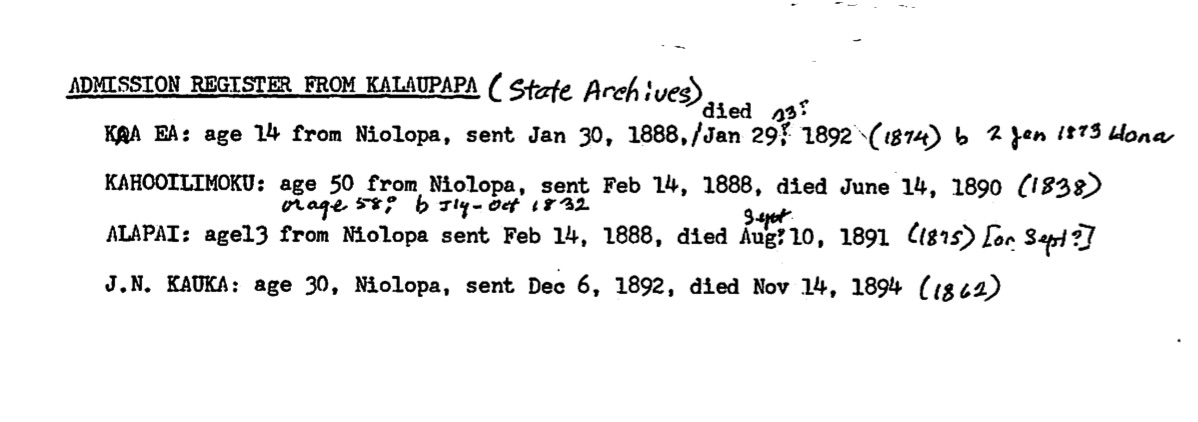
I believe it was my mother who retrieved this evidence of a sad chapter in her family history.

These notes were copied from the register used to record admissions to the leprosy colony in Kalaupapa. Apparently it is now held in the Hawaii State Archives.

This brief excerpt lists my great-great-grandfather, Kahooililmoku, and two of his young sons (Kaaea and Alapai) among those who were taken to Kalaupapa in 1888. All are listed as being from Niolopa, a land section in Nuuanu. It was a one-way trip. All three died in Kalaupapa.

My late sister, who had inherited the role of family genealogist, believed our great-great-grandmother, Heleualani, also contracted leprosy but died at home in Hana in 1886 before she was sent to Kalaupapa.