Category Archives: Genealogy/family

Where’s George Galbraith now?

A story by Kirsten Downey in Civil Beat this week described the situation of a cemetery in Pearl City now in shambles after being abandoned, and repeatedly vandalized, for years, or perhaps decades (“Vandals Nearly Destroyed This Central Oahu Cemetery. Now The Community Is Standing Up For The Dead“).

It’s a story that has been of interest to my family for a number of years because its predecessor, Loch View Cemetery, was the burial place of George Galbraith, who died in 1904. His estate, held in trust for over 100 years, was eventually valued at more than $60 million, and was finally distributed to the beneficiaries by the end of 2013.

My great-grandfather, Robert William Cathcart, was a friend and associate of Galbraith and, according to family lore, was the non-lawyer who wrote his will. Although records show Galbraith was buried at Loch View, nothing remains there to mark the grave.

My late sister, Bonnie (Lind) Stevens, moved from her longtime home in California to Hawaii after her husband’s death in 2007. She had inherited my mother’s deep interest in genealogy and local history, and one of her early projects was to find Galbraith’s grave. She tried. She had to battle bureaucracies and fragmentary records. But she slowly pieced together pieces of the puzzle.

I’m going to share her findings over the next day or two in hopes there are details here that might assist those trying to rescue the cemetery and the souls put to rest there.

Here’s Bonnie’s first installment.

Where’s George Galbraith now?

Galbraith was buried at Loch View Cemetery on the shores of Pearl Harbor. Most burials in the cemetery were moved to make way for the widening of Kamehameha Highway some 50 years ago. According to Nanette Napoleon, director of the Cemetery Research Project:

The cemetery, as it exists today, only has 12 identifiable markers. George Galbraith is not one of them. There was at one time 562 other people buried there, but they were all removed and relocated. I do not know where they were relocated. However, I do have the list of people who were disinterred, but you ancestor, George Galbraith is not on this list. This leads me to conclude that if he is still there he is in an unmarked grave. This is very common in our old graveyards.

According to the authors of Next Stop Honolulu, “Oahu Railway created the first planned housing development in the Islands. Called Pearl City, it offered house lots and featured Remond Park, a large picnic grounds and dance pavilion. In 1901 the line also created Loch View, a private cemetery overlooking the waters of Pearl Harbor.”

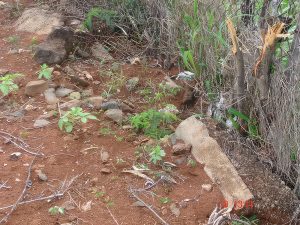
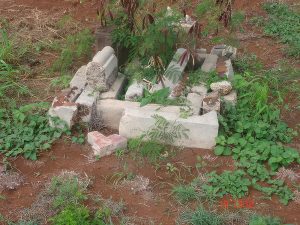
There’s not much left of it today.

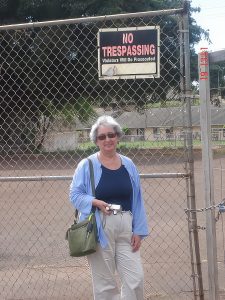
In November 2007, David Dickinson (a Galbraith beneficiary from British Columbia) accompanied Bonnie on a search for the remains of the cemetery.

This is what they found.
Ancestry.com fine tunes its analysis of Hawaii and Pacific islands DNA

Ancestry.com has updated the computer algorithm it uses to assess its ethnicity estimates, providing more detailed results for those with Pacific ancestries.

Those following this blog for a while know that I’ve been struggling to make sense of the results of several DNA tests I’ve done since my late sister, Bonnie, talked me into it as a way for her to extend her understanding of our father’s roots in Scotland.

The DNA, however, led in a different direction.

I’ve ended up doing tests through three different companies–ancestry.com, familytreendna.com, and myheritage.com. The companies differ in the size and makeup of the DNA database that they use to interpret the broad sweep of family history and ethnicity. Each company, based on their own database, produces slightly different lists of DNA “matches.”

It turned out that Bonnie’s carefully researched Lind family genealogy which she painstakingly traced back over a number of generations through records in Scotland was undermined several generations back when there was apparently a “non-paternity event,” something that disrupted the apparent family tree. In other words, it appears that one of my male Lind ancestors was adopted, or perhaps, as my mother would say, “someone jumped the fence,” as in an extra-marital relationship. Shocking, I know, but par for the course, I’ve come to believe.

In any case, my DNA tests turned up surprisingly few genetic Lind relatives. But they have turned up hundreds of Maori “cousins” going back around four generations. It’s that connection that I’ve been trying to untangle.

In the past week, Ancestry sent out notices that it has made changes to its ethnicity estimates.

Ancestry is constantly updating our technology and cutting-edge science. As we update our algorithm and reference panel, your results may change. Additionally, as we add more and more customers to our AncestryDNA database, we hope to increase the number and granularity of our ethnicity regions, making each update more precise.

We calculate your AncestryDNA ethnicity estimate by comparing your DNA to a reference panel made up of thousands of DNA samples from people with long family histories in one place or within one group. Our reference panel is robust due to the millions of family trees linked to our DNA customers. For this update, Ancestry’s team of scientists increased the AncestryDNA reference panel size we use to make ethnicity estimates. The updated reference panel has more samples from more parts of the world to increase the total number of regions available for analysis from 77 to 84.

Because this update is more precise overall, many users will see improvements in their ethnicity estimates as percentages change. Others will see new or updated regions in their estimates. Ancestry will continue to work to expand the diversity of our products to provide more precise ethnicity estimates to our customers.

Previously, Ancestry calculated that my DNA included 13% traced to “EasternPolynesia&New Zealand Maori,” which included Hawaii. That’s just about what I would expect, since I am 1/8 Hawaiian (my great-grandmother was Hawaiian, and my grandmother and mother married non-Hawaiians).

In the most recent Ancestry update, the category has been split, so they now estimate my background as Scotland (42%), Ireland (30%), Hawaii (9%), England and Northwestern Europe (8%), New Zealand Maori (4%), Sweden and Denmark (4%), Wales (2%), and Tonga (1%).

To tell the truth, I don’t know how or whether this will assist me in tracing the Maori connection. I subscribe to another genetic genealogy site, Gedmatch.com, which offers software to do different types of DNA analysis with links to traditional genealogical research and family trees. But, for now, it’s beyond my skill level.

It seems unlikely that I’ll ever identify the source of that Maori DNA. My understanding is that these “autosomal” identify ancestors over more recent generations rather than the kinds of DNA tests that trace back to the beginning of time. But I’m just trying to learn more, a bit at a time. That’s what it’s all about, isn’t it?

Another DNA surprise

I signed Meda up for an Ancestry.com DNA test a couple of years ago, but then managed to lose the credentials needed to access her account, which I think were lost in the transition to new computers for both of us.

In any case, I was reminded of this the other day, and got up early this morning and reestablished the connection to her DNA test results and matches.

Meda was named after her maternal grandmother, Meda Menardi Renton, whose great-grandfather, Joseph Sebastian Menardi, came to the US from Italy in 1821. The family lore was that he had been involved in revolutionary politics in Italy had finally had to flee, although we have no details about that.

In any case, Meda expected to find plenty of distant cousins in Italy, which might eventually produce some European travel adventures. After all, my DNA has turned up hundreds of Maori cousins, and we expected her to find Italians in similar numbers.

So the DNA results came in, and Ancestry traces her back to England, Scotland, Ireland, and Wales. No sign of Italy. Zip. So what happened?

It looks like another non-paternity event, “when someone who is presumed to be an individual’s father is not in fact the biological father.”

Here’s my guess. Joseph Sebastian Menardi, the first on her Italian side to come to the US, was just over 50 when he arrived and settled in Pennsylvania. He then married a young woman of 18 or 19. They had a son, and old Joe died a year or so later. My guess: the son, Meda Menardi Renton’s grandfather, was not the biological child of Joseph Menardi. But, of course, that’s pure speculation at this point, although it would explain the DNA, or more properly its absence.

It’s ancient history, but still interesting to try to put the pieces together.

Throwback Thursday: My dad’s parents circa 1940

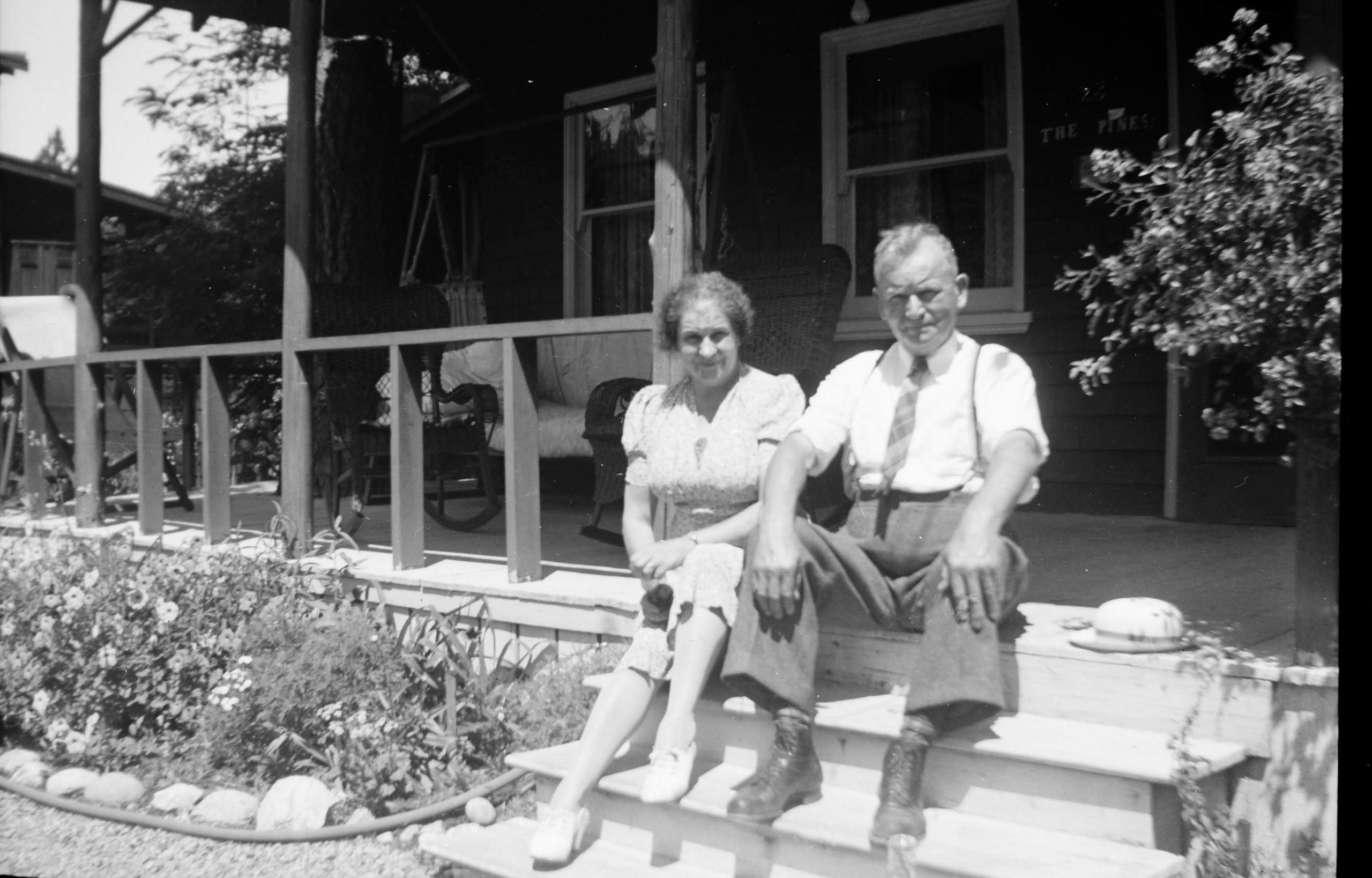
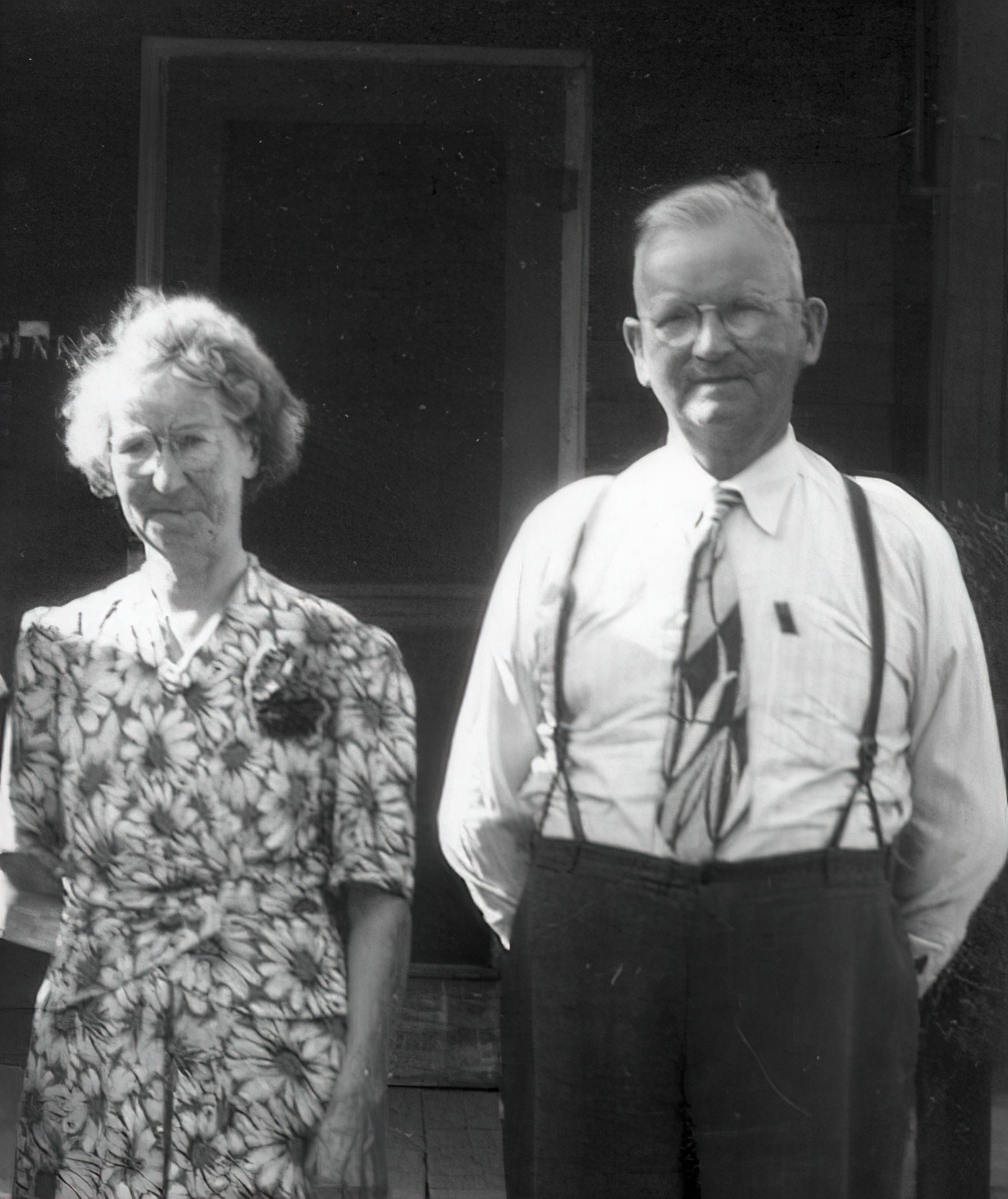
This is a photo of my dad’s parents, William Grace Lind and Jane Galt Montgomery Lind, who went by Jeanne, or Jeanie.

Willie was about 10 years older than his wife. Both were born in Scotland, and came to the US in the first decade of the 20th Century.

I’m believe this photo was taken somewhere around 1940 at the home of Willie’s older sister, Elizabeth (Bessie) Fairley.

My sister told the story of how they met and married. And I posted a copy of the letter Willie wrote to Jeanie dated June 7, 1910, discussing details of her upcoming trip to New York and then across the country by train to California.

They raised four children: William, John, Tom, and Janet. A fifth, Gracie, died when she was 3 years old.

Top photo: Willie and Jeanie Lind.

Lower photo: Willie and his sister, Bessie Fairley.

Dorothy and Loretta Lind with Willie Lind and his sister Bessie