Category Archives: Hawaiian issues

Occupation of OHA offices in 2019 finally leads to felony indictments

Hawaii News Now reported last week that a grand jury has returned felony indictments against six men associated with the self-proclaimed Polynesian Kingdom of Atooi who were part of a larger group that took part in a January 17, 2019 attempt to takeover the headquarters of the Office of Hawaiian Affairs, reportedly detaining, threatening, and assaulting several OHA employees after announcing they were there to seize agency assets.

This Hawaii News Now story was surprisingly the only mention of the indictments in the mainstream media that I could find.

The Kauai-based Kingdom of Atooi is one of several competing groups advocating varied forms of Native Hawaiian sovereignty, with each claiming to represent the mythical Hawaiian Kingdom in one form or another.

During the OHA office takeover, the men from Atooi were dressed in red or black t-shirts identifying them as “federal marshals,” most also displaying badges . Police were called and a two-hour standoff ensued. Four men were arrested and charged with misdemeanor assault and harassment.

They were quickly released on $100 bail each, while others involved in the takeover were not detained. Prosecutors quickly withdrew the charges without prejudice, meaning that additional charges could be brought following a more thorough investigation.

The latest indictment alleges several felonies were committed during the incident, raising the stakes for all involved.

The six named in the indictment are:

Sadhu-Bhusana Bott
Jordan Faletogo
Ene Faletogo (aka Ene Faletoga)
Rheece Lopaka Richard Bulu Kahawai
Peter Laban (aka Peter Laman)
Remedio Dabaluz

Dabaluz was named in a single count of first degree terroristic threatening, a Class A felony, for threatening Zuri Aki.

The other five men each face two counts of kidnapping, also a Class A felony, for restraining OHA employees Davis Price and Kyle-Lee Ladao “with intent to terrorize…and/or interfere with the performance of any governmental or political function….”

The five are also charged with one count of second degree assault, a Class B felony, for attacking Price, who was admitted to Kaiser Hospital after the attack with two broken ribs and multiple contusions.

Conviction on Class A felonies is punishable by a maximum sentence of 20 years in prison, while a Class B felony sentence is as much as 10 years.

According to the indicdtment, all except Dabaluz could face enhanced or extended sentences if convicted as repeat or persistent offenders.

Faletoga is the only one with a serious criminal record, having pleaded guilty in state court to three counts of promoting dangerous drugs in 2007, for which he was sentenced to a ten year term in prison.

Two weeks before the January 17 incident at OHA, a group of about eight men claiming to represent the Kingdom of Atooi first entered the OHA lobby on January 4, 2019.

A civil lawsuit filed on behalf of Davis Price later described what then took place.

“While inside the lobby area, Atooi began yelling and making aggressive gestures and loud statements that they were there to take over the building, to seize assets, and arrest OHA Trustees. Employees at OHA were able to clearly hear the threats made….,” the lawsuit alleged.

The men agreed to leave, but told OHA staff they would return. And they did.

A larger group 13 men returned late in the morning of January 17, 2019 and again immediately attempted “to take control of the OHA office area by the use of force and violence,” according to the civil lawsuit.

The men confronted Price, “demanding to be allowed into the back-office area adjacent to the lobby.” Davis was blocking the door to the area, and the men from Atooi then started “forcing their way through the door and…pulling Mr. Price away fron the door striking hinm in the face, head, neck and shoulder areas.”

He was then overpowered, and forced face down on the floor. While his his arms and legs held, another man put him in a “rear naked choke hold” which left him unable to breath. He was then carried to the front door by four of the men who then swung Price and threw him head first out the lobby door, the lawsuit alleged.

According to the Kingdom of Atooi, its government officials, ambassadors and assisting diplomats, as well as its “Federal Marshalls,” are subject to the Hawaiian Kingdom Constitution and not to Hawaii or US law.

When Ene Falatogo was arrested in November 2020 after an altercation at the Nomnom Convenience Store at King and Cooke Streets in Honolulu, a letter from the Office of the Royal Magistrate addressed to the City and County of Honolulu, the chief of police, and Honolulu Prosecutor Steve Alm advised these officials they had been “found liable for some or all of the following: defamation of character, discrimination, terroristic threatening, detainment of a diplomat, bail fraud, lack of jurisction, illegal confiscation of Government Property of the Sovereign Polynesian Kingdom of Atooi/Hawaiian Kingdom.”

The letter, which is included in the court record, said these offenses “require monetary remedies, fines, fees, and penalties, and may include imprisonment as determined by the Royal Magistrates of the Kingdom of Atooi/Hawaiian Kingdom….”

The folks associated with the Kingdom of Atooi have reportedly leveraged their sovereignty claims to solicit donations, as well as by selling “Kingdom” drivers licenses and passports to unwary buyers.

Here’s something I wrote back in early 2014, which is as true today as it was then.

Suddenly it seems we’ve got a bumper crop of Wannabe Royals staking their claims, however questionable, to wield power on behalf of what each says is a sovereign Hawaiian government tracing its roots back prior to the 1893 “overthrow” of the kingdom.

It seems like everywhere you turn, there’s another cult-like group formed around a charismatic central figure claiming sovereign rights and asserting that they and their followers are above the laws that apply to the rest of us. Pretenders, some might call them.

Their claims, of course, are conflicting and overlapping, leading to repeated attempts by certain sovereigns to undercut the claims of others, and vice versa.

Timid news coverage and a reluctance among many Hawaiians to publicly criticize these royal claimants for fear of hurting other more mainstream sovereignty initiatives that are also underway has resulted in the Wannabe Royals getting more respect and deference than they would otherwise merit.

Also see:


The Polynesian Kingdom of Atooi,” Hawaiian Kingdom Blog, June 26, 2013.

Hawaii Monitor: Some Laughable Royalty Claims,” Civil Beat, February 26, 2014.

Critical reporting needed on self-proclaimed sovereigns,” iLind.net, January 30, 2019.

Connecting some different dots

In September, the US Attorney’s Office in Honolulu announced it had charged six people with conspiring to defraud the IRS, and last week announced the last three defendants had been arrested.

According to the press release (which is attached below):

As part of the tax fraud scheme, the conspirators allegedly filed fraudulent individual tax returns and other tax documents that reported false withholdings from mortgage lenders and then claimed substantial refunds from the IRS. After processing the false returns, the IRS allegedly issued refunds totaling over $1 million.

Several defendants were also charged with filing false tax returns and making false statements under oath in a bankruptcy proceeding, and a superseding indictment added money laundering to the charges against three defendants.

Four of the defendants lived in Hawaii, while the other two were in Georgia.

The name of the lead defendant in the case, Rosemarie Lastimado-Dradi, sounded familiar, and sent me back to search my files.

It turns out that back in 2018, Rose Dradi and two well-known Hawaiian sovereignty proponents were accused by the state Office of Consumer Protection of committing mortgage rescue fraud through a scheme “targeting homeowners desperate to save their homes from foreclosure.”

Here’s what I wrote about that case in a May 2019 blog post:

In a series of legal filings in both state and federal court since the beginning of 2018, the consumer protection agency alleges the scheme involves David Keanu Sai, an activist scholar who has vigorously promoted his own theory that the illegal overthrow of the Hawaiian Kingdom invalidates subsequent laws and land titles; attorney Dexter Kaiama, who has defended a number of sovereignty activists with arguments based on Sai’s theory; and Rose Dradi, a former Kapolei resident.

In court filings, Sai and Kaiama have strongly denied doing anything illegal. Dradi could not be located and has not responded to the allegations.

The agency alleges homeowners facing imminent or threatened foreclosure were told, both explicitly and implicitly, that a legal defense based on Sai’s sovereignty beliefs would result in the foreclosures actions being dismissed and their homes being saved.

The allegations eventually led to a court order permanently barring Kaiamafrom providing “legal services or any other assistance” to any homeowner facing foreclosure.

In addition, OCP said in court filings it had referred the allegations for possible criminal investigation by other authorities.

I have to wonder whether lawyers for the state consumer protection office had any idea they had stumbled into one piece of what prosecutors now allege was a broad criminal conspiracy by Dradi and others.

According to the indictment of Dradi and others, the broad federal investigation in Dradi’s various activities has been ongoing for several years.

DOJ Press Release re Fraud Charges Against Six Defendants by Ian Lind on Scribd

Coelho Way named for a prominent Hawaiian figure

My recent post about the house at 91 Coelho Way got me wondering about the history of the name.

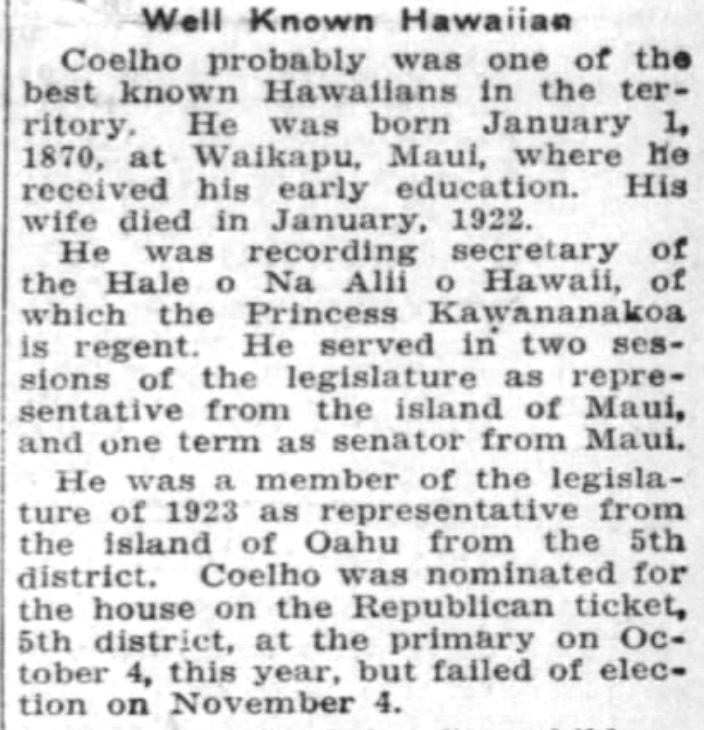
It turns out to be named for one of the most well-known Hawaiians of his day, William Joseph Coelho, who was born on Maui in 1870, and died of injuries received in an automobile accident in November 1924.

According to news accounts, Coelho was a passenger in a car driving through Kipapa Gulch on the way back to Honolulu from Schofield the evening of November 11, when it skidded out of control and overturned. Coelho was trapped under the car and suffered serious injuries. He was first driven to Tripler Hospital, then moved to Queen’s Hospital, where he was operated on overnight. He died at 10 am the following morning.

Coelho served two terms in the Territorial House and one term in the Senate, was a well known musician, a lecturer on things Hawaiian, and introduced the bill in 1907 that created the College of Agriculture and Mechanic Arts of the Territory of Hawai‘i, predecessor of the University of Hawaii.

This from the website, Discogs.com:

William Joseph Coelho
Hawaiian musician and composer, later Territorial Senator (born January 1, 1870 at Waikapu, Maui, HI – died November 12, 1924 in Honolulu, Oahu, HI)

A graduate of St. Louis College, Coelho was part of a large group of Hawaiian musicians managed by Mayor John H. Wilson that performed for sixteen weeks at the Pan-American Exposition in Buffalo, NY, in 1901. Later, he became Recording Secretary of one of the four royal Hawaiian societies, the Hale O Na Alii O Hawaii (est. 1918), and served in the territorial legislature of Hawaii, twice as representative, once as senator from Maui. He died as the result of a car accident.

Composed “Lei Poni Moi” (Wreath Of Carnations), “Kilakila O Haleakala” (Majestic Mt. Haleakala), and “Roselani.”

And this description was included in a Honolulu Star-Bulletin story on the accident that took his life.

Digging through old newspaper clippings, I found Coelho acquired a lot in the area in Nuuanu then known as Niolopa, and acquired a second parcel in 1911.

In 1923, a name change notice was publlished in the Honolulu Advertiser:

A column by Donald Billam-Walker with the story behind the name change appeared in the Honolulu Star-Bulletin on August 12, 1941.

In 1911, according to Walker, it was first proposed the small roadway be named for William Coelho, whose home was located along the road.

Coelho, however, declined, and instead suggested it be named “Ku Lane” in honor of his newborn son, who was known within the family as Ku, rather than by his long Hawaiian name, Kukailimokunuiakeaenaikalani. “Accordingly, the roadway was renamed Ku lane in 1911,” Billam-Walker reported.

However, “an odd set of circumstances arose.” The family home of George Waterhouse, a vice-president and assistant manager of the Bank of Bishop, the predecessor of First Hawaiian Bank, was also located on Ku lane. His daughter’s name was Julia, which was Hawaiianized as Kulia, according to Billam-Walker, leading some of her friends to call it Kulia Lane.

“In order to guard against possible loss of the name of this street to the Coelho family through the term ‘Kulia’ creeping into use, it was decided in 1917 to rename Ku lane as Coelho lane (since changed to ‘way’) in honor of Ku’s father, W.J. Coelho.”

Looking through old newspapers, Coelho Lane and Coelho Way seemed to have been used interchangeably through much of the 20th. However, since 2002, all the published references have used Coelho Way.

Just as an aside, my mother was outraged by the continuing snub of Coelho by the University of Hawaii. She felt the failure after more than a century to name a building after the Hawaiian legislator whose bill created the university was another sad example of casual (or not so casual) anti-Hawaiian prejudice. It’s hard not to agree.

More of my great-grandmother’s story

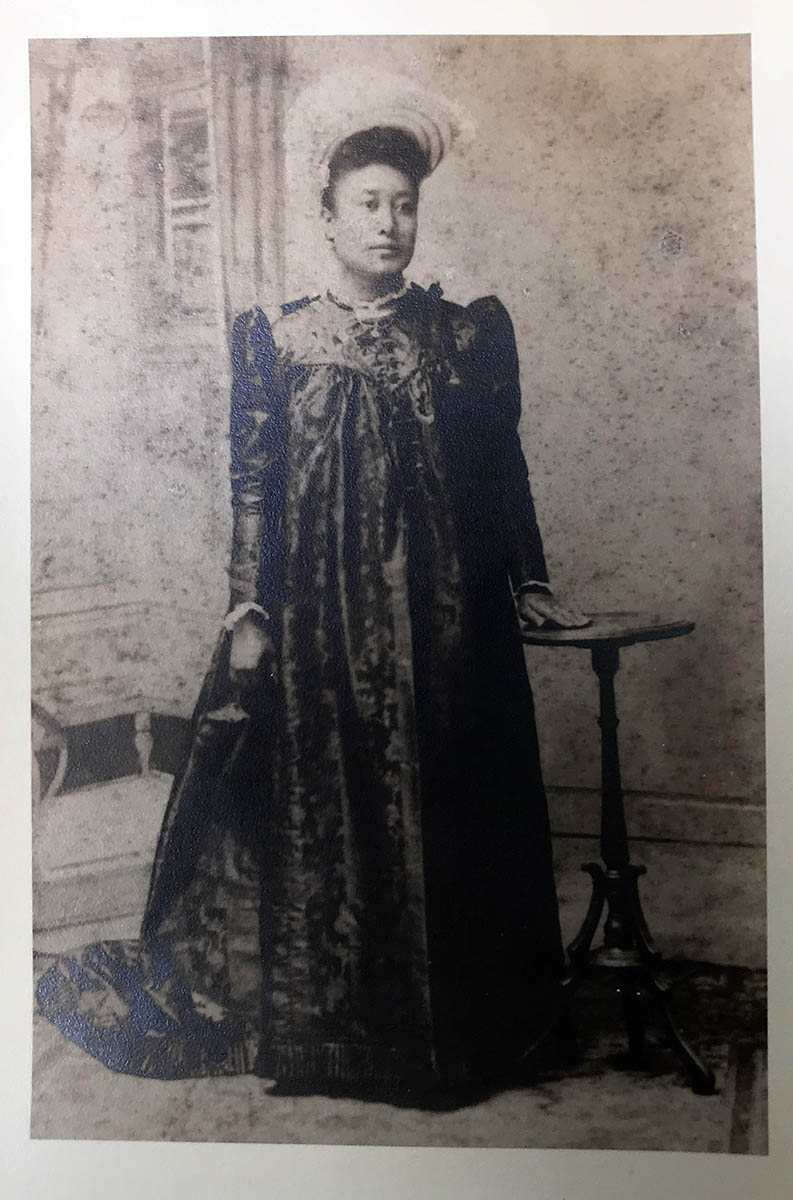
After posting a photo last week of my great-grandmother, Kina Cathcart, several people asked for more of her story.

I am dependent here on the years of research by my mother, Helen Yonge Lind, and my sister, Bonnie Stevens, who did the genealogical digging to further our understanding of our family roots. Had they been living, I would immediately punt a request like this over to one of them. But, since they are both gone, I’ll have to give it a try.

It’s not a happy story, really.

Kina was born in Hana, but there’s uncertainty about her birth date.

Her death certificate in 1913 listed her age as 47. The information apparently came from her oldest son, James Kahele. No birthdate is listed.

My mother noted the uncertainty in a note found among her papers.

Frin several sources, I have heard that she was a twin. From records of the Cockett family we have the birth of Kalua, a twin, born 1 March 1869. I have given Kina the same birthdate since she was reportedly a twin. Bt her son said she was 47 years old at death, and this would place her birth as circa 1866. Perhaps Kalua was the twin of another child in the family and Kina was born earlier.

Such are the vagaries of genealogical research.

Her father, Kahooilimoku, and mother, Kaheleualani, held property in Hana, and as I recall, Kahooilimoku was an awa farmer.

Kahooilimoku is listed in an 1880-1881 commercial directory as owners and planters of Awa on 25 acres located on Hana Road in Hana, Maui.

They were said to have been the first family to build a wood frame two-story home in Hana, but that could just be an ungrounded family tale.

Kaheleualani was one of 12 children of Kapehe, who was born in Kaupo circa 1829 but lived most of her life on the Keanae peninsula. Kapehe was said to be “something of a legend,” a kahuna lapa’au or Hawaiian medical doctor knowledgeable in herbal medicine, healing, and, another said, bone setting.

“In Keanae and other remote places, the kahuna lapa’au filled an important community role well into the 20th century, although they were not approved or licensed by the haole government,” my mother wrote in a note years later. “I remember when I was a child in the 1920’s there were Hawaiian neighborhoods where their kahuna lapa’au was favored over haole doctors.”

One family source told my mother Kapehe was considered e’epa, someone born with spiritual or psychic qualities, although this was disputed by others. She is remembered as tall and slim, “tall enough to hang gourds of food from the ceiling to keep them away from inquisitive children.”

Little was found about Kina’s early life, but when she was about 15, she was sent to Honolulu to attend school, possibly at St. Andrew’s Priory, which was established in 1867. She lived near the school with the Brickwood family. She became pregnant and was sent back to Hana, where she gave birth to a son in 1883, who was named James Kahele. It is believed the “Kahele” name came from the first letters of Kaheleualalani, Kina’s mother.

However, the uncertainty of the year of her birth means that when Kahele was born in 1883, Kina could have been as young as 14.

The following year (1884) Kina gave birth to Florence “Flora” Toomey, the first of two children fathered by William Dennis Toomey. In 1886, a brother, Alexander Toomey, was born.

My sister identified Dennis Toomey as “an English-born Haole, manager of Hana Plantation for a period in the 1880’s.”

“He was a planter and a landowner at Hana, Maui according to a Hawaii Directory of 1890,” cited by Findagrave.com. Land records show he purchased 6 acres of land from Kahooilimoku and Kaheleualani in 1885.

Kina’s mother, Kaheleualani, died in Hana in 1886 at age 37.

Kina then returned to Honolulu and met Robert William Cathcart, my great-grandfather, and gave birth to three Cathcart daughters as described in my earlier post.

Photo: Kina Cathcart c.1891

In 1888, the same year my grandmother, Heleualani, was born, Kina’s father, Kahooilimoku, and two of her younger brothers, Alapai and Kaaea, were admitted to the leper colony at Kalaupapa, records show. Kahooilimoku died there in 1890, Alapai in 1891, and Kaaea in 1892.

Cathcart left Kina shortly after the birth of the couple’s third daughter, Louisa, in 1892. He married Ellen Poaha in 1905, after the birth of four boys born between 1895 and 1905.

In 1905, at age 39, Kina married Kanu Puha. She died in Honolulu on August 1, 1913, of an acute infection at the age of 47.

In August 1915, James Kahele married Becky Keliiaipaha, Rev. Samuel Kamakaia officiating, according to a notice in the Honolulu Star-Bulletin. He was been listed in the City Directory as a laborer. He died just three years later at age 35. Three years later, his widow, Becky, died. Her published death notice says the cause of death was typhoid fever.

And in April 1925, there was an accident at Makapuu Lighthouse. This description is from the book, “Brilliant Beacons: A History of the American Lighthouse,” by Eric Jay Dolin.

Early in the morning on April 9 of that year, assistant keepers Alexander Toomey and John Kaohimaunu were getting ready to change the watch. In the process of putting alcohol into the lighter that was used to heat the IOV lamp, a small amount of alcohol dripped on the floor. When Toomey struck a atch, the alcohol fumes ignited, causing a fiery explosion. Both keepers were severely burned, but Toomey got the worst of it, his clothes having caught fire, leaving him “charred black and crinkled.” As the head keeper was about to rush the two injured en to the hospital, Toomey’s wife begged to come along. Toomey, however, insisted that she remain at the lighthouse, since with all three keepers gone she was the only one who could watch the light. According to the Bulletin, before being taken away Toomey gathered his wife and children around him to recite the Lord’s Prayer, and then he turned to his wife and said, “Stand by the light and keep it burning.” Those were the last words he and his wife ever shared, for he died the next day.

Toomey was 39.