
Category Archives: Hawaiian issues

The Other Reunion

My late sister, Bonnie Stevens, could write. And she did, in her own blog.

This is an entry she wrote six years ago, on June 12, 2011. Reading it again, it’s really quite beautiful.

I’m republishing it today in honor of Bonnie and our mother, Helen Yonge Lind. We returned their ashes to the ocean off Diamond Head last Thursday, and I’m still thinking of them.

The Other Reunion

After months planning my own 50th-year-from-high-school-graduation reunion, and our celebratory weekend last month, this weekend it was my mother’s turn.

Mother graduated from Kamehameha School for Girls in Honolulu in 1931.  That’s 80 years ago.  That’s before the Kapalama campus was opened.  In her day, the Girls Campus took up most of the makai (towards the ocean) block of King Street between Kalihi St. and Waiakamilo, across the street from the present-day Farrington High School.

She went to Kamehameha in 1925 as a 7th grader and boarding student.  It was a small, close-knit class.  Most remained lifetime friends.  Now there are only two from the class left:  Janet (Hopkins) Richards  in San Diego, and Helen (Yonge) Lind in Honolulu.  They are the oldest surviving graduates of Kamehameha Schools.

See my brother’s post, “Last Woman Standing?” 12 June 2011 for a short video of our mother talking about her experiences as a student at Kamehameha.

The present-day campus is lovely and large.  It crawls up a high ridge in Kalihi Valley.  On a clear day, the view must be spectacular.  Yesterday, the campus was shrouded in rain clouds.  The Hawaiians say that when it rains, the gods are sending their blessings.  There were a lot of blessings given yesterday — it poured most of the afternoon.

I begged, pleaded for, finally demanded, accommodation from the Alumni Office to make it possible for my mother to enjoy the event.  They were quick to agree that we could have a reserved parking spot so she  didn’t have far to walk to get where she needed to be.  Only after I asked did they agree that she could be shuttled up to the luau site in a Security Cart.  But they were hard-headed about pictures.  Even though they did not begin food service until 5:30 p.m., there was no way they could move her class photo from 2:30 p.m.  We finally had to call the Alumni office and opt out of the photo.  She simply does not have the stamina to arrive in time for a 2:30 photograph and then hang around until the program is over some time after 7 p.m.

Enter the host class, Class of 1992.  If you are a 1992 graduate, if you know a 1992 graduate of Kamehameha Schools, if you know someone who knows someone — let them know they did a masterful job.  The event was beautifully planned and executed.  But what made it special was their attitude.  They couldn’t have been more gracious, more accommodating, more caring when dealing with their most senior surviving graduate.  Someone called my mother last Monday morning.  “We want you to have a photo taken,” she said.  “Can you come at 4:30?”  Yes, she could do that.

We arrived at the campus main entrance.  “I’m supposed to tell you we have reserved parking, and you would have someone show us where that is.”  The guard waved us up the hill.  “Just follow the road to the top.  Someone will show you when you get there.”   OK.  I’d never been on this campus before.  Gotta’ trust.

Next guard, 1/2 mile or so up the road:  “Go up there, turn left, and pull in just before the tent.”

Found the tent.  By now it was really raining.  “Just park anywhere in there.  We’ll come with the cart to take you up to the tent.   Oh, you need to take pictures?  I don’t know if I can get the cart up there, but will do the best I can.”  So I left my mother to the solicitous ’92-er and trekked off on foot to find the photo venue.  There, a lovely young woman who identified herself as Kanani assured me that the electric cart could get to the front door of the photo room, they were expecting THE Class of ’31 graduate, and that she would be next after the current class.  It didn’t end up exactly that way, but did work out in a way that pleased my mother, and she did have her picture taken.  Along the way Kanani said, “If she cares enough to come, we’ll do what ever we can to make her happy.”
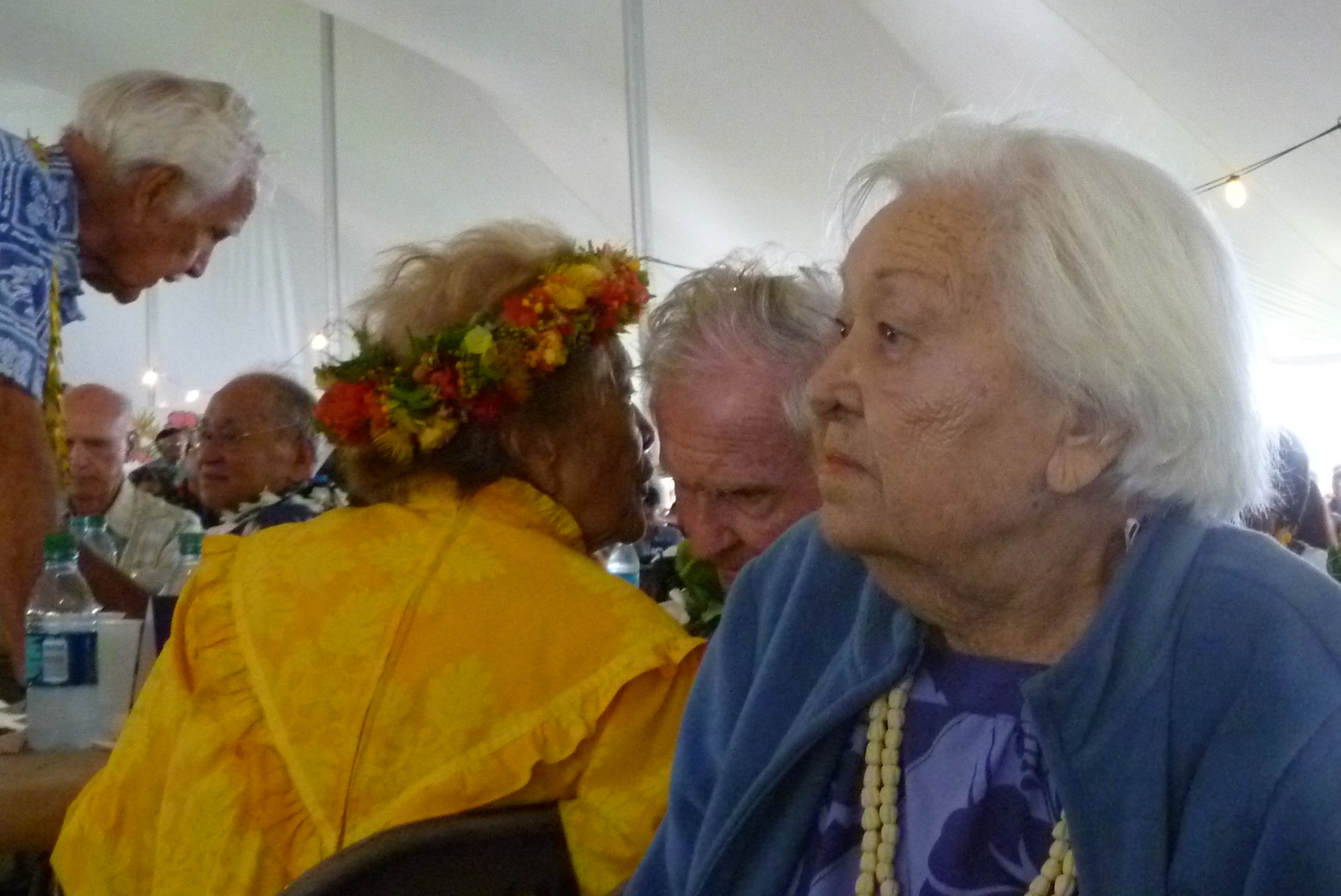
The entire time we were on campus, Mother never went more than a few steps in her walker.  From the photo venue to her table in the tent over Konia Field, from her table back to the car, in the pouring rain, where ever she went she was transported in a little cart, usually with one or two men grinning broadly, listening attentively, treating her as if she were their own grandmother.  Someone brought her a coke while waiting for dinner.  The meals were all served by ’92-ers.  They were still serving some of the younger classes when the first of the garbage collection crew appeared with their 30-gal bags.  “Pau? Let me take that for you.”
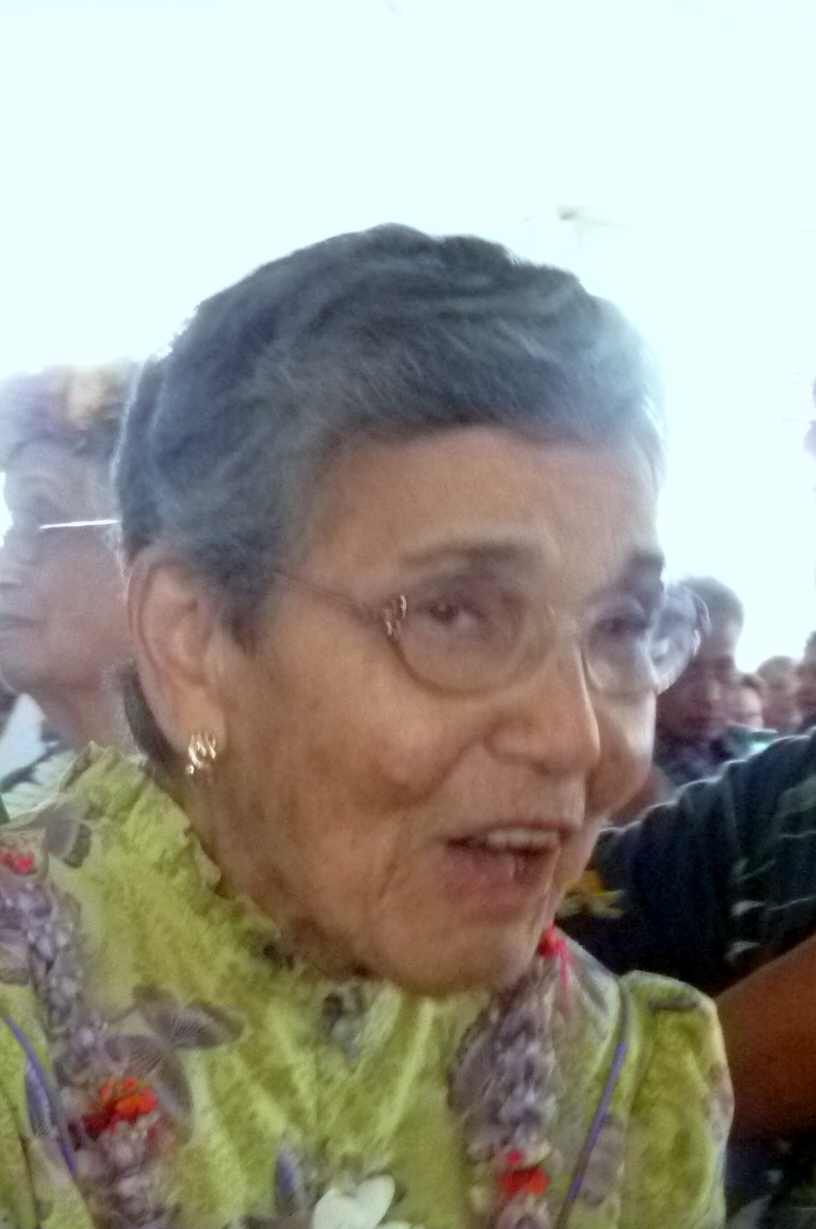
Mother said several times, almost wistfully, “All these people, and I don’t see anyone I know.”  This is a relatively new problem for her.  She’s always been able to connect with someone in a crowd.  Despite its growth and influx of residents, Honolulu is still, socially, a very small town.  As the only person from your class in attendance, it was inevitable that there would not be many seated at her table.  But someone was there — Mikihala, class of ’36, who was Mother’s little sister when Miki entered Kamehameha.  Classes of ’41 and ’46 were at the table behind us.  Then the school president, Mike Chun, stopped to greet her.  “You worked for the Rentons?” she asked.  “My daughter-in-law is a Renton.  And aren’t you related to the Mossmans?”  Yes, his wife is a Mossman.  She a granddaughter of a friend of Mother’s.  It wasn’t such a group of strangers after all.

Give thanks for those who practice the Hawaiian custom of honoring our elders, our kupuna.   Give thanks for those from Kamehameha Schools Class of ’92 who yesterday treated an aged stranger with such care and consideration.

Don’t forget to pray!

Hawaiian attorney censured for war crime allegation

You might be interested in my Civil Beat column for the week–“Ian Lind: Here’s Why Hawaii Judges Are Not ‘War Criminals.’”

It examines the Hawaii Supreme Court’s recent public censure of Honolulu attorney Dexter Kaiama for accusing a judge of committing war crimes, which follows from the argument that the Hawaiian Kingdom still exists as an independent island nation.

The court affirmed the recommendation of the Office of the Disciplinary Counsel for public censure, and also ordered Kaiama to pay the expenses incurred in the ODC proceedings.

I won’t say more here right now, so hop on over to Civil Beat to read the column.

KauaiEclectic blog ends a 10-year run

KauaiEclectic, a blog published by Joan Conrow, has had its last post.

“All Pau,” Conrow announced today. “It’s time for a change.”

KauaiEclectic has been around for ten years. It’s been a vehicle for Conrow’s excellent reporting. Here long-running “Abuse Chronicles” exposed the seamy side of Kauai’s vacation rental industry, and set a standard for reporting that’s not often matched in these islands.

She blogged about the environment, about social conflict on Kauai, about being local, about agriculture, GMOs, politics, dogs, and walking on the beach.

It’s been a great ride, Joan. Thank you.

By the way, Conrow has launched a new blog.

Please visit my new site, where I will be writing about science, agriculture, GMOs, tourism, philosophy, politics and whatever strikes my fancy.

I just went back to the earliest KauaiEclectic post I could find. It’s dated September 18, 2007.

Conversations: Prosperity

Prosperity isn’t even a word in the Hawaiian language, Ka`imi said. It’s an entirely Western concept, that idea of making good in a way that sets you apart from others; accumulating possessions with an eye toward achieving status; attracting money and material things to be stored up, hoarded.

But there is waiwai, she reminded him, the word used interchangeably for water and wealth, and she’d experienced it herself at Aliomanu, just recently. Walking to the beach, after a month of heavy rains, she’d noticed naupaka leaves, plumped and swollen; ironwood needles, a tender pale green; springy moss, clinging thickly to gray pohaku.

The red soil had darkened deep brown with a surfeit of wet; heliotrope seedlings had sprung boldly from the sand.

It was suddenly all so rich, so plush, so luxuriant, that drought-parched patch of east Kauai coastline, restored to vibrant life by rain alone.

That’s when she saw with her own eyes, she told him, that waiwai truly is wealth. Because everything in that moist scene was so lushly abundant, it seemed wholly ludicrous to value anything more than water.

And you can call the rain, he reminded her. You can evoke the water; you can turn the trickle into a torrent. Isn’t that prosperity?

Posted by Joan Conrow at 11:26 AM

Legislature’s attacks on judges tied to past failure to fund Hawaiian Homes

With a key legislative deadline looming Thursday at midnight, the Legislature still on a collision course with the State Supreme Court as it pursues an apparent game of chicken in a dispute over the power of the courts to enforce provisions of the state Constitution.

House and Senate conferees are scheduled to meet at 1:30 Thursday afternoon on a bill that would strip future state judges and justices of 1/3 of the retirement benefits they would earn under current law.

The conference committee meeting is set just hours before Thursday’s midnight deadline for final decking of non-budget bills, which have to be filed in their final form in order in order to be voted on before the annual legislative session wraps up next week.

The bill, SB 249, which faced virtually unanimous opposition during public hearings, is widely seen as a bargaining chip in a behind-the-scenes effort by legislative leaders to muscle the Hawaii Supreme Court into backing off from enforcing a constitutional provision requiring the legislature to provide “sufficient” funds for the administrative and operational budget of the Department of Hawaiian Home Lands.

The bill, introduced by Senator Gil Keith-Agaran, is the latest in a series of anti-Judiciary bills introduced over the past several years, and has gotten farther than any of the prior measures. The only difference between the House and Senate versions is their effective dates, a technical change often inserted simply to force a bill to conference. Observers say agreement seems simple to reach, if legislators want to push this battle to the next stage.

And that next stage is already set. The lawsuit challenging the insufficient funding for Hawaiian Homes, Nelson v. Hawaiian Homes Commission, will return to the Hawaii Supreme Court for consideration of an appeal by the state, and a counter-appeal by the original plaintiffs, on July 6.

The focus of that hearing seems to be on arguments in a legal brief filed on behalf of the Legislature which asserts the courts do not have the power to determine just what the Legislature must do to comply with the constitution. In particular, the Legislature objects to the courts putting a dollar value on what would be a “sufficient” DHHL budget to comply with the constitution.

The Amicus brief filed by former Attorney General Mark J. Bennett, now in private practice, argues that a 2015 Supreme Court decision was misinterpreted in later proceedings, which he asserts caused a major violation of legislative prerogatives under the “separation of powers” doctrine.

The Hawaii Legislature respectfully submits that neither this Court, nor any judge or justice, has the power to either determine the amount of any appropriation, order any appropriation, or impose any penalty should the Hawaii Legislature, in fulfilling its constitutional role, decide how much to appropriate (or not appropriate) to DHHL.

There’s a long history to this case.

A 1978 amendment to the state constitution adopted by voters was intended to take away the Legislature’s discretion and assure these Hawaiian programs adequate funding in the future, according to records of that year’s constitutional convention.

But despite the constitutional amendment, the increased funding never materialized. In the Hawaii Supreme Court’s 2012 decision in the case, the high court found the Legislature had failed to meet the constitution’s funding requirement for most of the past 40 years. And a subsequent 2015 ruling by First Circuit Court Judge Jeanette Castagnetti found that more than $28 million was required to comply with the constitutional mandate in 2016.

Legislative leaders called it a violation of the separation of powers, an argument which had been raised before the Supreme Court but proved unpersuasive. So in fit of legislative pique, they launched a thinly disguised campaign of intimidation aimed at judges and justices, putting forward bills threatening to require Senate approval for reappointment of any sitting judges, calling for judicial elections rather than merit selection, and in the latest case, singling out judges for a large cut to retirement benefits. All the measures were seen as undermining the independence of the courts.

You could almost hear House and Senate leaders taunting the high court. “If you want your independence, you’d better keep your hands off of ours,” they seemed to be loudly signaling.

But plaintiffs in the Nelson case accuse the Legislature of using the separation of powers argument as a smokescreen, “nothing more than a rhetorical gambit.”

They argue that the courts didn’t create the constitutional mandate. It came from the people when voters approved the 1978 constitutional amendment.

“Constitutions are the work of the people, not of the courts, not of the legislature. It was neither the courts nor any other branch of government that decided to impose a mandate upon the State to fund DHHL. It was the people of the state of Hawai`i who made this social contract with the beneficiaries of the Hawaiian homelands trust.

It is the essential role of this court to uphold and enforce this social contract. The amicus brief asks the Court to abdicate this role. Under the guise of the separation of powers doctrine, the amicus brief asks our courts to cede their power to declare whether the constitution has been violated and to order appropriate relief.”

And plaintiffs paint the underlying issue this way:

If not the courts, then to whom does the legislature answer when their actions run afoul of the Hawaii Constitution and the mandates embodied therein? And if not now, after running afoul for more than forty years, then when if ever will the legislature be held to answer?

They point out that although the courts initially held back in order to give the state, and the Legislature, time to address the lack of DHHL funding in their own manner, the Legislature and the state did not act.

Lawyers for DHHL point to testimony during an evidentiary phase of the case in which the state’s representative said they did not know what it cost to operate the Department of Hawaiian Home Lands, and had not set up any mechanism for determining what would be sufficient. Instead, they were waiting on the court to provide a framework for making that determination.

But now the Legislature asserts that by doing just that, the courts have improperly trampled on legislative turf.

It’s an ugly scene. On the one hand, you’ve got judges and justices trying to apply the law, as they are required to do. On the other side, legislators hiding in the shadows, none of them willing to publicly explain or even acknowledge what they’re doing, are pushing bills like SB249 that have not a shred of public support.

They appear to be saying, “forget the law, just stay out of our business.”

If it were simply a legal issue, the appeal of the ruling would have been enough, and we wouldn’t have seen this spate of bills aimed at punishing the Judiciary, and its judges and justices.

At least we don’t have long to wait to find out just how far this strategy of extra-legal intimidation of the courts is going to be pursued by the Legislature. The final decking deadline is tomorrow night.