
Category Archives: Law

Other claimants enter government’s civil forfeiture case targeting Mike Miske’s assets

Bank of Hawaii has filed a claim to the 8,206-square foot luxury home on nearly an acre of land overlooking the ocean in Portlock owned by the estate of the late Honolulu business owner and crime boss, Michael J. Miske, Jr.

The home is the most valuable asset among a list of 27 items, valued at an estimated $25 million, that the government is attempting to seize in a civil forfeiture lawsuit filed in January and now pending in Honolulu’s Federal District Court. These properties, which include real estate, cash, cashier’s checks, vintage cars, and art, were owned by Miske at the time of his death, either personally, as part of his living trust, or in the name of one of the companies that he owned.

Miske purchased the 37,891 sq.ft. property Lumahai Street in 2010 for $2.3 million, and poured millions into the construction of an oceanfront mansion. It is currently appraised for tax purposes at $7.3 million, although testimony in Miske’s criminal trial indicated he claimed to have spent upwards of $11 million on the home’s construction. Since Miske’s indictment and arrest in 2020, the home has reportedly been available for rent at around $100,000 per month.

Miske was convicted by a federal jury last year on 13 counts including racketeering, murder for hire, kidnapping, assault in aid of racketeering, obstruction of justice, and other offenses. The jury also found that his assets should be forfeited to the government because they were tied to his criminal activities.

However, Miske died in Honolulu’s Federal Detention Center on December 1, 2024, weeks prior to his scheduled sentencing. As a result, his indictment and conviction have been vacated, along with the jury verdict on forfeiture, requiring government attorneys to proceed in a civil forfeiture proceeding.

Attorneys for BOH say the bank is “the mortgagee of record” of the Portlock home based a $1,999,999 mortgage loan secured by the property that was recorded in the Bureau of Conveyances in 2018. The bank’s court filing does not indicate the outstanding balance, including interest, now owed to the bank.

An official notice of the government’s lawsuit seeking the forfeiture was posted February 24 on an official government web site (www.forfeiture.gov), and remained public for 30 days.

According to the court filing, “any person claiming a legal interest” in any of Miske’s properties must file a claim within 60 days of February 24, and then file an answer to the complaint within another 21 days.

The government may also consider granting petitions for remission or mitigation, which pardon all or part of the property from the forfeiture. A petition must include a description of your interest in the property supported by documentation; include any facts you believe justify the return of the property; and be signed under oath, subject to the penalty of perjury, or meet the requirements of an unsworn statement under penalty of perjury.

Bank of Hawaii also said it is “the mortgagee of record” for a 3-bedroom home on Paokano Loop in Kailua’s Enchanted Lake subdivision. Miske purchased the residence in 2011 for $570,000. It has nearly doubled in value since Miske was indicted and arrested in 2020, and is now appraised for tax purposes at over $1.3 million. The $212,000 BOH mortage secured a revolving line of credit Miske obtained in early 2017. A copy of the mortage is part of the bank’s court filing, but the outstanding balance of the loan has not been reported.

U.S. Bank Trust National Association has also filed a claim based on a first mortgage lien on the Paokano Loop home securing a $608,000 loan in June 2013. The loan was originally made by Pinnacle Capital Mortgage Corporation in Roseville, California, but has been transferred through a series of subsequent assignees. U.S. Bank, as trustee for the current mortage owner, has demanded “payment in full of all sums due and owing…through the sale and/or seizure of the Kailua Property.”

Cith records show real property taxes are paid and up to date for both the Portlock and Kailua properties.

Meanwhile, San Francisco attorney Edward M. Burch has entered the governent’s forfeiture case representing both The Michael J. Miske, Jr. Revocable Living Trust, as well as Miske’s granddaughter, a minor who is identified in the court filing only by her initials, “N.M.”

She is the child of Caleb Miske and Delia Fabro Miske. Caleb, Miske’s son and only child, died in 2016 of complications of injuries suffered in a high-speed crash in Kaneohe several months earlier. She was born while Caleb was hospitalized.

Burch and his law partner, David Michael, have a law practice specializing in civil asset forfeiture defense.

Criminal defense specializing in civil asset forfeiture (cases involving the seizure of property by law enforcement who believe the property is related to crime – usually illegal drug sales – including cash, vehicles, and real property). Both California and Federal statutes allow law enforcement to seize cash and other valuables on the grounds that the property is connected to crimes such as drug trafficking. These drug asset forfeiture laws are based on the “legal fiction” that the property is guilty of wronging society, and permit the government to sue the property as defendant in civil court. As owner or possessor of the property, one is considered a third party to these civil forfeiture actions, who is voluntarily in court. These “claimants” are afforded less rights and protections than a traditional criminal defendant. My office effectively represents claimants and aggressively opposes these forfeiture actions to get your property back.
Civil Beat tracks one big shipment of illegal fireworks

Don’t miss the fantastic investigative story today over at Civil Beat (“Hidden Links Exposed: Hawai?i Fireworks Bust Tied To Mainland Suppliers“).

The long sub-head provides a good idea of what’s in the story: “One mysterious address on shipping documents in a seizure at Honolulu Harbor is the first in a chain of clues that lead across the country and through the decades — a mysterious web of connections between the legal and illegal fireworks trade.”

Reporters John Hill and Blaze Lovell tracked paperwork, court and licensing records, business records in multiple states, all in order to tell the story of a shipment of $2.7 million dollars of illegal fireworks seized in a shipping container at Sand Island.

It’s really a classic story, starting with a small piece, and then building the story one document, one name, one address, one business, one official record, across a number of states and time frames, one piece at a time until the web of connections is revealed.

And the subtext is, of course, if these reporters several year after the fact could find all this out, how is it that with multiple state and federal agencies involved, how is it that no one was held legally accountable?

Civil Beat should host a program with John and Blaze talking about how the pieces of the puzzle fell into place as they pursued the investigation.

Maryland Judge blocks enforcement of anti-DEI orders as unconstitutional

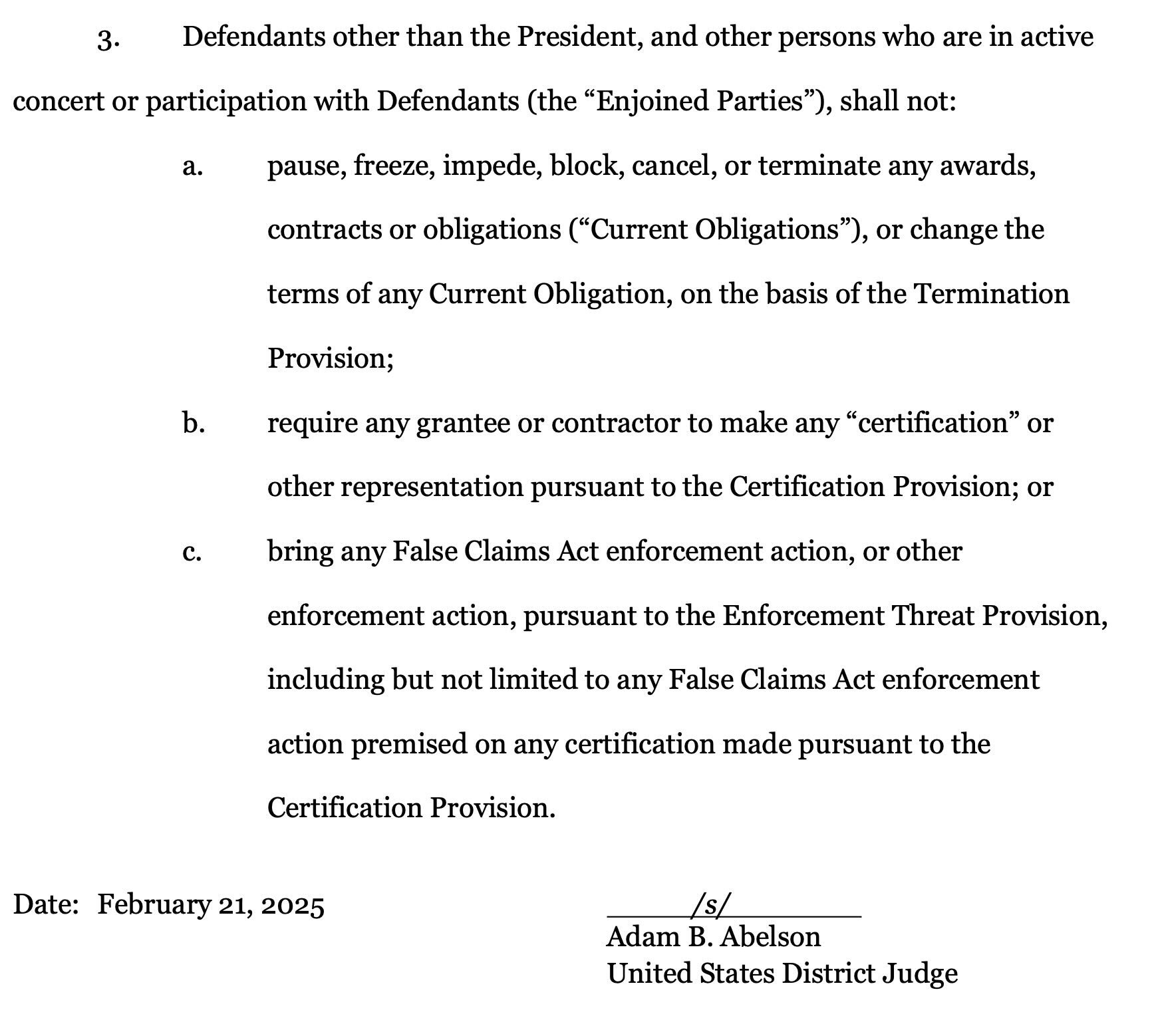
Last Friday, a federal judge in Maryland issued a preliminary injunction blocking major parts of Donald Trump’s anti-DEI (Diversity, Equity, Inclusion) orders.

The injunction provides, in relevant part:

Screenshot

The injunction is based on the judge’s finding that these executive orders are likely unconstitutional because they are unconstitutionally vague, or trample on the First Amendment’s right of free speech.

His legal findings are spelled out in a 63-page opinion which provides a tutorial of sorts in constitutional law. To understand why the Trump directives appear to be unconstitutional, I suggest reading through the first section of the opinion, and then perhaps look at specific sections that spell out the legal case in more detail.

This particular case was brought by several plaintiff organizations: The National Association of Diversity Officers in
Higher Education; American Association of University Professors; Restaurant Opportunities Centers United; Mayor and City Council of Baltimore, Maryland.

Each plaintiff provided specific examples of how the rights of their members were being violated by the Trump administration’s actions.

Judge Abelson’s opinion granting the motion for preliminary injunction appears below.

If you’re interested, I have also posted the original complaint filed February 3, 2025, and the plaintiff’s memorandum of law supporting their request for preliminary injunction.

Dozens of similar lawsuits have been filed across the country and are slowly making their way through the courts. A simple way to follow their progress is via the Trump Administration Litigation Tracker posted by Lawfare Media.

Memorandum Opinion Granting… by Ian Lind

Court ruling makes Miske indictments and convictions disappear

Chief Judge Derick K. Watson, who has presided over the racketeering case of the late owner of Kamaaina Termite and Pest Control, Michael J. Miske, Jr., since its inception, issued a 6-page legal order on Wednesday that, as expected, dismissed the Miske indictments pursuant to the doctrine of abatement ab initio. Miske’s attorneys and federal prosecutors agreed on this point, and the ruling was a foregone conclusion.

The parties appear to disagree, however, over whether the Jury Verdicts should be vacated. The same Ninth Circuit precedent set forth above is clear: all proceedings are abated from the inception of Miske’s prosecution. In perhaps more common parlance, everything that occurred in this prosecution, as it relates to or affects Miske, is negated. See Black’s Law Dictionary 3 (12th ed. 2024) (defining “abatement ab initio” as the “negation of a criminal trial and verdict after a convicted defendant has died before exhausting all legal appeals. The case reverts to the beginning point as if the trial and conviction had never occurred.”). This means that points of interest, such as the Order permitting defense counsel to withdraw, the Order denying a change of venue, and the Order addressing over fifty (50) motions in limine never occurred, at least as they relate to Miske. More pertinent to the parties’ specific dispute, it means that the Jury Verdicts never occurred too. It is, thus, entirely unnecessary for the Court to formally vacate or not vacate the Jury Verdicts, as the parties appear to fight over, because, under the circumstances here, the natural consequence of Miske’s death is that all proceedings in this prosecution from its inception are negated.

Watson’s ruling, citing 9th Circuit precedent, notes that this “prevents, among other things, recovery against the estate of a fine imposed as part of the conviction and sentence and use of an abated conviction against the estate in related civil litigation.” Emphasis added.

This clearly precludes the government from using the jury verdicts to support its pending civil forfeiture lawsuit that was filed on January 22.

However, due to the pending lawsuit, Watson declined to release any of the disputed Miske property to his heirs or beneficiaries. The outcome of the civil case will determine whether the long list of assets will eventually be seized by the government or distribted to Miske’s beneficiaries.

Watson agreed with the government that Miske’s defense attorneys do not have standing to challenge the government’s forfeiture lawsuit.

“Rather, it is Defendant’s estate and/or heirs that must do so, if at all,” Watson noted.

It is currently unclear just who has such standing to represent Miske’s estate or heirs. In August 2020, a month after Miske’s indictment and arrest, he signed a power of attorney giving his mother, Maydeen Stancil, “full power and authority to do and perform all and every act, deed, matter and thing whatsoever in and about my estate, property and affairs….” A section of the trust agreement was filed in court during the criminal proceedings.

One phrase in a portion of the trust agreement caught my eye.

It states, in part: “This assignment includes all of my real, personal, tangible, and intangible property, located in the United States….”

Is this simply legal boilerplate language, or does it imply there may be additional property outside of the United States?

In any case, the power of attorney is no longer valid after Miske’s death.

Prior to his death, Miske remained the trustee of his own living trusts. The trust agreement named three individuals who would take over as successor trustee of his trust, along with “separate trusts” established to benefit an individual whose name is redacted, in the event of Miske’s death. The named trustees, in order, are Jason Yokoyama, Miske’s longtime employee, business partner, and co-defendant; Alen Kaneshiro, an attorney whose clients included Miske and a number of his associates; and John Stancil, Miske’s half-brother and co-defendant.

Nothing in the public record has yet indicated whether one of these individuals is now serving as trustee, with standing to intervene in the government’s civil foreclosure lawsuit on behalf of Miske’s estate. The properties themselves are named as defendants in this lawsuit, rather than Miske’s trust, or any of Miske’s possible heirs or beneficiaries. The limited court record to date does not include notice of the lawsuit to any other party.