Category Archives: Law

When “immediately” apparently isn’t

On June 4, three men were convicted in federal court on multiple felony charges for their roles in a complex and long running bribery scheme to defraud Hawaii County’s affordable housing program.

Two of the defendants–Paul Sulla and Gary Charles Zamber–are Hilo-based lawyers, the third a businessman.

A month after the jury verdict, a friend asked a simple question.

How is it that the two are still listed as having active law licenses even after being found guilty of multiple felonies?

Hmmmm. Good question. Here’s what I found.

The three were convicted on all charges, including one count of conspiracy to commit honest services wire fraud and nine counts of honest services wire fraud, all felonies. Sulla was also convicted of money laundering, another felony. They are all scheduled to be sentenced in early December.

To appreciate what was involved, here’s a summary of the case from Environment Hawaii, a monthly newsletter that has reported on parts of the underlying transactions for years and is credited with sparking the federal investigation that eventually led to the indictments.

In its case…the Department of Justice has argued that between late-2014 and late-2021, the three men were involved in a conspiracy to provide bribes or kickbacks to former Hawai’i County Office of Housing and Community Development employee Alan Rudo in exchange for his help in securing affordable housing agreements, valuable excess affordable housing credits (made even more valuable by building restriction waivers he facilitated), and land in Waikoloa meant for the development of affordable housing.

The DOJ estimated that their schemes netted them nearly $11 million and eventually charged the men with honest-services wire fraud. It also charged Sulla, who created the various “shell” companies involved, with money laundering.

Looking back at court records, it appears both men continued to practice law and appear in court on behalf of clients over the three years between their indictment in 2022 and conviction in 2025.

The whole process of attorney discipline is shrouded in layers of secrecy, ostensibly to protect the public, but which mostly protect the reputations of those attorneys being investigated, as well as ODC itself. See my 2022 post, “Hawaii’s Office of Disciplinary Counsel has long considered itself a secret enclave.”

Court records show that on July 9, five weeks after Sulla and Zamber were convicted, ODC filed petitions asking the Supreme Court to issue an order “immediately restraining” both men from the practice of law, and to consider this a suspension from law practice for purposes of court rules.

That seems like it should have been a simple matter, but more two weeks have passed and the court has taken no action.

ODC also asked the court to refer the matter back to the Disciplinary Board to “institute formal disciplinary proceedings that will determine the appropriate discipline to be imposed, with formal hearing stayed until such time as the conviction is final.”

And just when is a conviction final? As we learned after the death of Mike Miske, a conviction isn’t final until the defendants have been sentenced and any appeals have been exhausted, or the deadline for filing appeals has passed. Even if the Supreme Court had actually taken “immediate” action, it could still be many months before the ODC’s confidential formal proceedings would begin. Or longer, if the defendants appeal.

This despite the fact ODC has the benefit of a running start. The office opened disciplinary cases against both attorneys when the federal charges were filed in 2022. These cases, which track the federal allegations, were and remain confidential. Their existence was made public only after ODC received subpoenas from federal prosecutors to produce any records of the disciplinary cases involving Sulla and Zamber, along with any statements made responsive to ODC’s actions, requiring ODC to ask the Supreme Court for a partial waiver of case confidentiality so that it could respond to the federal subpoenas.

More information about the status of the disciplinary cases opened in 2022 is unlikely to become public unless and until the pair are sentenced, run out any appeals, and the ODC formalities lead to a recommendation that will go back to the Hawaii Supreme Court for its decision.

Disbarring both men as convicted felons seems like it should be a slam dunk. But procedurally, even that isn’t simple or transparent.

A correction and a comment

First, a correction.

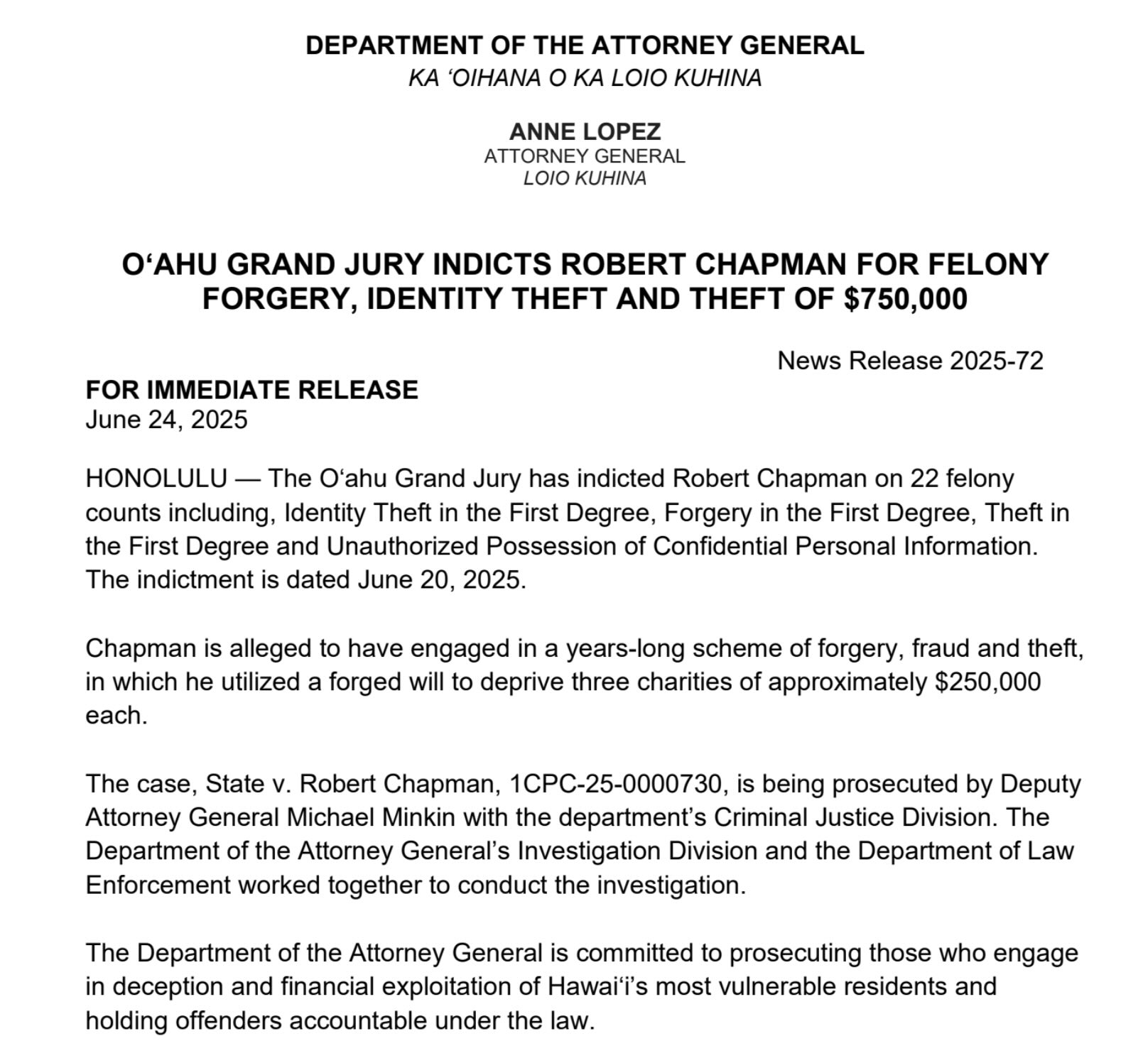
The Office of the Attorney General issued a news release on Tuesday, June 24, regarding the case of former Honolulu attorney Robert E. Chapman, featured in a post here on Saturday.

Indictment

The estimated $750,000 is about half the value of my original estimate. To arrive at my original estimate that the case involved a theft of about $1.5 million, I simply went through each of the counts and totaled the value of each transaction that was listed.

The AG’s lower figure seems to indicate that the indictment includes one set of charges stemming from the alleged thefts of cash or property from the estate of a deceased Honolulu resident, and a separate set of charges for stealing the same funds from the intended beneficiaries named in the victim’s will.

I have corrected my earlier post about the case to lower the total value of the property to the $750,000 figure used in AG’s news release.

Then there’s the presumption of innocence, raised in a reader’s comment on my initial post about the case.

The reader wrote:

I want to raise a concern that I believe is shared by others who care deeply about justice and fairness.

We must not lose sight of the principle that every person accused of a crime is presumed innocent until proven guilty. While your reporting on Chapman’s indictment is accurate and sourced, the tone and detail come across as adjudication rather than reporting. It leaves the reader with little doubt that Chapman is guilty, even though he has yet to have his day in court.

We must also remember that an indictment is a one-sided presentation by prosecutors, and grand juries do not hear defenses. Using these documents as narrative fact, especially when tied to disciplinary proceedings or unrelated past conduct, risks blurring the line between accusation and conviction in the public eye.

Your work reaches and shapes opinion, and with that comes responsibility.

I agree in part with the comment that everyone is presumed innocent of criminal charges until proven guilty, and as a result added a statement to the original blog post noting that an indictment is only one side of the story, it’s not proof of guilt, and Mr. Chapman hasn’t yet had his chance to respond in court.

But it seems to me there’s more to be said.

A news story isn’t a trial. My job as a reporter is to give readers a clear picture of the charges, the surrounding circumstances, and their significance, especially when we’re talking about a defendant who held a position of trust. Chapman wasn’t just another attorney—he was the managing partner of one of the biggest firms in the state, handling estates and trusts, offering himself and his firm up as protectors of their clients’ interests, entrusted with clients’ financial lives and access to their personal and confidential information.

That kind of position demands the highest standard of ethics, and when that trust is called into question, I believe the public deserves serious, fact-based scrutiny of the allegations.

Of course, it’s the court’s job to decide criminal responsibility, and juries are routinely asked to separate media reports from trial evidence. But that doesn’t mean we avoid reporting on the facts that are already public, especially when they raise legitimate concerns about how someone in power uses or abuses their position of trust.

In any case, I thank the reader for their thoughtful comment. It’s an important conversation to have.

Former Honolulu attorney indicted in alleged $750K probate fraud

[Correction: This post originally estimated the total amount involved in this fraud case at $1.5 million. This has been reduced to $750 based on information in a June 24 press release by the Office of the Attorney General.]

Robert Earl Chapman, a former managing partner at one of Hawaii’s largest law firms, has been indicted on 22 counts including forgery, theft, and identity theft in connection with an alleged scheme to seize control of about $750,000 from a deceased Honolulu resident’s estate.

Chapman, a graduate of the University of Maryland law school, was licensed to practice law in Hawaii in 1980. He became a named partner in the firm, then known as Stanton, Clay, Tom & Chapman, Attorneys At Law, in 1987, and later served as managing director of the firm, then known as Clay Chapman Iwamura Pulice & Nervell. He resigned from the practice of law in lieu of discipline in 2022.

The grand jury indictment was filed in Honolulu’s First Circuit Court on Friday morning, June 20, by the Office of the Attorney General. A Grand Jury Bench Warrant set bail at $1 million, and Chapman posted a $1 million bond after the warrant was served on Saturday afternoon.

A grand jury indictment is a one-sided process, based only on the prosecutors’ version of events and interpretation of the evidence. It means that the grand jury believed there was enough evidence to bring charges, but is not proof that any crimes have occurred.

Court records do not indicate whether Chapman has retained an attorney, and he has not yet had an opportunity to respond to the charges or enter a plea in the case.

According to the indictment, Chapman allegedly accessed confidential personal information of Robert Boulette without authorization on or about October 19, 2018. Then, “with intent to defraud,” Chapman allegedly created or altered what “purported to be the will and codicil of Robert Boulette” which he then used to take control of the accounts and properties making up Boulette’s estate.

None of the offense were “discovered prior to January 13, 2023, by either an aggrieved party or a person who has a legal duty to represent an aggrieved party,” the indictment states.

Boulette died in Honolulu in November 2016 at age 77. Originally from Portland, Oregon, Boulette served in the Navy and later worked for the Naval Audit Service until his retirement, according to an obituary in the Portland Oregonian newspaper. After retiring in the mid-1990s, Boulette made Honolulu his home, but traveled extensively.

Neither Chapman nor his law firm represented Boulette in any court case prior to his death, court records show. However, Chapman handled many estates and trusts, and was the contact person in numerous probate proceedings, according to a review of published legal notices. The indictment does not indicate where or how Chapman accessed Boulette’s confidential personal information, and whether the information was taken from the firm’s own records.

On October 24, 2018, Chapman filed an application to be named personal representative and to proceed with informal probate of Boulette’s will and a codicil amending the will, court records show. Informal probate usually sidesteps court supervision, which would have been an advantage if the intent was to defraud Boulette’s estate. The indictment alleges either or both of the documents, the will and codicil, were fraudulently created or altered, but does not provide further specifics. Legal notices of Chapman’s application were published in the Honolulu Star-Advertiser on three consecutive Thursdays in November 2018.

The indictment alleges Chapman then used the fraudulent documents to gain control over Boulette’s accounts and property with a total value of close to $750,000 that Boulette had bequeathed to the Make a Wish Foundation, Elderhostel Inc., and the Portland State University Alumni Association.

The indictment does not identify the specific accounts or properties Chapman is alleged to have improperly controlled, although it reports their respective values.

However, real estate records show that at the time of Boulette’s death in late 2016, he owned a small 1 bedroom-1 bath apartment in the Nuuanu Brookside condominium. On May 29, 2020, two years after Chapman applied to serve as the personal representative of Boulette’s estate, the leasehold apartment was transferred from Boulette’s estate to a new entity, NuBrook LLC.

State business registration records show NuBrook LLC had been registered to do business just three weeks before it took title to Boulette’s interest in the Brookside condominium. Chapman was listed as NuBrook’s sole member and manager, and was registered at the address of Chapman’s law firm. Chapman signed the assignment of lease document as the personal representative of Boulette’s estate, and as manager of NuBrook LLC.

In May 2023, the apartment was sold to a private buyer for $395,000, real estate records show.

This appears to be the transaction corresponds to Count 22 of the indictment, which charges Chapman with first degree theft for allegedly diverting $362,566.13 from Boulette’s estate to his own benefit in 2023. The amount may represent the net selling price of the Nuuanu Brookside apartment after paying fees and costs of the sale.

The charges against Chapman appear to mirror those detailed in the 2022 case brought by the Office of Disciplinary Counsel, which ended Chapman’s legal career. In that case, which did not involve criminal charges, Chapman admitted to the misconduct.

ODC launched its investigation after receiving a complaint alleging Chapman had “wrongfully attempted to lay claim to approximately $2,000,000.00 in abandoned property held by the Hawai’i Department of Budget and Finance….”

The abandoned property belonged to a former client whose company he had represented in the 1980s. He had never met the client, and had not even had any indirect contact with her for three decades. After questions were raised about Chapman’s application to claim the property on behalf of the client, a handwriting analyst retained by the Attorney General’s office determined that a power of attorney Chapman used in an attempt to legitimate his claim was a forgery.

ODC completed its investigation and initiated formal disciplinary proceedings against Chapman in October 2022. A month later, Chapman submitted a legal declaration admitting the allegations were true and offering to resign in lieu of discipline while the charges against him were pending. ODC then filed a petition in open court asking the Hawaii Supreme Court to approve Chapman’s request, which made public its previously confidential 37-page petition for discipline spelling out the allegations and evidence.

The Supreme Court agreed, finding Chapman’s misconduct had entailed “egregious violations” of the court’s Rules of Professional Conduct. No criminal charges were filed in that case.

Two subsequent lawsuits were later filed against Chapman and his former firm by former clients alleging legal malpractice, breach of contract, and other offenses. Both ended with confidential settlements.

Also see:

Fraud allegations lead to resignation of prominent business attorney,” iLind.net, December 29, 2022

News media turn a blind eye to attorney misdeeds,” iLind.net, January 17 2023

Miske Trust files an answer to the government’s forfeiture complaint

The trustees of the Michael J. Miske Jr. Revocable Living Trust have filed their answer to the government’s complaint for forfeiture of Miske’s personal and business property.

The government filed its original forfeiture complaint on January 22, and followed with an amended complaint on May 7. The government has identified a long list of properties consisting of cash and checks, real estate, a commercial longline entry permit issued to a fishing vessel Miske previously owned, along with several vintage cars and miscellaneous art work. Estinates of the overall value range from approximately $13 million to as much as $28 million.

The 13-page answer was filed in Honolulu’s Federal District Court on behalf of the trustees by San Francisco attorney Edward M. Burch, a criminal defense attorney who specializes in forfeiture defense.

Burch serves notice that the Trust “demands trial by jury of the issues and defenses raised by its claim and answer.”

The full document is attached below.

Burch generally “denies that the properties are subject to forfeiture…and denies that any violations of the listed statutes occurred with regard to the properties.”

Burch also asserts that he “lacks sufficient information to form a belief as to the truth of the allegations contained therein, and on those grounds, denies each and every allegation contained therein.”

In addition, Burch raises seven affirmative defenses, arguing that forfeiture of some or all of the property “is barred by the applicable statute of limitations, and that Miske’s properties “were derived from legitimate
activities and were otherwise unconnected to any violations of law….”

He asserts “some or all of the Defendant properties is not subject to forfeiture because it constitutes that of an innocent owner as defined by 18 U.S.C. § 983(d),” apparently a reference to the status of the trust’s primary beneficiary, Miske’s granddaughter, who is not named in the court filings. She was the daughter of Miske’s late son, Caleb Miske, who died in March 2016.

He then argues the civil forfeiture provisions of federal law “are unconstitutional and unenforceable, in that they constitute a denial of claimant’s due process and equal protection rights under the United States Constitution – the procedures used to adjudicate the seizure of the property should require the government to carry its burden by either beyond a reasonable doubt or by clear and convincing evidence rather than by a preponderance of the evidence.”

Answer to the government's civil forfeiture action by the Miske Revocable Living Trust by Ian Lind