Governor David Ige’s adinistration and the Hawaii State Legislature have been considering exactly how to restart and redirect Hawaii’s economic recovery.
Whatever decisions are made, there are likely to be winners and losers.
Do you suppose Hawaii’s professional lobbyists have been standing down during this health crisis, since they recognize their special interests, or those of their clients, are far less important than the overall public interest at times like this?
Nah.
Seriously, I doubt lobbyists have curtailed their efforts during the crisis. After all, there are lots of behind the scenes discussions, and are likely to be relatively hasty decisions made that involve an awful lot of public money. That spells opportunities for some of those special interests.
Our problem right now is that we know even less than usual about what lobbyists have been up over the past few months.
Next Monday, June 1, is the deadline for registered lobbyists, and organizations that employ lobbyists, to disclose what they’ve been spending to influence public policy.
It’s the normal due date for disclosure reports covering lobbying activities during March and April. In a normal year, this would include all but the final few days of the legislative session.
This year, it is also the deadline to report lobbying expenditures during the earlier January-February period, because the State Ethics Commission voted to extend the usual March 31 disclosure deadline, first to April 30, and then again to June 1.
It appears the delay in the disclosure of money spent by lobbyists and their clients to influence public policy decisions is another of the less-than-obvious impacts of the coronavirus.
At the commission’s regular meeting on March 27, 2020, the five members voted unanimously to approve an order resetting the disclosure deadline. The order states that the commission found “good cause” to extend the reporting deadline “[g]iven the threats posed by COVID-19, and given the directives from many employers for employees to work remotely….”
However, no further details concerning the basis of the “good cause” determination appear in either the meeting minutes or in the meeting materials that were available with the meeting notice and agenda.
Neither is there any discussion of the authority for the commission’s action. Lobbyist reporting deadlines are set by statute, and the relevant statute–Chapter 97 HRS–requires disclosures for the period from January 1 through February 28 to be submitted by March 31.
The law requires these reports to disclose the amounts spent on items related to lobbying, including preparation of lobbying materials, advertising, gifts, entertainment and events, receptions, meals, food & beverages, and compensation to lobbyists.
While Governor David Ige did suspend a number of laws, including the state’s sunshine law, in a suplemental emergency proclamation issued on March 16, 2020, However, neither the state ethics law (Chapter 84 HRS) nor the lobbyist law (Chapter 97 HRS) were among the statutes that were temporarily suspended.
In the normal scheme of things, boards and commissions have to operate within the constraints of the law. It would be useful for the commission to provide a more complete public explanation of the legal basis for overriding the deadline provided by law.
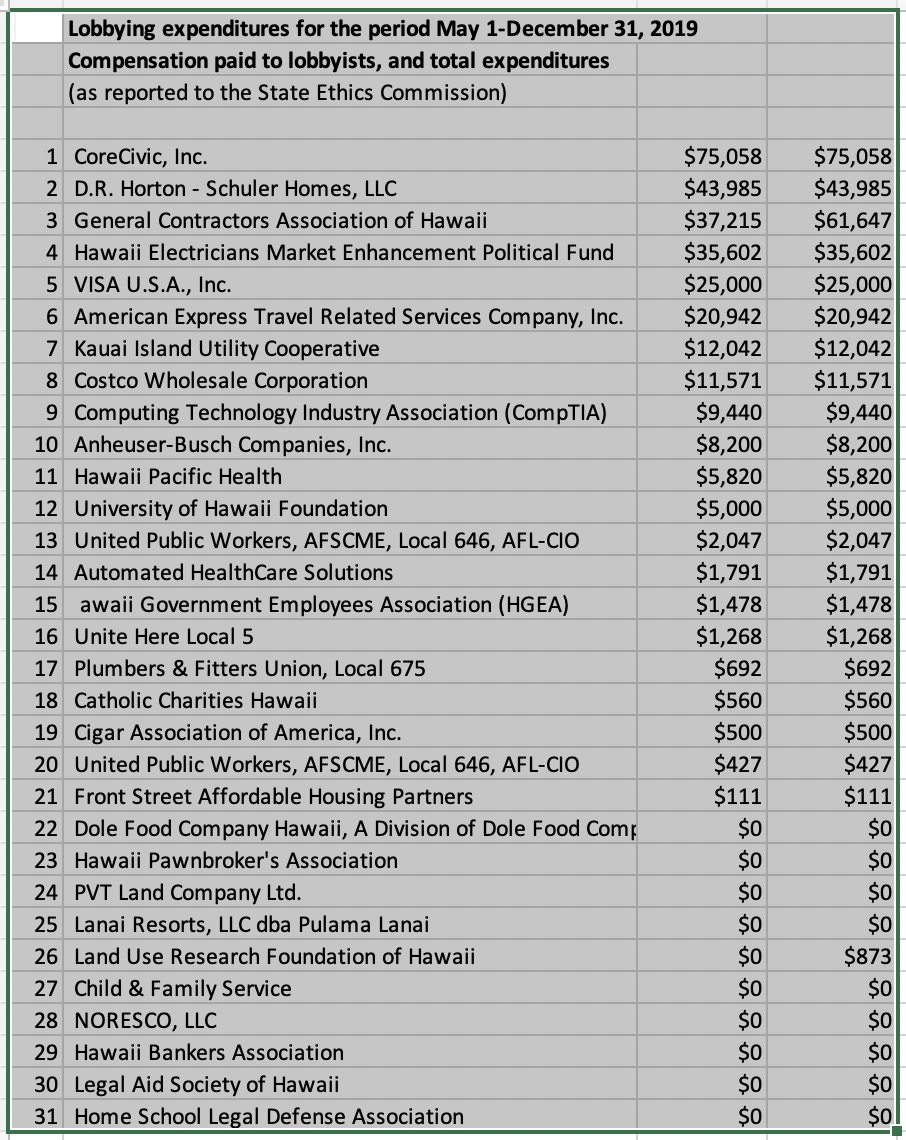
Currently, the most recent lobbyist disclosure reports were for the period May 1, 2019 through December 31,2019. The following organizations disclosed lobbying expenditures during the period.
In case you’re wondering about the company at the top of the spending list, CoreCivic. It’s a private prison operator formerly known as Corrections Corporation of America.