Category Archives: Mike Miske

Closing arguments mark end of the Miske trial

It’s Thursday morning, July 11. Over the next two days, both federal prosecutors and Mike Miske’s defense attorneys will have their opportunity to put the more than five months of testimony in context. Some of that testimony was riveting, while some was plainly boring. There were also hundreds of trial exhibits shown briefly to the jury, including varied photos, charts and graphs, and all will somehow have to be woven into a coherent story line aimed at convincing jurors of the defendant’s guilt or innocence.

The attorneys’ stories have to take into account and, more importantly, make sense of the stories told by hundreds of witnesses, some confident, some reluctant, some experts in their fields, others telling their stories after previously pleading guilty and now hoping to redeem themselves and potentially be rewarded with reductions in their own criminal sentences. Jurors have to decide just how much truth was told by each witness, and how much weight should be given to each.

During the months of testimony, jurors did not know the specific charges against Miske or what charges each bit of information was supposed to be relevant to. They got a detailed description of the charges for the first time when the jury instructions were read to them last week. There are 16 criminal charges remaining. Some are charges involving substantive crimes–murder, kidnapping, assault. Others allege Miske’s participated in conspiracies intended to carry out crimes. In the case of conspiracies, the crime is in the agreement to attempt the crime, and whether or not the planned crime actually took place isn’t relevant to the question of guilt or innocence. That’s got to be confusing for the jury.

And there’s an overarching racketeering conspiracy charge, Count #1 in the lengthy indictment. To prove this charge, prosecutors must prove that two or more persons “agreed to conduct or participate, directly or indirectly, in the affairs of an enterprise through a pattern of racketeering activity,” that Miske joined that conspiracy, and that its activities would “effect” interstate or foreign commerce, which “includes the movement of goods, services, money, and individuals between states.”

The idea of an “enterprise” is kind of a nebulous concept. It can be a formal organization, like a company or corporation, or it can just be a more informal association of people.

The jury instructions describe it this way: “[T]he government must prove beyond a reasonable doubt that this was or would have been a group of people with (1) a common purpose, (2) relationships among those associated with the enterprise, and (3) longevity sufficient to permit these associates to pursue the enterprise’s purpose. The government need not prove that the enterprise had any particular organizational structure or that the enterprise existed.”

The complexity of the jury’s task is reflected in the length of the jury instructions (156 pages) and the 11-page verdict form that tallies the jury’s votes on each element of the charged offenses, where the jury” keeps score of its decisions, guilty or not guilty.

In this criminal trial, there is no finding of “innocent.”

In total, given all that has been presented, it’s safe to say that Mr. Miske is not innocent. However, whether he is guilty of each offense “beyond a reasonable doubt” in legal terms is a wholly different question, on in which members of the jury are the sole decision-makers.

Government prosecutors have presented numerous witnesses who described acts of extreme violence allegedly carried out at Miske’s direction, some that targeted competitors or their employees, some aimed at his own employees suspected of wrongdoing, others planned to eliminate individuals with potentially damaging information if provided to authorities trying to bring down his business and criminal empire.

Despite Miske’s reputation for violence, he appears to be unlike prominent Hawaii gangland leaders of the past, most of whom have been cold-blooded killers willing to do their own “dirty work.” Miske was not feared as a known triggerman, but for surrounding himself with paid thugs willing to commit vicious assaults on his command without knowing the reasons behind the requests.

Beyond the violence that was the backbone of Miske’s business empire, there was the routine and pervasive fraud, big and little. Fraud in obtaining licenses. Fraud in meeting routine requirements of regulated industries, whether as a liquor licensee or a company handling dangerous and highly restricted chemicals used in termite fumigation. Forgery routinely used in applying for building permits. Creation of false character reference letters submitted to court on his behalf.

But wrapping it all up within a persuasive narrative is the challenge of the next two days.

I’m sure the closing arguments will draw considerably more news media attention than the rest of this long trial, which will hopefully result in some good reporting.

The jury is expected to begin deliberating on Monday. With a case this complex, I doubt they’ll be able to get done any time soon, but I could certainly be wrong.

Screenshot

Screenshot
All that remain are closing arguments and the jury’s deliberations

The jurors and alternates in the trial of former Honolulu businessman Michael J. Miske Jr. entered the courtroom Tuesday morning at 9 a.m.

Within minutes, Miske’s defense attorneys rested their case, and followed by prosecutors, who rested their rebuttal case without calling a single witness.

The trial, which started on January 6 with jury selection and pretrial matters, was suddenly nearing an end.

At 9:07 a.m., the jury too a break, and Miske’s attorneys again made an oral motion for a directed “judgement of acquittal.” A similar motion was made at the conclusion of the prosecution’s case, and at that time Judge Derrick Watson agreed that two charges related to the alleged attempted murder of Lindsey Kinney in an ambush at Kualoa Ranch had not been proven. These two counts were dismissed. At the same time, the government had withdrawn a single drug conspiracy charge. These left 16 charges intact.

Court minutes show that oral arguments were made Tuesday, but Judge Watson “reserved decision on this motion.”

At 10:10 a.m. the jury returned to the courtroom, where Judge Watson read the 156 pages of jury instructions, spelling out the legal parameters of each charge they will have to consider.

At 2:05 p.m., the jurors were excused and started a one-week break.

They will return at the end of next week. Prosecutors will make their closing argument on Thursday, July 11. The following day, the defense will put forward their best case, and prosecutors will have an opportunity to present a rebuttal. The jury will begin their deliberations on Monday, July 15, at 8:30 a.m., and will work through until 4:30. This schedule will be repeated until a verdict is reached. “Lunch will be provided,” according to the court minutes.

In all, the government’s case took about four months, the defense about three weeks.

Check out Madeleine Vierra’s story in Civil Beat, “Miske Defense Rests After Casting Doubt On Alleged Crime Boss’s Involvement In Conspiracy.”

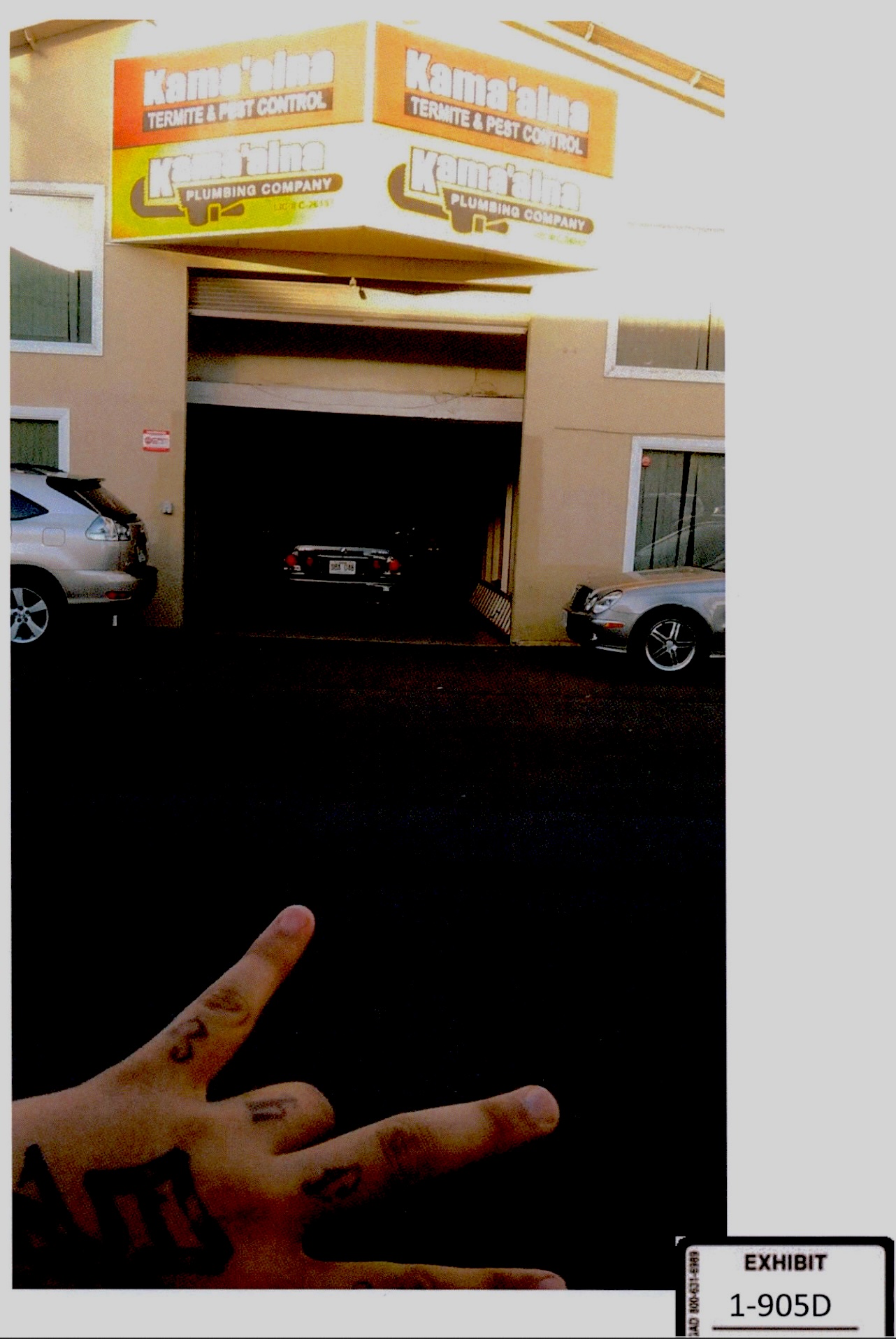
“E” for “East Side”

This photo is among the hundreds of documents admitted into evidence over the 5 months since the racketeering trial of Mike Miske got underway.

During his prior trial testimony, Jacob “Jake” Smith identified it as his hand making an “E” signal, which he said was a symbol for “East side,” a reference that appears to have encompassed many of the associates who reported to or took directions from accused racketeering boss Michael Miske, the former owner of Kamaaina Termite and Pest Control, and several other local companies.

The photo was taken outside the headquarters of Miske’s Kamaaina Termite and Pest Control on February 9, 2016. Smith said it was taken after the first several assaults he had carried out at Miske’s directions.

In other photos and social media posts, several people identified with a gang known as the “North Shore Boys” indicated an alliance with Miske’s “East Side” associates, at least during a certain time period.

Miske defense expected to rest its case on Monday

The racketeering trial of former Honolulu business owner Michael J. Miske Jr., which started on January 6 with jury selection, is now expected to wrap up soon, according to a discussion in court on Thursday following an abbreviated trial session.

The discussion was prompted by the early and abrupt end of today’s session. In only about 40 minutes, Miske’s defense attorneys called three witnesses who were quickly questioned, cross-examined, and excused in short order. The defense was then unprepared to proceed further.

The jury was excused, and Judge Derrick Watson called the attorneys to task, noting that the past few days had also ended without using the full time available.

“We are wasting a massive amount of time, my time, the jurors time,” Watson said. “The defense is showing a lack of appreciation and a lack of respect for jurors, me, and the process.”

Watson then attempted to pin down both prosecutors and defense attorneys, asking how many more time they need.

The defense said they may finish their non-expert lay witnesses Friday, but that they could spill over until Monday. They now hope that they now hope to be able to reach an agreement to stipulate to the information they had hoped to elicit from a DNA expert who lives on the East Coast, avoiding the need to schedule that witness.

Prosecutors said they intend to call only a single rebuttal witness, who was not identified.

Watson then spelled out a tentative schedule.

According to the court’s minutes:

Based on the information provided by the parties, Court outlined the following schedule:
1. defense should be finish with their witnesses by Monday, July 1, 2024;
2. if time permits on Monday, Government should be ready to present its rebuttal case;
3. Court to instruct the jury on Wednesday, July 3, 2024;
4. Court will be dark from July 4, 2024 through July 10, 2024;
5. Closing arguments estimated to take two days starting on July 11, 2024 and conclude on July 12, 2024; and
6. Jurors estimated to get the case by Monday, July 15, 2024.

The latest draft of proposed jury instructions is 223 pages, just one indication of the complexity of the jury’s remaining task.