
Ms. Kali is our senior calico.
She was adopted in September 2020 from a cat colony at the top of Aiea Heights, followed the next year by two others from the same place.
She is very sweet. She can also be difficult if, for example, you try to trim her claws, or do other things that violate her sense of privacy and independence. Which gets us to this story.
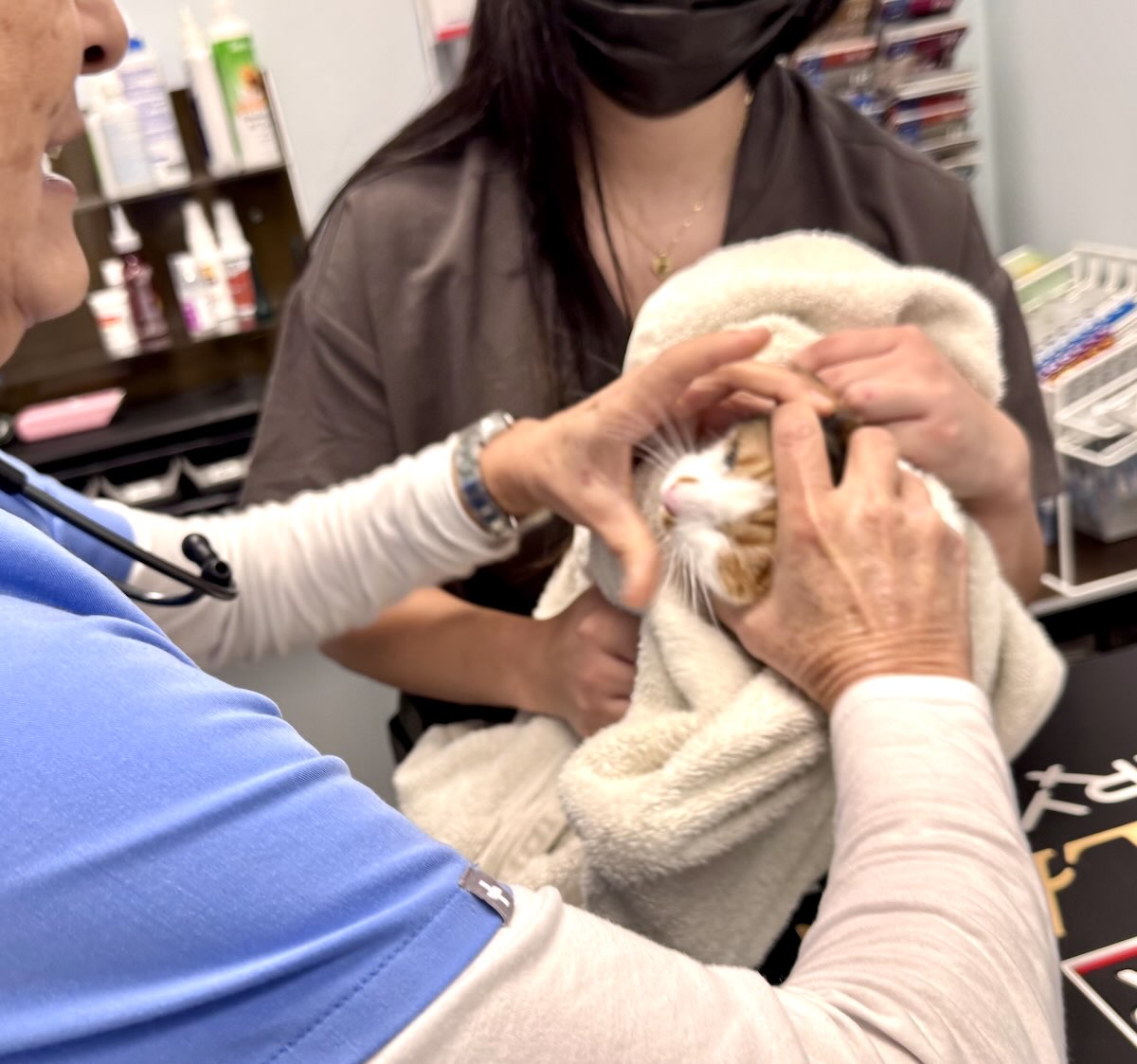 The last time we took Kali for a routine checkup by our favorite vet, Dr. Ann Sakamoto, Kali would not open her mouth so her teeth could be examined. She put up a very spirited and successful defense to keep prying hands at bay. She even defeated the dreaded towel burrito, somehow managing to get one or more paws into a position to do damage despite being wrapped in several layers of towel. After several minutes struggling to get her under control and finish the exam, Dr. Sakamoto cut it short and told us to put Kali back in her carrier.
Later, Dr. Sakamoto sent us home with a supply of small gabapentin pills with instructions to use them to experiment with drugging Kali to make her more cooperative. If it worked, we were to dope her up right before her next exam.
Gabapentin is a medication that can be used to help reduce fear, anxiety, and stress in cats, particularly in situations like veterinary visits. It is generally considered safe and effective when prescribed by a veterinarian. When administered before an appointment, gabapentin can help make travel and handling easier for both the cat and the owner. The effects of gabapentin can last for several hours.
Dr. Sakamoto suggested giving Kali 2-3 of the 50mg pills and then seeing if it calmed her down enough so that I could clip her claws, something she usually actively objects to.
This turned out to be more difficult than it sounded. While I could give Kali a pill, giving her a second or third pill proved to be, well, impossible. Once she knew what was coming, she deployed very, very effective defensive maneuvers, twisting different parts of her body in opposite directions while using all four paws to fend off human hands. So those pills have been sitting in the closet waiting for, I don’t really know, but waiting just in case.
Then I saw an advertisement for transdermal gabapentin, and remembered that years ago we rubbed a small bit of gabapentin cream on the inside of an ear of one of our cats for pain relief, much easier than giving him a pill.
 So I emailed Dr. Sakamoto, and she sent a prescription to a compounding pharmacy across the island in Kailua that created just what we need.
They mailed the new compounded concoction back and it arrived yesterday, just in time for an afternoon experiment. I can report that the minimumm dose, a dab of about .1 mL, calmed her down but it wasn’t enough. The next experiment will be to apply that same dose in each ear, about the equivalent of two gabapentin pills. That should be sufficient to put her in a pliable mindset, and if it works I’ll get her an appointment for another vet adventure.