
Tag Archives: University of Hawaii at Manoa

Some news reports create misleading public impression of UH pay

Here’s a small but significant example of how misreporting can confuse the public and impact public opinion about university contract negotiations.

A lot of those who teach on the University of Hawaii’s Manoa campus were surprised by an October 7 news item broadcast by KGMB, which reported:

The average salaries for tenured professors at UH Manoa range from $115,000 a year to $147,000.

In the academic world, “Professor” refers to the highest academic rank, usually achieved only after decades of teaching and research, and promotions via a rigorous peer review process. To the public, however, “professor” is a term which generally refers to all instructional faculty.

The figures broadcast by KGMB appear relatively accurate for those at the acadmic rank of “Professor”, often referred to as “full Professor”, but are wildly misleading if applied to all UH faculty.

In 2003, the last year for which data are readily available, there were 569 faculty at the rank of Professor out of the 2,529 faculty on the Manoa campus, just 22.5 percent of all faculty and 38 percent of instructional faculty. Since that time, a number of lower ranking assistant professors have been hired. [See Table 1 of this 2003 UH report.]

According to an annual salary study by the American Association of University Professors, those at the highest rank of Professor at UH Manoa have an average salary of $116,800.

Associate Professors average $88,200; Assistant Professors, $74,400; and Instructors, $58,700.

In addition, “average” salary figures are skewed by significantly higher salary scales in certain parts of the university, including the law school, medical school, and certain sciences.

Jon Goldberg-Hiller, a professor of political science, set about tracking down the source of the misleading numbers. His series of emails have been circulating to all faculty and drawing a considerable response.

Goldberg-Hiller first emailed KGMB reporter Jim Mendoza.

In regards to your story on the teach-in yesterday: how did you get the figures for the pay of a tenured professor. I assure you that I have tenure and am paid far below your minimum posted on the news. Most of my colleagues, when given tenure, make about $70,000 per year. That’s 40% below your “minimum”. Figures like this only hurt us and deflect from the important story we are trying to tell about our commitment to education.

Mendoza replied that the numbers came from Greg Takayama, special assistant to the Manoa Chancellor Virginia Hinshaw.

Golberg-Hiller then contacted Takayama, who confirmed that he had provided Mendoza with the data. But Takayama said his office was not the source.

In response to a request for information from KGMB-9, I informed reporter Jim Mendoza that the average salary of a 9-month tenured (instructional) professor at UHM is $115, 073; and the average for an 11-month professor is $147,817. These figures were provided by the VCAA’s office.

In a later email, Takayama added:

I was asked the average salary for a UH Manoa professor – that is the information I obtained and provided, as best I could.

Goldberg-Hiller continued to press Takayama on the issue, noting that “the differences in salary are considerable as are the political implications of these various figures.”

Yesterday, Takayama emailed another set of salary figures to KGMB’s Mendoza.

In the interests of clarity and more accurate disclosure – I am providing additional information on the salary average and range of tenured UH Manoa professors (the ranks of tenured professors include both full and associate professors):

Salary range for 9-month associate professors is $67,632-133,731. Average is $87,381.

Salary range for 9-month full professors is $79,029-208,317. Average is $115,073.

I hope this helps correct and more fully explain the information I provided earlier.

And this has not put an end to the reverberations.

Cynthia Franklin, a Professor of English, posted the following comment to the Google Group, “Preserving Hawaii’s University” yesterday afternoon.

I don’t have Gregg Takayama’s email address but I hope you will let him know that this “correction” needs immediate correction.

I am a full professor who is nearly $10,000 beneath the lowest figure he cites and I doubt that I am alone (in fact I know I’m not).

The initial figures given to the media do urgently need correction, but the correction needs to be accurate and not just another inflation of the numbers that will serve political purposes. I can’t imagine the administration does not have access to these figures. Or, on the other hand, perhaps those of us who are off the charts here can hold the administration to their figures and petition for quite substantial raises.

Media matters: Neither Honolulu daily newspaper reports on large rally on state’s largest university campus, Abercrombie won or lost depending on your choice of newspaper, missed online opportunities

March & Teach-inThe crowd at yesterday’s teach-in on the budget crisis at the University of Hawaii’s Manoa Campus was estimated at “over 500”, while organizers said they signed up 700 people who provided email addresses to be notified of future actions.

Please click on the photo for more views of the event.

After a march through the heart of the campus by as many as 100 students, the crowed gathered and grew in the hot noon sun on the lawn in front of Hawaii Hall to listen to 90 minutes of speakers. Offices of the Manoa Chancellor and her staff are located it the building. It was the largest, or at least one of the largest campus gatherings in years, according to observers.

There was a real sense of unity, some not apparent to casual observers. For example, although Hawaiian programs have so far been exempt from budget cuts, faculty and students from Hawaiian Studies were prominent on the program and among the organizers of the event, a powerful political statement.

But despite the high level of campus interest and the high stakes involved for higher education statewide, and implications for the UHPA contract negotiations, neither Honolulu daily appears to have reported on the event today.

Lingle was called a “liar” by several speakers as a result of her claims about the budget, including a professor of accounting. His speech drew loud applause and comments (“That’s an accounting professor! I’m gonna change my major!”).

But you won’t read about it in our daily newspapers today. You can read a bit more in the UH campus newspaper, Ka Leo.

This really is a puzzle. Newspapers (and other advertising vehicles) claim to be desperate to attract the college/university student demographic, but they ignore news relevant to exactly that group of potential readers. Cutting out the higher education beat means far less hard news that could accustom students to reading newspapers. Students have interests that go beyond clubs and music. Hello?

Meanwhile, we have another two-newspaper morning to report, with parallel stories left wondering if they’re covering the same bill.

From today’s Honolulu Advertiser:

Deal ensures Guam jobs will go to U.S. workers

By John Yaukey
Advertiser Washington Bureau

WASHINGTON — Congressional negotiators reached agreement yesterday on legislation that would ensure that many of the jobs created on Guam by the transfer of Marines to the island will go to American workers from Hawai’i and the Mainland.
Advertisement

The 2010 defense authorization bill contains provisions by Rep. Neil Abercrombie, D-Hawai’i, that would strip away some incentives for bringing foreign workers to Guam, while establishing greater federal oversight of the massive project there.

But from today’s Honolulu Star-Bulletin:

Abercrombie loses Guam wage fight

U.S. Rep. Neil Abercrombie has lost a battle with the Navy over workers’ wages.

House and Senate converees yesterday rejected his proposal to require contractors to hire Americans for 70 percent of the jobs created on Guam to accommodate the move of 8,000 Marines and their families being relocated from Okinawa.

And in other media trivia, yesterday’s Honolulu Advertiser also contained a correction:

The final six paragraphs about safety requirements in a story on Page B1 yesterday (Tuesday) on the death of a diver were copied from a June 9 Department of Land and Natural Resources press release and did not have attribution.

The original story has been corrected to add contain the proper attribution, and the updated version of the story is available online with the correction noted at the bottom.

That appears to be a good way to handle an embarrassing slip-up.

And here’s another of my ongoing media gripes. I thought newspapers are supposed to be trying to make highest and best use of the opportunities created by the web to provided additional information to readers.

So why do they continue to ignore the opportunity to provide primary documents to readers?

It’s happened again with the lawsuit by a Honolulu police officer alleging test recruitment test results have been altered or “fixed”, and that the department retaliated when the problems were reported.

I’ll pick on the Advertiser, but only because I have Rick Daysog’s story on the lawsuit open on my desktop. How hard would it be to provide a simple link to the document?

In any case, if you would like to look at the actual complaint filed in court, just click here.

Odds and ends on a Wednesday morning–HGEA negotiations, food notes from Louisiana & Paris, Tinfish Press #19, a rail question, and UH bureaucracy

First, from the incoming mail, a reader comments on the HGEA negotiations:

Yesterday’s article seemed like a puff piece fed by Lingle’s office blamming the Mayors for holding up a contract with HGEA. Absent from the reporting were such details as how long the Mayors have had to review the details of the proposed contract and what role, if any, the Mayors played in settlement discussions. While all of us want a settlement, it struck me as a typical Lingle media piece. Wouldn’t prudence dictate that the Mayors actually review what they are agreeing to first? This rings particulary true since the county mayors may have been simply cut out of the process by the adminstration and then given a take it or leave it kind of deal.

This note from Bob Jones:

love Hawaii, but oh the joys of the cheaper mainland. just returned from Louisiana where I was paying $2.14 a gallon for gasoline and the average price of a restaurant dinner with endless shrimp, crab, alligator and sweet potato fries was $10.

Still on the food theme, this note is from a friend now in Paris on an emergency trip:

Food, btw, is amazing here. I have never been fond of French food but I now know that’s because I never actually had any. Such amazing cheese and truly exceptional bottles of wine at every corner store for a (converted) $3. I bought a (converted) $13 bottle of wine for comparison purposes and there was little discernible difference in quality. (I’d heard this was the case but had to test for myself!)

Street markets have incredible arrays of fruit, meat, olives, and prepared foods. Hard for me to figure out price comparisons with both kilo and euro conversion to calculate, but since it’s clearly cheaper than eating at restaurants, I’ve not allowed myself to become overly concerned with those details.

We did eat at a lovely cafe the first night I was here as a celebration of sorts. Prices there were comparable to mid priced Honolulu fare but the food quality was over the top. These folks really know how to enjoy the moment! And they make those moments last. . .dinner hour begins at 8-9 p.m. and extends to 2 a.m. On cafe night we watched elderly couples arrive for dinner at midnight as we were finishing our meal. Quite a cultural phenomenon for me. . .

From Susan Schultz at Tinfish Press:

I am writing to announce publication of our 19th issue of the annual journal, which is beautifully designed, covered by hand-made stuffs, and full of wonderful work. Please support our efforts to publish experimental poetry from the Pacific.

We are charging $12. To order, go to Tinfishpress.com, click on “purchase,” go to the bottom of the 2checkout page and order that way) because we no longer get our postage from UH. You can also order by mail at 47-728 Hui Kelu Street #9, Kane`ohe, HI 96744, the home office.

For more, please read the Editor’s Blog, which includes photographs of our making the covers by hand, and of very cute children (if I may say so myself!).

Here’s a sound bite from the ongoing rail debate:

No rail project like the Vancouver SkyTrain elevated hot third rail system, the one Mayor Hannemann’s administration has used as a model, has been built in any other major Canadian or US city in the 23 years since the SkyTrain was built in 1986.

Toronto, Calgary, Montreal, Seattle, Portland, Sacramento, San Francisco, LA, San Diego, Denver, Phoenix, Salt Lake City, Dallas, Houston, Charlotte, etc. all chose a more flexible technology.

If that SkyTrain is so great, why didn’t any of those other US and Canadian cities build a similar system??

I know the city has canned answers. But I don’t think they’ve got any good answers.

And, from Manoa, something for the “bureaucracy” file:

Since the 1990s, this university has seen an explosion in both the number of administrators and the salaries they receive. In 1994, there were 20,041 students at UHM, in 2008, 20,169, a percent increase of .6. In 1994 there were 2,008 faculty and in ’08, 1,984, or a decease of .1%. In 1994 the UH system and UHM administration had 62 positions, in 2008, it had 234 for an increase of 277%.

Those are the numbers. Here’s a story of those numbers in action:

According to a story making the rounds, David Ross, the Chair of the Manoa Faculty Senate Executive Committee, invited President Greenwood to attend the Senate’s convening of the Faculty Congress at the end of October. He received a reply saying that proper protocol requires that he ask the Chancellor to invite the President on his behalf–and that the President will reply to him through the Chancellor.

I certainly hope that he asserted the rights of the faculty and extended the invitation directly, rather than being shunted off through “channels”.

Don’t miss Sunday’s New York Times story by Julie Creswell detailing the collapse of the Simmons Bedding Company, brought down by a series of investors who bought the company, buried it in debt, extracted huge profits without concern for the ongoing business, and then jumped ship.

When crooks do it, it’s often referred to as a “bust out”. In the case of hundreds of large companies, it’s called “leveraged buyout”, I guess.

I wonder what this kind of digging would show about Hawaii’s hotels. How much of current financial pain in the visitor industry is the result of similar leveraging of our island assets? I would guess it is substantial, but it would be a big project to track down the data.

And did you catch NPR’s story last week about Venezuela’s system of musical training for kids? Amazing.

Equally amazing was that there was no mention of Venezuelan leader, Hugo Chavez, a popular target of media demonization.

It seems that we’ve got a thing or two to learn from Chavez and Venezuela, if this musical program is any indication.

Here’s another indication that big money will be flowing into federal elections.

From the First Amendment Coalition:

The Federal Election Commission (FEC) decided with a 4-1 vote that a consulting firm, Black Rock Group, can act as a vendor for individuals who want to run political advertisements without violating campaign finance law. The FEC approved the advisory opinion allowing the political consulting firm to provide guidance to clients, each acting as their own liability companies (LLCs), without being regulated as a “political committee.”

University of Hawaii orders evacuation of Manoa building, citing safety fears

University of Hawaii officials have abruptly ordered the evacuation of a flood-damaged building on the Manoa campus due to fears that it could collapse.

Gartley Hall, an older two-story building that houses the Department of Psychology, was to be closed to faculty, staff, and students after Friday, according to an emergency notice issued yesterday.

But an email today said worsening conditions have forced an immediate evacuation. Those working in the building have been told to take home anything needed to continue their work in the short term. The university will then reportedly hire movers to finish clearing the building.

It’s another symptom of the backlog of long-deferred repairs and maintenance on the campus.

Department and faculty offices, research labs, and a number of classrooms are affected. The department has about 20 faculty and 100 graduate students.

The basement of the building was flooded in December 2008 with about a foot of water. Several basement rooms were damaged and have been vacant and unused since then.

Last week, preparations were being made to move two research projects from the basement to temporary space upstairs in order to install 12×12 columns to shore up damaged walls. But when work started, the structural damage was determined to be more extensive than previously believed and an order given to evacuate the entire building.

Staff were told they must leave the building and remove any essential materials by Friday.

One professor who inspected the basement last week said bluntly, “the building may fall down.”

“The walls (in the basement) look like cooked oatmeal in at least 5 rooms. The plaster is bowing and flexing and crumbling. It has a wet oatmeal look.”

The university already faces a shortage of office space, and relocating an entire department on short notice will not be easy. Classroom space is already at a premium, and relocating classes will be another headache. It is another serious financial blow to the Manoa campus, which already faces the most serious financial crunch in its history.

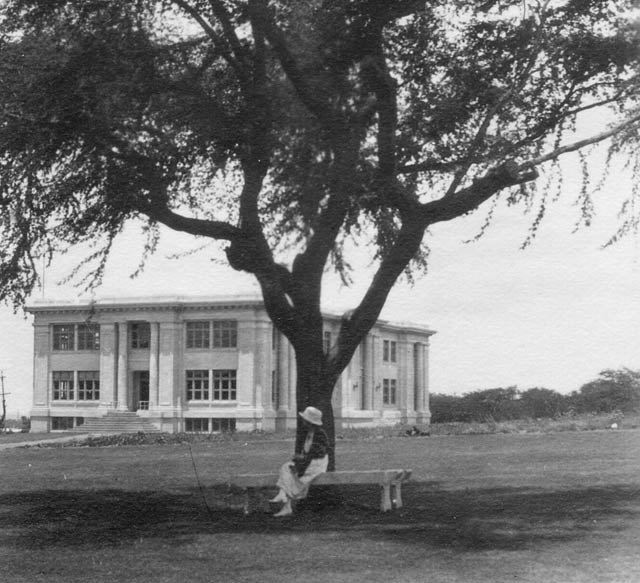
Gartley HallGartley Hall is one of the original campus buildings, shown here in a 1922 photo. It is named after Alonzo Gartley, a key figure in the history of Hawaiian Electric, an executive with C. Brewer & Co., and chairman of the first UH Board of Regents.