
A state Senate committee hearing this past week raised questions about legal ownership of parts of the Mauna Kea access road where the current protests are taking place, potentially weakening the state’s ability to take more aggressive actions to clear TMT opponents from the access road.
According to the Honolulu Star-Advertiser report on the information meeting:
About 50 years ago, the Department of Transportation built Mauna Kea Access Road over Department of Hawaiian Home Lands property without permission. That road and others throughout the state that were built on DHHL land became part of a much bigger $600 million settlement that the state entered into in 1995 to compensate DHHL for the misuse of Hawaiian home lands. As part of that agreement, known as Act 14, the state was required to compensate DHHL for Mauna Kea Access Road via a land swap.
However, the state never executed a land transfer, DHHL Director William Aila told lawmakers during a legislative briefing called by the Senate Hawaiian Affairs Committee.
It called to mind a 1974 protest by a Hawaii Island rancher, Sonny Kaniho, who had been on the Hawaiian Homes waiting list for a number of years. Kaniho was seeking a lease of pasture land, and became increasingly distressed by the granting of pasture leases to commercial interests, including Parker Ranch, while qualified Hawaiian lessees remained in waiting list limbo.
Finally, in May 1974, Kaniho took direct action, backed up by a small group of supporters. Together they removed a gate in to a 375-acre pasture leased to Parker Ranch, and symbolically “occupied” the pasture.
Hawaii County police issued trespass citations, and those cited were ordered to face trial on the charges in the district court in Waimea.
I’m familiar with the case because I was one of those charged with trespass and facing trial. The official complaint served on me appears below. Just click on the photo to read the document.
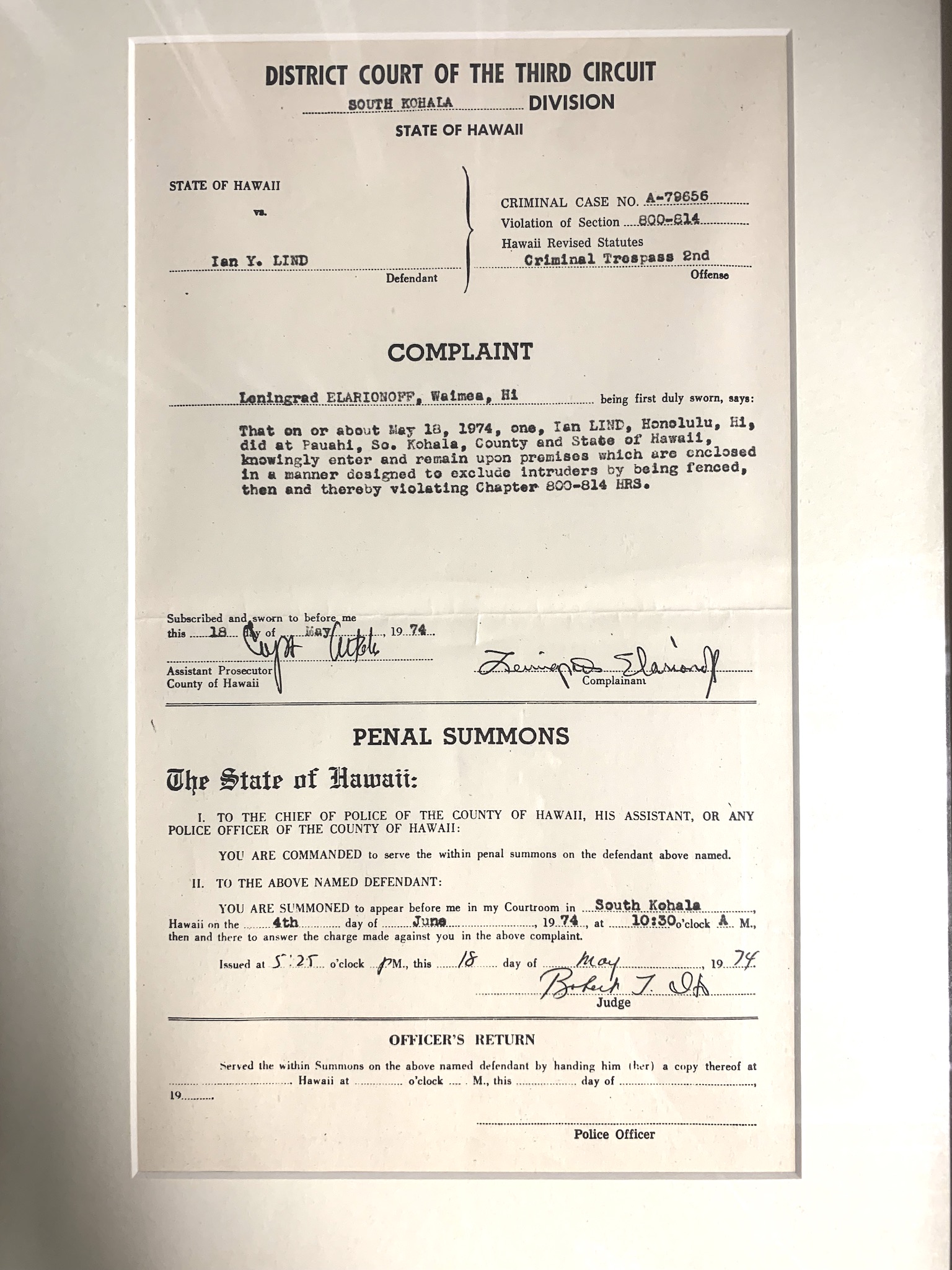 Kaniho and 17 supporters went to trial in August 1974. During the trial, attorney Robert “Gil” Johnston elicited testimony showing that the Parker Ranch lease had expired at the end of 1973. This prompted Judge Norman Olds ruled the land had reverted to state ownership at the expiration of the lease, and that as a result the defendants had not trespassed on Parker Ranch property. Trespass charges dismissed!
The Parker Ranch leases had been extended beyond their expirations under a provision allowing short-term permits of up to a year after lease expiration, presumably so that the lease terms could be renegotiated. In this case, however, that had not happened, and Judge Olds ruled that it made all the difference in this case.
The lease to Parker Ranch, and similar leases to other commercial interests, were made because chronic underfunding of Hawaiian Homes programs necessitated commercial use to generate income that could in turn fund the department’s administrative and development budgets.
So there were series of what could reasonably be seen as breaches of duties to Native Hawaiian beneficiaries, to the benefit of other segments of the public.
Chronic underfunding was the result of legislative decisions that prioritized other interest groups ahead of qualified Hawaiians waiting for homestead leases.
The decision to rely on commercial leases for income, while understandable as a reaction to chronic underfunding, could again be reasonably seen as putting private commercial interests ahead of those of DHHL beneficiaries.
Then add the broader context provided by the 1983 report of a joint federal-state task force, which determined that thousands of acres of Hawaiian Homes Commission land was illegally taken from the homestead program by executive orders between 1923 and 1969, including land under the Hilo Airport.
In 1985, Gov. George Ariyoshi approved approved returning to the Department of Hawaiian Home Lands 27,836 acres that had been illegally transferred over the years.
And a decade later, the state agreed to pay $600 million, and to take other steps (including the land swap for the Mauna Kea access road) as compensation for past illegal use by the state. But when the agreed upon land swap didn’t happen, it was again Hawaiian interests suffered.
Whether or not the failure to make the land swap back in the 1990s leaves the State Department of Transportation in the same position as Parker Ranch in 1974 is an open question.
However, it does add to the series of transactions in which Hawaiians were promised, but did not receive, their due.
And there are many more examples, including the Hawaii Supreme Court’s finding several years ago that the legislature breached its constitutional duties by failing to provide sufficient funds for the DHHL administrative budget.
In the broad sweep of things, it’s no wonder to me that Hawaiians are angry and resentful, feelings are are now on public display in the TMT controversy.
Discover more from i L i n d
Subscribe to get the latest posts sent to your email.
“sonny’s been waiting a long, long time…” time to give this song some air play!
Unless the state has refused to execute the land transfer despite DHHL’s insistence, you have a rhetorical argument rather than a court case.
More likely, an agreement on the specific property wasn’t quickly reached and DHHL promptly forgot all about it.
But more importantly, can any Hawaiian access and occupy at will any property under DHHL jurisdiction and obstruct travel of others whose lawful access is undisputed?
That’s not a rhetorical question.
My memory is fuzzy on this. There was a state supreme court case that ruled in favor of HHL along the lines you suggest. That was overturned by the US supreme court. In response the legislature set up a super majority for all land deals. I watched Senator Kahele’s grilling of the AG representative. What came out of that, where he was referring to the land being “fee” was the land under the road still belonged to OHA and a fee agreement had not been reached, thus no land swap needed. There is a broader issue here. Much of the 200.000 acres owned by DHHL is unsuitable for homes, like the Mauna Kes road land. Because there is no entity to negotiate with everything remains frozen, DHHL actually needs land swaps, but what to swap. Ceded lands? Which have their own problematic issues. Mauna Kea is a metaphor, TMT was willing to pay $1,000,000 yearly in the lease. $100,000 to OHA, the remainder goes to preserving and protecting Mauna Kea. The narrow benefits are directly to Hawaiians. Yet the claims of those protesting aim at preventing this. Thus nothing happens except a stew of ill will and frustration.
“Much of the 200.000 acres owned by DHHL is unsuitable for homes”
Not sure they want homes. There has always been a desire on the part of Hawaiians to own small farms and ranches. As Ian pointed out, only large operations like Parker Ranch can turn a profit in agriculture.
Ian – you’ ve made a solid point, mirroring conceptually what Maxine Ramos recently published in her opinion piece in Civil Beat on Aug 17, entitled: “Wake Up, Hawaii: It’s Not All About a Telescope.” Hers is a critique of how our state has “exploited” lands for decades, acting as poor stewards for lands, much as the modern world has ignored indigenous cultures reverence for them. It transformed her from being pro-TMT to being against it now in view of the record of our political leaders. It is just a short step away to take this viewpoint if one follows the recent suggestion of Pope Francis, who The Guardian reports urged that indigenous peoples have the right to “prior and informed consent” on any development affecting their lands. In other words, nothing should happen on – or impact – their land, territories and resources unless they agree to it. The Mauna is ceded lands, a category of state lands that come from the lands taken (some would say, “stolen”) from the Hawaiian Kingdom during the 1893 overthrow. The U.S. has formally apologized for its illegal role in supporting that overthrow and resolved to reconcile this dispute with Hawaiians. It never has, leading our Hawai’i Supreme Court to acknowledge that these claims remain “unrelinquished.” The State was the latest steward for these lands, assigned that role at statehood, but the history of its management of these lands form the backdrop of the TMT controversy. It clearly is not all about a telescope.
Ian: Mahalo for honoring the name of Sonny Kaniho, as well at Gil Johnston. Sonny was a pioneer of the modern Hawaiian political movement. He deserves this mention and the tie to his relationship to the ongoing controversy. Gil preceded me in representing him. Their story of confronting Parker Ranch is legendary.