
Bob Jones, longtime journalist turned blogger, tossed out an opinion on Facebook this week that caught my attention.
I’m pleased that UH religion Prof. Jay Sakashita’s column in gone from MidWeek.
Why? Well, he was one of my favorite reads, but he was working for nothing. That degrades the bargaining chip for professional journalists. A worthy writer should never give his/her stuff for free.
I do miss him. And even Dan Boylan, Jade Moon and I, paid columnists, were “suspended” when Covid hit. “Freebies” now prevail.
I understand that position. Rate-busters are never appreciated in a competitive marketplace.
Of course, I don’t think Bob literally means “never”. After all, Bob is now distributing his own writing via his own blog, which is free to the reader. So he is, in large part, giving his stuff away for free.
So I’m thinking Bob means journalists shouldn’t offer our work product for free to the owners of corporate media. I’m mostly okay with that, although I think even that statement needs to be qualified, since there are circumstances where it still makes economic sense to do so. I’ll get back to that point later.
Disclosure: I’ve been writing for Honolulu Civil Beat for at least 7 years. For much of that time, I was paid to produce what tried to be a regular weekly column. At other times, I’ve submitted articles now and again when I thought the topic deserved broader exposure than it gets through this blog. And, for at least a year now, I’ve declined to accept the fee that Civil Beat has repeatedly offered.
Here’s why I made that decision. At this point, I have partly–well, perhaps mostly–retired. I try to avoid deadlines unless they are self-imposed deadlines. And we are living comfortably on a lifetime of savings and investments, so although a little extra income is always nice, I don’t need the money. I hope that by declining my fee, that same money is available for Civil Beat to invest in other writers.
Yes, it’s vitally important that journalists are able to make a decent living plying their trade. But that’s not the end of the story. Right now, no one has perfected the business model that is going to allow local news to survive, especially local newspapers, and the journalist jobs that go with them.
Nonprofit news is one approach being tried, and Civil Beat is part of that broad experiment after trasitioning to nonprofit status. I think that makes a difference. By declining Civil Beat’s fee, I’m not helping some corporate owner to extract more profit. By contributing what I do best, in-depth investigative reporting, I feel like I’m donating something to this worthy experiment in nonprofit journalism that is worth more than just money. I’m volunteering time and, more importantly, my expertise to sustain Civil Beat’s public purpose, providing news that we need to sustain democracy. I don’t consider this to be rate-busting. My occasional articles don’t threaten the jobs of Civil Beat reporters. They just add to what CB can offer to the public.
There are a lot of organizations that function with both paid staff and a corps of active volunteers. I spent more than a decade on the staff of two different not-for-profit organizations that relied heavily on volunteers, the Quaker-based American Friends Service Committee, and the watchdog group Common Cause. More generally, we typically laud those who serve the community through volunteer service. Why shouldn’t that extend to journalists and journalism as well?
And to return to an earlier point, there are certainly circumstances in which it still makes sense for journalists to write for free, at least by choice and on occasion. If I were trying to monetize this blog, placing articles (for free or for fee) in mainstream corporate media would be a form of advertising, a way to get broader visibility and invite readers back to the blog. A lot of freelance writers pursue just such a strategy as they build their portfolio and reputation. They might write for free, but they’re not writing for nothing, since they gain tangible benefits in the bargain.
My advice to my friend Bob: Never say never.
Writing this post reminded me that I’ve struggled with the same question since I lost my only job as a full-time investigative reporter when the old Honolulu Star-Bulletin was sold in March 2001. You might be interested in the little essay I published at that time (“After the Star-Bulletin left“).
Here’s the lede.
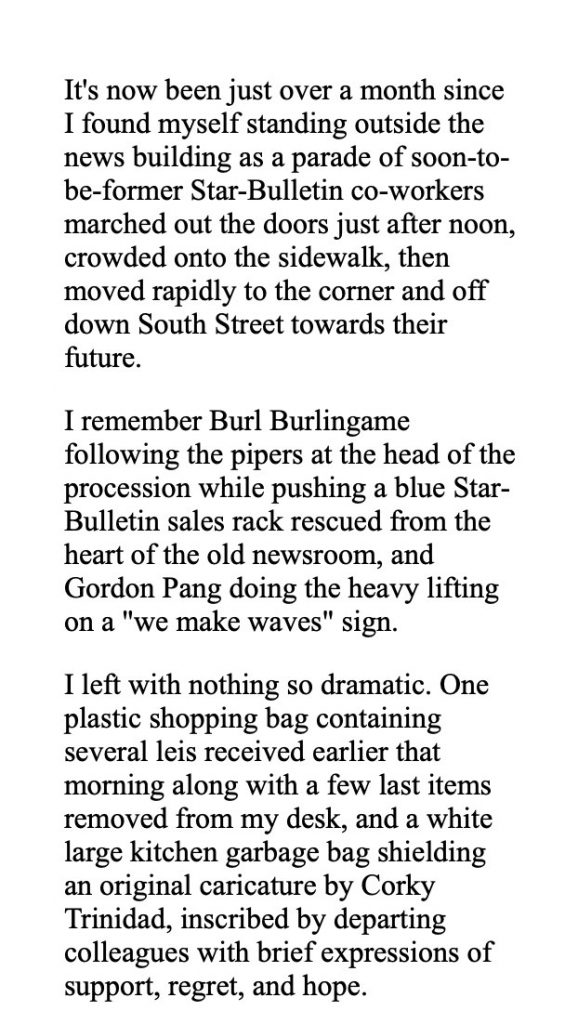
To read the full essay (trust me, it’s really good), use the link above or just click on the text.
Discover more from i L i n d
Subscribe to get the latest posts sent to your email.
When Pierre Omidyar changed Civil Beat from a paid subscription business model to non-profit, it occurred to me that his move was not exactly a case of charitable noblesse oblige. Because under his new model he gets to take all his huge subsidies to CB as tax deductions thereby saving himself lots of money he would otherwise be forced to pay as taxes, while shifting that tax burden to the rest of America’s taxpayers. He gets to use CB to push political views he likes, while editors he pays shield himself and his readers from critical comments. And I laugh when CB runs occasional fundraising campaigns which create the impression that it is the readers who actually keep CB operating — those fundraisers are merely a public relations stunt to give readers a feeling of partnership and loyalty because they can imagine they are rowing the boat. Clearly, CB must be paying megabucks in salaries, travel expenses, rent and equipment — far more than the occasional 50K or 100K acquired through fundraiser campaigns. Donations from Omidyar or CB readers given to explicit political campaigns are not tax-deductible and thus do not shift tax burdens to other taxpayers, but donations to a non-profit with a heavy political agenda ARE tax-deductible while getting a political mission accomplished. By the way, when CB published its article a few years ago announcing its new business model, I submitted a comment similar to this one but of course the editors suppressed it even though it did not violate anybody’s standards of civility and decorum.
I never agree with anything Ken says. But have to say, he nailed this post regarding the ploy of non profit status of CB. While they do pay mostly 6 figure salaries to their reporters they also basically give away for free their work. They make pleas for donations which is ironic since their owner is one of the richest people on the planet. They are non union labor competing with their union labor counterparts.Hardly a fair fight at the end of the day since the union guys make people pay for their work.
Factually, I doubt very much that Civil Beat reporters “mostly” have 6-figure salaries. In 2018, just three people were paid 6-figure salaries, and that group didn’t include any reporters, according to the CB tax return.
And you really need to understand what Civil Beat represents. I believe it was started as one of a number of experiments launched by Pierre Omidyar and his foundations as experiments. In the case of Civil Beat, it was an experiment in building sustainable news at the local level. Local news is an endangered species, and Civil Beat was meant to test the theory that good online news could become a sustainable business, using the economies that on-line delivery provides. That phase of the experimental apparently failed, or else didn’t succeed as well as hoped, and the for-profit business model was abandoned five years ago as CB transitioned to a non-profit model that solicits contributions from the public, just as public radio and public television stations do. We desperately need the kind of news that Civil Beat is committed to delivering. Without it, we would all be much worse off.
There are Civil Beat journalists who do make six-digit salaries, but their salaries are paid for by outside sources. These sources are not ideologically oriented with a political agenda, but research oriented on specific areas (renewable energy). Journalists gather local data which is valuable to universities and foundations.
2018 was before the veteran SA reporters were being lured away. Maybe the younger reporters are not making that kind of dough so maybe correct in that sense. Maybe they need a union.
Here’s another thought regarding authors declining to be paid for what they write. Authors benefit by having their work published, because they get their views out to the public while also getting name-recognition; and publishers benefit by having authors’ writings as part of the content which subscribers pay for. The question might arise: Which side gains more and therefore which side should pay the other, and how much? I often ponder this issue when we see those annual warnings on TV programs when a content producer (like CBS or Showtime) and the broadcaster of that content (like Spectrum cable TV) are unable to agree on terms for renewing their contract, so viewers are warned that they might no longer be able to see their favorite shows. But that dispute makes me wonder which side is producing and paying for the warning; and which side has been paying the other, and how much money, for producing or distributing content. Inquiring minds want to know. Perhaps an investigative reporter could make a splash by finding out.
I don’t see how the non profit status shields him from people like Ken. I’m pretty sure the for profit advertiser also wouldn’t print his conservative illegal overthrow denying crap either.
That said I do agree it’s a tax ploy. P.O. is worth 12 billion. The reader donations are less than the interest he makes on all that wealth.
Does it really make sense to say that Civil Beat’s non-profit status is a tax dodge by a multi-billionaire who would at best save a few dollars in taxes from a small online publication? Being incredibly wealthy means that he does not need a loophole for a tiny operation. Now, if he had a business empire and he relocated its head office to an off-shore tax haven, then *that* would be a tax dodge.
Ok, valid comment but then why did he go to the trouble to make it a non profit if money is no object? Clearly CB loses millions and as you point out he doesn’t need a loophole to operate the site. So, why?
Money may be no object for Mr. Omidyar, but money certainly is an object of Civil Beat and other experiments. The goal is to find a way to make critical local news financially sustainable. Not through continued underwriting by a billionaire, but on its own.
Another fascinating insight to journalism in Hawaii. Thank you Ian – I’d really like to read your (“After the Star-Bulletin left“) but the link takes me to your Wednesday entry…. hope you can work that out for a later entry.
All of my published material has been in the form of books and historical entries relating to Hawaiian history. I continue to contribute to journalistic papers relating to Pacific/Oceanic heritage, cultural, indigenous and historical disciplines. Like the rest of us, I have also contributed my full measure of give-away work for Aloha.
I was also married to a journalist who freelanced his entire career in addition to his many best-selling published books. The point is that I know from experience that journalism is one of the toughest avocations a person can aspire to, and still hope to carve out a decent living.
You are to be commended on your stellar record and longevity as a paid journalist, as well as your enduring contribution in dues paid the community. In addition, I look for and voraciously read, every entry you post in Civil Beat and anyplace else I see your byline.
+1 !
(former, sometimes casual journalist)
Sorry about the bad link. Hopefully it’s fixed now.
After graduating with a useless degree in journalism from Oregon State University, I went to work for a year at a newspaper in Wheeling, West V.A. where my dad’s sister was head of the “Women’s Page” and her husband was editor of the paper. Had a grand time there writing about coal strikes and occasionally writing humor columns. I had applied at the Star-Bulleitin after graduating from college and after a year in W. VA I got a call from Star-Bulletin publisher (?) John Simonds. He offered me a job but not at the Star-Bulletin. Instead he sent me to the Gannett paper in Guam where I began my career as a crime reporter. Spent two years there. It was great. Very corrupt place with lots of bad guys. Got my first death threat. But the surf was great and best waves were just across the street from the news building with very few surfers. After two years, Simonds called and moved me to the Honolulu Star-Bulletin and onto the police beat. Wonderful time! Lots of bad guys from Henry Huihui to 400 pound hitman Ronnie Ching. Very colorful characters who wouldn’t kill you unless ordered to. Knew Ronnie very well. Covering crime in those days was like covering the Wild West. After Ronnie pleaded guilty to killing City Prosecutor Chuck Marsland’s son and three other dudes, including State Sen. Kuriyama and ratting out some his associates he was sent to an East Coast prison. Before leaving he asked to talk to me and Advertiser investigative reporter Jim Dooley. We me him at Marsland’s office and asked “What’s up, Ronnie?” He just wanted to talk about his criminal past and how he liked to get rid of the bodies during his early hitman career. He liked to bury them on Makua Beach “cuz easy fo’ dig, eh?” He liked to bury them in the winter because by summer time when the sand came back in “the buggahs stay forty feet deep, you know.” A long time heroin addict, Ronnie returned from prison to Hawaii to die, having shrunk to 100 pounds. He did so quickly.
Although we were unionized at the Star-Bulletin we were paid pretty well but it wasn’t a lot. But that didn’t matter, It was a blast. The colorful people I met, the death threats I got and the friends I made at both papers, along with eventually writing a humor column that was named by the National Society of Newspaper Columnists the top humor column (twice) for newspapers under 100,000 circulation and second in the country for newspapers over 100,000 circulation when writing for the Advertiser. It was a blast.
When it became clear one of the papers were going to fold, being a senior staffer at the Bulletin, I was able to be “let go” and kept writing here and there, including as a staff writer for “Baywatch Hawaii” and writing the 100 year history of the American Red Cross in Hawaii for which was paid the tidy sum of $8 thousand dollars. Also was able to get my novel “Aloha, Lady Blue” published nationally, which largely contained characters I met as a newsman in Hawaii.
Money was never an issue for me and still isn’t. I wrote for the fun of it and sometimes it paid well and sometimes not so much. I also wrote for free for various nonprofits. And did some standup comedy for free with Andy Bumatai and others for the fun and sheer terror of it.
I feel lucky for having been able to make a living writing in Hawaii and getting to know of all characters who make up this crazy quilt called Hawaii. I was getting my hair cut one day at Pearl Ridge and the attractive young lady doing the cutting turned out to be the daughter of notorious Hawaii gangster Henry Huihui. (ONLY in Hawaii!)
Henry had ratted out his crew and plead guilt and, like Ronnie Ching, sent to an East Coast prison to do his time. His daughter told me was had been set free and was hiking in Switzerland or some strange place. I asked her how the rest of her family turned out and she said, “pretty good.” Her younger brother had been convicted of rape, but, as she put it, it was only “statutory rape,” which apparently in the Huihui world was not that bad of a thing. Only in Hawaii!
Any of you writers out there who want to share a story can reach me at 285-8891 or post to this site!
Cheers!
Charley
Civil Beat reporters are non-union workers and the local paper is unionized, but they do not compete with each other, the two newspapers have a different audience. A newspaper is not a factory. Omidyar is not out to drive the competition into the ground. Local daily newspapers were once owned by local big shots who had a stake in society and a sense of duty, but now those local papers are owned by multinational corporations who do not understand the old ethic of service. Civil Beat is kind of a throwback to the old ethic, but nowadays that is based on philanthropy.
Civil Beat’s original business model was that only subscribers could comment. With their identity confirmed and revealed to the public, they would remain civil and contribute just as much information as the reporter. The comments were polite, but they were either from retired men with strong opinions or by public relations people. The experiment was concluded to be a failure, but I am not sure why. Was it the lack of revenues? Or was it that the comments were predictable, uninformative and slanted? Could this model work if it were modified?