
Hawaii’s Landlord-Tenant Code was part of the legislative package put forward by Gov. John Burns in 1970, and it was passed into law by the Legislature in during the 1972 session. It was seen as a major step forward in protecting tenants’ rights.
The Honolulu Advertiser reviewed the law following its passage in a story published May 31, 1972: “After a couple hundred years, a new deal has been established between landlords and tenants in the Islands.”
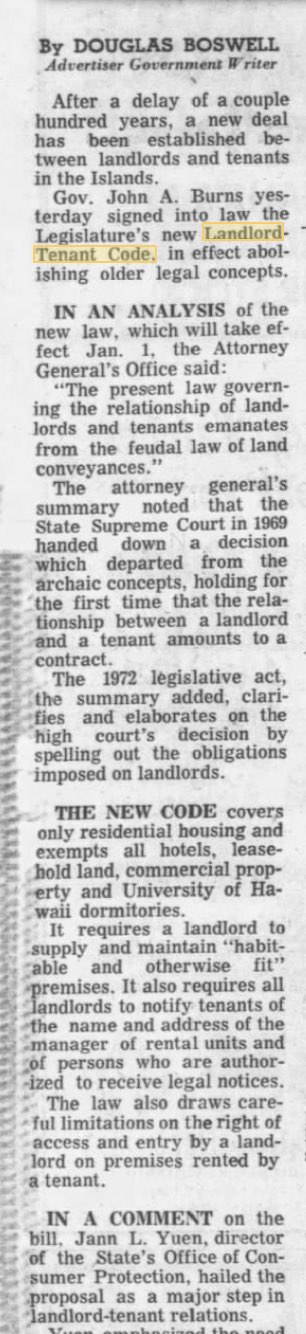 It was, at the time, a progressive move.
But a decision by the 9th Circuit Court of Appeals issued on Tuesday involving an Oakland law is a pretty stark reminder that Hawaii’s Landlord-Tenant Code has failed to keep up with the times or to address the needs created by the related problems of high housing costs and equally high rates of homelessness.
The 9th Circuit decision came in a lawsuit against the City of Oakland by a couple that was required to pay more than $6,500 to their tenants who were evicted because the owners wanted to move back into their own home. The payment was below the standard set by city ordinance because the tenants had been renting less than two years, which reduced the amount of the payment.
The East Bay edition of The Mercury-News reported:
The lawsuit took aim at Oakland’s Uniform Relocation Ordinance that requires landlords to pay tenants thousands of dollars if they are evicted for no fault of their own, such as making way for the owner or a family member to move in or when an apartment is converted into a condo. Tenants’ rights advocates say the ordinance helps displaced renters afford first and last month’s rent and a security deposit in a new place — and helps prevent them from becoming homeless in the Bay Area’s expensive rental market.
San Francisco, Berkeley and Palo Alto have similar ordinances, but landlords have complained the laws put an unfair burden on homeowners.
Oakland’s ordinance eases the hardship of eviction, particularly for tenants who lose their rent control status and are thrust into a significantly more expensive market, according to Oakland City Attorney Barbara Parker.
Is a law requiring landlords to pay tenants’ “relocation assistance” considered radical?
Do a bit of online searching (“Uniform Residential Tenant Relocation Ordinance”) and you’ll find that the idea of required relocation assistance when tenants are tossed out through no fault of their own seems quite common and well established, although it’s hard to say whether the Oakland law is more onerous for landlords than is the case in other jurisdictions.
Ballinger v. City of Oakland, Decided by the 9th Circuit Court of Appeals 2-1-2022 by Ian Lind on Scribd
Discover more from i L i n d
Subscribe to get the latest posts sent to your email.
Relocation Assistance, may be the final
straw for many small Mom & Pop renters.
This will remove and deter many rental units from the market. More regulation, will guarantee only large corporations with deep pockets remain.
including me
With tenant’s rights should come tenant’s RESPONSIBILITIES as well. That is what is often not documented.
Everyone likes to paint landlords as these greedy, money obsessed blood suckers and tenants as helpless, noble victims. In many, many cases this couldn’t be further from the truth!
As an aside, I wonder how many properties have been seized by the government because tenants were caught doing illegal activities with (unwitting) landlords having virtually no recourse afterwards?
$6,500 is nothing. In San Francisco, a friend’s apartment had been rented for a short period of time. When they tried to arrange for a family member to move, in they were informed that a payment of almost $30,000 might be enough to get the tenant out. This is a tiny studio not even in central San Francisco. The tenant remains there after several years. And I concur with What Me Worry – “With tenant’s rights should come tenant’s RESPONSIBILITIES as well.” If you want some sad stories I can fill you in. Dealing with one right now.
Good topic for review by the Board of Realtors, the City and the AOAO groups. Will you be able to follow up on this?
Mahalo,
I consider myself a live-and-let-live liberal, but the infringement of basic property rights–especially the right to exclude–is not where I land. If the City or the State want to provide relocation assistance, great; however, this is not a burden that should fall on the landlords but the community at large.
Keep in mind that the Oakland fees don’t apply if the landlord has cause to evict a tenant, or if the tenant decides on their own to move. It applies, as I understand it, to situations in which a landlord wants to oust a tenant without cause.
Is the expiration of a lease considered cause?
As I understand it, no, it is not.