Category Archives: Housing

More on the plight of Union Plaza tenants

The third story in Stewart Yerton’s series on the situation of residential tenants in Union Plaza, a 9-story commercial building in downtown Honolulu, was published this morning (“Honolulu Officials Are Doing Little To Help ‘Hell-Hole’ Tenants“). It documents the abysmal failure of the system to respond to the situation. Although courts have ruled in favor of tenants and ordered changes, these court orders have not been enforced. Police, elected officials, and other agencies have managed to tip-toe around the need for action.

Here are links to Yerton’s earlier stories in Civil Beat:

October 1: They Signed Up For Co-Living In Honolulu And Got A ‘Hell Hole’

November 10: ‘Hell-Hole’ Building Tenants Gain Traction In Court As Conditions Deteriorate

But while public officials and government agencies are missing in action, others have stepped up.

Honolulu Tenants Union has been a presence in the building, offering education on the laws of tenants rights and helping to spread the story of what’s going on in the building.

Food Not Bombs Oahu, a group that for years has fed the hungry and homeless on Sunday evenings at Thomas Square. “Solidarity Not Charity” is their motto.

And legendary Hawaiian songwriter and musician, Liko Martin, along with longtime Hawaiian Peace activist and musician, Laulani Teale, have quietly emerged as key participants, using music, along with their simple presence, to lessen tensions and seek peaceful solutions.

Here are two of many videos available online, either on YouTube or Instagram. Additional video can be found on the YouTube channel of @Aloharevolution.

The first video was made at a gathering at the building on Thursday evening, November 20. It provides an overview of the situation through stories of tenants and supporters.

This is an excerpt from a longer video made last week at Union Plaza with Liko Martin and Laulani Teale, who said they try to be there at crucial times to diffuse some of the hostility, which reaches dangerous levels.

“It could get somebody killed, it is that tense,” Teale said.

“But it’s really awesome to be restoring some kind of calm and peace, what we’ve been trying to do,” she said.

Tenants caught in the middle after city cites downtown building owner for illegal residential rentals

Civil Beat’s recent coverage of horrendous living conditions in illegal residential rentals in a derelict commercial building in downton Honolulu caught my attention, so I decided to look at the situation. Maybe something useful will result, maybe not. You never know at this point. So come along for the ride.

The CB stories focus on the situation in Union Plaza, a 59-year old building at 1136 Union Mall.

Reporter Stewart Yerton first reported on conditions in the building last month (“They Signed Up For Co-Living In Honolulu And Got A ‘Hell Hole’“), and followed with a second story just last week (“‘Hell-Hole’ Building Tenants Gain Traction In Court As Conditions Deteriorate“).

In his first story, Yerton summarized the situation.

For the last year, dozens of people have been living in the office building without kitchens, air conditioning and proper ventilation — and limited access to showers, multiple current and former residents told Civil Beat. Despite complaints to city and state agencies, conditions for residents have deteriorated. A police officer noted the building was totally unsecured in April, the same month a tenant reported a teenager had been sexually assaulted in the family’s unit.

Then, as pressure mounted, the building’s owners shut down power and air conditioning, and issued eviction notices to everyone.

Screenshot

It seems those who have been paying to live in these squalid conditions are caught in a legal battle in which the building’s former owner and mortgage holder is seeking to foreclose and retake control of the building from a limited liability company that bought it last year.

The former and current owners are both real estate investers and developers.

Real estate records show the building was purchased for $6.5 million on April 8, 2024 by Union Mall Development Group LLC, which financed the purchase largely via a $5.2 million purchase money mortgage from the seller, real estate developer Tomoya Tsuruhara. That simply means that the seller accepted a down payment, and took back a mortgage in which the buyer promised to pay off the mortgage loan by a set date. The principals in Union Mall Development Group, Chad Waters and his partner, Scott Bingo, aslo provided personal guarantees that the loan would be repaid.

The mortgage required UMDG to make three payments–$200,000 due on October 8, 2024 an additional $450,000 that was due April 8, 2025, and a final payment of the outstanding balance due at maturity on April 8, 2026.

After the first payment was missed, UMDG was given written notice that it was in default on the mortgage, and that the plaintiff “reserved its rights and remedies against the Borrower under the Loan Documents, including, but not limited to, foreclosure of the Mortgage.”

The April deadline also passed without any payment, and a foreclosure lawsuit was then filed in First Circuit Court on June 9, asking that the court certify the amounts due and authorize sale of the building at a foreclosure sale, with Tsuruhara able to use the unpaid amount as credit to be bid in the foreclosure sale. The complaint put the total amount then due at $5,712,067.61, with interest and other costs, including legal fees, continuing to rise.

Waters, Bingo, and Union Mall Development Group responded that an allegedly undisclosed “subterranean encroachment that materially affects the property’s boundaries, use, and value,” created a cloud on the building’s title which blocked their attempts to refinance the mortgage loan.

Waters and Bingo allege that following their purchase, they were informed by a maintenance employee that portions of the driveway into the parking garage of the neighboring building at 1132 Bishop Street, including walkways and a utilities room, extended under a portion of their building at 1136 Union Mall. They claim they had been unaware of the encroachment, and allege Tsuruhara had been informed of the encroachment but did not disclose it prior to the sale.

For his part, Tsuhara has denied the allegations and said he “acted in good faith and in compliance with all applicable laws, regulations, and contractual obligations,” and raised a nunber of other defenses, including that the sales contract contained an “as is” clause, meaning that the property was being sold in its present condition.

On November 10, the same day Civil Beat published a follow-up on the plight of residents, Tsuhara’s attorneys filed a motion asking the court to appoint a receiver, attaching Civil Beat’s initial description of rapidly deteriorating conditions in the building to demonstrate “a legitimate concern exists as to the worsening condition of the Property.” And within days, a motion was filed to expedite a hearing on the request for appointment of a receiver due to the building’s continuing deterioration. That motion is pending.

A copy of the Civil Beat story was attached to the motion. Also attached is an email from Dawn Apuna, director of the city’s Department of Planning and Permitting, identifying multiple notices of violation and notices of orders issued to Chad Waters “for unpermitted construction, change of occupancy, and illegal short-term rentals (STRs).”

She says the city has not been able to serve Waters despite repeated attempts, perhaps indicating he is actively avoiding legal service.

A notice of violation (NOV) officially informs a property owner of a violation and provides a deadline to fix it. A notice of order (NOO) is issued when no corrective action is taken, including potential fines and the appeal process.

It appears that each of these violations could violate another provision of the mortage requiring Union Mall Development to comply with “all existing and future laws, ordinances, rules, regulations, orders, building restrictions and requirements of, and
all permits and approvals from, and agreements with and commitments to,” any government or legal authority.

Apuna’s email with the list of violations is included below.

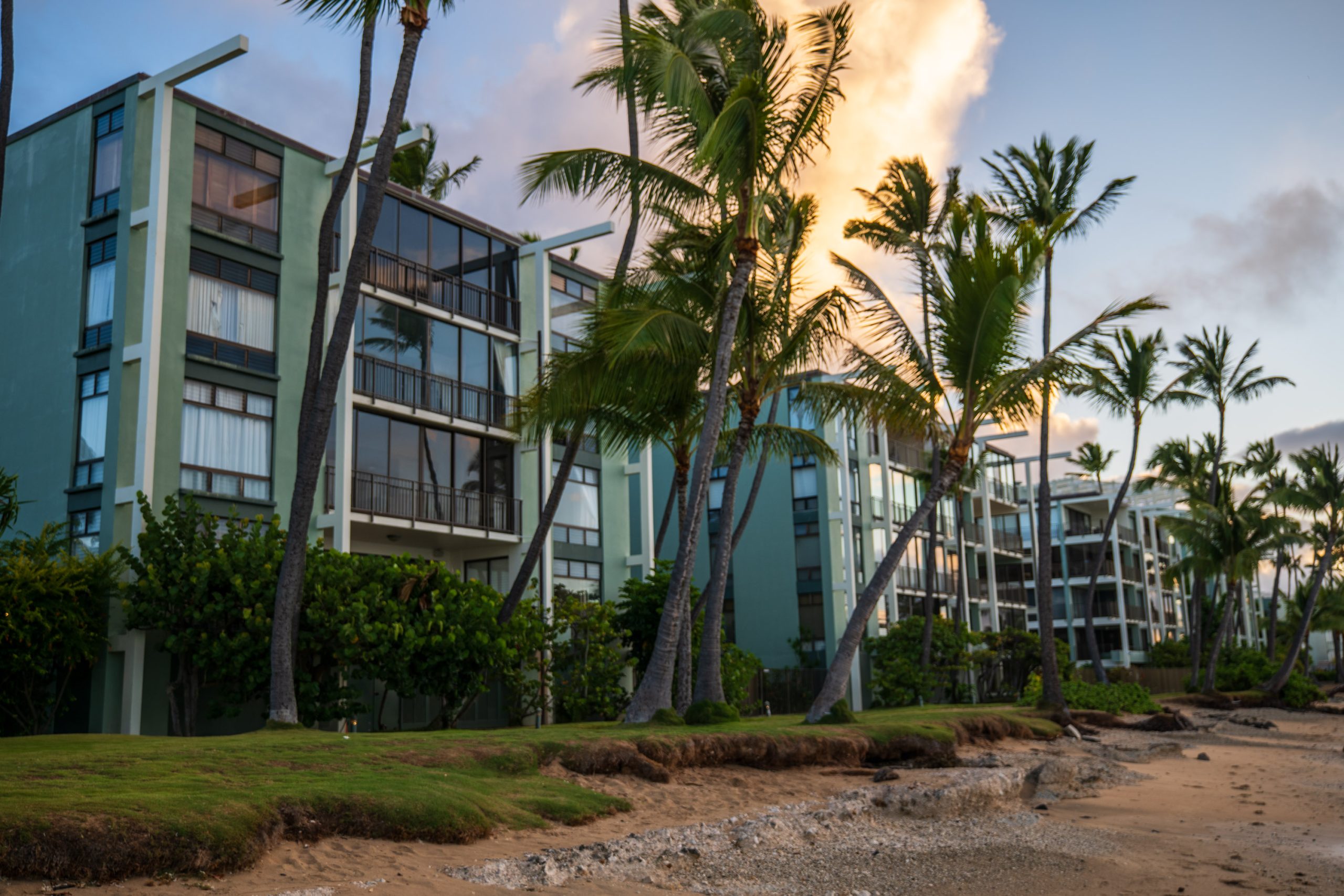
Kahala oceanfront condos face looming deadline

Owners of apartments in the Kahala Beach Condominium are preparing to surrender their properties and walk away empty handed in just two years.

The original 60-year ground lease for the 196-unit oceanfront project expires on July 15, 2027, and ownership of the buildings will revert to the landowner, Kamehameha Schools, the charitable trust established in 1884 to benefit Native Hawaiians.

Apartments in the Kahala Beach, nestled between the Waialae Country Club and the Kahala Hotel and Resort, range in size from 1,050 square feet to 3,510 sq. ft., and are spread across four 4-story buildings on 6.7 acres, with over 460 feet of beach frontage.

Kamehameha Schools also owns the land under the neighboring Waialae Country Club and Kahala Resort and Hotel, but previously extended those leases to 2060 and beyond.

However, Kamehameha has declined to extend the Kahala Beach lease, and refused to consider several offers from the Assocation of Apartment Owners to purchase the fee interest.

Although individual lessees have purchased their condominium apartments, the leased land and any improvements (meaning the buildings themselves) revert to the landowner when the ground lease expires. Hawaii is one of the few places in the United States where leasehold residential properties are found.

This reality of just walking away is common with commercial leases. If a business lease isn’t renewed, the business owner simply packs up and moves on. But it is far less common for residential properties, given the idea that one’s home is their castle.

There haven’t been many examples of lease expirations leading to evictions. Owners of the Kailuan Apartments were evicted by Kaneohe Ranch at the expiration of their lease at the end of 2007. Although there was substantial negative publicity, the ranch proceeded with redevelopment of the property.

As the Kahala lease expiration nears, owners have reported Kamehameha Schools may offer month-to-month rebtals or short-term rental agreements, perhaps a year at a time, while working on a longer term development plan for the property.

During an extended legal battle over setting of the lease rent for the final 10-year term (2017-2027), consultants concluded the “highest and best use” would be an ultra-luxury condominium development that maximizes the site’s best attributes, such as its direct ocean frontage and allowable height and density. It’s current A-2 zoning imposes a 60-foot height limit, 50% higher than the current 40 foot building height.

However, redevelopment won’t be simple. The Kahala Beach condo was built a decade before the state enacted laws for coastal zone management to ensure access to and protection of the shoreline, and its development limits have become stricter over time. There has already been considerable erosion along the ocean side of the property which continues at a rapid pace.

With the effects of climate change and rising sea levels, the property is now in a designated high-risk flood zone. This requires a base flood elevation of 9 feet, which would reduce the size of any new development. Further, underground parking, as exists in the current buildings, would no longer be allowed for new construction on the site.

Other factors include stricter regulations for handling of stormwater, and new street regulations require wider roadways and fire truck turnarounds, which could impose additional limits.

These and other factors leave the future of the area in doubt. Only one thing is clear. Current owners in the Kahala Beach will have to surrender their apartments to Kamehameha Schools in 24 months, even if they are allowed to stay with temporary short-term rental agreements.

The building was a luxury address when it opened in 1967, but as the remaining term of the lease has dwindled, long-term owners have been fleeing, with just 34% of apartments now owner-occupied, according to the condominium’s latest biennial registration filed with the state. Many units are being used as high-priced vacation rentals.

Although the buildings appear relatively well maintained, visitors report apartment owners are now reluctant to invest in needed repairs and maintenance in their individual units, and conditions are deteriorating. Apartments have been selling over the last several years at what often seem like bargain prices for oceanfront living, except that lease rent and monthly maintenance fees can run over $5,000 monthly, and in two years the master lease will end.

What happens to Miske’s Portlock luxury home and other assets?

It seems almost certain that the original indictment of Mike Miske, along with the three superseding indictments that expanded both the charges and the list of co-defendants, will soon be “vacated” or set-aside due to his death prior to sentencing and appeal, along with the government’s seizure an estimated $25 million or more of Miske’s personal and business property and assets.

Miske’s defense counsel filed a motion just a week after his death in December, and prosecutors have agreed that the law requires that the indictment’s disappear. Vacating the indictments as to Miske will not affect the convictions of nearly 20 co-defendants and associates who pleaded guilty prior to trial.

So what happens to Miske’s Portlock mansion valued for tax purposes at $7.5 million, along with a Kailua home, $4.3 million in cash and cashier’s checks, collectible cars (including a 2017 Ferrari F12 Berlinetta), art work, and other assets?

Contrary to conspiracy theories floating around, all this property will not automatically be returned to his family when the indictments, and his convictions, are voided.

Continue reading