
Civil Beat’s “Sunshine Blog” threw it’s weight behind House Bill 371, proposed legislation described as “the measure that would ban the owners, officers and close family members of government contractors and organizations that receive state grants in aid from donating to political campaigns.”
Apparently CB sees it as a way to put an end to pay-to-play politics.
A worthy goal.
However, in my view, CB and the Sunshine Blog are making a grave error in not taking into account the First Amendment implications of this bill.
The sweeping scope of this bill and its restrictions on First Amendment political speech is breathtaking. Despite this, the legal issues surrounding free speech in the context of political campaigns and campaign finance were not mentioned in any of the testimony during hearings on this bill.
That’s a huge omission because, if passed into law, HB371 would not simply “chill” free speech of corporations, it would eliminate the First Amendment rights of an large but as-yet-undetermined number of individuals associated with , and would trample on long-accepted legal precedents.
These issues are so glaring that the bill appears written to invite a successful First Amendment legal challenge.
Back to Basics
What happens when there’s a direct conflict between the First Amendment right to free speech during an election campaign, and the public’s interest in combatting corruption?
Political speech and expression are at the heart of the First Amendment. After all, the First Amendment’s primary purpose was to protect open discourse about government affairs. Thus, political speech usually receives the strongest protection.
This means that courts tend to apply strict scrutiny to test the constitutionality of restrictions on political speech or expression. Strict scrutiny is the most difficult standard to meet. It requires a restriction to serve a compelling government interest in the least restrictive manner.
A compelling government interest, implemented in the least restrictive manner, or at least in a narrowly targeted manner.
So let’s take a look at HB371.
It would prohibit contributions by state or county contractors, as well as state or county grantees, along with their officers or immediate family members, whether or not they have any role in the contracts or grants, or even any contact with the family member directly involved.
And immediate family members, according to the bill, includes any child, parent, grandparent, brother, or sister, and the spouses or reciprocal beneficiaries of those officers.
I haven’t seen any discussion of the loss of rights for officers of state grantees, along with their family members.
Check this list of organizations that received state grants in aid during the 2024 legislative session.
Here’s page 1 of the 4-page list of grant-in-aid recipients, just to provide a sense of the bill’s broad impact.
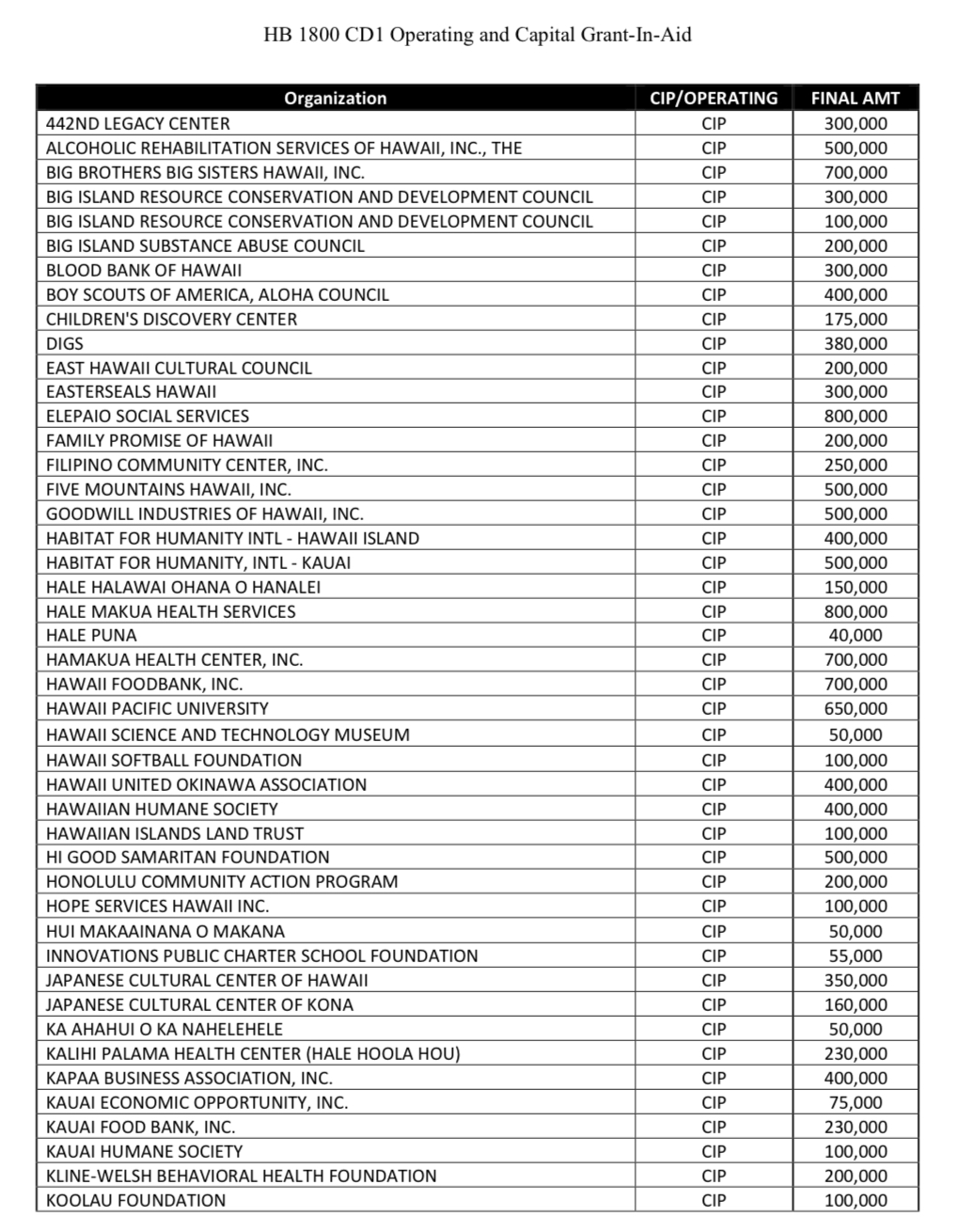
Somewhere about 150 community nonprofit organizations are on the list. And all of their officers, along with their parents, grandparents, siblings, and their spouses or partners, will not only be prohibited from contributing to the candidates of their choice, but from contributing to “any political committee,” or to “any person for any political purpose,” or to solicit any contribution “for any purpose.”
One glaring omission is the lack of any nexus between these sweeping prohibitions, the contracts or grants that trigger them, and any actual potential for corruption stemming from those contracts or grants.
For example, an argument can be made that a corporate contractor or grantee, and its officers, should be prohibited from making campaign contributions to the level of government that originates the contract or grant. So you get a state contract, and you shouldn’t then contribute to the governor. But why should that state contract limit your ability to contribute to the mayor’s race, or a city council race, when those positions play no role whatsoever in awarding the contracts or grants?
At one point, my father’s small restaurant supply company competed for contracts to equip school kitchens. If he had landed any of those contracts, my political rights would have been eliminated, along with those of my wife, despite there being no crossover between my dad’s Republican leanings and my own political views.
It seems to me that this is classic overreach, and far from the targeted restrictions that First Amendment analysis requires.
There are already plenty of laws prohibiting pay-to-play corruption. It’s illegal to enter into explicit or implicit quid-pro-quo understandings linking campaign contributions to discretionary action by an elected official. It’s illegal to structure campaign contributions in order to evade contribution limits, by giving money to others (employees, relatives, friends, customers, etc) that they would then contribute in their own names.
Obviously, a narrowly-targeted approach to clamping down on pay-to-play would be to substantially increase the budget for investigation and prosecution of these crimes, and they are crimes, or perhaps to prohibit all contributions by corporations to state and local candidates, as is done at the federal level.
Those are approaches which do not get into the thorny area of restricting constitutionally protected rights.
In any case, this is a discussion that hasn’t happened during the consideration of HB371.
There is also a broader issue. How do we see the political arena? Is it a system in which conflicting special-interest groups clash in a complex dance of deals, accommodations, and tradeoffs, or one in which the goal is to eliminate actual “interests” and leave decisions to neutral arbiters of the “public” interest?
But that is necessarily a discussion for another day.
Discover more from i L i n d
Subscribe to get the latest posts sent to your email.
Sent to Civil Beat. Are you no longer associated?
Very, very insightful post. Thanks Ian!
I agree! Government corruption is a foul thing and should be fought on all fronts. But not at the expense of our free speech.
“CB and the Sunshine Blog are making a grave error ”
Say it ain’t so!
Way to go Ian!
Very good point.
But don’t worry because this will never pass.
This bill smells like an attempt to appease those angered by CB’s reporting last year on pay to play.
One big clue is the effective date set at 7/1/3000. This is destined to die a quiet death in the murky depths of committee.
But the effective date is often set like this while the bill is still being debated, and a real date inserted in the final draft, perhaps in conference. So at this point it is not a fatal flaw.