
Category Archives: Business

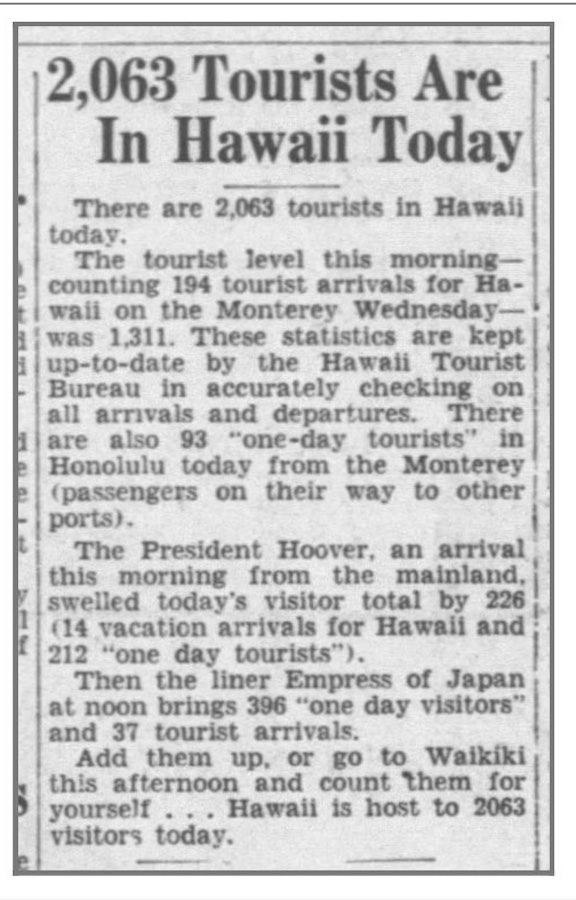
2,063 Tourists are in Hawaii Today

Well, that was apparently the visitor count on September 29, 1932, according to the Honolulu Star-Bulletin of that date.

Although they refer to tourists “in Hawaii,” the article seems clear that they’re talking about Honolulu, and likely Waikiki in particular. Apparently there weren’t many visitors traveling to the neighbor islands at that time.

Just click on the clipping to see a larger version.
It’s a lot different today.

According to preliminary data gathered by the state Department of Business, Economic Development, and Tourism, the average daily visitor count for Oahu during the three months of 2019 was 114,165.

Lee Cataluna was right on point with her recent column in the Honolulu Star-Advertiser about all the illegal transient vacation rentals in our neighborhoods. The Legislature voted to collect taxes from them. Cataluna replies that local residents want to stop them, not tax them.

Here’s a part of her column.

Are Hawaii residents mad because vacation rentals aren’t kicking in their share of state taxes?

No. That’s not what you hear. That’s not what people post online about the strangers coming and going at the house next door or the all-night parties down the street in the house that used to be a home for actual neighbors, not transients. That’s not what they talk about with their friends when they say, “I don’t even know whose car is parked in front of my house!”

It’s not, “Make them pay!” It’s “Make them stop!” Nobody who lives with these illegal hostels on their street or across the fence is worried much about them paying taxes. Nobody who has to jockey for parking or deal with the lights on all night or watch as strangers take pictures of their backyard plants is asking for money.

They want their peace and privacy back. They want actual neighbors to be their neighbors, people they can get to know, who can cat-sit for them when they go on trips and who will call them at work when they see something amiss and say, “Hey, Barbara, you left your side gate open. Want me to close it for you?”

Hawaii residents want tourists to go back to all the vast prime beachfront that our kupuna saw taken away and paved over, built up and maximized for tourism. That was the unspoken deal, that we would give up Waikiki and Poipu and Lahaina and Wailea to the tourist machine but keep the country country and the neighborhoods neighborhoods. The deal has now been broken.

Assessing the impact of hedge fund corporate takeovers

The story it tells isn’t new. But a recent article in The Nation did a good job of describing the way in which hedge fund ownership has contributed to the demise of so many companies that have been household names for decades.

The model is to take over a company by loading the acquired company up with debt, recouping costs by selling off valuable assets and cutting staff and new investments to the bone, even added new debt financed by the hedge fund, which in turn collects fees and interest from the captive company. And employees are too often left out in the cold.

See: “Hedge-Fund Ownership Cost Sears Workers Their Jobs. Now They’re Fighting Back.”

If you don’t have a subscription, you’re able to read a few articles before running up against The Nation’s paywall.

Here’s an excerpt from the article describing what happened after a hedge fund controlled by Eddie Lambert took over Sears.

Lampert bought Kmart in 2003 and merged the two companies in 2005. He came into ownership of both with basically no experience in retail; his background was in risk arbitrage at Goldman Sachs. To buy Sears and Kmart, Lampert, through his hedge fund, used the private-equity model of a leveraged buyout: He financed the purchase of those companies by saddling them with debt and using little of his own capital. Once he became a retail CEO, he stuck with the Wall Street playbook. He sold off Sears’s most valuable assets, such as the Lands’ End clothing and Craftsman tool brands. Many business lines ended up in separate companies that he has invested in through his hedge fund and profited from as Sears withered. Lands’ End, for instance, is now worth more than Sears. He also sold off a cluster of Sears stores for $2.7 billion to Seritage, a real-estate company that he headed as chairman. Sears then had to pay rent at many of those locations.

Meanwhile, Lampert’s hedge fund loaded the company up with debt through loans it issued itself, making money off commissions and interest. ESL and its affiliates lent Sears some $2.6 billion—about half the total debt it had as of September—earning $400 million in interest and fees. All those losses, all that debt, and all the rent it was paying on its stores left the company little to invest to keep up with Walmart and Amazon.

The newspaper industry is still suffering through the same impacts brought on by hedge fund investors.

But here’s my question. Hawaii hotels have also been a favorite investment for hedge funds. How have they fared in the process? Have these hotel investments followed the hedge fund strategy outlined by The Nation?

It seems to me that’s a story that is begging to be researched and written.

WSJ article examined Honolulu’s rail debacle

You don’t want to miss the Wall Street Journal story published at the end of last week about Honolulu’s rail project (“How a Train Through Paradise Turned Into a $9 Billion Debacle“).

In case you aren’t familiar with Honolulu rail, the subtitle to the story went further: “The project has tallied one of America’s biggest transit cost overruns; a grand jury is investigating.”

I guess that’s really it in a nutshell!

The story is by journal reporters Paul Overberg and Dan Frosch.

I believe the full story is behind a paywall. But if you know someone who subscribes, or have other access to the WSJ, definitely read through this telling of the tale.

Among the cascade of problems: Honolulu pushed ahead before fully planning the project, and nearly 100 contracts had to be reworked, causing delays. The city began construction before fully checking Native Hawaiian burial grounds, and a judge halted the project for over a year. Planners built too close to power lines, so Honolulu must shell out hundreds of millions of dollars to move them.

Dogged by such blunders, the project has seen its price tag soar to more than $9 billion from about $5 billion. The cost overruns are among the largest that transportation experts say they’ve ever seen. The cost has led to an extra excise tax on businesses, which can affect the price of goods and services, and it has hit tourists through an expanded hotel tax.

A few more random quotes from the story.

Honolulu’s elevated rail line shows how badly municipalities can stumble in tackling giant infrastructure projects, especially when they’re powered by political urgency.

***

Some federal officials had long been worried. A 2006 note from one FTA official to another, unearthed in a lawsuit, said, “We seem to be proceeding in the hallowed tradition of Honolulu rapid transit studies: never enough time to do it right, but lots of time to do it over.”

***

Delays, such as losing bidders’ appeals, triggered a cascade of contract adjustments, ultimately costing hundreds of millions of dollars. A financial analysis ordered in 2010 by then-Gov. Linda Lingle, a Republican, said the project would cost $1.7 billion more than Honolulu anticipated. The report also said tax revenue for the project was likely to grow at 30% less than forecast. And it said ridership forecasts—about 100,000 a day when built and 120,000 daily a decade later—were too rosy.

***

“They tried to force this as a major solution,” said Panos Prevedouros, civil and environmental engineering chairman at the University of Hawaii and a former mayoral candidate. “Now, we’re paying the dividends of all the lies, and we haven’t gotten any benefits.”

No, there’s nothing really new that was uncovered. But seeing it all together, in context, displayed for a national audience, is sobering. To say the least.

Confusion over housing prices

The front page of this morning’s Honolulu Star-Advertiser illustrates the confusion of the media, and the public, over the issue of housing prices.

This story and graphic took up two-thirds of the front page. The sub-head reads: “Sales and median prices for single-family homes and condos all fell for the first time since 2010.”

Slightly lower, or “weakened” prices, add up to a “stumble.”

This, of course, is the view of the real estate industry, which tends to mold news coverage of real estate sales.

The problem is that real estate and “housing” sound like the same thing, but in practice they are very different.

While reporting a slight dip in real estate prices as a “stumble,” the media also give prominent attention to our crisis in housing affordability. From this perspective, a prolonged dip in housing prices would appear to be something to cheer about.

So the news coverage of “real estate,” on the one hand, and “housing” on the other, appear as contradictory and misleading. Some news reports bemoan the fact that Honolulu is one of the most expensive housing markets in the country, while others gloat about increasing “values”.

No one really wants to say it, but this is an example of “haves” and “have nots,” both significant parts of the population, with different interests in real estate and housing. If you own real estate, you are likely cheered up by rising prices. If you don’t own anything, then rising prices are just a reminder that you’re still unable to own a home, or find a reasonable rent.

Perhaps the Star-Advertiser or other media could lead the way in trying to reconcile these divergent ways of viewing the business of real estate and the human reality of housing, although I’m not sure how that can be done.