Category Archives: environment

Stadium redevelopment aims to bring Waikiki tourism to Aiea

The redevelopment of the Aloha Stadium relies on a vision of extending tourism from Waikiki to a new visitor playground on the site of the old Aloha Stadium, according to the project’s draft environmental impact statement. The EIS makes clear the “entertainment district” concept is driven by the perceived opportunity to extend Waikiki’s brand of tourism out to Aiea.

At the same time, the lengthy pause in tourism imposed by the pandemic offered the rest of us a vivid lesson in the negatives impacts of mass tourism, and has generated lots of talk about the need to control and limit tourism in the future. None of that discussion and debate appears to have informed the EIS in any way.

Instead, the EIS discloses that the stadium redevelopment plan continues to define the expansion of Waikiki tourism to this new part of the island as wholly positive and justified.

The existing retail in the region predominantly serves local households and employees but does not serve the broader tourist market, which is responsible for a major portion of the State’s economy. The nearest, notable, clusters of retail include the Pearlridge Shopping Center. However, the Leeward Honolulu submarket lags behind the more tourist-serving Central Honolulu submarket (Victus, 2019). A vibrant and exciting retail destination will be crucial to the Proposed Action’s commercial viability and success, contributing towards the creation of an attractive destination that not only serves local and onsite households / employees and visitors to the New Aloha stadium, but that will also draw in tourists as well as residents from across the entire island of O?ahu that may have otherwise not considered visiting the submarket.

Did you get that? Existing retail stores serve locals, but “don’t serve the broader tourist market” and as a result the area “lags behind the more tourist-serving Central Honolulu submarket.” Planners are making clear they see that as something wrong that needs to be fixed. And the fix is to “draw in tourists” from other parts of Oahu.

This is seen as important enough that it was emphasized in the EIS, with at least one hotel proposed “significantly increase the area’s desirability from a hospitality perspective….”

Moreover, the island of O?ahu continues to be one of the most attractive and healthy hotel markets in the country. On the island, Waik?k? is the preferred hotel submarket but, other resort areas with unique amenities or activities are becoming increasingly viable hotel destinations that offer a value alternative to Waik?k?. The Proposed Action could significantly increase the area’s desirability from a hospitality perspective contributing to the vibrancy of the Proposed Action. A hotel at the Project Site could serve potentially over 1.5 million annual visitors to the Aloha Stadium; furthermore, the Proposed Action could potentially serve as a catalyst for growth in visitation, attracting tourists and visitors to the Project Site retail and mixed-use environment that would have otherwise not considered coming to the submarket.

Let me translate–a “hospitality perspective” refers to a perspective from within the tourism industry. So get ready, Aiea!

There are a few other revealing items to be found in the EIS.

The need to replace the aging Aloha Stadium is clearly the basis for the perceived “need” for the project, as well as the sense of urgency that is pushing it forward at breakneck speed in a manner that forecloses thorough public consideration of the issues and options.

Here’s how the EIS puts it:

The existing Aloha Stadium has stood for over 44 years and is deteriorating structurally, with numerous deferred maintenance issues. It has fallen out of compliance with current accessibility and building codes and lacks the amenities of other modern stadiums. While it was once hailed as a first-class, state-of-the-art facility, the existing Aloha Stadium has effectively served its mission as a gathering place well beyond its practical life-span as a multi- purpose venue. Its numerous unaddressed deferred maintenance items are contributing to its obsolescence, and substantial ongoing investment is required to keep it functioning, accessible, and safe for public use.

In other words, at some point the cost of ongoing maintenance just doesn’t make sense any longer, and it isn’t unreasonable to think we’ve reached that point.

So who is affected if the stadium becomes unavailable due to safety concerns?

As I recall, most of the discussion was about the fate of University of Hawaii football, as policy makers recoiled from the spector of our Division 1 football team without a home field to play on.

Of course, UH is not the only user of the stadium, but for more than 40 years it has been the most consistent user, and up until the past couple of months appeared to be the one with the most to lose of Aloha Stadium were to become unavailable. Here’s a list of stadium users that appears in the EIS.
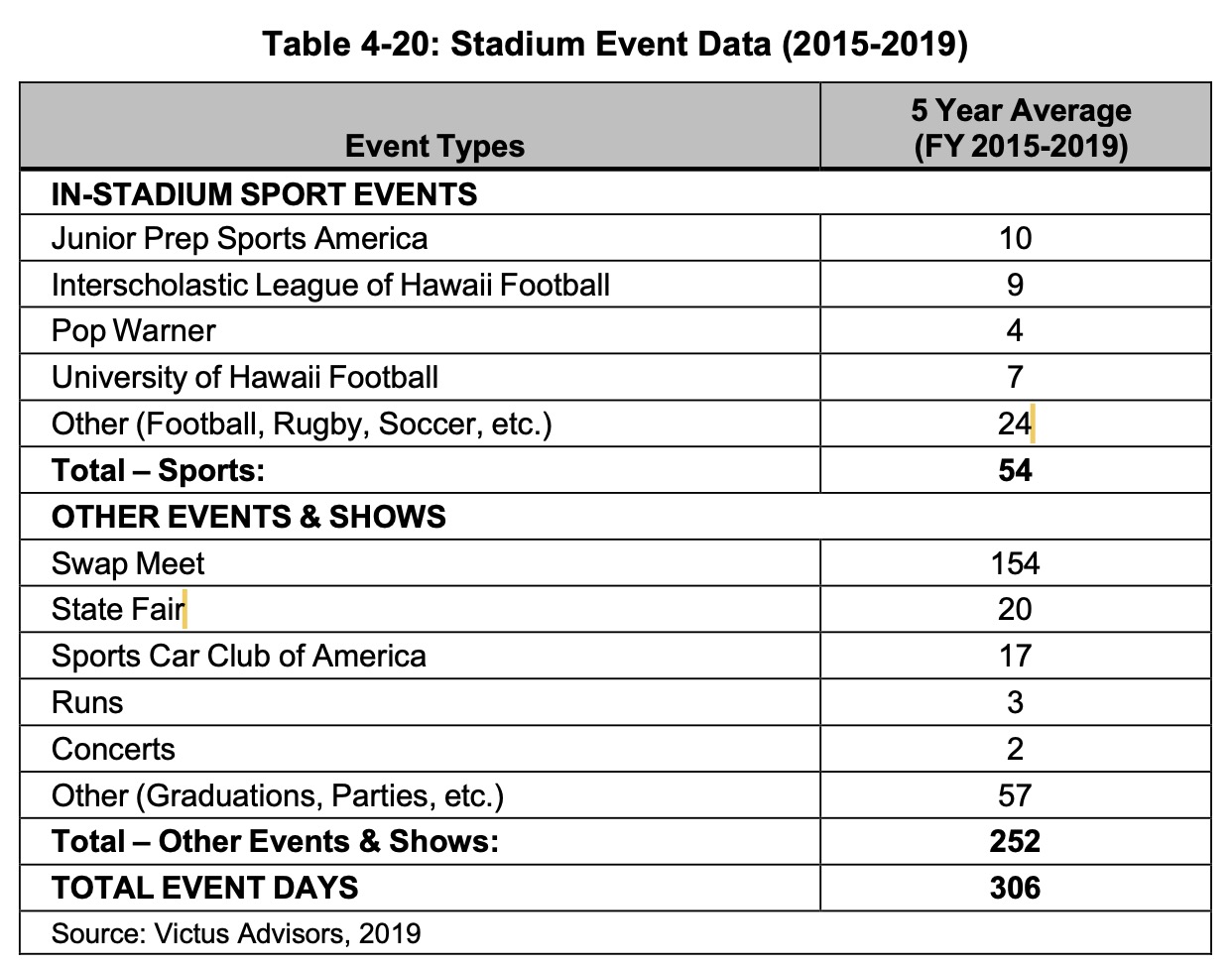
The “time critical and time sensitive nature” necessitating cutting corners procedurally to rush it forward was based on “escalating construction costs and mounting deferred maintenance expenses tied to the continued operation of the existing Aloha Stadium.” Essentially, we would have to keep investing in the old stadium until a new field were ready for UH, and so anything that could be done to speed the process seemed justified.

Then the Stadium Authority threw that plan book out the window, declared Aloha Stadium closed, and forced UH into a last-minute search for an alternative. And by all accounts, they have developed a workable plan, at least for the short term.

At this point, with UH out of the picture, the rationale for unusual haste, and the secrecy it creates, is no longer valid.

Meanwhile, the EIS assures us the selected developer will be required to comply with all current affordable housing requirements. But that approach has done nothing to ease our affordable housing crisis. Kakaako is case in point. Current requirements are simply inadequate. If affordable housing is indeed a crisis, the Aloha Stadium site represents a unique asset, and utilizing it effectively can make a significant contribution to meeting the obvious public need.

See:

Stadium redevelopment plan’s legacy of deceit,” iLind.net, February 25, 2021.

A dissenting view of the Aloha Stadium redevelopment,” iLind.net, March 2, 2021.

New Aloha Stadium Entertainment District website

Draft EIS New Aloha Stadium Entertainment District, Vol. 1

[Additional volumes, download from the Office of Environmental Quality Control]

Making the catch

I’ve posted photos before of some of the birds that hang around our yard and that I’ve taken to feeding bits of old bread or fruit.

The regular crew includes a pair of red vented bulbuls, a pair of Brazilian cardinals, about a half-dozen mynahs, and a pair of red whiskered bulbuls. The latter, which have classy white chests, are the smallest, and when I throw out bits of bread, they are pushed aside by the other birds, which are larger and more aggressives.

But this red whiskered couple are smart. They’ve learned to watch and wait for me to make eye contact with one of them, then throw a bit of bread specifically to them, at which point it will flutter up and catch the snack on the fly.

I managed to record one of them in the act Saturday afternoon, iPhone set to slow motion in one hand, bread in the other.

One, two, three…then you see a bit of bread as a light-colored blur launched from the lower right of the screen. It goes up out of view, then reappears at the top of the screen as it starts to drop and the bulbul makes the catch.

Two recent Hawaii Supreme Court rulings

I noticed a couple of recent Hawaii Supreme Court decisions of note.

Electronic signatures

On Monday, February 1, the court finally rejected the attempt to impeach former city prosecutor Keith Kaneshiro utilizing online petitions signed electronically, rather than traditional petitions containing handwritten signatures. The court said the law allows government agencies, including the city clerk, may decide whether or not to accept electronic signatures as valid.

Local businessman Tracy Yoshimura had challenged the Honolulu city clerk’s position that petitions seeking to trigger impeachment proceedings are required to contain “the full legible names, handwritten (not electronic) signatures, and residence addresses of at least 500 signatories.”

Yoshimura, who was locked in a feud with Kaneshiro over the legality of gaming machines sold by Yoshimura’s company, launched his initial impeachment petition using change.org in December 2018, and quickly followed it with a second petition based on electronic signatures collected through the DocuSign system used by many businesses, including banks.

Yoshimura challenged the city’s refusal to consider the online petitions. He pointed to HRS § 489E-7(d) (2008), which states, in part, “If a law requires a signature, an electronic signature satisfies the law.”

However, another section of the same law exempts government agencies from the electronic signature requirement, and provides that each agency can determine “whether, and the extent to which, it will send and accept electronic records and signatures….”

In response, Yoshimura argued the city couldn’t make such a decision on the fly, but instead should have go through a formal rulemaking process before it could refuse to accept electronic signatures.

For what seemed like a relatively simple question, there court had to trace the tangled procedural and legal history of the impeachment case, which it did in Monday’s 62-page decision.

Hu Honua

In a second decision on a case of public importance, the court rejected the request by Hu Honua Bioenergy to simply order the Public Utilities Commission to throw out two orders the commission issued last year that stripped the company’s proposed wood burning power plant on the Hamakua Coast of its previously granted waiver from having to go through a competitive bidding process in order to win a contract to provide power to Big Island consumers.

It its petition to the court last September, Hu Honua argued it would face devastating consequences if the court did not intervene against the PUC

Failure to provide immediate relief would cause irreparable harm to Hu Honua’s constitutional due process rights; catastrophic financial damage to Hu Honua; and a devastating loss of income to the Hu Honua workforce and their families during this pandemic.

But in a brief 2-page decision, the court cited an earlier case that found the relief being sought, a writ of mandamus, “is an extraordinary remedy that will not issue unless the petitioner demonstrates a clear and indisputable right to relief and a lack of alternative means to redress adequately the alleged wrong or obtain the requested action; it is not intended to supersede the legal discretionary authority of the trial courts, cure a mere legal error, or serve as a legal remedy in lieu of normal appellate procedures.”

The court found those conditions were not met, and ruled Hu Honua arguments are more appropriate for the direct appeal of the PUC’s actions it filed on the same day in September 2020 as its request for an extraordinary writ.

That appeal is pending. On January 19, 2021, Hu Honua filed a motion asking the court to expedite it’s appeal, using language that appears targeted more for public relations than legal effect.

Hu Honua’s renewable energy project (“Project”), which is 99% complete and will provide the State of Hawai`i with numerous immediate and long-term benefits, hangs in the balance following the Public Utilities Commission’s (“PUC”) erroneous and disastrous decision to revoke the Project’s waiver from the Competitive Bidding Framework. The loss of the Project and the benefits it provides, and the PUC’s multiple violations of applicable law, are matters of “significant statewide importance” that the Court must resolve as expeditiously as possible.

Just nine days later, on January 28, the high court denied the motion in a terse single-sentence order signed by Associate Justice Todd Eddins.

Here’s the order in its entirety: “Appellant Hu Honua Bioenergy, LLC’s “Motion to Expedite Appeal Filed on September 16, 2020” is denied.”

The Forever Rail

I remember the 1970s sci-fi book, The Forever War.

That’s the phrase brought to mind by the city’s latest guestimate of what it will cost in time and dollars to get through the rail quagmire. The city’s latest figures–an $11 billion price tag, and 2033 completion date, are simply staggering. And it’s just a guess, it seems. No hard money figures involved. And lots of reasons for skepticism. By the year 2033, there will be a generation of 30-somethings who will have spent their entire lives in the physical and economic shadow of Honolulu’s rail system.

Compare the cost and timeline to the Wikipedia list of the most expensive U.S. public works projects. Hey, we’re right up there with the big boys, and nowhere near getting the final bill yet. And that’s just on raw dollars, not converted to per capita or per mile cost to reflect the modest size of the planned system and our small population base.

It’s looking like we’ll never get a chance to wear the new off this rail system. By the time it is finished, if that ever happens, some of its rarely-used components will be so old they’ll be ready for replacement, including the rail cars and some parts of the rail line itself. It’s kind of like finding an old toy, or tool, forgotten years ago in the back of a closet, now found again, still in its unopened box. You’re excited to open it. Then you discover roaches have been nesting in the tissue paper it was wrapped in, the salt air has managed to do its thing on metal parts, wiring has decayed, foam parts have disintegrated, and what you hoped would be a pristine treasure is just a piece of junk. But the cool old box might be worth saving. Those rail cars Honolulu bought and stashed away in advance of construction are going to be old and and more than ready for replacement before the full system is done, assuming optimistically that it will be finished some day.

When all this started 15 or more years ago, I was a fan of light rail, based primarily on our experience with the rail system in the Portland, Oregon metro area. We visited often before and after construction started, then returned periodically over the years as the initial system was extended in several different directions. Even though I disliked the system eventually approved in Honolulu, I admit looking forward to seeing it in action.

That was then. This is now.

Now rail is a financial disaster that just keeps on delivering new, unpleasant, and painful surprises.

Worried about jobs? A lot of people could be employed to tear the whole thing down.

Or how about converting some portion of it to a long rambling city park? Perhaps bike paths on one side, walking trail on the other.

There’s a word for it: Rail trail.

From Wikipedia:

A rail trail is the conversion of a disused railway track into a multi-use path, typically for walking, cycling and sometimes horse riding and snowmobiling. The characteristics of abandoned railways—flat, long, frequently running through historical areas—are appealing for various developments. The term sometimes also covers trails running alongside working railways; these are called “rails with trails”. Some shared trails are segregated, with the segregation achieved with or without separation. Many rail trails are long-distance trails.

A rail trail may still include rails, such as light rail or streetcar. By virtue of their characteristic shape (long and flat), some shorter rail trails are known as greenways and linear parks.

Check out the New York City High Line elevated park rail trail. It drew 5 million visitors in 2014, at least according to their figures.

At least it’s a creative reuse.

We could turn it into heck of a good visitor attraction, don’t you think?