Category Archives: Hawaiian issues

My sister’s update of our family’s Kalaupapa story

My sister, Bonnie (Lind) Stevens, died early in the morning on this day three years ago. She was 73.

Today is also her son Kimo’s 4th wedding anniversary. He and Sabrina are celebrating (and remembering) on Maui.

Life goes on.

Bonnie wrote this paragraph about herself as part of the 50th reunion of her high school Class of 1961 at University High School in Honolulu, now known as the University Laboratory School.

Other info you want to share about yourself:

Transitioning from the academia of UHS, my own college years, then 12 years in Palo Alto and the Stanford community, to living in a part of California that the media describes charitably as “remote and rural” was a wake-up call. So was working in a community of 165 employees, most in the trades, most of them men, many of them who didn’t know how to deal with a woman outside of the office. Learned to love the days when I could load cameras, boots, hard hat, and coveralls into a car and head out to meet one of the field crews. Learned about all kinds of things I never thought I’d be interested in — electric power generation, sewage treatment, industrial health and safety, the mechanics of how some things work… or don’t work. Why a road washes out in a rainstorm. How a dam operates. Electrolysis. Water rights. Learning them well enough to explain the how-to bits to others….What do I regret not doing? Taking Otto up on his offer to teach me to operate a D9 cat! That, folks, is a B-I-G tractor!!

I decided a good way to mark this day is to let Bonnie add the next part of our family’s Kalaupapa story in her own words, updating and explaining discrepancies in my post on Friday.

I found this essay on her computer after her death. Bonnie created the original computer file in Microsoft Word on March 1, 2012.

A MYTH UNCOVERED by Bonnie Stevens

A long-held story in my mother’s family is that her great-grandmother died at Kalaupapa, the leper colony on the island of Moloka’i where St. Damien, then Fr. Damien, served as priest. There are a variety of ancillary stories — how she had a mole, not leprosy; how there was some jealousy over her reputed beauty; how her husband and two sons went with her as kokua (care-givers); how she refused to leave the colony because she could not take her trunk of beautiful dresses (holoku) with her back to Maui.

PROBLEM: There are no records of Hele’ualani at Kalaupapa. No record of diagnosis. No record of admission as a patient. No record of housing. No census entry. Nothing. There are multiple records for her husband and two sons — admission as patients in Honolulu, transfer to Kalaupapa, church records in Kalaupapa, and records of their deaths in the register of patients.

A cousin (Timmy Leong on Molokai) and I began to wonder if Hele’ualani ever was there. We looked further.

This morning I found a computerized entry for a woman named Heleualani among a collection of Hawaiian Deaths and Burials. This woman was born about 1846, and died at Kaaluloa (sic) on 6 Apr 1886. She fits the expected profile, more or less, for my great-great-grandmother. The computerized version of this record does not tell which island Kaaluloa is on, nor does it tell whether Hele’ualani is buried on private land or in a cemetery.

The gazetteers were useless. The place may no longer exist. It may be too small to count. It may be misspelled. It just doesn’t appear. Anywhere. Nor does the transcription tell us anything else about Heleualani to help identify her as our ancestor. I gave a copy of the print-out to my cousin to mull over.

A couple of hours later he called back. “Could that place be Kaululoa?” he asked. I’ll know on Saturday when I can read the source microfilm.

“Read the land records you already have. Hele’ualani and Kaho’o’ilimoku sold just under 6 acres of land to Dennis Toomey in 1885. Where was it?”

Toomey fathered two of this couple’s grandchildren, and in 1885 was living with their daughter. I found the deed he mentioned. The parcel was identified as being in Kaululoa, Kawaipapa, Hana. Where we know Hele’ualani and her husband Kaho’oilimoku lived.

The source for the burial record is a register of burials from the Kingdom of Hawaii. If this particular register is from the Hana district of Maui, we have found what happened to our great-great-grandmother. She may or may not have had leprosy. My guess is that she did, since her husband and two youngest children were known leprosy patients. But she died, at home, in Hana, before she could be sent to Moloka’i.

Another myth created in family tradition may be shattered. A transcription error may be overcome. It helps to have someone with whom to bounce around ideas. Thank you, Timmy, for sharing the hunt.
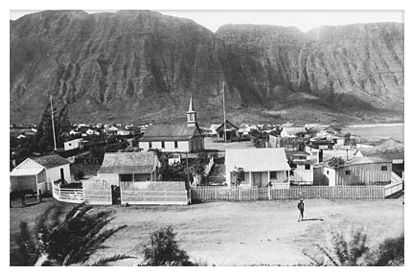
Kalaupapa was an unacknowledged part of many family histories

From Amazon’s teaser for W.S. Merwin’s book, The Folding Cliffs: “The story of an attempt by the government to seize and constrain possible victims of leprosy and the determination of one small family not to be taken.”

For our family, like so many others, this story strikes close to home. According to mostly unspoken family lore, my grandmother’s grandparents, and two of their sons, were taken to Kalaupapa, the 19th century leprosy colony on a remote peninsula on the island of Molokai, and were believed to have died there.

This was not talked about in the family over several generations. My mother recalled that both her mother, and her mother’s sister, professed to know nothing about their grandfather, Kahooilimoku, and grandmother, Heleualani, who had lived in and around Hana, Maui in the second half of the 1800’s.

“They acted as if they had never known a thing about them,” my mother wrote later in her carefully prepared notes.

But sometime in the 1950s, she was told a family story by George C.K. Kopa, a cousin of her mother, about how Kahooilimoku and Heleualani had been sent to Kalaupapa.

Mr. Kopa had worked at the territorial Bureau of Conveyances for abut 40 years. He had been raised by his grandfather in Hana, and later became a devout Mormon, so he was a significant source of family and genealogical information. In the 1950s he lived just a short distance from my parents’ home in Kahala.

“It seems unbelievable that no one mentioned this before, or that Mr. Kopa was the only living person who knew it,” my mother wrote later. “I now think that my mother and her sister were aware of the facts but chose to remain silent because of the stigma attached to the unhappy circumstances.”

So here’s the tale, recorded by my mother in 1994.

I was in my 40’s when I heard the following story…

At sometime probably in the 1880’s, a person reported to the authorities of the Board of Health that Heleualani had a suspicious spot on her face. Everyone was concerned about leprosy (now called Hansen’s Disease) which had been brought to Hawaii from China and had spread. In an effort to control it, all suspects with skin conditions indicating a possible infection were banished to an isolated center at Kalaupapa, Molokai. Naturally, there was a big commotion in the family and they hid Heleualani away while the kupuna went to Honolulu to a gathering of the relatives at the home of Kaawalauole on Jack Lane to discuss what they should do. The final decision was that she should surrender for examination and in the event she should have to go to Kalaupapa, her husband and two young sons would accompany her as kokua. It is said that all four of them died at Kalaupapa. I once tried to obtain information from the Department of Health, but was given so many excuses that I finally gave up.

And that’s where the story stayed for years. I’ll update the tale here on Sunday.

From the Dept of Interior hearings to TMT

Back in the summer of 2014, following the series of statewide public hearings held by the U.S. Department of Interior on then-proposed federal rule allowing for the recognition of a native Hawaiian governing entity, I tried to explain my reaction to the process.

The new rule was welcomed by many Hawaiians because it appeared to commit the United States to recognizing a government-to-government relationship with a duly approved Hawaiian governing entity, allowing negotiations over past transgressions to begin.

The rule was finally approved two years later, despite loud opposition by many. However, although delegates gathered and drafted a constitution for a governing entity, that effort sputtered and has never made further progress due to the divisions in the Hawaiian community.

Here’s how I began that 2014 column:

If I had to sum up in a single word the testimony of Hawaiians in the current round of statewide hearings, the word would be: “Dispossessed.”

The hearings, sponsored by the Interior Department, have sought input on whether, or how, the U.S. should seek to reestablish an official, government-to-government relationship with Hawaiians. They have drawn lots of input, most of it direct, in-your-face, passionate, and personal, often reflecting a religious-like zeal which makes evidence irrelevant and renders certain “facts” beyond debate.

Five years later, it’s the TMT and Mauna Kea which has galvanized the same type of highly emotionally and politically charged reaction.

And my thoughts remain very much as they were back in 2014, so I thought that the column would be worth sharing once again.

Here’s the link to that 2014 column: Did Hawaiian hearings set up a political train wreck?

Civil Beat polls legislators on TMT

An Civil Beat article today reports that most state legislators who were willing to go on the record with a clear opinion say they support the construction of the Thirty Meter Telescope on Mauna Kea. Just two said they are opposed.

But 33 “did not respond to Civil Beat’s phone calls, texts and emails.”

See “Where Hawaii Legislators Stand On The Thirty Meter Telescope,” Civil Beat, 10-7-2019.

Here’s the basic list as published by Civil Beat. To read the various justifications and attempts at clarification, you’ll have to read the original article using the link above.

Hawaii Senate

Support TMT: Sens. Roz Baker, Mike Gabbard, Breene Harimoto, Lorraine Inouye, Donna Kim, Sharon Moriwaki, Clarence Nishihara, Karl Rhoads and Glenn Wakai.

Support with reservations: Sen. Stanley Chang.

Oppose TMT: none on record.

Neither “yes” or “no”: Sens. J. Kalani English, Kai Kahele, Gil Riviere and Laura Thielen.

Declined comment: Sens. Les Ihara, Jarrett Keohokalole and Russell Ruderman.

Did not respond: Sens. Donovan Dela Cruz, Kurt Fevella, Dru Kanuha, Gil Keith-Agaran, Michelle Kidani, Ron Kouchi and Maile Shimabukuro.

Could not be reached: The office of Sen. Brian Taniguchi said he was traveling abroad and could not be reached for comment.

Hawaii House of Representatives

Support TMT: Reps. Della Au Belatti, Tom Brower, Rida Cabanilla, Romy Cachola, Bert Kobayashi, Bob McDermott, Val Okimoto, Richard Onishi, Scott Saiki, Calvin Say, Gregg Takayama, Cynthia Thielen and Jimmy Tokioka.

Support with reservations: Rep. John Mizuno.

Oppose TMT: Reps. Dale Kobayashi and Amy Perusso.

Neither “yes” or “no”: Reps. David Tarnas, Gene Ward and Tina Wildberger.

Declined comment: Reps. Sharon Har, Nicole Lowen and Chris Lee.

Did not respond: Reps. Henry Aquino, Richard Creagan, Ty Cullen, Lynn DeCoite, Stacelynn Eli, Cedric Gates, Mark Hashem, Troy Hashimoto, Daniel Holt, Linda Ichiyama, Aaron Ling Johanson, Sam Kong, Sylvia Luke, Scot Matayoshi, Lauren Matsumoto, Angus McKelvey, Dee Morikawa, Mark Nakashima, Scott Nishimoto, Takashi Ohno, Sean Quinlan, Joy San Buenaventura, Roy Takumi, Chris Todd, Justin Woodson, Ryan Yamane and Kyle Yamashita.

Could not be reached: Rep. Lisa Kitagawa was traveling and her office said she could not be reached for comment. Rep. Nadine Nakamura could not be reached because of a family emergency.